
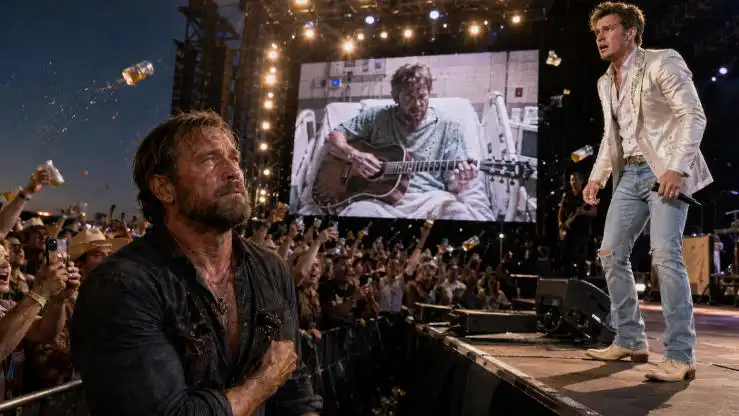
The first guitar note came through the Texas night like a ghost.
Not polished.
Not perfect.
Not studio-clean.
Just one cracked chord from an old guitar, shaking under a man’s tired fingers.
Tyler’s smile died before the second note.
He turned toward the giant festival screen, his microphone still raised, while 100,000 country fans stared up at a picture none of them were supposed to see.
For one second, nobody moved.
Not the band.
Not the label executives.
Not the security guards who had dragged John behind the beer tent two hours earlier.
Then the screen flickered again.
A hospital room appeared.
Dim lights.
A white blanket.
A woman sleeping with a pale hand resting on the rail.
And John, ten years younger, sitting in a chair beside her with the same battered guitar across his lap.
His hair was darker then.
His face was softer then.
But his voice?
That was the voice.
The real one.
The one that could not be faked with a laptop, a stylist, or a million-dollar tour bus.
On the stage, Tyler whispered, “Cut it.”
No one cut it.
He spun toward the side of the stage.
“Cut the screen!”
Still nothing.
The old recording engineer, Earl, stood beside the control booth with tears in his eyes and both hands on the console.
Beside him stood John’s oldest friend, Ray, holding a phone like it weighed a thousand pounds.
Ray didn’t smile.
He didn’t cheer.
He just watched the screen and said quietly, “You should’ve left her song alone.”
John was still behind the main stage fence when the video began.
A festival medic had wrapped his ribs tight under his shirt, but every breath felt like a knife.
One eye was swelling.
His lip was split.
His old denim jacket was torn at the shoulder where Tyler’s guards had grabbed him.
A younger security guard had tried to tell him to leave.
“Sir, you don’t want trouble.”
John looked at him and said, “Son, trouble already found me.”
He wasn’t there for money.
That was what nobody understood.
He had lived poor before.
He could live poor again.
But that song was not just a song.
It was the last thing his wife, Mary, heard before she closed her eyes for the final time.
Ten years earlier, John had sat in room 317 at St. Augustine’s Hospital in Nashville while the woman he loved more than breathing slept through pain medicine.
He had written the first line on the back of a cafeteria receipt.
“I’ll meet you where the red dirt road runs out…”
Mary had smiled without opening her eyes.
“That one’s yours,” she whispered.
John shook his head.
“No, baby. That one’s ours.”
For years, he never played it in public.
He kept the demo on an old master drive at Earl’s studio.
A few trusted people heard it.
A couple of label men asked about it back then.
John said no every time.
Some songs are meant to sell.
Some are meant to survive.
Then Tyler’s version dropped.
The world called it “the most authentic country ballad of the decade.”
Tyler went on talk shows and said he wrote it “alone in a dark season.”
He cried on camera.
He thanked God.
He thanked his fans.
He never thanked the dead woman whose last smile lived inside every line.
At first, John told himself to stay quiet.
“Maybe I’m wrong,” he said to Earl.
Earl nearly threw his coffee mug across the studio.
“John, don’t insult me. I recorded your first take. I mixed the room noise. I heard Mary cough in the background. That boy stole from a grave.”
John sent a private letter to the label.
No lawsuit.
No press.
No public fight.
Just a request.
Correct the songwriting credit.
Pull the fake origin story.
Stop saying the song came from Tyler’s pain.
The label responded through an assistant.
“Mr. John Mercer has no recognized commercial claim at this time.”
That was the polite version.
The ugly version came from Tyler himself behind the beer tent at the Texas festival.
John had found him after soundcheck.
He carried a plain folder with handwritten lyrics, dated pages, and a copy of the old studio log.
“Tyler,” John said, “I don’t need a scene. I need you to make this right.”
Tyler had his entourage around him.
Two guards.
A publicist.
A manager.
Three backup singers.
A label executive in a white hat who acted like the night belonged to him.
Tyler looked at the folder and smirked.
“You brought homework?”
John opened it.
“That first verse. The line about the porch light. Mary wrote that phrase in her journal. It wasn’t yours to sing.”
The backup singer closest to Tyler swallowed hard.
Her name was Amber.
She had sung harmony on Tyler’s tour for eighteen months.
She knew something was wrong.
A month earlier, she had seen a lyric sheet in Tyler’s dressing room with John’s name scratched off in black marker.
But Amber had two kids.
Rent.
A mother on medication.
So she stayed silent.
Tyler leaned toward John and spoke louder.
“Listen to me, old man. Nobody wants your sad little bar song.”
John’s jaw tightened.
“You wanted it enough to steal it.”
The publicist hissed, “Tyler, cameras.”
Tyler ignored her.
He loved having an audience.
People like Tyler always do until the audience turns.
He stepped close enough for John to smell whiskey and mint gum.
“You’re not country,” Tyler said. “You’re a cautionary tale. This is what happens when old nobodies think they still matter.”
John’s hand shook, but his voice did not.
“My wife mattered.”
For half a second, Tyler’s expression changed.
Not guilt.
Annoyance.
Like John had brought a church bell into a casino.
Then Tyler snapped his fingers.
“Get him out.”
Two guards grabbed John.
Amber whispered, “Tyler, don’t.”
Tyler pointed at her.
“You want to sing in Tulsa next week or not?”
She went quiet.
The guards dragged John behind the beer tent, away from the VIP fence, away from the cameras, away from the families buying shirts with Tyler’s face on them.
One guard shoved John against a stack of empty kegs.
The other punched him in the side.
John dropped to one knee.
“Stay away from Mr. Vale,” one guard said.
John coughed.
“I wrote the song.”
The guard hit him again.
This time John fell into the gravel.
His ribs cracked with a sound he felt more than heard.
Tyler stood at the corner of the tent and watched.
Then he said the line that would finish him.
“Break whatever helps him hold a pen.”
That was when Earl heard it.
Old Earl had spent forty years inside studios, hearing lies dressed up as art.
He had worked with legends.
He had watched record labels turn farmers into kings and kings into fools.
He stood near the sound truck with a coil of cable in his hand, and for the first time all night, his face went white.
He walked away without saying a word.
Straight to his truck.
Straight to the locked case under the back seat.
Inside was the old master drive.
The studio log.
And a backup copy of the hospital video John had forgotten Earl even had.
Mary had asked for it.
That was the part John didn’t know.
The week before she passed, Mary had told Earl, “Record him. Someday he’ll forget that his voice mattered.”
Earl had recorded quietly from the doorway.
Not for business.
Not for court.
For love.
But love becomes evidence when a thief gets bold.
Ray was the one who made the call to the stage technician he knew from twenty years of festivals.
Ray didn’t ask him to do anything fancy.
He just said, “There’s stolen music on that stage, and a man with broken ribs behind it.”
The technician paused.
Then he said, “Send me the file.”
What happened next was messy, fast, and beautiful.
Not illegal movie magic.
Not some fantasy.
Just people who had been looking the other way finally deciding to look straight ahead.
Earl had the dated session logs.
Amber had a photo of the scratched-out lyric sheet.
The stage technician had the emergency video feed access because the festival used the main screen for weather warnings and safety announcements.
Ray had John’s phone, unlocked with John’s shaking thumb.
And John had one thing Tyler never had.
The truth.
Now that truth filled a screen forty feet tall.
In the hospital video, young John looked at Mary and said, “You awake, sweetheart?”
Mary’s eyes barely opened.
“Sing the red dirt one.”
John laughed softly.
“I just wrote it.”
“Then don’t ruin it.”
The crowd at the festival laughed through tears.
On stage, Tyler’s face twisted.
“This is private footage!” he barked into a dead microphone.
But his microphone was not the feed anymore.
The screen was.
The hospital video continued.
John began the first verse.
The same first verse America knew.
The same melody Tyler had claimed came to him “alone at sunrise.”
But John’s version had something Tyler’s never had.
A heartbeat.
The guitar buzzed on the third chord.
Mary whispered a word John forgot.
He corrected the line and sang it again.
There it was.
The birth of the song.
No co-writers.
No producer.
No Tyler.
Just a husband singing to a wife he was about to lose.
The crowd changed all at once.
You could feel it.
At first it was silence.
Then sniffles.
Then one woman near the front shouted, “You stole that?”
A man in a cowboy hat yelled, “Where’s John?”
Another voice joined.
Then ten.
Then a hundred.
“JOHN!”
Tyler backed away from the front of the stage.
The band members lowered their instruments.
His drummer pulled out his in-ear monitor.
His guitar player turned his back.
Tyler looked to the label executive in the white hat.
“Do something!”
The executive was already on his phone.
Not helping Tyler.
Saving himself.
Behind the stage, John tried to stand.
Pain shot through him so sharply he grabbed the fence.
Amber ran to him.
She was crying.
“I’m sorry,” she said. “I saw the sheet. I should’ve said something.”
John looked at her.
Not angry.
Just tired.
“Then say it now.”
Amber nodded.
She walked onto the side of the stage with her hands shaking.
The crowd saw her on the screen because the camera operator had turned toward the chaos.
She took a live mic from a stagehand.
Tyler shouted, “Amber, don’t you dare.”
She looked right at him.
“You told me you bought that song from a dead man’s catalog.”
The crowd roared.
Tyler lunged toward her, but his own bassist stepped between them.
Amber kept going.
“I saw John Mercer’s name on the original lyric sheet. I saw it blacked out.”
That was the moment the label executive stopped pretending.
He stepped onto the stage, face red, phone still pressed to his ear.
“Tyler, walk off. Now.”
Tyler stared at him.
“You work for me.”
The executive said, “Not anymore.”
The crowd heard enough.
Beer cups started hitting the stage.
Not glass bottles near people’s heads.
Cups.
Cans.
Boots pounding the ground.
A hundred thousand fans who came to celebrate country music realized they had been sold a costume.
They didn’t just boo.
They mourned.
Because country fans can forgive a bad note.
They can forgive a cheap stage jacket.
They can even forgive a man getting too big for himself if he comes back humble.
But stealing a widower’s last love song?
Then beating him for asking for his wife’s name back?
That crossed a line older than any record deal.
Security formed a wall around Tyler, but not the same way they had protected him before.
This time they protected the crowd from him.
John was brought to the side stairs by Earl and Ray.
Every step hurt.
The medic said, “Sir, you need a hospital.”
John looked at the screen, where Mary’s face was frozen in the blue hospital light.
“I know.”
Ray said, “Then let’s go.”
John shook his head.
“Not yet.”
He took Amber’s microphone.
The crowd saw him.
For a second, the festival went still again.
John Mercer stood under the lights with a split lip, a torn jacket, and one arm wrapped around his ribs.
He looked smaller than Tyler.
Older than Tyler.
Poorer than Tyler.
But every person there knew who the real artist was.
John raised the mic.
“My wife’s name was Mary.”
The crowd went quiet enough to hear the wind hit the flags.
“She liked porch swings, black coffee, and making me rewrite lazy second verses.”
A soft laugh moved through the crowd.
John swallowed hard.
“This song was the last one she asked me to sing. I didn’t release it because I couldn’t bear strangers clapping for my grief.”
He turned toward Tyler.
“But I should’ve known better than to hide something sacred where greedy men could find it.”
Tyler’s face hardened.
He pointed at John.
“You’ll never prove I stole anything.”
Earl stepped forward with the old master drive in his hand.
Amber lifted her phone.
The label executive lowered his eyes.
And then Ray said into another mic, “The studio logs, hospital recording, dated lyric sheets, witness statements, and Tyler’s own demo transfer emails have already gone to the festival lawyers, the label, and John’s attorney.”
That was the legal hammer.
Not revenge in a parking lot.
Not a punch back.
Paper.
Dates.
Metadata.
Witnesses.
Contracts.
Copyright filings.
A chain of custody an entertainment lawyer could eat for breakfast.
Within twenty minutes, Tyler’s team tried to get him into a black SUV.
Fans surrounded the road, not touching the car, just filming.
“Say Mary’s name!” one woman shouted.
Tyler kept his head down.
By midnight, the label released a statement.
They called it “a serious rights dispute.”
By morning, they called it “termination for cause.”
By Monday, every tour date was canceled.
The sponsors pulled out first.
The whiskey brand.
The truck company.
The boot line.
Then the streaming platforms updated the credits.
Then the radio stations stopped playing Tyler’s version.
Then the lawsuit hit.
Copyright infringement.
Fraudulent authorship claims.
Assault liability tied to his security team.
Breach of morality clauses.
Tyler’s lawyers tried to say he had “believed the song was acquired properly.”
That lasted until Amber turned over the photo of John’s name scratched off the lyric sheet.
The old recording engineer gave a sworn statement.
The stage technician gave one too.
Even one of the guards admitted Tyler told them to “make the old man disappear.”
No one went to prison in some dramatic movie ending.
Real life is colder than that.
Tyler was dropped.
Sued.
Banned from the festival circuit.
Removed from the award show lineup.
His tour buses sat empty in a Nashville lot with his face still printed on the side like a bad joke.
His “authentic country” brand collapsed in less than a week because there was never anything under it but theft and hairspray.
The label tried to survive by blaming a “rogue creative process.”
John’s attorney laughed so hard he had to take off his glasses.
The settlement took months.
John didn’t ask for Tyler’s mansion.
He didn’t ask for every dollar.
He asked for Mary’s name in the credits.
He asked for his authorship restored.
He asked for Tyler’s version to be pulled from promotion.
And he asked for the hospital video never to be used in advertising.
“Mary wasn’t a marketing plan,” John said.
That line spread faster than any press release.
People began searching for John’s old bar recordings.
Clips surfaced from twenty years earlier.
John singing in empty rooms.
John playing guitar behind stars who never mentioned him.
John fixing choruses for people who won awards while he drove home in a truck with no air conditioning.
Nashville knew him.
America finally did.
Six months after the festival, John walked into Earl’s studio.
Same cracked Martin guitar.
Same boots.
New scar on his lip.
Ribs healed.
Heart still complicated.
Earl sat behind the console and said, “You ready?”
John looked through the glass at the microphone.
“No.”
Earl smiled.
“Good. That means it’s still honest.”
Amber stood in the corner, hired this time by John, paid fairly, credited properly.
Ray sat on an old couch with a paper cup of coffee.
On the music stand was the lyric sheet.
At the top, John had written:
“For Mary.”
He recorded the song in three takes.
No electronic drums.
No fake thunder.
No glossy stadium trick.
Just guitar, fiddle, steel, and a voice that sounded like gravel learning how to pray.
When the song came out under John Mercer’s name, radio didn’t know what to do with it.
It was too quiet.
Too old-school.
Too real.
Then listeners decided for them.
Widowers called in.
Wives called in.
Truck drivers called in from midnight highways.
Veterans.
Nurses.
Farmers.
Grandmothers.
Men who hadn’t cried in years sat in pickups outside grocery stores and let the whole song play before going inside.
It climbed the Billboard country chart slowly at first.
Then all at once.
Number 37.
Number 18.
Number 6.
Number 1.
It stayed there twelve weeks.
Tyler posted one apology video.
No hat.
No stage lights.
Just him at a kitchen table saying he was “misled by industry pressures.”
The comments destroyed him.
Not because people wanted cruelty.
Because he still couldn’t say the sentence that mattered.
“I stole John Mercer’s song.”
He never said it.
So the world moved on without him.
At the Grammys, John wore the same boots Mary had hated and secretly loved.
Amber walked the carpet beside her two kids.
Earl wore a suit that looked like it had fought him and lost.
Ray carried the old master drive in his jacket pocket like a lucky charm.
When John’s name was called for Song of the Year, he didn’t jump.
He didn’t pump his fist.
He just closed his eyes.
For one second, he was back in room 317.
Mary’s hand on the rail.
The beep of the machine.
Her whisper.
“Sing the red dirt one.”
John walked to the microphone while the room stood.
Not because he was famous.
Because some rooms still know the difference between fame and truth.
He unfolded a small piece of paper.
“My wife Mary once told me not to ruin this song,” he said.
The audience laughed softly.
“So I’ll keep this short.”
He looked down.
“Thank you to every person who finally listened. Thank you to the ones who told the truth even when they were scared. And thank you to the woman who made an ordinary man believe his words were worth keeping.”
His voice broke.
“But this award is not revenge. Revenge is too small for what she gave me.”
He lifted the Grammy just a little.
“This is a receipt.”
The room erupted.
Back in Nashville, Tyler watched from a rented condo, according to someone who later talked too much.
No entourage.
No guards.
No screaming fans.
Just a muted television and a career he had built on another man’s grief.
John didn’t celebrate that part.
He didn’t need to.
The punishment had already fit the crime.
Tyler wanted applause for a pain he never lived.
Now he had silence he could not escape.
A year later, John used part of the settlement money to start a small foundation for unknown songwriters over 45.
No flashy launch.
No celebrity gala.
Just a studio grant, legal help, and a promise printed on the application:
“No song with a soul should be stolen because its writer doesn’t have power.”
Amber became the foundation’s first mentor.
Earl kept the archive.
Ray handled nothing official, but showed up every Friday with barbecue and opinions nobody asked for.
And John?
He still played small rooms sometimes.
Not because he had to.
Because Mary liked small rooms.
One night, after a show in Fort Worth, a young man came up with a notebook.
“Mr. Mercer,” he said, “I almost quit writing. Then I heard what happened to you.”
John took the notebook and signed the inside cover.
“Don’t write to get famous,” he told him. “Fame is a hungry dog. Write so the truth has somewhere to sleep.”
The young man nodded like he’d been handed scripture.
John walked outside under the Texas stars.
For the first time in years, he didn’t feel like the song had been taken from him.
He felt like it had finally found its way home.
So no, Tyler didn’t lose everything because of one mistake.
He lost everything because he stole a sacred thing, mocked the man he stole it from, and thought money could make truth kneel.
John didn’t beat him.
John didn’t curse him.
John simply stood up, broken ribs and all, while the evidence sang louder than any superstar.
That is the kind of karma I still believe in. 🎸
So pick a side:
Was John right to let the whole crowd see the truth, or should he have handled it quietly after Tyler’s apology?
Disclaimer: Mention of any brand or trademark is for identification only and does not imply partnership or endorsement
The Tavern Owner Set A Trap To Make Paul Drink Again… But He Had NO IDEA The Entire Town Was Watching 👀
They Laughed When Mark Announced He Was Running for Office… Then One Sealed Envelope Made the Whole Room Go Silent 😳
My Stepdaughter Thought Her Real Father Paid for Her Golf Club Wedding… Then I Showed the Guests the Letter He Sent Me