



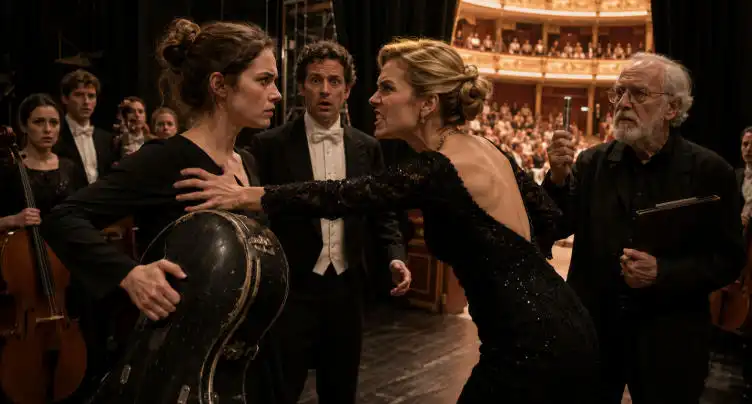
The conductor did not reach for the folder.
Not at first.
He stared at Mr. Ellis like the old stagehand had just stepped into the wrong room, at the wrong time, with the wrong kind of truth.
Victoria’s face went white.
Clara heard the audience beyond the curtain coughing, shifting, waiting.
A sold-out hall does not care about backstage politics.
It only knows when the music is late.
“Ellis,” the conductor said quietly, “this is not the time.”
The old man did not move.
“With respect, Maestro,” he said, “this is exactly the time.”
Clara stood there in her plain black dress, one hand still on the handle of her worn cello case.
Five years.
That was how long she had been invisible.
Five years of rehearsals where she arrived early and left last.
Five years of being told she had “promise,” but never opportunity.
Five years of hearing Victoria laugh softly whenever Clara’s name appeared on the substitute list.
It was never one big cruelty.
That would have been easier to name.
It was a thousand little cuts.
“Move your chair back, Clara.”
“Don’t stand in the publicity photo, Clara.”
“Let the principal players speak to donors, Clara.”
“Maybe soften your accent, Clara. It sounds… local.”
Local.
That was the insult they used when they wanted to say poor.
Clara came from a small house outside Boston where her father fixed air conditioners and her mother worked the front desk at a dental office.
There had been no marble foyer.
No summer program in Salzburg.
No family foundation paying for master classes.
Her first cello had been rented.
Her second had been bought used from a retiring church musician.
Her current cello had scratches along the ribs and a varnish stain near the bridge.
Victoria once called it “a respectable instrument for teaching children.”
Everyone laughed.
Clara did not.
She only went back after midnight and practiced until her fingertips burned.
Mr. Ellis was the one who made that possible.
He was a retired Army mechanic who had become a stagehand after his wife died.
He moved risers.
Checked doors.
Swept rosin dust from the stage.
He wore the same navy work jacket every night and kept peppermint candies in his left pocket.
And every evening, when the official rehearsal schedule ended, he would glance down the empty hallway and say, “Room B is unlocked for another hour, Miss Clara.”
Sometimes it was three hours.
Sometimes it was until dawn.
He never asked why she stayed.
He only listened.
From a folding chair near the door.
While she played Bach like grief.
Dvořák like thunder.
Elgar like forgiveness.
And the impossible royal-tour solo like a secret she was saving for God.
The solo was not supposed to be hers.
It belonged to Victoria.
Everything belonged to Victoria.
Her family name appeared on donor plaques.
Her mother chaired the gala committee.
Her uncle had helped secure the European tour sponsorship.
The conductor praised her “legacy.”
The music critics called her “aristocratic.”
Backstage, she called Clara “backup.”
Not “a substitute.”
Not “a colleague.”
Backup.
Like an extra battery.
Like something kept in a drawer.
That night, Boston Symphony Hall was packed with the sort of people who never had to ask the price of a ticket.
The front rows glittered with diamonds, tuxedos, and old money.
There were CEOs from multinational companies.
State officials.
European cultural attachés.
Critics who could make or break a career with one sentence.
The opening-night performance would launch the orchestra’s royal tour.
One mistake would travel faster than music.
The conductor knew it.
Victoria knew it.
Clara knew it too.
That was why Victoria was terrified.
Her panic attack had come like a storm.
One minute she was adjusting the silk sleeve of her white gown.
The next, she was gripping a chair so hard her knuckles looked bloodless.
“I can’t breathe,” she whispered.
The conductor rushed to her.
“Victoria, look at me.”
“I can’t go out there.”
“You have to.”
“I said I can’t.”
Her mother appeared from the donor corridor, pearls shaking against her throat.
“What is happening?”
“She’s overwhelmed,” the conductor said.
Victoria’s mother turned her eyes toward Clara, as if Clara had caused it by existing.
“No,” Victoria said suddenly.
Everyone looked at her.
Her voice was thin, but sharp.
“Do not put Clara on that stage.”
The words landed harder than a slap.
Even now.
Even shaking.
Even unable to perform.
Victoria would rather the orchestra collapse than let Clara be heard.
The conductor swallowed.
“Victoria, she is the only cellist who has rehearsed the full solo.”
Victoria’s eyes filled with rage.
“She practiced because she is desperate. Not because she is qualified.”
A few musicians looked down.
Nobody defended Clara.
Not the clarinetist who mocked her accent.
Not the violist who once asked if her family “understood classical music.”
Not the assistant manager who moved her name off a rehearsal list because Victoria said Clara made the section “look uneven.”
They all waited to see which way power would turn.
That was when Mr. Ellis stepped forward with the sealed personnel folder and the silver recorder.
Victoria’s mother snapped, “Who allowed staff into this conversation?”
The old man’s jaw tightened.
“I work here, ma’am.”
“You move chairs.”
“And tonight,” he said, “I am holding evidence.”
The hallway went silent.
Clara looked at him.
“Mr. Ellis…”
He gave her one small nod.
Not dramatic.
Not loud.
Just steady.
The kind of nod soldiers give each other when the truth has already crossed the line and cannot turn back.
The conductor looked at his watch.
Seven minutes to curtain.
“Clara,” he said, voice strained, “can you play it?”
Victoria laughed once.
It came out broken.
“Ask her if she can play it? She’ll embarrass all of us.”
Clara opened her cello case.
The metal latches clicked like a judge’s gavel.
Inside lay the old cello, polished by years of use and midnight discipline.
She lifted it carefully.
Her hands did not shake.
“Yes,” she said. “I can play it.”
Victoria’s mother stepped between Clara and the stage door.
“This is outrageous. My family did not support this orchestra so some unknown girl could turn our royal opening into amateur hour.”
Clara looked at her for the first time.
Really looked.
“I’m not unknown,” she said softly. “You just never asked who I was.”
The conductor closed his eyes.
For one second, Clara thought he might do the right thing.
Then his fear returned.
He lowered his voice.
“Clara, if you go on, you follow my tempo exactly. No interpretation. No risks. We are surviving this, not making a statement.”
Clara almost smiled.
Surviving.
That was what powerful people called it when the person they had buried started breathing.
Mr. Ellis moved closer to the conductor and held up the recorder.
“The board chair is already in the house,” he said. “So is legal counsel. I sent them the first file ten minutes ago.”
Victoria’s mother gasped.
“You did what?”
Mr. Ellis did not answer her.
He looked at Clara.
“Play first.”
The stage manager’s voice cracked over the headset.
“Two minutes.”
The conductor stared at Clara.
The entire orchestra waited.
The audience waited.
Victoria waited, trembling and hateful.
Clara stepped toward the curtain.
As she passed Victoria, Victoria grabbed her wrist.
Hard.
“You think one night makes you me?”
Clara looked down at Victoria’s fingers.
Then back at her face.
“No,” Clara said. “One night shows everyone I never needed to be you.”
She pulled free.
And walked onstage.
The light hit her like heat.
For a moment, she could not see faces.
Only gold balconies.
Dark suits.
White programs.
A sea of expectation.
Then the applause began.
Polite at first.
Confused.
People were reading the program.
This was not Victoria Langford.
This was the substitute.
Clara sat.
Adjusted the endpin.
Placed the cello against her body.
The conductor walked out behind her, pale as paper.
He lifted his baton.
The hall went still.
The first notes belonged to the orchestra.
Soft.
Elegant.
Careful.
Then the cello entered.
Clara’s bow touched the string.
And everything changed.
It was not loud at first.
That was what shocked them.
She did not attack the hall.
She drew it toward her.
One low note opened like a door in winter.
The audience stopped moving.
The critics stopped writing.
The donors stopped whispering.
The orchestra, used to Victoria’s polished perfection, suddenly heard something else.
Pain.
Discipline.
Loneliness.
Fire held under glass.
Clara played as if every insult had been stored in the wood of that old cello.
As if every locked door had tuned her.
As if every midnight hour had been waiting for this exact breath.
The impossible run came near the center of the solo.
Victoria always played it fast and bright, like she wanted applause before it ended.
Clara played it like a confession.
Clean.
Fearless.
Human.
The conductor forgot to control her.
For once, he followed.
Backstage, Victoria sank into a chair.
Her mother stood frozen beside her.
Mr. Ellis watched the monitor with his hands clasped in front of him.
The clarinetist who mocked Clara’s accent whispered, “My God.”
No one laughed.
By the final movement, the entire hall had changed temperature.
You could feel it.
The orchestra leaned into her.
The strings breathed with her.
The woodwinds softened under her line.
The brass entered like sunrise.
And when Clara reached the last note, she held it just long enough for the whole room to understand one thing:
She had not been rescued by chance.
She had been ready for years.
Silence followed.
One second.
Two.
Three.
Then the front row stood.
A gray-haired critic stood next.
Then a CEO.
Then the balcony.
Then the entire hall.
The applause hit like weather.
People shouted.
Not polite “bravo” applause.
Real applause.
The kind that makes wealthy people forget they are supposed to be restrained.
Clara stood, bow in one hand, cello at her side.
She looked toward the wings.
Mr. Ellis was there.
He touched two fingers to his brow.
She nearly cried.
But the night was not over.
The first standing ovation belonged to Clara.
The second reckoning belonged to the people who had buried her.
When Clara returned backstage, Victoria’s mother was speaking fast into her phone.
“This is defamation. This is theft of opportunity. My daughter was unwell, and that woman exploited—”
The board chair cut her off.
He had entered quietly during the applause.
He was an older man in a dark suit with the calm face of someone used to reading contracts before speaking.
Beside him stood the orchestra’s legal counsel.
And Mr. Ellis.
The conductor tried to smile.
“Wonderful save tonight. Truly. We can discuss the rest tomorrow.”
“No,” the board chair said. “We discuss it now.”
Victoria’s mother lifted her chin.
“With all respect, this family has given more to this institution than any substitute musician ever could.”
The board chair opened the sealed folder.
“That is part of the problem.”
He laid out printed emails.
Not rumors.
Not gossip.
Proof.
Victoria had privately contacted critics before concerts, feeding them lines about Clara being “technically unstable” and “unfit for major repertoire.”
Her mother had pressured donor-relations staff to remove Clara from public rehearsals.
The conductor had approved seating changes that kept Clara away from visiting conductors.
A section manager had written, “Victoria prefers Clara not be visible in tour materials.”
There were messages about “protecting the Langford gift.”
There were notes about “avoiding a public comparison.”
There were even payment records from a shell arts consultancy linked to two critics who had repeatedly praised Victoria while dismissing unnamed “less refined players” in the cello section.
Victoria stared at the papers.
Her mouth opened.
Nothing came out.
The conductor whispered, “These are internal communications.”
Legal counsel said, “Yes. That is why they are so useful.”
Mr. Ellis placed the tiny recorder on the table.
It held weeks of backstage audio.
Victoria calling Clara “a scholarship case without the scholarship.”
The clarinetist mocking her accent.
The conductor saying, “Keep Langford happy until the donation clears.”
Victoria’s mother saying, “There are ways to make substitutes disappear.”
Clara stood very still.
Hearing it out loud hurt more than she expected.
Not because it surprised her.
Because it proved she had not imagined it.
Every small humiliation had been real.
Every closed door had been deliberate.
The board chair turned to the conductor.
“You allowed a donor family to influence personnel decisions.”
The conductor’s face sagged.
“I was protecting the tour.”
“You were protecting yourself.”
Then he looked at Victoria.
“Miss Langford, the board has also received statements from three former players who allege similar intimidation.”
Victoria snapped, “They were jealous.”
Legal counsel slid another page forward.
“And two critics have already confirmed improper payments in exchange for favorable coverage and targeted negative commentary.”
Victoria’s mother grabbed the back of a chair.
“This is a misunderstanding.”
“No,” Clara said.
Everyone turned.
Her voice was quiet.
But it carried.
“A misunderstanding is when someone hears a wrong note. This was five years of making sure no one heard me at all.”
No one spoke.
The board chair closed the folder.
“Effective immediately, Maestro Reynolds is suspended pending termination review. Miss Langford will be removed from the European tour and placed under external investigation. The orchestra will issue a formal statement naming Clara Bennett as acting principal cellist for the tour.”
Victoria staggered back.
“You can’t do this to me.”
Mr. Ellis looked at her.
“You did it to yourself.”
The words were not cruel.
That made them worse.
By midnight, the story had already started moving.
Not because Clara leaked it.
She did not need to.
Hundreds of people had witnessed the performance.
Critics had posted stunned reactions.
A clip of the standing ovation spread across music circles before the after-party even ended.
The next morning, the headlines did not use Victoria’s name first.
They used Clara’s.
“Unknown Substitute Cellist Saves Royal Tour Opening Night.”
“Boston Audience Gives Emergency Soloist Thunderous Standing Ovation.”
“Board Opens Investigation Into Donor Influence and Orchestra Bullying.”
By the end of the week, Victoria announced she was “stepping away for personal reflection.”
That was the polite version.
The real version was uglier.
Her paid critic network collapsed.
Her family’s influence became a liability.
Two festivals quietly removed her from future programming.
A recording label paused her contract.
Invitations disappeared.
The classical world can be cruel when it wants to be elegant.
The conductor did not survive the board review.
His statement mentioned “regret” and “institutional learning.”
Nobody believed it.
The clarinetist sent Clara a text.
“I’m sorry if I ever made you feel unwelcome.”
She did not answer.
Some apologies are not for the wounded.
They are for the frightened.
The European tour went on.
With Clara in the first chair.
At the first concert in Vienna, she wore the same plain black dress.
A famous German critic wrote that her playing had “the rare authority of someone who has suffered without becoming small.”
That line followed her everywhere.
After Paris, a top European orchestra requested a private meeting.
After Prague, they made an offer.
A lifetime principal chair.
A salary Clara had to read three times.
Full recording support.
Housing allowance.
Artistic freedom.
When she called her parents, her mother cried so hard she had to hand the phone to Clara’s father.
Her father cleared his throat and said, “So… does this mean we can finally tell people you’re not just filling in?”
Clara laughed.
For the first time in weeks, she really laughed.
“Yes, Dad,” she said. “You can tell them.”
Her first album went platinum in a way classical albums almost never do anymore.
Not because of scandal.
Because people heard something true in it.
They heard the midnight rooms.
The swallowed insults.
The discipline no one applauded.
They heard a woman who had been treated like a spare part finally play like the whole machine belonged to her.
Months later, Clara moved her family into a beautiful apartment on Manhattan’s Upper East Side.
Her mother cried again when she saw the kitchen.
Her father stood at the window, looking down at the city, and said, “Your cello did all this?”
Clara smiled.
“No,” she said. “The cello helped. But mostly, I stopped letting small people decide how much room I was allowed to take.”
Mr. Ellis came to her first New York recital.
Front row.
New suit.
Peppermints still in his pocket.
At the end, Clara walked onstage for an encore and spoke into the microphone.
“I want to dedicate this to the person who unlocked the practice room when everyone else locked the doors.”
The audience turned as she pointed to him.
Mr. Ellis shook his head, embarrassed.
But they stood for him too.
And this time, Clara let herself cry.
Not from humiliation.
Not from exhaustion.
From relief.
Because justice does not always arrive loud.
Sometimes it waits in a sealed folder.
Sometimes it hides in an old man’s pocket recorder.
Sometimes it sounds like one woman playing a battered cello in a room full of people who finally have no choice but to listen. 🎻
So here is the side to choose:
Was Clara right to save the orchestra after they mistreated her for years — or should she have let their royal opening night collapse in front of the world?
Share this if you believe talent should never have to beg for permission to be seen.
Disclaimer: Mention of any brand or trademark is for identification only and does not imply partnership or endorsement

The Tavern Owner Set A Trap To Make Paul Drink Again… But He Had NO IDEA The Entire Town Was Watching 👀
They Laughed When Mark Announced He Was Running for Office… Then One Sealed Envelope Made the Whole Room Go Silent 😳
My Stepdaughter Thought Her Real Father Paid for Her Golf Club Wedding… Then I Showed the Guests the Letter He Sent Me