



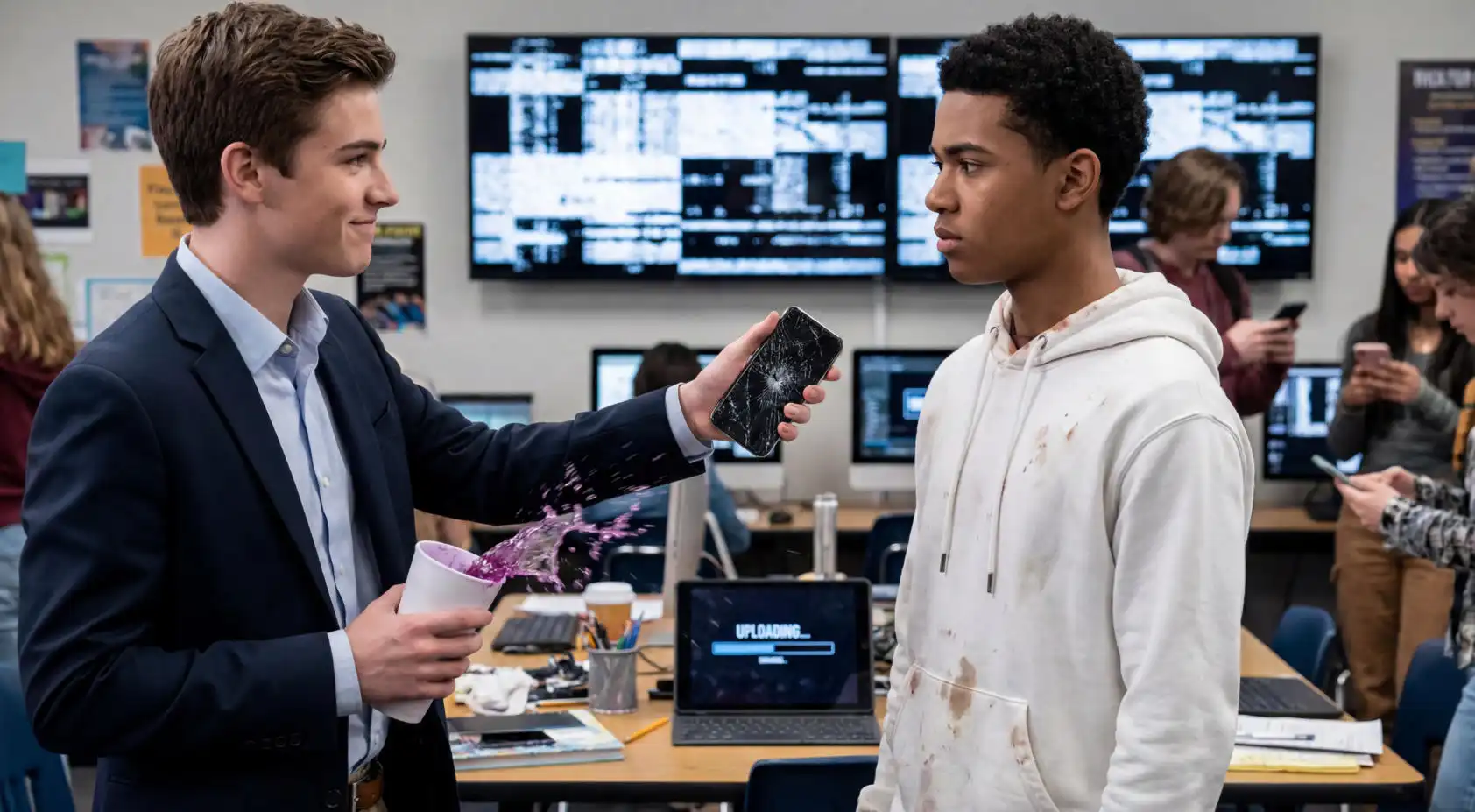
The first file opened slowly, one line at a time.
Nobody in the multimedia center laughed anymore.
Not Jackson.
Not the computer club boys.
Not the teacher standing near the printer with her hand over her mouth.
The room that had been full of jokes ten seconds earlier now sounded like a courtroom before a verdict.
Lucas stood in the middle of it all with grape juice sliding down his white shirt.
Purple stains spread across his chest like bruises.
Jackson still had the empty plastic cup in his hand.
His smirk was gone.
“What is this?” he snapped, but his voice cracked on the last word.
The big screen did not answer him.
It only opened another file.
And then another.
Lucas did not move.
He didn’t wipe his shirt.
He didn’t grab his phone back.
He just watched Jackson realize that the video he thought would destroy someone else had become the first piece of evidence against him.
That morning had started like every other Friday.
Lucas came to school early because the multimedia information center was warm, quiet, and had computers strong enough to run the coding projects he could not run at home.
To most students, Lucas was the quiet kid with the old backpack.
The scholarship kid.
The boy who ate lunch alone sometimes because his mother worked double shifts and his father had passed away when he was younger.
He never talked about money.
He never corrected people when they assumed he had none.
He never explained why he knew more about software architecture than half the school’s computer science teachers.
That was the part Jackson loved most.
Jackson Blake came from one of those families that made every room smaller.
His father was on donor boards.
His mother smiled in charity photos.
Jackson wore expensive shoes and treated the school like it was a hotel his family had paid for.
He never said, “Move.”
He said, “You’re in my way.”
There is a difference.
That Friday, Jackson walked into the multimedia center with four friends behind him.
Two were athletes.
Three were computer club boys who liked to call themselves “digital wolves,” even though they mostly spent their time making fake meme accounts and harassing kids who couldn’t fight back.
Lucas was sitting at a workstation near the front, finishing a presentation for the regional innovation showcase.
It was a simple project on the surface.
A school safety dashboard.
Anonymous reporting.
Timestamped incident logs.
Encrypted evidence storage.
Nothing flashy.
Nothing loud.
Lucas liked systems that protected quiet people.
Jackson saw the screen and laughed.
“Look at this,” he said. “Hall monitor software.”
Lucas kept typing.
Jackson stepped closer.
“You making an app to report hurt feelings?”
The boys behind him laughed.
Lucas saved his file.
“Please don’t touch the keyboard,” he said.
Jackson looked around as if Lucas had just insulted him in church.
“Please don’t touch the keyboard,” he repeated in a high, mocking voice.
One of the computer club boys, Tyler, lifted his tablet.
“Oh, this is content.”
Lucas turned his chair slightly.
“Don’t film me.”
That was when Jackson smiled.
Not a normal smile.
The kind of smile a spoiled person makes when he realizes rules only matter if someone enforces them.
“You don’t get to tell me what to do in a building my family paid for,” Jackson said.
The multimedia center had maybe thirty students inside.
A few freshmen near the 3D printers.
Two girls editing a school news segment.
A substitute teacher at the front desk.
Everyone heard him.
Everyone saw Lucas shrink back a little.
Lucas wasn’t weak.
But he was tired.
There are moments when a person knows fighting back will only give the bully a better video.
Jackson wanted a reaction.
A shove.
A curse.
A punch.
Anything he could clip, caption, and send around school by lunch.
Lucas gave him nothing.
So Jackson made his own scene.
He reached for the large grape juice cup sitting on the table beside one of his friends.
“White shirt,” Jackson said, looking Lucas up and down. “Brave choice for a charity case.”
Lucas stood.
“Jackson, stop.”
Those were the only two words he got out.
Jackson dumped the entire cup down the front of him.
The cold hit Lucas first.
Then the stickiness.
Then the sound.
Gasps.
Laughter.
A chair scraping backward.
Someone whispering, “Oh my God.”
Lucas looked down at himself.
The purple stain spread from his collar to his waistband.
Jackson stepped close enough that only the front row could hear him.
But Tyler’s tablet caught every word.
“Now you look sponsored,” Jackson said. “By poverty.”
That was when the room changed.
People love to say they would step in.
Most don’t.
A few students looked ashamed.
One girl started to stand, then sat back down when Jackson’s friend gave her a look.
The substitute teacher said, “Jackson, that’s enough,” but it came out small.
Jackson heard weakness and fed on it.
“Relax,” he said. “It’s just juice. If he wants a new shirt, maybe he can code one.”
The computer club boys were already working.
They were fast.
Cruel people often are when cruelty gets applause.
Tyler recorded the video.
Mason clipped it.
Drew uploaded it.
They pushed it to every social platform they could reach.
School group chats.
Local meme pages.
Anonymous accounts.
One of them even tried to tag Lucas’ project account.
“Make him famous,” Jackson said.
That line would matter later.
Lucas reached for his phone, not to call a teacher, not to text his mother, and not to beg.
He opened one message thread.
Ethan.
His older brother.
The person almost nobody at school knew existed.
Ethan had raised Lucas as much as any parent after their father died.
He had taught him how to write his first line of code at ten.
He had taught him something more important at thirteen.
“Never use power to humiliate someone,” Ethan had said. “Use it to protect the people who have none.”
What Lucas never told anyone was that Ethan was not just a programmer.
He was the founder of a Silicon Valley security company used by banks, hospitals, and school districts.
A company that had donated safety infrastructure to schools after several cyberbullying lawsuits made national news.
Their school district had quietly signed a contract with Ethan’s company six months earlier.
The multimedia center’s emergency broadcast network?
His company built it.
The evidence preservation system?
His company maintained it.
The anti-harassment upload freeze that triggered when a minor’s abuse was being mass-distributed from campus devices?
Lucas had helped test the first prototype.
That was the hidden piece.
Not magic.
Not luck.
Not revenge outside the rules.
A legal compliance system designed for exactly this kind of public cruelty.
Lucas texted one word.
“Now?”
Ethan replied.
“Only if you consent.”
Lucas stared at Jackson.
At Tyler filming.
At Drew laughing while the upload bar crawled toward 99%.
At thirty witnesses pretending not to be witnesses.
Lucas typed:
“Not yet.”
Why?
Because one spilled drink could be called a prank.
One insult could be called a joke.
One video could be dismissed as “kids being kids.”
But coordinated harassment?
Mass upload?
Use of school devices?
Defamation?
Threatening distribution of a minor’s humiliation?
That was different.
Lucas had learned from his brother that the truth needs more than anger.
It needs a record.
So he waited.
Jackson mistook silence for fear.
That was his fatal mistake.
He snatched Lucas’ phone.
“What are you gonna do?” Jackson shouted. “Call your mommy?”
Everyone laughed because they thought they were supposed to.
Lucas lifted his head.
“No,” he said.
“My brother.”
That was the moment the system triggered.
The uploads hit the threshold.
Multiple school devices.
Same abusive content.
Same victim.
Same network.
Same location.
The multimedia center lights flickered because the emergency display protocol took over.
Every student device on the school Wi-Fi froze the upload.
The wall screens went black.
The principal’s office screens went black.
The cafeteria projector went black.
The library announcement monitors went black.
Then one sentence appeared.
“Jackson, your family taught you to upload evidence. Thank you.”
Jackson laughed once, but it sounded wrong.
“Cute,” he said. “Who did this?”
Lucas finally took his phone back.
“You did.”
The first file opened.
It was not a secret diary.
It was not gossip.
It was a public court record summary linked through the district’s legally approved incident review system.
Jackson Blake.
Prior disciplinary incidents.
Harassment warnings.
Restorative agreements signed and violated.
Three previous bullying complaints that had been “handled privately” after his father donated money to school programs.
The substitute teacher stepped away from the desk.
Jackson’s ears turned red.
“Turn it off,” he said.
Nobody moved.
Then the second file opened.
Blake Family Foundation.
Large donations to youth programs.
Matching transfers.
Shell vendors.
Unpaid contractor claims.
A red banner at the top said:
“Evidence packet forwarded to district counsel and financial crimes unit.”
Jackson’s face emptied.
“What is that?” he whispered.
The room got colder.
Lucas knew about some of it, but not all.
Ethan had been careful.
He did not break into private accounts.
He didn’t need to.
Jackson’s father had been sloppy in public records, vendor filings, and court documents.
A powerful man had hidden behind status, not secrecy.
And status only works when nobody looks too closely.
The third file opened.
A video.
Jackson’s father at a private school board fundraiser, shaking hands with administrators.
The caption beneath it was not dramatic.
It was worse.
“Donation recorded two days after misconduct complaint closure.”
A girl near the printers said, “Wait… my brother was one of those complaints.”
Jackson spun around.
“Shut up.”
The room heard him.
The microphones heard him.
The system logged it.
The principal burst through the door with two administrators behind her.
“What is going on?”
Before anyone could answer, her tablet buzzed.
So did the dean’s.
So did the district compliance officer’s phone.
Ethan’s system had done what it was built to do.
Preserve evidence.
Freeze distribution.
Notify guardians.
Notify administrators.
Send the incident package to the people legally required to respond.
And because Jackson’s friends had used school devices to upload the abuse, their own accounts were tied directly to the event.
Tyler stared at his tablet.
“No,” he said. “No, no, no.”
His screen displayed:
“Account suspended pending investigation: coordinated harassment from protected campus network.”
Drew tried to switch to mobile data.
His account locked too.
Mason turned pale.
“My dad is gonna kill me.”
Jackson grabbed Tyler’s tablet and slammed it face down on the desk.
The sound cracked across the room.
Everyone jumped.
Lucas did not.
The principal said, “Jackson Blake, step away from him.”
Jackson pointed at Lucas.
“He did this! He hacked the school!”
Ethan’s voice came through the wall speakers.
Calm.
Adult.
Terrifying.
“No, Jackson. You used school equipment to record and distribute an assault on a student. The system responded according to district policy.”
Every head turned toward the speakers.
Jackson shouted, “Who are you?”
There was a pause.
Then the screen changed.
A simple company logo appeared.
Veyron Shield Technologies.
Several students gasped.
Even people who didn’t know tech knew that name.
It was the company that had been in the news for protecting hospital networks and exposing fraud rings.
The principal knew it too.
Her face changed completely.
Ethan’s voice returned.
“My name is Ethan Vale. Lucas is my brother.”
Jackson looked at Lucas like he had never seen him before.
That was the first real punishment.
Not the police.
Not the headlines.
Not the suspension.
The first punishment was the second Jackson understood that the quiet boy in the stained shirt had never been beneath him.
He had simply been kind enough not to say who he was.
Lucas said nothing.
That silence did more damage than any speech.
The district compliance officer arrived within ten minutes.
Campus security came with her.
Parents were called.
Statements were taken.
The grape juice cup was bagged.
The tablets were collected.
The upload logs were preserved.
Jackson’s friends tried to say they were “just recording.”
But the logs showed captions written in advance.
Tags prepared.
A private chat named “Purple Lucas Launch.”
One message from Jackson read:
“Post it everywhere before the teachers get soft.”
Another from Tyler:
“His face when he realizes it’s online will be legendary.”
A third from Drew:
“Blake said his dad can erase consequences anyway.”
That line hurt Jackson more than he expected.
Because investigators love arrogance in writing.
By noon, Jackson’s father arrived in a tailored suit and fury.
He walked into the front office like a man entering a building he owned.
“I want every screen shut down,” he demanded. “And I want that boy expelled for cyberterrorism.”
Lucas sat beside his mother, who had left work with her uniform still on.
Her hands were folded tight in her lap.
She looked at Lucas’ stained shirt and tried not to cry.
Ethan stood behind them in a plain black jacket.
No entourage.
No shouting.
No performance.
Jackson’s father pointed at him.
“You.”
Ethan turned.
“Yes.”
“You think because you run some tech company, you can attack my family?”
Ethan slid a folder across the table.
“I didn’t attack your family. Your son created an incident. Your family records triggered an existing fraud review. Separate matters. Same pattern.”
The room went quiet.
Jackson’s father did not open the folder.
That told Lucas everything.
In the following days, the truth came out in layers.
Jackson had not picked Lucas randomly.
He had heard that Lucas’ project might win the regional innovation showcase.
Jackson wanted that spotlight for his own college applications.
His computer club friends had planned to humiliate Lucas badly enough that he would drop out of the showcase.
They thought a viral video would make him too ashamed to stand onstage.
They also planned to copy pieces of his software after he withdrew.
But they had underestimated the quiet kid.
They had underestimated the stain.
They had underestimated the difference between a prank and a documented conspiracy.
The school board held an emergency meeting.
This time, no donation smoothed the edges.
Too many parents had seen the files.
Too many witnesses had given statements.
Too many reporters were asking why previous complaints against Jackson had vanished into “private resolution.”
Jackson was expelled.
Not suspended.
Expelled.
His three friends were banned from district networks and referred for cyberbullying violations.
Their college recommendation letters were withdrawn.
Their competition entries were disqualified.
The school issued a public apology to Lucas and to the other students whose complaints had been buried.
But the bigger fall happened outside the school.
Jackson’s father was investigated for laundering money through foundation vendors.
Several contracts were frozen.
Two associates cooperated.
Within a month, federal agents walked him out of his office.
Jackson’s mother resigned from every charity board before they could remove her.
The Blake family’s carefully polished name became a search result nobody wanted attached to them.
And Jackson?
He learned that the internet has a memory.
Not because Ethan cursed him.
Not because Lucas begged the world to hate him.
Because official records exist.
Because expulsion records, civil findings, documented harassment, and fraud-connected family investigations follow people who once believed consequences were only for the poor.
Years later, when Jackson applied for internships using polished essays about “leadership” and “integrity,” compliance systems flagged inconsistencies.
Not a secret blacklist.
Not revenge.
Just the truth catching up every time he tried to outrun it.
The same systems his family had trusted to protect their image now protected everyone else from their lies.
Lucas still went to the innovation showcase.
He wore a new white shirt.
Not expensive.
Just clean.
His mother bought it after Ethan insisted and she finally stopped arguing.
Before Lucas walked onstage, he hesitated backstage.
“I don’t want them staring at me,” he said.
Ethan fixed his collar.
“They’re going to stare,” he said. “Let them see you standing.”
Lucas stepped onto the stage.
For a second, all he could think about was grape juice.
The cold.
The laughter.
Jackson’s voice.
“Poor kids look better when they’re purple.”
Then he looked into the audience.
His mother was crying.
The girl from the 3D printer section was standing and clapping.
So were other students.
Then teachers.
Then parents.
The applause grew until Lucas had to blink hard just to see his slides.
He presented the safety dashboard with steady hands.
He explained how anonymous reports could protect students who were afraid to speak.
He explained how evidence should be preserved without turning pain into entertainment.
He explained that technology was not supposed to make cruelty faster.
It was supposed to make justice harder to bury.
He won first place.
But that wasn’t the healing part.
The healing part came three weeks later.
A freshman walked up to Lucas in the hallway.
Small kid.
Old backpack.
Eyes on the floor.
He held out a folded note.
“My brother said you’re safe to tell,” the kid whispered.
Lucas took the note.
It was a report about another student being bullied.
This time, nobody laughed.
This time, the system worked before the damage went viral.
This time, an adult listened.
Lucas kept the grape-stained shirt.
His mother wanted to throw it away.
Ethan wanted to frame it.
Lucas did neither.
He folded it and put it in a box under his bed.
Not because he liked remembering the humiliation.
Because it reminded him of the exact second he stopped mistaking silence for weakness.
Jackson had wanted to make Lucas famous for being helpless.
Instead, he made him known for building something that protected people.
That is the part bullies never understand.
When you humiliate someone in public, you are not just showing the world who they are.
You are showing the world who you are.
And sometimes, the world finally pays attention. ⚖️
So pick a side:
Jackson deserved every consequence because public cruelty needs public accountability.
Or Lucas went too far by letting the truth hit while everyone watched.
Share this if you believe dignity should never depend on how rich your family is.
Disclaimer: Mention of any brand or trademark is for identification only and does not imply partnership or endorsement

A Rich Polo Player Tore A Hardware Store Owner’s Jacket In Front Of Everyone… Minutes Later, He Was Begging On The Grass

A Round-Bellied Carpenter Was Humiliated by an Elite Ski Coach in Front of Rich Guests… But Sven Had NO IDEA Who Bob Really Was 😳

Parents Covered Their Noses When the “Cheap Mom” Walked In… Minutes Later, the PTA Queen Was on Her Knees Begging 😮