
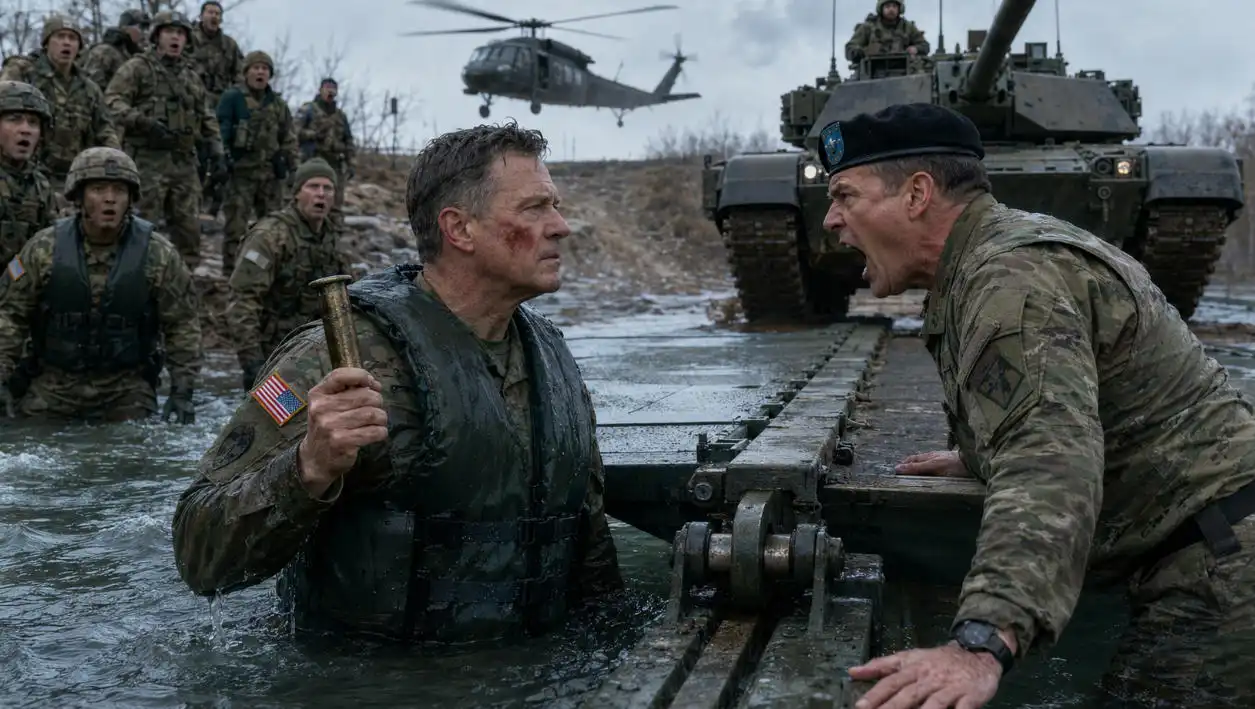
The helicopter came in low over the river.
The rotors slapped the cold air so hard that every loose tarp on the floating bridge snapped like a flag.
Colonel Hamilton had been screaming one second earlier.
Now he was silent.
Captain Noah stood in the icy water with a red handprint on his face, one brass-marked bridge pin in his wet glove, and every soldier on the bank staring at him like he had just pulled the trigger on his own career.
Hamilton stepped close and hissed, “Put that pin back before I destroy you.”
Noah looked past him.
At the helicopter.
At the corps commander stepping onto the muddy bank.
Then Noah said, calm as stone:
“No, sir. Not until the real weight is verified.”
The entire riverbank froze.
Noah was only a company commander.
An engineer.
The kind of officer men like Hamilton treated like a tool — useful when silent, disposable when inconvenient.
Hamilton was the armored brigade commander.
Polished boots.
Perfect uniform.
A voice that made young lieutenants stand straighter before they even knew why.
And that morning, he believed rank could bend steel.
He believed anger could move water.
He believed a floating bridge would obey him because everyone else did.
The problem was simple.
Physics did not salute.
Noah’s engineers had been in the river since dawn.
Their fingers were stiff.
Their lips were pale.
Two young specialists had been standing in water so cold it made their legs tremble.
Behind them, Hamilton’s armored crews kept honking.
One driver leaned out and shouted, “Come on, bridge boys!”
Another laughed, “Maybe they need a coffee break!”
Noah heard it all.
He did not react.
He kept checking the hinge lines.
The buoyancy numbers.
The anchoring angle.
The current speed.
The load chart clipped inside a waterproof sleeve.
He had designed improvements for pontoon systems before joining the training command.
He knew how a bridge spoke before it failed.
A groan in the joint.
A low shift in the float line.
A pin taking too much shear.
That morning, the bridge was whispering danger.
Hamilton refused to hear it.
He marched down to the bank and shouted, “Captain Noah!”
Noah turned.
“Sir, crossing is delayed. The bridge needs another load inspection.”
Hamilton laughed loudly enough for the tank crews to hear.
“A load inspection? My brigade has an exercise timeline.”
Noah pointed to the lead vehicles.
“Sir, those vehicles are riding too low. They are not configured according to the submitted manifest.”
Hamilton’s face hardened.
“Are you accusing my brigade of lying?”
“No, sir. I’m saying the bridge was calculated for the listed weight.”
Hamilton stepped closer.
“Then recalculate faster.”
Noah looked him in the eye.
“I can’t make the river stronger.”
That was when Hamilton grabbed a helmet from a private standing nearby, scooped river water into it, and threw it into Noah’s face.
The water hit Noah so hard he staggered.
The riverbank went quiet.
Then Hamilton slapped him.
A sharp, open-handed crack.
Right in front of engineers, tank crews, mechanics, radio operators, and junior officers.
A young engineer whispered, “Captain…”
Noah raised one hand to stop him.
Hamilton smiled.
“Now you understand chain of command.”
Noah’s cheek burned.
His uniform dripped.
His men looked humiliated for him.
But Noah did not shout.
He did not swing back.
He did not beg.
He simply turned, reached down to the main joint, unlocked the safety keeper, and pulled the bridge pin.
Metal slid out with a heavy click.
Every engineer knew what that meant.
The bridge was no longer cleared.
No tank could cross.
Hamilton’s smile vanished.
“What did you just do?”
Noah held up the pin.
“I made sure no one dies because someone was embarrassed by math.”
Hamilton lunged forward.
Two majors stepped in, not brave enough to grab him, but scared enough to slow him.
The corps commander’s helicopter touched down seconds later.
Lieutenant General Marcus Reed stepped out with his aide, his helmet still on, his face unreadable.
“Who halted my armored crossing?” Reed asked.
Hamilton immediately pointed at Noah.
“This engineer officer disobeyed a lawful order, sabotaged the bridge, and delayed a brigade movement.”
Noah said nothing.
That bothered Hamilton more than any argument could have.
General Reed looked at Noah.
“Captain?”
Noah walked out of the river slowly.
His boots sank in mud.
Water ran from his sleeves.
The slap mark was still bright across his cheek.
He saluted.
“Sir, I halted the crossing because the vehicle manifest and observed axle behavior did not match. The bridge was rated for the submitted load, not the actual load.”
Hamilton snapped, “That is speculation.”
Noah turned to his first sergeant.
“Bring the riverbank photos.”
The first sergeant handed over a waterproof tablet.
Noah had not been standing there helpless.
He had been documenting.
Photos of the lead tank’s suspension.
Photos of extra armor kits bolted under side skirts.
Photos of unauthorized recovery equipment chained to the rear decks.
Photos of ammunition pallets stacked in places that were supposed to be empty during training movement.
Noah pointed to each image.
“Sir, these vehicles are carrying additional equipment not declared on the crossing sheet.”
General Reed’s aide opened the official manifest.
His face changed first.
Then Reed’s did.
Hamilton spoke quickly.
“General, those are minor additions. Field reality requires flexibility.”
Noah answered softly.
“Not on a floating bridge, sir.”
One of the engineers stepped forward with the bridge load chart.
Noah had marked the numbers in grease pencil.
The listed load was already near the upper safe range because of the cold current.
With the undeclared equipment, the first three vehicles would overload the center span.
If one tank sank the joint, the current would twist the bridge.
The vehicles behind it would have nowhere to go.
Men could be trapped inside armored hulls in freezing water.
Fuel and equipment could spill downstream.
A training shortcut could become a mass-casualty disaster.
Nobody laughed now.
The tank crews who had honked earlier stared at the river.
The same river they had mocked.
General Reed looked at Hamilton.
“Did you authorize these vehicles to cross with undeclared load?”
Hamilton’s jaw clenched.
“General, we were maintaining combat realism.”
Reed’s voice went cold.
“Combat realism does not include falsifying safety documentation.”
Hamilton’s face turned pale.
“I did not falsify—”
The aide interrupted.
“Sir, there are handwritten changes on the brigade copy. They are not on the engineer copy.”
Noah looked down.
He had suspected it.
But hearing it out loud still made the riverbank feel colder.
Hamilton had not merely rushed the crossing.
He had hidden the weight.
He had tried to force Noah’s men to certify a bridge under false numbers.
And when Noah resisted, he publicly humiliated him to break him.
General Reed took the altered document.
“Who made these changes?”
Hamilton did not answer.
A logistics captain near the command vehicle suddenly looked sick.
Reed noticed.
“You. Step forward.”
The captain’s voice shook.
“Sir… Colonel Hamilton told us to keep the extra equipment off the engineer sheet. He said the bridge team would ‘hide behind numbers’ if they saw the real load.”
Hamilton spun around.
“You coward.”
Reed raised one hand.
Hamilton stopped.
That hand carried more authority than all Hamilton’s shouting.
“Colonel Hamilton,” Reed said, “you are relieved of brigade command effective immediately.”
The riverbank went dead silent.
Hamilton looked like he had been struck.
“Sir—”
“You will surrender your command authority to the deputy commander. You will report to the installation commander pending investigation for reckless endangerment, falsification of safety records, and conduct unbecoming.”
Noah’s engineers stared.
Not cheering.
Not smiling.
Just breathing again.
Hamilton looked at Noah with pure hatred.
All morning, he had treated Noah like a wet obstacle in his path.
Now that same “obstacle” had stopped him with one pin, one chart, and the truth.
General Reed turned to Noah.
“Captain, why didn’t you report the assault first?”
Noah touched his cheek.
Then looked at his men.
“Because the bridge mattered more.”
For the first time that morning, General Reed’s expression softened.
“That may be the most engineer answer I’ve ever heard.”
A few soldiers almost laughed.
Not loudly.
But enough to break the fear.
Reed ordered a full inspection.
The tanks were unloaded.
The extra gear was weighed.
Noah’s numbers were confirmed within the hour.
The center span would likely have failed under the third vehicle.
Not maybe.
Not “possibly.”
Likely.
Hamilton had been seconds away from turning arrogance into a river full of trapped soldiers.
The consequences came fast.
Hamilton was removed from brigade command.
His career board opened a formal review.
The safety office referred the case for public endangerment-related charges under military authority.
The logistics captain cooperated.
Several officers admitted they had been pressured to “make the paperwork match the mission.”
And the young soldiers who had watched Noah get slapped gave written statements.
One tank driver wrote:
“I honked at the engineers. I thought they were slow. Captain Noah saved my life.”
That sentence followed Noah longer than the slap mark did.
Weeks later, Noah was called to headquarters.
He expected another safety briefing.
Instead, General Reed was waiting with engineers from three different commands.
On the table was Noah’s pontoon modification package.
The brass-marked pin.
The revised load indicator.
The visual stress markers that could warn a bridge team before failure became visible.
Reed tapped the file.
“Captain, your design is being patented through military channels.”
Noah blinked.
“Sir?”
“It will be adopted across training and field bridge operations. Army-wide.”
Noah did not know what to say.
For a man who trusted numbers more than speeches, silence was the only honest answer.
Reed smiled faintly.
“You pulled one pin and saved a brigade. Now your design may save thousands.”
Months later, the river obstacle had a new sign near the bridge staging area.
It did not mention Hamilton.
It did not mention the slap.
It simply read:
LOAD FIRST. RANK SECOND. LIVES ALWAYS.
Noah’s engineers loved that sign.
They would tap it before entering the water.
Not for luck.
For pride.
Because that day taught every soldier on that bank something simple and permanent:
A loud man with authority can still be wrong.
A quiet man covered in river water can still be the only thing standing between order and disaster.
And sometimes justice does not arrive with shouting.
Sometimes it arrives in a helicopter.
Sometimes it wears wet boots.
And sometimes it fits in the palm of one engineer’s hand. ⚙️
Hamilton lost his command.
Noah’s bridge system went Army-wide.
And every soldier who had laughed at the “slow engineer” learned the same lesson the hard way:
Never insult the person who understands the thing keeping you alive.
Share this if you believe Noah was right.
Stand with the man who followed physics — or the commander who demanded obedience. Pick one.
Disclaimer: Mention of any brand or trademark is for identification only and does not imply partnership or endorsement
An OLD Lighthouse Keeper Was Punched Onto the Rocks by a Rich Developer… But He Had NO IDEA Who Silas Really Was ⚓
Young Actors Laughed When Their Director Pushed an Old Cleaner Offstage… Then One Sealed Black Folder Changed Everything
A Quiet Housewife Was Slapped In Front Of Her Whole Family Over Cold Mashed Potatoes… But Her Husband Had NO IDEA Who Was Standing Outside The Door