
The microphone squealed before the announcer could finish.
For one second, the whole course seemed to hold its breath.
Brock still had that smug little smile on his face.
Security still had one hand near Nora’s elbow.
And Nora was still standing there soaked, torn sleeve hanging loose, holding a wet folder that suddenly made three important men look terrified.
Nobody knew why.
Not yet.
Ten minutes earlier, Brock had been treated like royalty.
People clapped when he walked.
Volunteers whispered his name.
Cameras followed every step.
He was the kind of athlete who expected doors to open before he touched them.
Nora was the opposite.
She was a quiet woman in the crowd.
Round face.
Soft shoulders.
Comfortable shoes.
A sun hat that had seen better days.
She looked like someone’s aunt who brought extra napkins to family cookouts.
That was exactly why Brock thought she was safe to humiliate.
He didn’t think she mattered.
He didn’t think anyone would defend her.
He didn’t think a woman like Nora could touch a man like him.
He was wrong.
It started on the fifteenth hole.
Brock lined up his shot.
The wind shifted.
His grip tightened.
Then he swung too hard and sent the ball into the bunker.
The crowd made that low, disappointed sound golfers hate.
Brock’s jaw clenched.
He spun around.
His eyes landed on Nora.
“You moved,” he said.
Nora looked behind her, confused.
“I didn’t move.”
“Yes, you did,” Brock snapped. “You people think buying a ticket means you’re part of the game.”
A few people looked down.
Nobody wanted to challenge him.
A marshal stepped closer, but not toward Brock.
Toward Nora.
“Ma’am, please stay still during play.”
Nora’s cheeks flushed.
“I was still.”
Brock laughed.
It wasn’t a friendly laugh.
It was sharp.
Ugly.
Loud enough for everyone nearby to hear.
“Look at her,” he said to his caddie. “Front-row seat and still doesn’t know how to behave.”
That was the first phone that went up.
Then another.
Then five more.
Nora folded her hands over her program and tried to sit back down.
That should have been the end of it.
But Brock was not done.
He walked toward his caddie, grabbed a water bottle from the bag, and turned back.
His caddie whispered, “Brock, don’t.”
Brock ignored him.
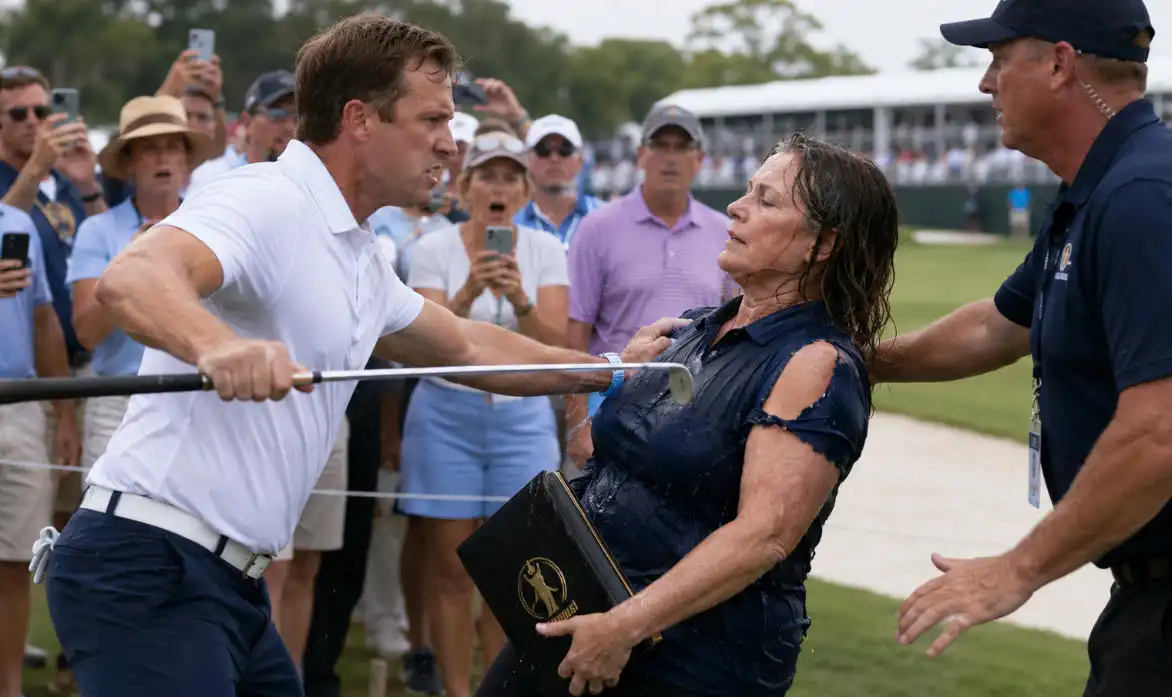
He stepped across the edge of the rope line and tipped the bottle over Nora’s chest.
Cold water ran down her blouse.
The crowd gasped.
Someone said, “Are you serious?”
Nora stood up fast, soaked and shaking.
“Why would you do that?”
Brock leaned close.
“Maybe that’ll cool you off before you ruin another shot.”
Then he lifted his club sideways and used it to push her back.
Not a swing.
Not a strike.
But a hard shove.
Enough to make her lose her footing.
Nora fell against the chair behind her, then down onto the grass.
Her sleeve caught on the metal armrest.
It tore open from shoulder to elbow.
For one horrible second, nobody moved.
Then people started shouting.
“Help her!”
“He pushed her!”
“Get him off the course!”
But the head rules official, Grant Ellis, hurried over with a tight, fake-calm face.
He didn’t check on Nora.
He didn’t ask if she was hurt.
He turned to the gallery and said, “Please put your phones away.”
Then he looked at Nora.
“Ma’am, we’re going to escort you from the grounds.”
Nora stared at him.
“Me?”
Grant lowered his voice.
“You interfered with a professional player during championship play.”
Brock stood behind him, wiping his hands like Nora was something dirty.
“Finally,” he said. “Get her out.”
A security guard reached for Nora’s arm.
That was when she stopped shaking.
Her face changed.
Not angry.
Not loud.
Just still.
She bent down and picked up the folder that had fallen from her bag.
The cover was wet now.
But the seal was visible.
Black and gold.
Official tournament licensing.
Corporate sponsorship documents.
Nora looked at Grant and said, “Before you touch me again, I suggest you call Elaine Mercer.”
Grant’s face went pale.
Elaine Mercer was the tournament’s finance director.
Brock laughed.
“Oh, now she knows names?”
Nora ignored him.
She opened the folder and pulled out a laminated badge.
Not a spectator pass.
Not a VIP guest badge.
An executive credentials card.
Nora Whitmore.
Chairwoman.
Whitmore Legacy Foundation.
Title Sponsor.
The same foundation whose name had been on every banner, every press wall, every televised commercial, and every ceremonial welcome dinner that week.
The same foundation funding the purse increase.
The same foundation covering broadcast upgrades.
The same foundation whose contribution had kept the championship alive after two major corporate partners pulled out six months earlier.
Grant took one step back.
The security guard released her arm.
Brock stopped laughing.
Nora turned to the crowd.
Her blouse was soaked.
Her sleeve was torn.
Grass clung to one side of her skirt.
But her voice was steady.
“I came today without the sponsor suite,” she said. “Without the hospitality badge showing. Without staff. I wanted to sit among the people this tournament claims to honor.”
The crowd went silent.
“I wanted to see how guests are treated when nobody knows their net worth.”
A camera crew moved closer.
Grant whispered, “Mrs. Whitmore, perhaps we should discuss this privately.”
Nora finally looked at him.
“You had your chance to handle this privately when he poured water on me.”
Then she pointed at Brock.
“And again when he shoved me.”
Then at Grant.
“And again when you punished me for being the person he chose to blame.”
Brock’s face turned red.
“Come on,” he said. “This is being blown out of proportion.”
A woman in the crowd shouted, “You pushed her!”
Another man yelled, “We all saw it!”
Brock lifted both hands.
“She distracted me. I reacted.”
Nora nodded slowly.
“That’s what entitled men always call it when consequences arrive. A reaction.”
That line hit the crowd like thunder.
People started clapping.
Not politely.
Not quietly.
Loud.
Angry.
Relieved.
Brock looked around, realizing for the first time that the gallery was not his audience anymore.
It was hers.
Elaine Mercer came rushing from the sponsor tent with two board members behind her.
“Nora,” she said, breathless. “I am so sorry. We just saw the footage.”
Nora looked at her.
“Then you know what has to happen.”
Elaine swallowed.
Grant stepped in quickly.
“Mrs. Whitmore, we can suspend Mr. Hale for the rest of the day. We can issue a statement. We can—”
“No,” Nora said.
One word.
That was all it took.
The entire green went quiet again.
Brock’s caddie stared at the grass.
The volunteers looked sick.
The cameras kept rolling.
Nora handed Elaine the wet folder.
“Our sponsorship agreement has a conduct clause,” she said. “Section 14. Public misconduct by players, officials, or representatives. Failure to enforce safety and dignity standards voids funding obligations immediately.”
Grant’s mouth opened.
Nothing came out.
Nora continued.
“It also requires neutral enforcement by officials. Today, your official attempted to remove the victim while protecting the player.”
She looked at Brock.
“And your player assaulted a sponsor in front of witnesses.”
Brock’s voice cracked.
“Assault? I didn’t assault anyone.”
Nora lifted her torn sleeve.
The crowd murmured.
A teenager near the rope line held up his phone.
“I have the whole thing,” he said.
Another spectator said, “Me too.”
Then another.
Then another.
It was not one video.
It was dozens.
Different angles.
Different witnesses.
All showing the same thing.
Brock blaming Nora.
Brock dumping water on her.
Brock shoving her down.
Grant ordering security to remove her.
Nora did not need to scream.
The evidence spoke loudly enough.
Brock turned to Elaine.
“Tell her this is insane. You can’t shut down a championship over one misunderstanding.”
Elaine’s face hardened.
“This championship exists because she funded it.”
Brock went still.
That was the moment he understood.
Not when the crowd booed.
Not when the cameras closed in.
Not even when Nora revealed the badge.
He understood when the finance director said the money was hers.
Brock took one step toward Nora.
“Nora, listen. I didn’t know who you were.”
The crowd reacted instantly.
That sentence was worse than an apology.
Because it told the truth.
He was not sorry he hurt a woman.
He was sorry he hurt the wrong woman.
Nora’s eyes filled, but she did not let the tears fall.
“That’s the problem, Brock.”
She held his gaze.
“You shouldn’t have needed to know who I was.”
For the first time all day, Brock had nothing to say.
The tournament board called an emergency meeting right there behind the scorer’s tent.
But it was already too late.
Nora formally withdrew the Whitmore Legacy Foundation’s title sponsorship.
Immediate effect.
All remaining funds frozen.
Broadcast support canceled.
Hospitality obligations canceled.
Prize supplement revoked.
A public statement was drafted within the hour.
The championship could not continue without the funding guarantee.
By late afternoon, play was suspended.
By evening, it was officially canceled.
Not postponed.
Canceled.
Brock’s team tried to control the damage.
They released a statement calling it “an unfortunate emotional exchange.”
That lasted twelve minutes.
Then the videos hit Facebook.
Then the videos hit every sports page in America.
Then sponsors started calling.
By Monday morning, Brock had lost his apparel deal.
By Tuesday, his equipment sponsor suspended him.
By Wednesday, the tour disciplinary board opened a formal conduct review.
By Friday, Brock’s professional eligibility was revoked pending permanent disqualification.
Then came the civil claims.
Breach of conduct clauses.
Morality clauses.
Damages from canceled broadcasts.
Vendor losses.
Sponsor reimbursements.
Contract penalties.
Tens of millions of dollars.
The man who thought Nora was too small to matter was suddenly drowning in paperwork with his own name on it.
The final hearing was held on the same green where he had shoved her.
Not for drama.
Because that was where the tournament officials gathered to announce the decision publicly.
Brock arrived pale.
No sunglasses.
No grin.
No swagger.
When the board confirmed his permanent ban from the championship circuit, his knees buckled.
He sank down on the green.
And cried.
Not quiet tears.
Open sobbing.
The kind a man makes when he realizes the world will remember the worst thing he did.
Reporters shouted questions.
“Brock, do you apologize to Nora Whitmore?”
“Brock, were you protected by officials?”
“Brock, did you know she was the sponsor?”
He covered his face.
Nora watched from a few feet away.
She did not smile.
She did not celebrate.
That surprised people.
But Nora had never wanted a man ruined for sport.
She wanted the rules to apply to him the same way they had almost been used against her.
Later, when a reporter asked if she felt guilty for pulling the funding, Nora said:
“I didn’t end the tournament. The people who valued money more than dignity ended it. I simply refused to pay for my own humiliation.”
That quote went everywhere.
Church groups shared it.
Grandmothers shared it.
Retired veterans shared it.
Women who had been dismissed, mocked, shoved aside, or told to “be quiet” shared it with one sentence:
“This is why you never judge who matters.”
A week later, Nora used part of the withdrawn sponsorship funds to create a new grant.
Not for pros.
Not for private suites.
For youth golf programs in small towns.
Free lessons.
Public courses.
Transportation for kids whose parents could not afford tournament fees.
And the first rule of the program was printed at the top of every application:
“Respect is not reserved for the rich.”
Nora’s torn sleeve was never repaired.
She framed it.
Not because she loved what happened.
But because it reminded her that silence is not weakness.
Sometimes silence is the sound of someone letting the evidence finish the sentence.
Brock lost his career because he thought power meant never having to look down.
Grant Ellis resigned after the investigation proved he had ignored two prior complaints about Brock’s behavior to protect tournament ratings.
The security contractor lost its event license.
The board rewrote its safety policy.
And Nora never sat in the sponsor suite again.
The next time she attended a public charity match, she sat right by the rope line.
Comfortable shoes.
Simple hat.
Program in her lap.
Only this time, when a little girl beside her whispered, “Are you famous?” Nora smiled.
“No, honey,” she said. “I’m just someone who learned not to leave when bullies tell me to.”
The little girl nodded like she had just been handed a secret.
And maybe she had.
Because the real victory was not Brock crying on the green.
It was every ordinary person watching that video and remembering:
You do not have to look powerful to deserve respect.
And you do not have to shout to make the truth loud.
So pick a side:
Team Nora — dignity has a price. Or Team Brock — one bad moment should not destroy a career.
Share this if you believe public disrespect deserves public consequences. ⛳
Disclaimer: Mention of any brand or trademark is for identification only and does not imply partnership or endorsement
The Tavern Owner Set A Trap To Make Paul Drink Again… But He Had NO IDEA The Entire Town Was Watching 👀
They Laughed When Mark Announced He Was Running for Office… Then One Sealed Envelope Made the Whole Room Go Silent 😳
My Stepdaughter Thought Her Real Father Paid for Her Golf Club Wedding… Then I Showed the Guests the Letter He Sent Me