


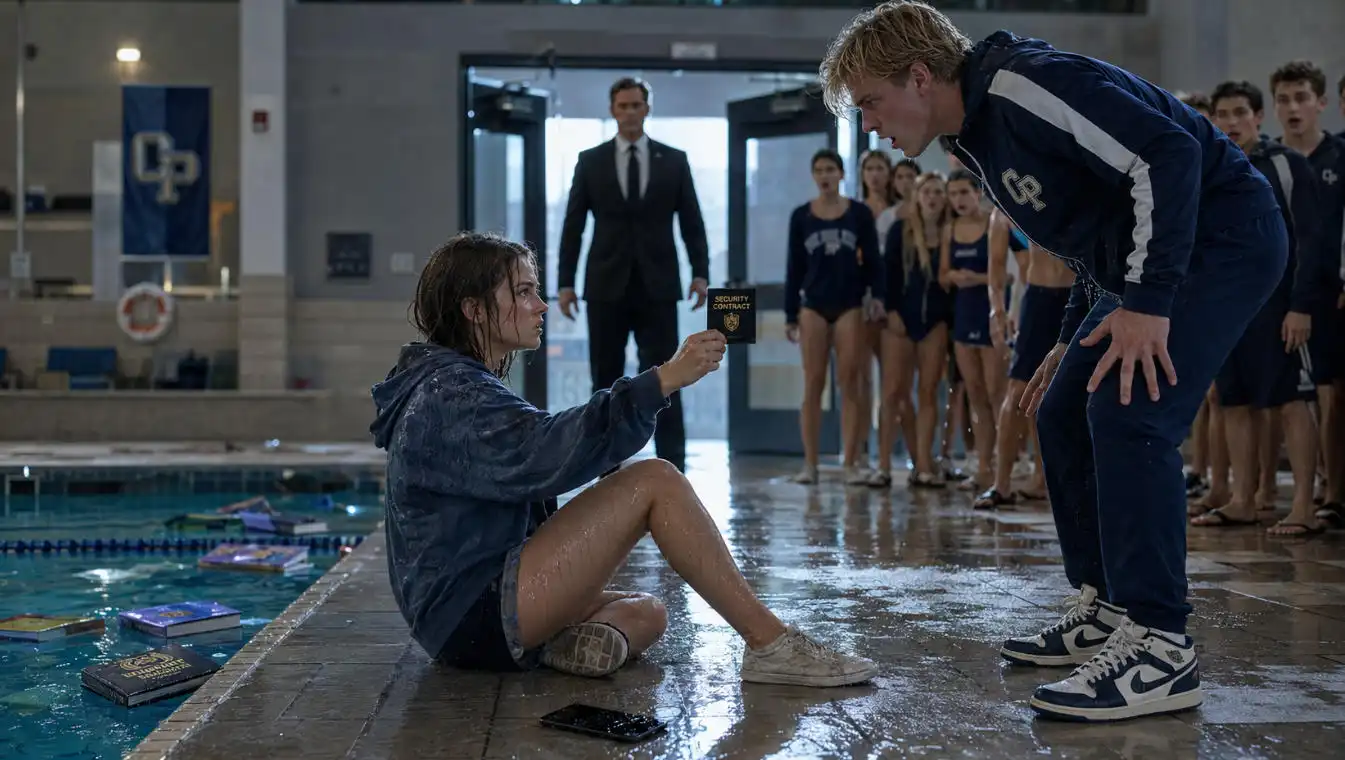
Then the heavy doors opened, and the first man in a black suit stepped onto the wet tile.
Lucas’s smile stayed on his face for one second too long.
Then it twitched.
The bats stopped hitting the railing.
The echo died so fast it felt like someone had sucked the oxygen out of the pool room.
Avery sat on the floor in a puddle of ice water, her hoodie plastered to her shoulders, her hands trembling from the cold.
Nobody moved.
Not the swim team.
Not the coach.
Not the students filming from the bleachers.
Not Lucas, who had spent the last ten minutes acting like that pool belonged to him, that school belonged to him, and that Avery’s dignity was something he could spill on the floor for entertainment.
The man in the black suit looked at Avery first.
Not Lucas.
Not the coach.
Avery.
His voice was low.
“Miss Avery, are you hurt?”
Lucas let out a fake laugh.
“Miss Avery?” he said. “What is this, some kind of mall-cop performance?”
The man did not look at him.
Avery swallowed.
“I’m cold,” she said. “My phone is destroyed. My school laptop is in the water. And they wouldn’t let me leave.”
That last sentence changed everything.
The man’s eyes moved slowly to the boys holding the bats.
They were not swinging anymore.
One of them lowered his bat behind his leg like hiding it would somehow rewind the last ten minutes.
Lucas lifted both hands like he was bored.
“Oh, come on. It was a prank.”
Avery looked up at him.
Her hair was dripping onto her face.
“You told them to block the exit.”
Lucas’s jaw tightened.
“I said nobody should interrupt team bonding.”
A girl in the bleachers whispered, “That is not what he said.”
Lucas snapped his head toward her.
“Shut up, Madison.”
That was the thing about people like Lucas.
They never know when to stop.
He was the kind of boy adults excused before he even opened his mouth.
Too handsome to be cruel.
Too rich to be guilty.
Too popular to be dangerous.
His father’s name was on the new scoreboard.
His mother chaired the fundraising committee.
His family donated enough money that teachers smiled through things they should have reported.
And Avery?
Avery was the girl who arrived early, sat in the back, kept her grades perfect, and never corrected anyone when they called her “sweetheart” like she was harmless.
She had transferred to Northlake Academy three months earlier on a merit scholarship.
No flashy car.
No designer backpack.
No parents at fundraiser night.
Just a quiet girl with straight A’s and a habit of watching every exit in every room.
Lucas noticed her on the first day.
Not because she bothered him.
Because she didn’t admire him.
That was enough.
At first it was little things.
A towel thrown into the pool.
Her locker jammed with wet swim caps.
A “joke” photo edited to make her look like she was crying.
Then Lucas found out Avery had been assigned as his chemistry lab partner.
That was when the bullying became personal.
“You’re not ruining my GPA,” he told her after class.
“I’m not trying to ruin anything,” Avery said.
“You’re here because the school needed charity numbers,” he said. “Don’t get confused.”
Avery said nothing.
That irritated him more.
Lucas wanted tears.
He wanted an argument.
He wanted proof that he had power.
Instead, Avery documented.
Dates.
Times.
Names.
Screenshots.
Damaged property.
Witnesses.
She emailed two teachers.
No response.
She reported one incident to the assistant dean.
The assistant dean called it “a social adjustment issue.”
She went to the swim coach after Lucas’s friends shoved her backpack into a shower stall.
The coach sighed and said, “Avery, boys with scholarships and boys with pressure sometimes act out. Try not to take everything personally.”
So Avery stopped asking adults to care.
She started saving evidence.
And she kept one card in her backpack.
A black card with gold letters.
Most people at Northlake didn’t know what the name on the card meant.
Lucas definitely didn’t.
He saw a quiet girl and assumed she belonged to no one.
That morning, the swim team had a closed practice before the winter invitational.
Avery wasn’t on the team.
She was there because the chemistry teacher had assigned her to collect water samples for a science fair project.
The indoor pool had controlled temperature readings, mineral logs, chemical records, and permission from the facilities office.
She had a clipboard.
A borrowed school laptop.
Three labeled sample tubes.
She was kneeling near lane four when Lucas walked in with six teammates behind him.
“Well, look,” he said. “The charity case is testing our water now.”
Avery didn’t look up.
“I have permission to be here.”
Lucas bent down and tapped the clipboard with one finger.
“You have permission to exist quietly.”
The boys laughed.
Avery capped the first sample.
“I’ll be done in five minutes.”
Lucas looked toward the bleachers.
A few students had come in early. Some were waiting for practice. Some were just hanging around where drama usually found them.
Lucas lived for an audience.
He stepped closer.
“You know what your problem is, Avery?”
She kept writing.
“You think silence makes you better than people.”
Avery finally looked at him.
“No. I think silence keeps me from wasting time.”
The laugh that came from the bleachers was small.
But Lucas heard it.
His face changed.
That tiny laugh cost Avery everything.
Lucas grabbed the clipboard and flung it across the tile.
Papers slid everywhere.
Avery stood.
“Don’t touch my materials.”
He smiled.
“There she is.”
One of his friends opened the storage closet.
Another dragged out the orange water cooler used for football conditioning.
Avery looked at it.
Then looked at Lucas.
“Lucas,” she said quietly, “don’t.”
That was the first time fear entered her voice.
And he loved it.
“Everybody get your phones,” Lucas said.
Avery stepped backward.
Two boys moved toward the exit.
Not close enough to grab her.
Just close enough to make the message clear.
Lucas lifted the cooler.
Avery’s voice shook.
“There’s ice in that.”
Lucas grinned.
“Good.”
Then he dumped it over her head.
The shock knocked the breath out of her.
The water hit her hair, her face, her chest, her backpack, her laptop, her phone, her sample tubes, her notebooks.
People gasped.
Then some of them laughed because laughing is what cowards do when they don’t want to be the next target.
Avery slipped and hit one knee on the tile.
Lucas leaned over her.
“Careful,” he said. “Scholarship girls can’t afford medical bills.”
That was when his friends started hitting the railings with bats.
CLANG.
CLANG.
CLANG.
The sound was awful.
Metallic.
Sharp.
Cruel.
It swallowed her first attempt to call for help.
The coach came out of his office.
He saw Avery on the floor.
He saw Lucas with the empty cooler.
He saw the boys at the exits.
For one second, he had a chance to be an adult.
He failed.
“Lucas,” he barked, “clean this up before the athletic director sees it.”
Avery stared at him.
“That’s all?”
The coach avoided her eyes.
“You shouldn’t have provoked them.”
That sentence was caught on three phones.
Including Avery’s backup recorder.
Because Avery had learned something long before Northlake Academy.
When people smile too easily, record everything.
She reached into her soaked backpack with fingers so numb she could barely move them.
Lucas crouched in front of her.
“What are you doing? Calling your broke daddy?”
Avery pulled out the black card.
He snatched it from her fingers.
The water had blurred some of the ink.
But the name remained.
Rourke Protective Group.
Lucas squinted.
“What is this supposed to be?”
Avery said, “The company that handles security for this building.”
Lucas laughed.
“You mean the guys who check parking passes?”
“No,” Avery said.
“The company your father’s foundation hired after the last liability audit.”
The coach went pale.
Lucas didn’t notice.
He tossed the card into the puddle.
“Then call them.”
Avery looked past him.
“I already did.”
That was when the SUVs arrived.
Black.
Quiet.
Too many for a school pickup lane.
They filled the curb outside the glass wall.
Students pressed toward the windows.
“Dude,” one boy whispered. “That’s like… twenty cars.”
Another said, “No way.”
Lucas turned.
For the first time that day, uncertainty crossed his face.
The first man through the door was Mr. Bell, the on-site security director.
Behind him came licensed security officers in black suits.
Behind them came two school board attorneys.
Behind them came the district compliance officer.
And behind them, walking slowly with a face carved from stone, came Avery’s father.
Dominic Rourke.
The name carried rumors in three states.
Some people said he had once been the most feared man on the East Coast.
Some said he had rebuilt his life through legitimate businesses, union contracts, private security, and a charity that paid tuition for kids who had no one powerful standing behind them.
The truth was simpler.
Dominic Rourke had been a dangerous man when he was young.
Then his wife died.
Then he raised his daughter alone.
Then he decided the only power worth keeping was the kind that could survive in court.
He wore a charcoal coat.
No jewelry.
No weapon.
No shouting.
That was what made him terrifying.
He stopped ten feet from Lucas.
His eyes went to Avery.
For half a second, all the steel left his face.
“Baby,” he said.
Avery’s chin trembled.
“I’m okay.”
“No,” he said. “You’re not.”
Lucas scoffed, trying to pull himself back into the role he understood.
“This is ridiculous. She’s being dramatic.”
Dominic looked at him then.
Lucas went silent.
Not because Dominic threatened him.
Because he didn’t.
A threat gives a bully something to fight.
Dominic gave him nothing.
He simply turned to the compliance officer.
“Is the system live?”
She opened her tablet.
“Yes. Cameras four, six, eight, and twelve captured the incident. Audio from the pool deck is usable. The blocked exits are visible. The coach’s statement is clear.”
The coach took one step back.
“Now hold on—”
One of the attorneys raised a hand.
“Do not approach the student.”
The coach froze.
Lucas looked around.
“Are you seriously doing this over water?”
Avery stood slowly.
The security director handed her a towel.
She wrapped it around her shoulders.
Her lips were still blue.
Dominic’s jaw flexed once.
The attorney spoke, calm and clean.
“This is not ‘over water.’ It involves assault, destruction of school-issued property, intimidation, possible unlawful restraint, retaliation against a scholarship student, and failure by staff to intervene.”
Lucas blinked.
Those words did not belong in his world.
His world had phrases like boys will be boys.
Prank.
Misunderstanding.
Bright future.
Donor family.
Not unlawful restraint.
Not evidence preservation.
Not civil liability.
His friend Tyler whispered, “Lucas, man…”
Lucas spun.
“Shut up.”
The compliance officer tapped the tablet again.
On the wall monitor, the footage appeared.
Lucas’s face filled the screen.
“You have permission to exist quietly.”
Then the cooler.
Then the ice water.
Then Avery falling.
Then the bats.
Then the coach saying, “You shouldn’t have provoked them.”
Nobody in that room could pretend anymore.
The bleachers were silent.
A few students lowered their phones.
One girl started crying.
Lucas’s face went red.
“You can’t play that for everybody!”
Dominic finally spoke to him.
“You played my daughter’s humiliation for everybody.”
Lucas opened his mouth.
Nothing came out.
Dominic looked at the security director.
“Lock down the footage. Full chain of custody. Export to legal, the board, and law enforcement.”
Lucas’s face drained.
“Law enforcement?”
The attorney nodded.
“They’re already outside.”
That was when Lucas looked through the glass.
Two state police cruisers were parked beyond the SUVs.
Not storming in.
Not making a scene.
Just waiting.
Because the adults in the room had done something Lucas had never expected.
They followed the rules perfectly.
No shouting.
No revenge fantasy.
No hands on him.
No dramatic threats.
Just evidence.
Procedure.
Witnesses.
And consequences.
Lucas turned to Avery.
“You’re really going to ruin my life over a prank?”
Avery looked at him for a long time.
Then she said, “No, Lucas. You did that when you thought no one important was watching.”
That line traveled through the bleachers like electricity.
Somebody whispered, “Wow.”
The coach tried to recover.
“Mr. Rourke, with respect, Lucas is under tremendous athletic pressure. We can handle this internally.”
Dominic’s eyes did not move from Avery.
“You had your chance to handle it when she was on the floor.”
The attorney handed the coach a folder.
“Effective immediately, you are on administrative leave pending investigation.”
The coach’s mouth fell open.
“For what?”
The compliance officer answered.
“For failing to protect a student, discouraging reporting, and allowing a hostile environment after prior complaints.”
Prior complaints.
That was the second blade.
Lucas turned slowly toward Avery.
“You complained?”
Avery nodded.
“Three times.”
The attorney continued.
“And those complaints were timestamped, archived, and ignored.”
The assistant dean arrived breathless two minutes later.
She was still holding a coffee cup.
“What is happening?”
The school board attorney handed her another folder.
Her face changed as she read it.
Avery watched her silently.
This was the woman who had called her pain “a social adjustment issue.”
Now she looked like someone had removed the floor beneath her.
The principal came next.
Then Lucas’s father.
Mr. Caldwell entered wearing a navy suit and the expression of a man used to rooms making space for him.
“Dominic,” he said loudly. “This has clearly gotten out of hand.”
Dominic turned.
“Your son poured ice water on my daughter and trapped her in a room while his friends drowned out her calls for help.”
Mr. Caldwell glanced at Lucas.
Lucas looked away.
Mr. Caldwell lowered his voice.
“Teenagers make mistakes.”
Dominic nodded once.
“They do.”
Relief flickered across Mr. Caldwell’s face.
Then Dominic said, “Adults who cover for them make lawsuits.”
The attorney stepped forward.
“We’ll be filing a preservation notice today. We’ll also be requesting the donor communications related to disciplinary decisions involving Mr. Caldwell’s son.”
Mr. Caldwell’s face hardened.
“You’re making accusations.”
“No,” the attorney said. “We’re requesting records.”
That was the moment the power shifted completely.
Because rich men can argue with opinions.
They cannot argue with records they forgot existed.
Avery had not only saved bullying evidence.
She had saved emails.
Not hacked.
Not stolen.
Forwarded to her by accident.
One month earlier, the assistant dean had mistakenly copied Avery on a message thread about “managing the Caldwell situation quietly.”
Avery never responded.
She screenshotted it.
Printed it.
Uploaded it.
And waited.
The thread showed everything.
Lucas had already been reported by two other students.
One family had withdrawn their complaint after a “scholarship review issue.”
Another student had changed schools midsemester.
The school had not protected Avery.
It had protected Lucas.
Because Lucas came with donations.
Avery came with a scholarship.
That was the real story.
Not the ice water.
Not the bats.
Not even the public humiliation.
The real story was a system that decided one child’s future mattered more because his father wrote checks.
And Avery had proof.
Mr. Caldwell looked at the assistant dean.
“What emails?”
She went white.
Dominic watched them both.
“You should talk to your counsel,” he said.
Mr. Caldwell pointed at him.
“You think you can intimidate my family?”
Dominic’s voice stayed quiet.
“No. I think the law can educate yours.”
Lucas stared at his father.
“Dad?”
For the first time all day, Lucas sounded like a scared kid.
But fear is not the same as remorse.
He still looked at Avery like she had betrayed him by refusing to stay powerless.
The state police entered after the attorney finished speaking with the school board.
They did not drag Lucas away.
They did not make a spectacle.
They separated the witnesses.
Took statements.
Collected the bats.
Photographed the water damage.
Requested copies of the footage.
Lucas kept saying, “It was a joke.”
Every time he said it, another student told the truth.
“He told us to block the doors.”
“He said she needed to learn her place.”
“He told us to hit the railing so nobody could hear.”
“He’s done stuff like this before.”
Madison, the girl who had whispered that it was too much, cried through her statement.
“I wanted to stop it,” she said. “But I was scared.”
Avery touched her arm.
“I know.”
Madison broke.
“I’m sorry.”
Avery nodded.
“I know that too.”
The investigation moved fast because the evidence was clean.
Lucas was suspended immediately.
Then expelled after an emergency board hearing.
His swim captain title was removed.
His college recruitment froze when the school was required to report the disciplinary action.
The coach resigned before the district finished its review.
The assistant dean was terminated for failure to follow student safety policies.
The Caldwell family’s donor influence became the subject of a public ethics complaint.
The school issued a formal apology to Avery.
Not one of those empty apologies that says “if anyone was offended.”
A real one.
They admitted she had reported harassment.
They admitted adults failed her.
They admitted the school’s response had been shaped by pressure from a donor family.
That apology was read at a board meeting with cameras present.
Avery sat in the front row.
Dry.
Warm.
Silent.
Dominic sat beside her.
He did not smile when the principal apologized.
He only held Avery’s hand under the table.
When the principal finished, Avery stood.
The room went still.
She had prepared a statement.
One page.
No drama.
No crying.
Just truth.
“My name is Avery Rourke,” she said. “For three months, I was told to be quiet, be patient, be understanding, and be grateful for my place here.”
She looked at the board.
“I want to be very clear. A scholarship is not permission to mistreat a student. Money is not character. Popularity is not innocence. And silence is not consent.”
Parents in the room began nodding.
Avery continued.
“I don’t want another student to have to prove they are worth protecting.”
That was the line that made people stand.
Not all at once.
First one mother.
Then a father.
Then a teacher.
Then half the room.
Lucas was not there.
His family’s attorney had advised them not to attend.
But the consequences followed him anyway.
The civil case did not become some wild public circus.
Dominic refused that.
He said pain should not have to perform to be believed.
Instead, the settlement required three things.
First, Northlake Academy had to create an independent reporting system for bullying and retaliation.
Second, every staff member had to complete mandatory intervention training.
Third, the Caldwell family’s foundation had to fund a protected scholarship program for low-income students, with no influence over admissions or discipline.
Avery asked for that part herself.
The attorney said, “You could ask for more.”
Avery said, “I am.”
That was Avery.
She did not just want Lucas punished.
She wanted the door locked behind him so no one like him could walk through it again.
As for Lucas, the official consequences were enough to change his life.
Expulsion.
Loss of athletic eligibility.
Juvenile charges handled through the court system.
Community service.
Restitution for damaged property.
Mandatory counseling.
A no-contact order.
His friends who held the exits and banged the bats faced discipline too.
Some were suspended.
Some lost team positions.
Two families transferred their sons out before the semester ended.
Nobody got to pretend they were “just standing there.”
Because standing there had been the point.
They had been the wall.
They had been the noise.
They had been the reason Avery couldn’t leave.
Lucas’s father tried one final move.
He called Dominic privately.
Avery was in the kitchen when the call came through.
Dominic put it on speaker.
Mr. Caldwell sounded smaller than he had at the pool.
“Dominic, our families don’t need to be enemies.”
Dominic looked at Avery.
She shook her head once.
Dominic said, “Our families aren’t enemies.”
Mr. Caldwell exhaled.
Then Dominic finished.
“Your son hurt my daughter. Your money helped people ignore it. That is not an enemy. That is a record.”
Mr. Caldwell was quiet.
Dominic added, “Teach your son the difference.”
Then he ended the call.
Avery expected to feel victorious.
She didn’t.
Not at first.
For weeks, she still flinched when someone laughed behind her.
She still hated the smell of chlorine.
She still woke up cold even under blankets.
That was the part people don’t put in viral posts.
Public justice feels good.
Private healing takes longer.
Dominic knew that.
He did not tell her to be strong.
He did not say, “It’s over.”
He made soup.
He drove her to therapy.
He sat in the parking lot during school board meetings.
He replaced her laptop and phone without making her feel guilty.
And every morning, before she went back to school, he asked the same question.
“Do you want me to come in?”
Most days she said no.
Some days she said yes.
He came in.
No speeches.
No intimidation.
Just a father standing where adults should have stood the first time.
By spring, Avery returned to the indoor pool.
Not for Lucas.
Not for the school.
For herself.
The facilities director met her at the door.
“We can use another room if you want,” he said gently.
Avery looked through the glass at the lanes.
The water was blue and still.
“No,” she said. “This one.”
She walked to lane four.
The same place where she had fallen.
For a moment, her hands shook.
Then Madison appeared beside her holding a clipboard.
“I labeled the sample tubes,” Madison said.
Avery blinked.
Madison gave a nervous smile.
“I figured science fair revenge is healthier than crying in my car.”
Avery laughed.
A real laugh.
Small, but real.
They took the samples together.
No bats.
No laughing crowd.
No Lucas.
Just two girls, a clipboard, and the quiet sound of water moving under fluorescent lights.
Avery’s project won first place at the state science fair.
The topic was pool chemical safety and student health protocols.
When she walked onto the stage, Dominic stood in the back of the auditorium with his hands folded in front of him.
He did not cheer first.
He waited.
Then, when Avery accepted the award and looked right at him, he clapped so hard everyone around him joined in.
Avery smiled.
Not because Lucas lost.
Because she was still standing.
Because the girl he tried to make small had become the reason an entire school changed its rules.
Months later, a freshman stopped Avery in the hallway.
“Are you Avery Rourke?”
Avery almost laughed.
“That depends.”
The girl held up a phone.
“My sister saw the board meeting video. She said if anyone messes with me here, I should find you.”
Avery looked down the hallway.
New posters hung on the walls.
Report harassment.
Retaliation is prohibited.
Every student has the right to safety.
Avery smiled softly.
“You don’t have to find me,” she said. “You go straight to the reporting office. And if they don’t listen, then you find me.”
The freshman nodded like she had just been handed a shield.
That was the real ending.
Not black SUVs.
Not powerful names.
Not Lucas losing his crown.
The real ending was a quiet girl learning that silence could protect evidence, but it should never be mistaken for surrender.
Lucas thought Avery had no one.
He was wrong.
But more importantly, Avery learned she had herself.
And that was the part no bully could ever take.
So choose a side:
Lucas was “just a teenager who made a mistake”…
Or Avery did exactly what every humiliated kid wishes they were brave enough to do.
Share this if you believe money should never matter more than a child’s dignity.
Disclaimer: Mention of any brand or trademark is for identification only and does not imply partnership or endorsement
A Rich Polo Player Tore A Hardware Store Owner’s Jacket In Front Of Everyone… Minutes Later, He Was Begging On The Grass
A Round-Bellied Carpenter Was Humiliated by an Elite Ski Coach in Front of Rich Guests… But Sven Had NO IDEA Who Bob Really Was 😳

Parents Covered Their Noses When the “Cheap Mom” Walked In… Minutes Later, the PTA Queen Was on Her Knees Begging 😮