

Kennedy stopped smiling the second she heard the voice behind the balcony door.
Not because it was loud.
It wasn’t.
That was the terrifying part.
It was calm.
Flat.
Controlled.
“Step away from the girl. Now.”
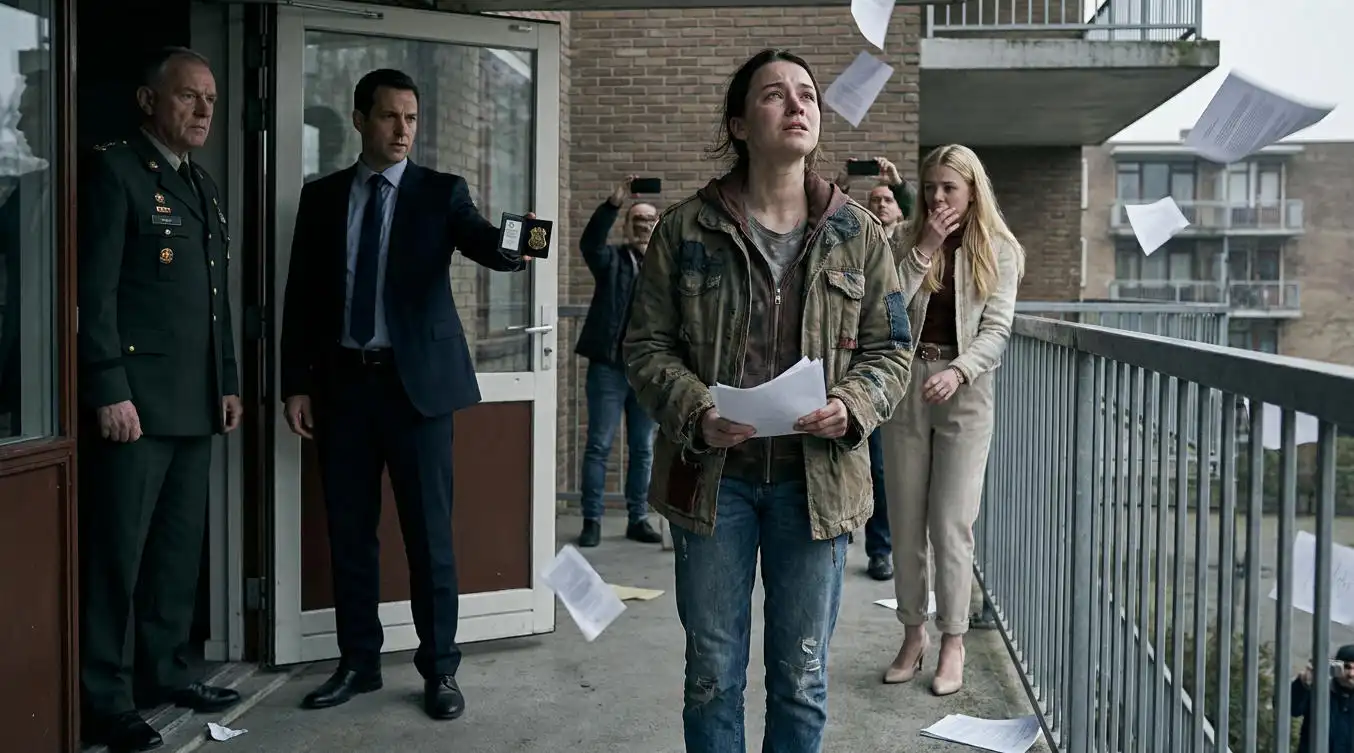
Kennedy’s hand was still twisted in the torn shoulder of my jacket. Her rings had snagged the fabric when she yanked me into the corner of the fifth-floor balcony. The slap marks on my face were still burning.
Behind her, students had gathered in a tight half-circle.
Some were filming.
Some were whispering.
Most were doing what people always did when Kennedy Mercer wanted blood.
They watched.
They waited.
They pretended they were helpless.
Kennedy turned slowly toward the balcony door.
Her two friends, Madison and Brooke, had been blocking it with their backs. They moved away as if the handle itself had burned them.
The door opened.
My father stepped through first.
Major Daniel Hayes.
To Kennedy, he probably looked like just another military dad at first glance.
Tall.
Broad shoulders.
Hard eyes.
A dark uniform coat moving in the wind.
But I knew the difference between my father walking into a room and my father entering a threat zone.
This was the second one.
His eyes found me immediately.
My torn jacket.
My scattered books.
The red marks on my cheek.
My hands shaking around the small metal challenge coin he had given me when I was twelve.
For half a second, his face broke.
Just half a second.
Then it closed again.
Behind him came four members of his military security detail and two adults in dark suits.
One of the suited adults was a woman with gray hair pinned neatly behind her ears. She held a leather folder against her chest and looked at the balcony like she had already decided every person on it was going to answer for something.
Kennedy tried to recover.
She lifted her chin.
“Who are you people?” she snapped. “You can’t just come into my school.”
My father didn’t look at her.
He looked at the hand still gripping my jacket.
“Let go of my daughter.”
Kennedy’s fingers opened.
Not because she became decent.
Because something in my father’s voice made her body obey before her pride could argue.
The wind dragged loose notebook pages around our shoes.
One page slapped against Kennedy’s ankle.
It was part of my scholarship essay.
The one she had ripped in the hallway that morning.
The one I had worked on for six weeks.
Kennedy kicked it away like it was dirty.
Then she laughed once.
A sharp, fake sound.
“Your daughter?” she said. “That’s cute. Maybe you should teach her not to act like she belongs where she doesn’t.”
A few kids gasped.
My father finally turned his head toward her.
Kennedy’s smile weakened.
She was used to adults who needed her mother’s approval.
Teachers who glanced at her last name and suddenly forgot the rules.
Counselors who said, “Maybe both girls should apologize.”
Security guards who looked away because Vice Principal Mercer handled their schedules.
But my father did not work for Kennedy’s mother.
And he did not look away.
“Grace,” he said quietly, “come here.”
My legs didn’t move at first.
I hated that.
I hated that after everything Kennedy had done, my body still asked permission from fear.
Then the gray-haired woman stepped toward me and said softly, “You’re safe now, sweetheart.”
Something in me loosened.
I walked past Kennedy.
She didn’t touch me again.
My father removed his uniform coat and wrapped it around my shoulders. It was too heavy, warm from him, and smelled faintly of cold air and cedar.
The second it covered my torn jacket, I almost cried.
Not because I was weak.
Because I had spent all day trying not to be.
Kennedy noticed.
“Oh my God,” she scoffed. “Are we doing a whole hero scene now? She’s not injured. She’s dramatic.”
My father’s jaw tightened.
But the gray-haired woman turned first.
“Miss Mercer,” she said, “I would strongly advise you to stop talking.”
Kennedy blinked.
“Excuse me?”
The woman opened the leather folder.
“My name is Elaine Porter. Senior compliance officer, State Department of Education. I am here regarding a formal investigation into administrative misconduct, retaliation, falsified disciplinary records, and failure to protect a student after repeated written complaints.”
The balcony went silent.
Even the students holding phones lowered them a little.
Kennedy looked confused for one second.
Then annoyed.
“My mom is the vice principal,” she said. “So you can go talk to her downstairs.”
Elaine Porter gave her the kind of look church ladies give when a child curses during Sunday service.
“We have.”
That was when footsteps thundered behind us.
Vice Principal Linda Mercer burst through the stairwell door in a cream blazer and heels that clicked fast across the concrete.
Her hair was perfect.
Her face was furious.
She didn’t look at me first.
She looked at the phones.
“Put those away!” she barked. “All of you! This is a private student matter!”
A boy named Ethan whispered, “Private? We’re outside.”
Kennedy snapped, “Shut up, Ethan.”
Vice Principal Mercer pushed through the crowd and grabbed her daughter’s arm.
“Kennedy, what happened?”
Kennedy pointed at me immediately.
“She threatened me.”
The lie came out smooth.
Practiced.
“She’s been acting unstable all day,” Kennedy said. “She followed me up here. She started crying and trying to make a scene.”
Madison nodded too quickly.
“Yeah. Grace was being weird.”
Brooke added, “Kennedy was just trying to calm her down.”
I stared at them.
My face hurt.
My books were destroyed.
My jacket was torn.
And still, they lied with the confidence of people who had never paid for a single lie in their lives.
Vice Principal Mercer turned toward my father.
“Sir, I don’t know what you think you’re doing, but this is a school matter. You cannot storm onto campus with—”
She stopped.
Because Elaine Porter held up her badge.
“Mrs. Mercer, we need to speak with you.”
Vice Principal Mercer’s mouth opened.
Then closed.
Then opened again.
“With me?”
“Yes.”
“This is outrageous,” she said, but her voice had lost some of its polish. “I’m the vice principal of this building.”
Elaine Porter nodded.
“That is precisely the problem.”
Kennedy’s face went red.
“Mom, make them leave.”
My father looked down at me.
“Grace, do you want to speak here, or downstairs?”
Before I could answer, Vice Principal Mercer cut in.
“She doesn’t need to speak at all. Grace has a long history of emotional overreaction.”
That sentence did something to me.
It didn’t make me cry.
It made me still.
Because those were the exact words she had written on my first complaint.
Emotional overreaction.
That was how she described Kennedy ripping my chemistry notes.
That was how she described Kennedy dumping my lunch tray in front of the cafeteria.
That was how she described Kennedy telling everyone my father had “probably dumped me in boarding school because I was annoying.”
Every complaint became a character flaw.
Every bruise became an accident.
Every witness became “unavailable.”
Every meeting ended with Vice Principal Mercer smiling over her desk and saying, “Grace, you need to learn resilience.”
So I looked at her.
And for the first time all year, I answered loudly enough for everyone to hear.
“I’ll speak here.”
The balcony shifted.
Phones came back up.
Vice Principal Mercer noticed and snapped, “Recording students without consent is against school policy.”
Elaine Porter didn’t even blink.
“Public area. Active incident. Administrative staff present. Continue if you wish.”
A ripple moved through the students.
Kennedy whispered, “Mom?”
Vice Principal Mercer’s face tightened.
I took a breath.
My father’s coat hung over my shoulders like armor.
“This morning,” I said, “Kennedy and her friends shoved me in the main hallway. They ripped my books and threw my notes down the stairwell.”
“That’s a lie,” Kennedy said.
I kept going.
“She called me a charity case. She said my future fell five floors.”
A few students murmured.
Someone behind me said, “She did say that.”
Kennedy spun.
“Shut your mouth.”
I looked at Madison.
“Then at lunch, Kennedy told me to come to the balcony or she’d send a video to the scholarship committee saying I started a fight.”
Madison’s eyes flickered.
Brooke stared at the ground.
Vice Principal Mercer raised her hand.
“That is speculation.”
Elaine Porter turned one page in her folder.
“It is not.”
Vice Principal Mercer went pale.
Kennedy looked at her mother.
“What does that mean?”
Elaine Porter removed several printed pages.
“Grace has submitted seventeen written complaints over eleven months. Twelve were marked resolved by your office with no interviews conducted. Four were altered after submission. One disappeared from the student portal entirely.”
The students went quiet.
Kennedy whispered, “Mom?”
Vice Principal Mercer’s smile returned, but it looked painted on.
“Administrative systems are complicated. Students often misunderstand what they file.”
Elaine Porter looked at me.
“Grace, did you keep copies?”
I nodded.
From inside my torn backpack, I pulled out a small plastic folder.
It was bent.
One corner was muddy from when Kennedy had shoved it onto the floor.
But it was intact.
I handed it to Elaine.
Kennedy stared at it like it was a snake.
For months, I had been silent because silence was the only thing that kept me from falling apart.
But silence didn’t mean I had done nothing.
I had kept screenshots.
Emails.
Dates.
Names.
Photos of torn pages.
Pictures of bruises on my wrists from when Kennedy’s friends blocked me in the library.
A voice memo of Kennedy laughing in the stairwell and saying, “My mom can make your scholarship disappear.”
I never posted any of it.
I never threatened anyone.
I just kept it.
Because my father had taught me something when I was little.
“Don’t fight every battle in the mud,” he used to say. “Sometimes you document, wait, and let the truth walk in wearing clean shoes.”
Elaine looked through the folder.
Then she passed one page to the man beside her.
He read it and looked directly at Vice Principal Mercer.
“Mrs. Mercer,” he said, “why did your office classify repeated physical harassment as ‘peer adjustment conflict’?”
Vice Principal Mercer swallowed.
“That is standard language.”
“No,” he said. “It is minimizing language.”
Kennedy’s friends began backing away.
Madison whispered, “I didn’t do anything.”
Brooke whispered back, “You literally helped block the door.”
Kennedy heard her.
Her head snapped toward Brooke.
“Don’t be stupid.”
That was when the helicopter sound grew louder overhead.
Not dramatic.
Not like a movie.
Just enough to remind everyone that my father had not come alone.
A school resource officer stepped through the door next, followed by Principal Howard, who looked like a man realizing his retirement plan had caught fire.
“Everyone needs to calm down,” Principal Howard said.
Elaine Porter turned to him.
“Principal Howard, were you aware of the complaints?”
His lips parted.
“Well, I receive many reports—”
“Were you aware,” she repeated, “that Grace Hayes had filed seventeen complaints?”
He glanced at Vice Principal Mercer.
That glance said everything.
The balcony saw it.
The phones caught it.
My father’s hand rested gently between my shoulders.
Not pushing.
Just reminding me I was not alone.
Kennedy tried one last time.
She pointed at me.
“She’s doing this because she’s jealous. Everyone knows she’s weird. She sits alone reading like she’s better than us.”
I almost laughed.
That was the charge.
I read books.
I kept to myself.
I tried to survive high school quietly.
And that offended Kennedy so much she needed to destroy me in public.
Elaine Porter closed the folder.
“Miss Mercer, we have video from the hallway, student statements, timestamped complaint records, and audio provided by Grace. We also have campus security footage from this balcony entrance showing your friends preventing her from leaving.”
Kennedy’s mouth opened.
No sound came out.
Vice Principal Mercer stepped forward.
“My daughter is a minor student under my protection.”
“She is eighteen,” Elaine said. “And so is Grace.”
That landed hard.
Kennedy had always used the school like a castle.
Her mother was the gate.
Her last name was the key.
But today, the gate had opened from the outside.
Principal Howard lifted both hands.
“Perhaps we should discuss this privately.”
Elaine’s voice turned cold.
“No. The harm was public. The first safety response will be public.”
A girl near the back whispered, “Finally.”
Vice Principal Mercer spun toward the students.
“Any student who shares video of this will face disciplinary action.”
My father spoke then.
Just one sentence.
“No student will be punished for documenting misconduct.”
Vice Principal Mercer looked at him like she wanted to slap him too.
“You have no authority here.”
The man beside Elaine reached into his coat and removed another badge.
“Actually, Major Hayes is here as Grace’s parent. We are here as the state authority. And your district superintendent is downstairs with legal counsel.”
For the first time, Vice Principal Mercer looked truly afraid.
Kennedy grabbed her mother’s sleeve.
“Mom, fix this.”
But there was nothing to fix.
Not anymore.
Because the machine her mother had used to protect her was now the thing turning toward them.
Elaine Porter read from a printed notice.
“Linda Mercer, effective immediately, you are placed on administrative leave pending termination proceedings. Your access to student records is suspended. You are prohibited from contacting Grace Hayes or any witnesses related to this investigation.”
Vice Principal Mercer’s face drained.
“You can’t suspend me on a balcony.”
Elaine looked around.
“Would you prefer the cafeteria?”
Someone snorted.
Kennedy screamed, “You can’t do this to my mom!”
My father’s eyes moved to her.
“You did this to your mother when you counted on her corruption to protect your cruelty.”
That silenced her.
Not completely.
But enough.
Kennedy looked from face to face, searching for her usual audience.
Madison looked away.
Brooke cried quietly.
Ethan kept filming.
The girl who had laughed in the hallway now looked sick.
Public power only works when the public still believes in it.
Kennedy’s had collapsed.
The school resource officer stepped forward.
“Miss Mercer, we need you to come with us to the office.”
Kennedy backed up.
“No.”
Vice Principal Mercer grabbed her arm.
“Kennedy, stop.”
“No!” Kennedy shouted. “You said nothing would happen! You said she was nobody!”
The balcony went dead quiet.
There it was.
The truth, ugly and simple.
You said she was nobody.
Vice Principal Mercer’s face twisted.
“Kennedy.”
But Kennedy was crying now, shaking so hard her voice cracked.
“You told me her dad was never around. You told me scholarship kids don’t have lawyers. You told me she’d be too scared.”
Every word fell like a stone.
Elaine Porter looked at Principal Howard.
He closed his eyes.
My father’s hand tightened slightly on my shoulder.
Not in anger.
In grief.
Because there are things a parent can protect you from.
And things they can only arrive after.
Kennedy suddenly dropped her proud act.
She looked at me.
Really looked at me.
Not like an object.
Not like a target.
Like a person holding proof.
“Grace,” she said, her voice thin. “Tell them it wasn’t that serious.”
I stared at her.
My cheek still burned.
My jacket was ripped under my father’s coat.
My notebooks were gone.
My scholarship essay was scattered over the balcony and down five flights of stairs.
For months, I had eaten lunch in bathroom stalls so she wouldn’t find me.
For months, I had checked corners before walking into hallways.
For months, adults told me to be mature, forgiving, resilient.
Now Kennedy wanted mercy because accountability had finally learned her address.
I said, “It was serious when it happened to me.”
Kennedy covered her mouth.
Then her knees gave out.
She sank to the concrete, sobbing.
There was no cheering.
Not at first.
Because justice, when it finally arrives, doesn’t always feel like fireworks.
Sometimes it feels like everyone realizing how long they watched someone drown.
The school resource officer helped Kennedy stand.
Madison and Brooke were escorted separately.
Vice Principal Mercer tried to follow her daughter, but Elaine stopped her.
“You will speak with investigators downstairs.”
“My daughter needs me.”
“Grace needed adults too,” Elaine said.
Vice Principal Mercer had no answer.
That was the moment I finally cried.
Not loudly.
Not dramatically.
Just one breath that broke apart.
My father turned me into his chest and held me like I was six years old again, scraped knee and all.
“I’m sorry,” he whispered.
I shook my head.
“You came.”
His voice cracked.
“I should have known sooner.”
I pulled back.
“I didn’t tell you everything.”
“I know.”
“I thought I could handle it.”
“You shouldn’t have had to.”
That sentence did more for me than any punishment ever could.
Because all year, adults had asked me what I could have done differently.
Why didn’t I avoid Kennedy?
Why didn’t I use another hallway?
Why didn’t I stop being so sensitive?
Why didn’t I try harder to fit in?
My father was the first one to say the truth plainly.
I shouldn’t have had to.
Downstairs, the school was chaos.
Students lined the hallway, whispering as Kennedy and her friends were taken to separate offices.
Teachers stood frozen in doorways.
The superintendent had arrived in a navy suit, face tight with damage control.
He tried to shake my father’s hand.
My father did not take it.
“Talk to my daughter,” he said.
The superintendent turned to me.
“Grace, on behalf of the district—”
Elaine interrupted.
“Careful.”
He swallowed.
“On behalf of the district, I am sorry. We failed to protect you.”
It was the first real apology I had heard from that school.
No “if.”
No “misunderstanding.”
No “both sides.”
Just failed.
By the end of the day, the facts were no longer rumors.
Vice Principal Mercer had changed complaint classifications to avoid triggering mandatory district review.
She had deleted one of my reports because it named Kennedy directly.
She had pressured two teachers not to provide written statements.
She had told the scholarship coordinator that I was “socially unstable,” even though my grades were near perfect.
Kennedy and her friends had used that protection like a weapon.
They chose hallways without cameras when they could.
They used group chats to plan who would block doors.
They laughed about which teachers were “too tired to care.”
But they had made one mistake.
They thought quiet meant empty.
Quiet had screenshots.
Quiet had dates.
Quiet had backups.
Quiet had a father who served his country and taught his daughter that rules matter most when powerful people think they don’t apply to them.
Within a week, Vice Principal Mercer was formally terminated.
Not resigned.
Not “moved to another role.”
Terminated.
The district referred the records issue for investigation. The scholarship committee received the full evidence packet and issued a written confirmation that my scholarship was secure.
Principal Howard retired early.
Two teachers submitted statements admitting they had been discouraged from reporting what they saw.
Kennedy was expelled after the disciplinary hearing.
Madison and Brooke were suspended and required to complete restorative accountability agreements before they could return to any district school.
Their parents were furious at first.
Not at what their daughters had done.
At being embarrassed.
But embarrassment has a strange way of teaching lessons money never could.
The videos spread through town before the district could contain them.
Not the slap.
Not the worst parts.
The moment everyone shared was Kennedy saying, “You said she was nobody.”
That sentence became the whole story.
Church ladies talked about it at Sunday coffee.
Veterans groups sent letters to the school board.
Parents packed the next district meeting until people were standing along the walls.
One father stood up and said, “If a quiet kid has to become a detective just to be safe at school, every adult in that building has failed.”
People applauded for nearly a minute.
I didn’t attend that meeting.
I watched it from home in my father’s coat, curled on the couch with hot tea.
For three nights after the balcony, I woke up thinking I heard Kennedy laughing.
For three mornings, I opened my backpack and remembered my notes were gone.
Healing didn’t happen the second the villain fell.
That’s not how real life works.
But something had shifted.
The fear was no longer sitting on my chest.
The shame had moved.
It belonged where it should have belonged all along.
On them.
Two weeks later, my father took me back to the school after hours to clean out my locker.
I thought I’d be afraid.
I was.
But less than I expected.
The hallway looked smaller without Kennedy in it.
My locker still had tape marks from where someone had once stuck a note that said “charity ghost.”
I peeled them off slowly.
Inside, I found one book Kennedy hadn’t destroyed.
A worn paperback I used to read on the balcony.
My father picked it up.
“This the one?”
I nodded.
“I used to go up there because it was quiet.”
He looked toward the stairwell.
“Do you want to see it again?”
Every part of me wanted to say no.
But I said yes.
We walked up five flights.
The open-air balcony was empty.
No phones.
No laughter.
No Kennedy.
Just wind moving across the concrete.
Someone had repaired the door handle. The wall had been cleaned. My torn notebook pages were gone.
But near the corner where I had stood, someone had placed a small paper flower made from folded notebook paper.
I picked it up.
On one petal, written in blue pen, were the words:
“We should have helped. I’m sorry.”
I don’t know who left it.
Maybe Ethan.
Maybe the girl who laughed.
Maybe someone who had watched and felt ashamed.
I kept it.
Not because apology erases harm.
It doesn’t.
But because sometimes the world gives you a small sign that not everyone stayed the same.
My father stood beside me at the railing.
Across the street, the glass building reflected the afternoon sun.
A tiny flash blinked back.
I smiled.
Not because of fear.
Because this time, I knew exactly what was there.
Nothing magical.
No revenge fantasy.
Just a city.
A reflection.
And the memory of the moment Kennedy realized the girl she called nobody had never been alone.
A month later, I transferred to a smaller school across town.
On my first day, I sat on a bench outside with a book in my lap.
A girl with curly brown hair walked over and said, “Is anyone sitting here?”
I froze out of habit.
Then I looked up.
She smiled.
Not cruelly.
Just normally.
“No,” I said. “You can sit.”
She noticed the challenge coin attached to my keychain.
“My brother has one of those,” she said. “Army?”
“My dad.”
“That’s cool.”
And that was it.
No sneer.
No joke.
No punishment for existing.
Just a conversation.
That afternoon, my father picked me up at the curb.
“How was it?” he asked.
I looked back at the school.
Students were laughing near the entrance.
A teacher held the door for someone carrying too many books.
The air felt different.
Not perfect.
Safe enough.
“I think I’m going to be okay,” I said.
My father nodded once, but his eyes shone.
“That’s all I needed to hear.”
Before we drove away, he reached into the back seat and handed me something folded in clear plastic.
A new jacket.
Navy blue.
On the inside, stitched small near the collar, were three words:
Never nobody. Ever.
I pressed my fingers over the letters.
For the first time in a long time, I didn’t feel like the quiet girl everyone forgot.
I felt like Grace Hayes.
A daughter.
A survivor.
A student with a future Kennedy failed to tear up.
And yes, Kennedy lost her throne.
Her mother lost her title.
Their family name stopped opening doors and started closing them.
But the best part wasn’t watching them fall.
The best part was walking away without becoming like them.
Because justice is not cruelty.
Justice is the truth finally standing where fear used to stand.
So choose a side:
Was Grace right to stay quiet, collect proof, and let the system crush the people who protected Kennedy?
Or should she have fought back sooner in front of everyone?
Share this with someone who still believes quiet people are weak. ⚖️
Disclaimer: Mention of any brand or trademark is for identification only and does not imply partnership or endorsement
A Rich Polo Player Tore A Hardware Store Owner’s Jacket In Front Of Everyone… Minutes Later, He Was Begging On The Grass
A Round-Bellied Carpenter Was Humiliated by an Elite Ski Coach in Front of Rich Guests… But Sven Had NO IDEA Who Bob Really Was 😳
Parents Covered Their Noses When the “Cheap Mom” Walked In… Minutes Later, the PTA Queen Was on Her Knees Begging 😮