



The man by the window didn’t speak at first.
That was what scared Mackenzie.
Not the black suits.
Not the sealed legal folder.
Not even the principal standing frozen behind his desk like he had forgotten how to breathe.
It was the silence.
Because rich people at Westbridge Academy were never silent unless money was moving.
And in that room, money had just entered like a storm.
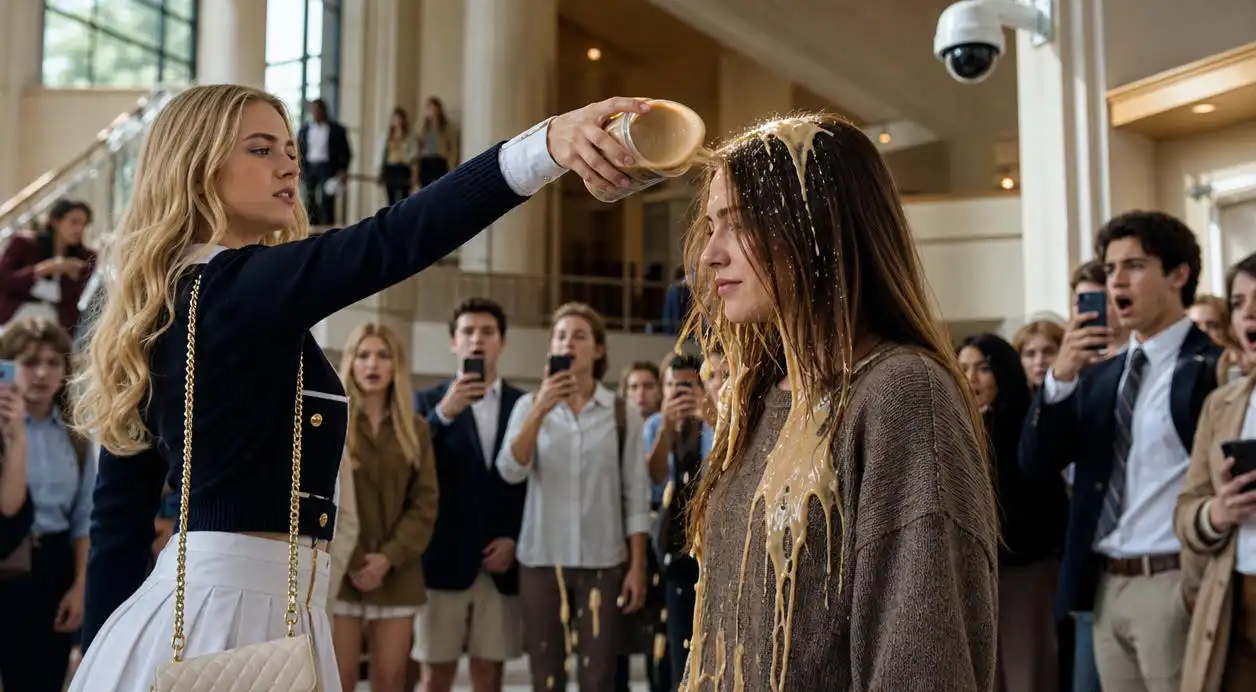
I stood in the doorway with coffee drying on my thrift-store sweater.
My cheek still burned from Mackenzie’s slap.
Behind me, Mackenzie laughed one last time, sharp and fake.
“Oh my God,” she said. “Is this a meeting about scholarship behavior? Because I warned everyone she was unstable.”
Nobody laughed with her.
The principal, Dr. Whitmore, looked like he wanted to disappear into the floor.
“Mackenzie,” he said quietly, “please sit down.”
She tossed her hair over her shoulder.
“I don’t sit for disciplinary theater,” she said. “My father is on the donor council.”
The man by the window finally turned around.
He was tall, gray-haired, perfectly dressed, and terrifying in the quiet way only old money can be terrifying.
His name was Victor Bellini.
To newspapers, he was a private equity king.
To banks, he was the man who could move a county’s economy with one signature.
To my family, he was Uncle Vic.
And to people who liked whispering, he was called “the Godfather of the state economy.”
Not because he was a criminal.
Because nobody crossed him twice.
He looked at my stained sweater.
Then my red cheek.
Then Mackenzie.
“Who did that to her?” he asked.
The room went colder.
Mackenzie blinked.
“Excuse me?”
He didn’t raise his voice.
He didn’t need to.
“I asked who put their hands on my niece.”
My niece.
Two words.
That was all it took.
Mackenzie’s face changed.
Just a flicker.
A tiny crack in the mask.
“What?” she said.
I could hear the students downstairs through the glass walls outside the office level. The whole school had followed the drama as far as security would allow. Dozens of them stood below in the atrium, craning their necks, phones still out, waiting to see if the “poor transfer girl” was about to be expelled.
That had been the plan.
Mackenzie’s plan.
Public humiliation first.
Administrative punishment second.
Social death by lunch.
That was how Westbridge worked.
I had learned it in three days.
Westbridge Academy was the kind of school where teenagers drove cars that cost more than most houses in my old neighborhood. The cafeteria had marble counters. The lockers had custom nameplates. The parents didn’t ask what clubs you joined. They asked which senator came to your fundraiser.
I arrived on a Tuesday morning wearing a gray sweater from a thrift store, black jeans, and boots with a scuffed heel.
That was enough.
By second period, someone had taken a picture of me walking past the fountain and posted it to a private student group.
“New charity case just dropped.”
By lunch, they knew my name.
By Wednesday, they knew I had transferred from a public school two counties over.
By Thursday, Mackenzie Vale had decided I needed to be taught my place.
Mackenzie was Westbridge royalty.
Her mother chaired the gala committee.
Her father, Preston Vale, owned hotels, construction contracts, restaurants, and a chain of medical office buildings. Their family name was printed on the performing arts center.
Mackenzie moved through school like she owned the oxygen.
People stepped aside before she reached them.
Teachers softened their voices around her.
Even the principal smiled too hard when she walked into a room.
The first time she spoke to me, she didn’t say hello.
She looked at my sweater and said, “Vintage or homeless?”
Her friends laughed.
I said nothing.
That disappointed her.
Bullies hate silence.
They want tears.
They want begging.
They want a scene they can edit and post.
The next day, she tried again.
In history class, she leaned over and whispered, “You know financial aid doesn’t make you equal, right?”
I kept taking notes.
At lunch, she knocked my tray with her hip and watched my apple roll across the floor.
“Oops,” she said. “Gravity hates poor people too.”
Still, I said nothing.
Because I wasn’t at Westbridge to win a popularity contest.
I was there for one reason.
My grandfather had built the original scholarship trust that kept Westbridge alive during the recession fifteen years earlier. The trust had one special clause almost nobody remembered.
Any family receiving major institutional benefit from Bellini-controlled funds had to maintain a strict anti-harassment compliance standard.
No exceptions.
No “donor child” loophole.
No quiet settlements.
No private apology over brunch.
If a student or parent used influence to cover up harassment, assault, financial intimidation, or retaliation, every connected benefit could be suspended pending review.
And the Vale family had a lot connected to that trust.
Their newest hotel expansion loan.
Their medical building refinance.
Their private school donor reputation.
Their city development partnership.
All of it leaned on financing tied to my uncle’s network.
I knew that before I ever stepped onto campus.
Uncle Vic knew too.
That was the point.
He didn’t send me to Westbridge as bait.
He sent me because my mother wanted me to finish senior year somewhere safe after my old school closed its advanced program.
But he warned me.
“Some people mistake kindness for weakness,” he told me the night before my first day. “Let them talk. Let them show you who they are. Don’t fight in the mud. Document.”
So I documented.
Screenshots.
Voice recordings where allowed.
Emails.
Witness names.
Security camera locations.
Dates.
Times.
Names of teachers who saw things and turned away.
I kept everything in a folder on my phone labeled chemistry notes.
By Friday morning, Mackenzie was bored with whispers.
She wanted a crowd.
And Westbridge gave her one.
It happened in the main atrium right before first bell.
Sunlight poured through the glass ceiling.
Students gathered near the coffee bar.
The principal was walking a donor couple through the lobby.
Everyone important was visible.
That was why Mackenzie chose that moment.
She came toward me holding a caramel latte.
Her friends followed like backup dancers.
“Isabella,” she said loudly, “we’ve been meaning to help you.”
I stopped by the fountain.
“Help me with what?”
She smiled.
“Presentation.”
A few students snickered.
Mackenzie looked me up and down.
“You can’t just walk into a place like Westbridge looking like a garage sale and expect people to respect you.”
I heard a boy whistle.
Another student lifted his phone.
Someone whispered, “This is going to be good.”
I could have walked away.
I almost did.
But then Mackenzie stepped closer and lowered her voice just enough for me to hear.
“My dad says your kind only gets in because rich people need tax write-offs.”
That one landed.
Not because it was clever.
Because it was exactly the kind of cruelty adults pretend their children don’t learn from them.
I looked past her.
At the camera above the atrium.
At the principal pretending not to see.
At three teachers standing near the coffee bar, watching.
Mackenzie noticed where I was looking.
She smirked.
“Oh, don’t worry,” she said. “The cameras never matter when your parents donate enough.”
Then she tipped the latte.
Hot coffee hit my chest.
My breath caught.
The heat spread fast through the sweater, sharp and humiliating.
The atrium exploded.
“Yo!”
“No way!”
“Film it!”
Mackenzie laughed.
“Oops,” she said. “Maybe next time you’ll remember poor girls don’t belong at Westbridge.”
Then she slapped me.
Once.
My head turned.
The room gasped.
Then she slapped me again.
Harder.
Her ring scratched my cheek.
And that was the moment something inside me went completely still.
Not numb.
Not weak.
Still.
I wiped coffee from my chin.
Mackenzie leaned close.
“My father owns half this city,” she whispered. “The principal eats lunch at our house. So go ahead. Cry.”
I looked at her.
Then at the camera.
Then back at her.
And I smiled.
“What are you smiling at?” she snapped.
“Nothing,” I said. “Just waiting.”
The principal finally rushed over, but not to protect me.
“Girls,” he said, voice tight, “let’s not make this dramatic.”
Mackenzie pointed at me.
“She threatened me.”
I almost laughed.
“With what?” I asked. “A wet sweater?”
Her friends started talking at once.
“She shoved Mackenzie first.”
“She was acting crazy.”
“She came at her.”
“She spilled the drink on herself.”
That was the part that hurt more than the slap.
Not the lies.
The speed of them.
Like they had rehearsed.
Dr. Whitmore looked at me and said, “Isabella, come with me.”
Not Mackenzie.
Me.
The crowd murmured.
Mackenzie smiled like a queen watching a servant dragged away.
But before I moved, the principal’s assistant, Mrs. Lane, came running across the atrium.
She was pale.
Not nervous.
Pale.
“Dr. Whitmore,” she said, “you need to come upstairs immediately.”
He frowned. “I’m handling a student matter.”
“No,” she said. “Sir, Mr. Bellini is in your office.”
That name hit the air like a dropped glass.
Dr. Whitmore’s mouth opened.
Mackenzie’s smile faltered.
I saw one teacher look straight at me for the first time all week.
Mrs. Lane turned to me.
“Isabella,” she said, voice shaking. “He asked for you too.”
Mackenzie burst out laughing because she still didn’t understand.
“Oh good,” she said. “Bring her up and expel her properly.”
So we went upstairs.
Me.
Mackenzie.
Dr. Whitmore.
Two security guards.
And about two hundred students watching from below.
When the elevator doors opened, Uncle Vic was already inside the office with three attorneys, the head of campus security, and a woman from the trustee board.
A sealed folder sat on the desk.
A laptop was open to the atrium camera feed.
My coffee-soaked sweater was still steaming faintly in the cold office air.
Uncle Vic looked at me, and for half a second, he wasn’t a financier.
He was my mother’s older brother.
The man who taught me to ride a bike.
The man who showed up after my father died and never missed a birthday.
His jaw tightened.
“Are you burned?” he asked.
“I’m okay,” I said.
“You’re not okay,” he replied.
Mackenzie scoffed.
“This is ridiculous. She’s exaggerating.”
One of the attorneys turned the laptop around.
The video was paused on Mackenzie’s hand striking my face.
Perfect angle.
Clear audio.
Full crowd.
Mackenzie stopped breathing for a second.
Dr. Whitmore whispered, “Oh my God.”
Uncle Vic looked at him.
“You saw this happening downstairs.”
The principal swallowed.
“I was trying to de-escalate.”
“No,” the trustee board member said. “You were trying to protect a donor family.”
Mackenzie snapped, “You people have no idea who my father is.”
Uncle Vic’s eyes moved to her.
“That is the first true thing you’ve said today,” he said. “Because you clearly have no idea who she is.”
Mackenzie’s face twisted.
“She’s a scholarship transfer.”
“No,” he said. “She is Isabella Bellini-Grace. Beneficiary of the Bellini Education Trust. My niece. And the reason your family’s financing review started thirty minutes ago.”
The room went silent.
Then Mackenzie laughed.
Not because it was funny.
Because her brain refused to accept it.
“Bellini?” she said. “No. No, she’s lying. Look at her clothes.”
I finally spoke.
“My clothes are mine,” I said. “Your character is yours.”
That landed harder than I expected.
Even one of the security guards looked down to hide a smile.
Mackenzie’s phone buzzed.
Then buzzed again.
Then again.
She looked at the screen.
Her face drained.
“Why is my mom calling?”
Uncle Vic gave a small nod to one attorney.
The attorney opened the sealed folder and removed several documents.
“Emergency board notice,” she said. “Formal harassment complaint. Assault report. Retaliation risk filing. Financial compliance suspension notice.”
Dr. Whitmore gripped the back of his chair.
“Suspension notice?”
The attorney didn’t look at him.
“Yes. Effective immediately, all pending Bellini-linked credit support connected to Vale Holdings is under review due to potential reputational fraud, institutional influence abuse, and undisclosed conduct risks.”
Mackenzie shook her head.
“You can’t do that because I spilled coffee.”
I stepped closer.
“You didn’t spill coffee. You assaulted me in front of cameras, then you and your friends lied about it, while the principal tried to blame me.”
Her eyes flashed.
“You think anyone will believe you over me?”
The attorney pressed play.
My own voice came through the laptop speaker.
Calm.
Clear.
“What are you smiling at?” Mackenzie’s recorded voice snapped.
“Nothing,” my recorded voice said. “Just waiting.”
Then her whisper came through.
“My father owns half this city. The principal eats lunch at our house. So go ahead. Cry.”
Nobody moved.
That was the sound of a spoiled empire cracking.
Dr. Whitmore put a hand over his mouth.
Mackenzie whispered, “That’s illegal. You recorded me.”
The attorney answered smoothly.
“Not in this hallway, under these circumstances, with posted campus recording notices and school security audio policies. And even if you want to contest the phone recording, the school’s own system captured enough.”
Uncle Vic walked to the desk.
“Call her parents.”
Dr. Whitmore looked up.
“Now?”
“Now.”
Mackenzie’s phone buzzed again.
She answered before the principal could move.
“Mom? What is happening?”
I couldn’t hear her mother’s words clearly.
But I heard the panic.
Mackenzie’s expression collapsed piece by piece.
“What do you mean frozen?”
She turned away.
“No, Daddy can fix it.”
A pause.
“What emergency injunction?”
Another pause.
“What do you mean the bank pulled the review?”
Uncle Vic did not smile.
That mattered.
This wasn’t revenge for entertainment.
It was consequence.
The kind that comes slowly for most people but instantly for those who build their lives on signatures, leverage, and reputation.
Downstairs, the students were still filming.
Someone must have posted that Mackenzie Vale was in the principal’s office with “some billionaire guy.”
Rumors moved faster than fire.
A security guard stepped into the office.
“Sir,” he said to Dr. Whitmore, “Mr. and Mrs. Vale are downstairs.”
Mackenzie spun around.
“Finally.”
She wiped her face fast, rebuilding the spoiled-princess mask.
“My parents are going to end this.”
Uncle Vic looked at the attorney.
“Let them in.”
Preston Vale entered first.
He was a broad man in a navy suit, red-faced and furious. His wife, Caroline, followed in pearls, gripping her handbag like a weapon.
“What the hell is going on?” Preston barked.
Then he saw Uncle Vic.
The anger died immediately.
Not faded.
Died.
“Victor,” he said.
Uncle Vic nodded once.
“Preston.”
Caroline looked at me, then at Mackenzie.
“Mackenzie, what did you do?”
That question told me everything.
Not “What happened?”
Not “Are you okay?”
“What did you do?”
Mackenzie started crying instantly.
“She set me up!”
Preston pointed at me.
“This girl?”
Uncle Vic’s voice cut through the room.
“My niece.”
Preston froze.
Caroline closed her eyes.
Just once.
Like she had been expecting disaster for years and it had finally arrived wearing a coffee-stained sweater.
The attorney handed Preston the first document.
He scanned it.
His hand trembled.
“This is excessive,” he said. “They’re kids.”
“She is eighteen,” Uncle Vic said. “Old enough to sign a statement. Old enough to commit assault. Old enough to understand consequences.”
Mackenzie screamed, “She was dressed like trash! How was I supposed to know?”
That was the sentence that finished her.
Not legally.
Morally.
Every adult in the room heard it.
The trustee board member straightened.
Dr. Whitmore looked physically sick.
Her mother whispered, “Mackenzie…”
But Mackenzie was too far gone.
“She tricked us!” she cried. “She came here looking poor on purpose!”
I looked at her and finally said the thing I had held in all week.
“You didn’t hurt me because you thought I was poor. You hurt me because you thought poor people were safe to hurt.”
Nobody spoke after that.
Not for a long moment.
Then Uncle Vic placed another paper on the desk.
“Dr. Whitmore,” he said, “the board has been notified of your failure to follow mandatory reporting procedures. You will be placed on administrative leave pending investigation.”
The principal looked like the floor had opened beneath him.
“I have served this school for eighteen years.”
“And today you served money instead of a student,” Uncle Vic said.
The trustee member nodded to campus security.
“Dr. Whitmore, please surrender your access badge.”
His hand shook as he removed it.
Mackenzie stared.
This was the first time she understood the shield around her was not made of steel.
It was made of people choosing to look away.
And now those people were protecting themselves.
Preston tried one last move.
“Victor,” he said quietly, “let’s speak privately. Man to man.”
Uncle Vic’s eyes hardened.
“You don’t get privacy after your daughter chose an audience.”
That sentence traveled.
The office door was open.
The assistant heard it.
Security heard it.
Students beyond the glass heard enough to know something historic was happening.
Preston lowered his voice.
“We can make this right.”
“You can start by admitting what your family did.”
“She’s a teenager.”
“She learned it somewhere.”
Caroline flinched.
Preston’s face turned red again.
“Careful.”
Uncle Vic stepped closer.
“No, Preston. You be careful. Your daughter assaulted my niece. Your school contact attempted to bury it. Your family benefited from influence while hiding a pattern of complaints.”
Pattern.
That word changed the room again.
I hadn’t known that part.
Mackenzie did.
I saw it in her eyes.
The attorney opened a second folder.
“Three prior complaints,” she said. “Two withdrawn after parent meetings. One student transferred mid-semester. All involved alleged harassment by Mackenzie Vale or her friend group. All were classified as ‘peer misunderstanding’ by this office.”
The trustee board member looked at Dr. Whitmore.
His face went gray.
I thought of the girl who had left before me.
The one whose locker still had faint tape marks where her nameplate had been removed.
I had heard whispers about her.
“She was weird.”
“She couldn’t handle Westbridge.”
“She lied for attention.”
Maybe she hadn’t lied at all.
Maybe she had just been alone.
My anger shifted.
It stopped being about my sweater.
It became bigger.
Cleaner.
Colder.
I looked at Mackenzie.
“How many girls did you do this to before me?”
She didn’t answer.
She didn’t have to.
Caroline sank into a chair.
Preston whispered, “This is a witch hunt.”
The attorney slid the final notice across the desk.
“Effective immediately, pending board ratification, Mackenzie Vale is barred from campus during investigation. Given the video evidence of assault and the risk of witness intimidation, the academy is issuing a permanent separation recommendation.”
Mackenzie shrieked.
“You can’t expel me! This is my school!”
The trustee member replied, “No. It is not.”
Security stepped forward.
Mackenzie backed up.
“Don’t touch me!”
Her friends were visible below through the glass, clustered together near the atrium stairs. Their phones were still raised, but their smiles were gone.
For the first time, they looked afraid of being seen.
Mackenzie pointed at me.
“This is all because of her!”
“No,” I said. “This is because everyone finally saw you clearly.”
Security escorted her toward the elevator.
She screamed the entire way.
“My father will sue!”
“My mother knows the governor!”
“You’re all going to regret this!”
But the elevator doors closed anyway.
And downstairs, the atrium that had laughed at me forty minutes earlier fell completely silent.
When Mackenzie stepped out with security beside her, nobody cheered.
Nobody whistled.
Nobody joked.
Her designer bag slipped from her shoulder.
Her mascara streaked down her face.
At the front doors, her father’s phone kept ringing. Her mother was crying quietly. A man in a suit I didn’t recognize was waiting near the entrance with documents for Preston.
Later, I learned he was from one of the banks.
By the end of that afternoon, Vale Holdings had lost two emergency credit extensions.
By Monday, their expansion deal was frozen.
By the end of the month, an independent review uncovered that Preston had used donor promises and school influence to pressure families, bury complaints, and protect Mackenzie’s reputation.
Nobody went to jail.
This wasn’t that kind of story.
It was worse for them.
It was public.
Contracts vanished.
Partners walked away.
The hotel project collapsed.
Caroline resigned from every board before they could remove her.
Preston’s company entered court-supervised restructuring.
And Mackenzie?
Her permanent separation became official.
No glowing recommendation.
No senior gala.
No graduation stage at Westbridge.
Her family tried to enroll her in two other private schools.
Both declined.
Not because of rumors.
Because of the video.
Because of the documents.
Because this time, there was a paper trail nobody could erase.
People love to say karma is some magical force.
I don’t think it is.
I think karma is what happens when the truth finally gets organized.
For one week, I had been the quiet girl in secondhand clothes.
The easy target.
The “charity case.”
The girl people could laugh at without consequence.
But my silence was never weakness.
It was evidence gathering.
Two days after the incident, Westbridge held an assembly.
Not the fun kind.
No orchestra.
No donor slideshow.
Just the entire senior class sitting in the auditorium while the interim head of school stood at the podium and said words adults hate saying out loud.
“We failed a student.”
People shifted in their seats.
Some stared at the floor.
Some looked back at me.
I sat in the third row wearing another thrift-store sweater.
Blue this time.
Soft.
Clean.
Mine.
The interim head continued.
“We allowed wealth to become a substitute for character. We allowed influence to distort discipline. That ends now.”
Then she announced new reporting rules.
Independent complaint review.
Anonymous witness submission.
Mandatory staff accountability.
Scholarship student protections.
Donor family conflict-of-interest disclosures.
The school that had once bowed to Mackenzie Vale was now rewriting policy because she couldn’t keep her hands to herself.
After the assembly, a girl named Hannah approached me near the library.
She had red hair, nervous hands, and eyes that looked tired in a way I recognized.
“My sister was the one who transferred last semester,” she said.
I turned fully toward her.
“She said Mackenzie ruined her life.”
My throat tightened.
“I’m sorry.”
Hannah shook her head.
“No. I just wanted to say… she saw the video. She cried. But not sad crying.”
I understood.
Sometimes justice does not undo the damage.
But it tells the wounded person one important thing.
You were not crazy.
You were not weak.
It really happened.
And it mattered.
That afternoon, Uncle Vic picked me up from school himself.
Not in a flashy car.
In his old black sedan.
The one he refused to replace because my aunt liked it.
He waited by the curb while students stood at a distance, whispering.
When I walked out, something strange happened.
People moved aside.
Not in fear.
Not exactly.
More like respect mixed with shame.
One by one, a few students nodded.
A teacher opened the door for me.
Then the security guard who had watched Mackenzie leave gave me a small smile.
“Have a good evening, Miss Grace,” he said.
I almost laughed.
Three days earlier, half those people had acted like my sweater made me invisible.
Now they watched me like I was made of glass and lightning.
As I reached the car, I heard footsteps behind me.
A boy from the atrium stopped a few feet away.
He had been one of the ones filming.
“I should’ve helped,” he said.
I looked at him.
“Yes,” I said. “You should have.”
His face reddened.
“I’m sorry.”
I nodded once.
Not warm.
Not cruel.
Just honest.
“Then do better next time.”
He swallowed.
“I will.”
Maybe he would.
Maybe he wouldn’t.
But he would remember that answer longer than any speech.
Uncle Vic opened the passenger door.
Before I got in, I looked back at Westbridge.
The glass atrium shined in the afternoon sun.
The same place where they had laughed.
The same place where my cheek had burned.
The same place where Mackenzie believed money had made her untouchable.
For a second, I thought I would feel victorious.
I did.
But I also felt sad.
Not for Mackenzie.
For everyone who had taught her that cruelty was confidence.
For every adult who smiled at her parents and ignored the children she hurt.
For every student who filmed pain because stopping it might cost them popularity.
Uncle Vic seemed to read my mind.
“Justice doesn’t always feel happy,” he said.
I looked at him.
“What does it feel like?”
He thought for a moment.
“Clean.”
That was the word.
Clean.
I got in the car.
As we pulled away, I saw Mackenzie across the street beside a tow truck.
Her family’s second car was being taken from the curb outside a financial office.
She wore sunglasses, but I could see her crying.
A woman from a luxury resale company was holding garment bags near Caroline Vale.
I heard later that most of Mackenzie’s designer wardrobe, handbags, and jewelry had been listed to satisfy personal debts and legal costs.
People exaggerated the story online, of course.
They said creditors ripped labels off her in the street.
That didn’t happen.
The truth was quieter.
And honestly, more humiliating.
Her mother stood on a sidewalk signing away the same status symbols Mackenzie had used to measure human worth.
Shoes.
Bags.
Coats.
Little trophies of superiority.
Gone into inventory.
Gone into receipts.
Gone into the kind of paperwork rich people fear more than shouting.
Mackenzie saw our car pass.
For one second, our eyes met.
She looked furious.
Then ashamed.
Then lost.
I didn’t wave.
I didn’t smile.
I didn’t look back.
Because the best revenge is not watching someone fall.
It is walking forward without needing them to see you anymore.
Three months later, I graduated from Westbridge.
Not as the charity case.
Not as the scandal girl.
As valedictorian.
I wore a white dress my mother found at a consignment shop and altered herself at the kitchen table.
Uncle Vic sat in the front row beside her, pretending not to cry.
He failed.
When I walked across the stage, the applause started politely.
Then grew.
Then became something bigger.
The scholarship students stood first.
Then the teachers.
Then almost everyone.
I took my diploma and looked out over the auditorium.
I did not see Mackenzie.
I did not need to.
After the ceremony, Hannah found me with her sister.
The girl who had transferred.
Her name was Emily.
She hugged me without asking, then pulled back fast.
“Sorry,” she said. “I just…”
“It’s okay,” I said.
Her eyes filled.
“You made them admit it.”
“No,” I said. “We made them unable to deny it.”
She smiled through tears.
That meant more than the applause.
That meant more than the headlines.
That meant the truth had reached someone who needed it.
Later that night, my mother hung my thrift-store gray sweater in a shadow box.
Coffee stain and all.
I told her it was ugly.
She said, “No. It’s evidence.”
Uncle Vic added, “It’s armor.”
I laughed.
But they were right.
That sweater reminded me of something I will never forget.
People who judge your worth by your clothes are usually terrified of anyone who cannot be bought.
Mackenzie thought I was powerless because I looked simple.
Dr. Whitmore thought I was disposable because my name didn’t sound useful.
Preston Vale thought money could turn consequences into negotiations.
They were all wrong.
Because dignity does not need designer labels.
And silence is not surrender when the truth is taking notes.
So here is the line I stand by:
I’m glad I didn’t slap Mackenzie back.
Not because she didn’t deserve consequences.
She did.
But because if I had hit her, they would have made the story about my anger.
Instead, I let the evidence make the story about her character.
And that destroyed everything her family had built on lies.
Choose a side before you share this:
Team “She Should’ve Hit Back” or Team “Silence Made The Trap Stronger.”
Disclaimer: Mention of any brand or trademark is for identification only and does not imply partnership or endorsement

A Rich Polo Player Tore A Hardware Store Owner’s Jacket In Front Of Everyone… Minutes Later, He Was Begging On The Grass

A Round-Bellied Carpenter Was Humiliated by an Elite Ski Coach in Front of Rich Guests… But Sven Had NO IDEA Who Bob Really Was 😳

Parents Covered Their Noses When the “Cheap Mom” Walked In… Minutes Later, the PTA Queen Was on Her Knees Begging 😮