
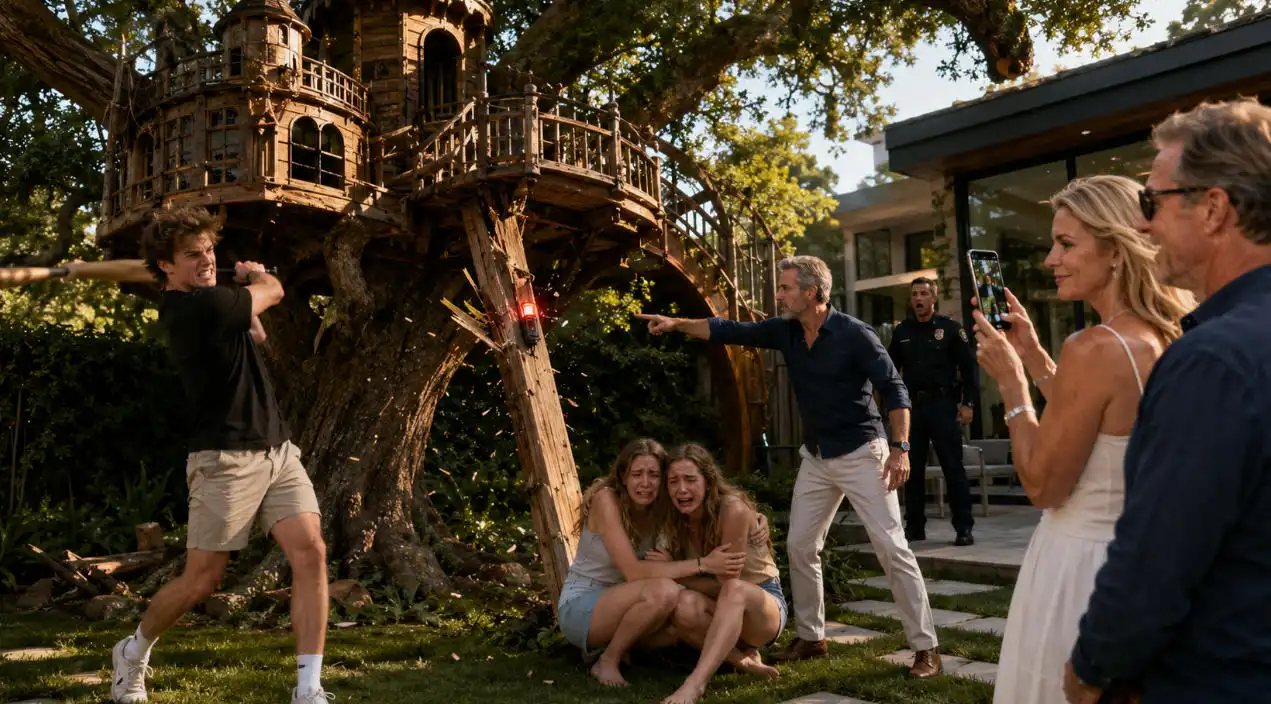
The neighbor father stopped laughing the moment the police cars turned onto our private road.
Not because he felt guilty.
Because for the first time that afternoon, he realized the backyard wasn’t his stage anymore.
His wife lowered her phone.
Their son still had the baseball bat in both hands.
My twin girls, Lily and Rose, were crying so hard they could barely breathe.
And the little red light beneath the cracked support column kept blinking.
Slow.
Steady.
Like a heartbeat.
I looked at the neighbor father and repeated what I had just said.
“Before your son hit that column… did you know your mortgage was already in default?”
His face changed.
Just for half a second.
Then he forced a laugh.
“What kind of sick joke is that?”
His wife stepped forward, still trying to look important in her white designer tennis dress.
“You people are insane,” she snapped. “It’s a children’s treehouse.”
I looked up at the oak.
The treehouse had never been just a treehouse.
It looked like a storybook castle wrapped around the branches of a giant oak tree. Slate-blue roof tiles. A little bridge. Round windows. Hand-carved wooden owls. Tiny lanterns shaped like floating candles.
Lily called it “the magic house.”
Rose called it “our safe castle.”
Every inch of it had been designed for them.
Not for Instagram.
Not for status.
For two little girls who still believed a backyard could be a kingdom.
And now they were standing in the grass, watching another child destroy it while grown adults smiled.
That was the part I could not forgive.
Not the money.
Not the broken windows.
Not even the cracked support beam.
The cruelty.
The cheering.
The way those parents taught their son that if someone had something beautiful, you could swing a bat at it and call it a lesson.
One officer approached first.
“Sir, we received an automated structural emergency alert from this address.”
The neighbor mother blinked.
“Automated what?”
I pointed to the small red sensor mounted under the main load-bearing column.
“Vibration alarm. It detects impact to the support system. It sends a direct alert to local emergency services and our structural monitoring team.”
The neighbor father scoffed.
“You wired a treehouse like Fort Knox?”
“No,” I said. “I wired a prototype like a responsible architect.”
That made him pause.
He knew the word.
Architect.
He had spent months calling me “the backyard dad.”
“The quiet guy.”
“The man who hides behind fences.”
He never asked what I did.
He only saw the property, the gates, the cameras, the old gray T-shirt I wore on weekends, and decided I was probably inherited money with no spine.
That was useful.
People reveal who they are when they think you are too harmless to matter.
Our problems with the Dawsons started six months earlier.
They moved into the mansion behind ours after buying it far above asking price, then immediately treated the whole street like staff.
Their son, Parker, was nine.
Old enough to know better.
Young enough that his parents still had the power to shape him.
Instead, they applauded every cruel thing he did.
If Parker shoved another child at the community pool, his mother called him “competitive.”
If he threw rocks over our fence, his father called him “spirited.”
If he screamed at gardeners, delivery drivers, and security staff, they called him “future leadership material.”
One afternoon, Lily and Rose were playing near the hedge when Parker climbed halfway over the fence and yelled, “Your dumb castle looks fake!”
Rose answered, “It’s not dumb. Daddy built it.”
Parker sneered.
“My dad says your dad is a loser who wastes money on baby stuff.”
My girls came inside quiet that day.
I didn’t confront anyone.
I documented it.
Date.
Time.
Camera angle.
Witness.
That is what I do for a living.
I build things that stand because every hidden force is calculated before the first beam goes up.
Pressure.
Load.
Movement.
Failure points.
People are not so different.
The Dawsons’ failure point was entitlement.
They believed every rule could be bent by money, charm, or intimidation.
And for a while, the neighborhood let them believe it.
Their parties ran past midnight.
Their guests blocked driveways.
Their landscapers cut into shared hedges.
Their delivery trucks crushed irrigation lines.
Every time someone complained, Mr. Dawson laughed.
“Send me the bill.”
He said it like money made him innocent.
But money does not erase behavior.
It records it.
Especially when the behavior touches contracts.
Two months before the treehouse incident, my CFO brought me an unusual file.
“Do you know your rear neighbor?” he asked.
“Unfortunately.”
He slid a folder across my desk.
“Dawson residence. Their mortgage note was bundled into a distressed private loan package we reviewed last quarter.”
I opened the file.
The Dawsons had purchased their home aggressively.
Too aggressively.
There were late payments, undisclosed second liens, and a side agreement that violated the loan covenants.
I did not buy the note out of spite.
Not then.
I told my team to keep monitoring it because the property sat beside mine, and because any forced sale could affect security easements, drainage rights, and shared boundary maintenance.
Then the Dawsons made it personal.
Not by annoying me.
By targeting my children.
The morning of the incident was supposed to be a celebration.
Lily and Rose had just turned five.
They invited three friends, their nanny, my sister, and the children of two employees who had helped with the build.
The treehouse was ready for its first “wizard tea party.”
There were cupcakes.
Tiny velvet capes.
A wooden sign that said “Welcome to the Oak Castle.”
No commercial logo.
No public announcement.
No reason for anyone outside our yard to care.
But the Dawsons cared.
They saw joy and called it showing off.
At 2:17 p.m., Parker came through the side service gate.
He did not sneak in alone.
His parents came behind him.
Mrs. Dawson had her phone already recording.
Mr. Dawson held a drink in one hand and waved at my security guard with the other.
“Just visiting,” he said.
My guard, Trent, stepped into his path.
“This is private property.”
Mr. Dawson smiled and folded cash into Trent’s palm.
“Don’t embarrass yourself over a playdate.”
Trent looked toward the house.
I was inside taking a call from Tokyo.
By the time I reached the patio doors, Parker had already picked up a decorative wooden practice wand and thrown it into the pool.
Rose screamed, “Stop!”
Mrs. Dawson laughed.
“Oh, honey, it’s just a toy.”
Then Parker pulled the baseball bat from behind his back.
That was when every adult froze.
Except his parents.
His father said, “Go on. Teach them not to brag.”
Those words were captured clearly on four cameras.
Backyard north angle.
Patio west angle.
Oak tree internal mount.
Gate camera.
Parker swung.
The bat hit the little arched door.
Wood splintered.
Lily sobbed, “Daddy!”
I started down the steps.
My sister grabbed the twins and pulled them back.
“Girls, come to me.”
Parker swung again.
The round window shattered.
Mrs. Dawson zoomed in with her phone.
“Look at their faces,” she said. “This is what happens when children grow up thinking they’re special.”
I stopped ten feet away from Parker.
Not because I was afraid.
Because he was a child holding a bat, and any sudden move from an adult man could become the story his parents wanted.
Mr. Dawson knew that.
He stepped between me and the treehouse.
“What are you going to do?” he said. “Tackle a kid?”
“No,” I said.
“Good. Then stand there.”
Parker hit the support column.
Once.
The red sensor blinked.
Twice.
The alarm transmitted.
He hit it again.
A low groan moved through the oak platform.
The twins screamed.
That was the moment the party ended.
Not because of the damage.
Because the structure registered unsafe movement.
I reached into my pocket and opened the monitoring app.
The alert was already logged.
Impact event.
Column B.
Emergency threshold exceeded.
Law enforcement notified.
Structural team notified.
Insurance counsel notified.
I looked at the Dawsons.
They were still smiling.
They had no idea the room had changed.
The first patrol car arrived in less than six minutes.
Then two more.
Then my attorney’s SUV.
Then a second black vehicle from my firm’s risk department.
Mrs. Dawson’s phone dropped slowly to her side.
Mr. Dawson pointed at the officers.
“This is ridiculous. He called the police over a toy.”
The first officer looked at the treehouse.
Then at the twins.
Then at the bat in Parker’s hands.
“Sir, place the bat on the ground.”
Parker looked at his father.
Mr. Dawson said, “Don’t you dare treat my son like a criminal.”
The officer’s voice stayed calm.
“Place the bat on the ground.”
For the first time all day, Parker obeyed someone.
The bat hit the grass.
My attorney, Margaret Vale, walked up beside me carrying a navy folder.
She had worked with me for thirteen years.
Calm.
Precise.
Terrifying in court.
She looked at the Dawsons and said, “Mr. and Mrs. Dawson, I advise you not to delete anything you recorded today.”
Mrs. Dawson’s face went stiff.
“Who are you?”
“Counsel for Mr. Whitmore.”
The neighbor father laughed again, but it was thinner now.
“Counsel? For a treehouse?”
Margaret opened the folder.
“For trespass, property destruction, child endangerment concerns, attempted bribery of private security, and intentional damage to a monitored architectural prototype.”
His smile vanished.
“Prototype?”
I finally answered the question he should have asked before swinging arrogance around my backyard.
“My firm designs structural systems for high-risk residential builds, vertical estates, elevated platforms, disaster-resistant housing, and private aviation structures. The Oak Castle is a small-scale live-load prototype using the same sensor network we install in occupied structures.”
Mrs. Dawson whispered, “That thing cost seven figures?”
“No,” I said. “The research behind it did.”
Mr. Dawson swallowed.
“You can’t put experimental equipment where children play.”
“It passed inspection,” I said. “Permits are filed. Safety redundancies are documented. And every parent here signed the event access form.”
I looked at him.
“You did not.”
Margaret handed one document to the officer and another to Mr. Dawson.
“This is the incident preservation notice. You are formally instructed to preserve phone footage, messages, payment records, and any communications concerning entry onto this property.”
Mr. Dawson slapped the papers away.
“This is harassment.”
Margaret did not blink.
“No. Harassment is entering a neighbor’s property with a bat while your spouse records two crying children for entertainment.”
A few adults behind us murmured.
That sound mattered.
Public shame had turned.
The same phones that captured Lily and Rose crying were now pointed at the Dawsons.
Mr. Dawson noticed.
His face flushed.
“Stop recording,” he barked at the parents behind him. “All of you.”
Nobody moved.
One mother said, “You filmed little girls crying.”
The silence after that was brutal.
Mrs. Dawson tried to recover.
“They were jealous. That’s all this is. Children get jealous. Children act out.”
My sister stepped forward, holding Rose against her hip.
“Your child brought a bat.”
Mrs. Dawson glared.
“You stay out of this.”
That was when Trent, the security guard, stepped forward.
His hand was shaking.
“I took the money,” he said quietly.
Everyone turned.
Mr. Dawson snapped, “Shut up.”
Trent kept going.
“He gave me five hundred dollars to let them through. I thought they were just coming to complain. I didn’t know the kid had a bat.”
Margaret looked at him.
“Did Mr. Dawson say why he wanted entry?”
Trent nodded.
“He said, ‘My son wants to knock the rich-girl castle down a peg.’”
Mrs. Dawson went white.
Mr. Dawson exploded.
“You ungrateful idiot!”
An officer stepped between them.
“Sir, lower your voice.”
That was the exact second Mr. Dawson realized his money was no longer controlling the smallest person in the yard.
The legal hammer had begun.
But the mortgage file was what broke him.
Margaret turned to me.
“You want me to proceed?”
I looked at Lily.
She was no longer crying loudly.
That was worse.
She was quiet in the way children get when adults make the world feel unsafe.
Rose had her face buried in my sister’s shoulder.
Their birthday capes hung crooked around their little necks.
I thought about mercy.
Real mercy.
Not weakness.
Not letting powerful adults pretend nothing happened because consequences were inconvenient.
Mercy is for remorse.
Not performance.
I nodded.
“Proceed.”
Margaret opened the second folder.
“Mr. Dawson, as of 9:00 a.m. this morning, Whitmore Holdings acquired the defaulted mortgage note and associated enforcement rights on your property.”
He stared at her.
“That’s impossible.”
“It is complete,” she said. “Your loan covenants were breached when you concealed the secondary lien and misrepresented liquidity reserves. The lender had the right to accelerate. That right now belongs to my client’s holding company.”
Mrs. Dawson grabbed his arm.
“What is she talking about?”
He didn’t answer.
Because he knew.
The neighbors did not.
The parents at the party did not.
The officers did not.
But his face told the truth.
This was not a man hearing shocking false news.
This was a man hearing a buried secret spoken out loud.
Margaret continued.
“After today’s trespass, documented bribery, and intentional damage to adjacent property, we are also filing an emergency petition related to boundary security and access risk. Your cure period is no longer a private negotiation.”
Mr. Dawson’s voice cracked.
“You can’t do that because of a treehouse.”
“No,” Margaret said. “We can do it because of your contracts. Today only removed any reason for my client to be patient.”
That line hit harder than shouting ever could.
His wife turned on him.
“Defaulted? You told me the bank extension was handled.”
He hissed, “Not now.”
“Oh, now,” she said, louder. “You let our son do this while we were already in trouble?”
Parker started crying then.
Real crying.
Not the angry, performative kind.
The scared kind.
For a moment, I looked at him and saw a child crushed under the weight of adults who had taught him that cruelty was confidence.
I did not hate him.
That surprised me.
I hated what they had made normal for him.
The officers separated everyone.
Statements were taken.
The bat was photographed.
The sensor logs were exported.
The broken column was secured by my structural team before anyone went near the treehouse again.
By sunset, the Oak Castle stood silent under the tree, wrapped in temporary supports.
Lily and Rose sat inside with hot chocolate, still wearing their little capes.
Rose asked me, “Daddy, did we do something bad?”
That question almost broke me.
I knelt in front of them.
“No, sweetheart.”
“Then why did he break our castle?”
I looked at both of them.
“Because some people think being unhappy gives them permission to hurt what other people love.”
Lily whispered, “Are they going to come back?”
“No,” I said. “They are not.”
And I meant it.
Over the next forty-eight hours, the video spread through the neighborhood.
Not online.
I made sure my team requested privacy for my daughters.
But among residents, board members, school parents, security staff, and lenders, the truth traveled fast.
The Dawsons’ version collapsed first.
They claimed Parker had been invited.
Gate footage proved otherwise.
They claimed the bat was found in our yard.
Camera footage showed Parker carrying it through the service gate.
They claimed Mrs. Dawson was recording “for safety.”
Her own audio captured her laughing at my crying children.
They claimed Mr. Dawson gave Trent “a tip.”
The video captured the words.
“Don’t embarrass yourself over a playdate.”
That phrase followed him everywhere.
People stopped returning calls.
The school requested an emergency conduct review.
Their country club suspended their membership pending investigation.
The homeowners’ association opened a security violation case.
The lender enforcement process moved quickly because the default had already existed.
That part mattered.
I did not “make them poor.”
I did not invent their debt.
I did not create their lies.
I simply stopped protecting them from the consequences they had already signed.
Within three weeks, their house entered a forced sale process.
They moved into temporary lodging arranged by Mrs. Dawson’s parents.
Not the street.
Not some cartoon punishment.
Real consequences.
Public ones.
Humiliating ones.
The kind that happen when rich people discover paperwork does not care about their tone of voice.
Mr. Dawson tried to sue me.
The case did not survive the first serious review.
His attorney withdrew after seeing the footage.
Mrs. Dawson deleted part of her video and then claimed her phone “glitched.”
Our preservation notice made that a separate problem.
As for Parker, the school and juvenile family services required a behavioral intervention program.
Not because I demanded revenge on a child.
Because a boy who walks onto private property with a bat while adults cheer needs correction before life teaches him with something worse than court papers.
I heard later that his grandparents enrolled him in a strict therapeutic boarding program focused on accountability and behavioral repair.
I hope it helps him.
I truly do.
A child can still become better.
Adults who train cruelty into him do not get to cry when the world calls it abuse.
The Oak Castle was rebuilt.
Not slowly.
Not cheaply.
My daughters woke up three mornings after the incident to find the backyard filled with quiet workers, cranes, carpenters, painters, engineers, and lighting specialists.
My best team came voluntarily.
Some brought coffee.
Some brought their own children’s drawings for Lily and Rose.
My lead designer, Elena, knelt in front of the twins and said, “We heard the castle needs stronger magic.”
Lily looked at me.
“Is that allowed?”
I smiled.
“It is very allowed.”
The new structure was not just repaired.
It was transformed.
A safer stair system.
Hidden steel reinforcement inside carved timber.
Better sensors.
A tiny reading tower.
A miniature drawbridge.
A “potion kitchen” with child-safe copper bowls.
A secret bookshelf door that opened when the girls pressed two wooden owls at the same time.
The old damaged pieces were not thrown away.
We saved one cracked window frame and hung it inside the new reading room.
Under it, I placed a small brass plaque.
Not for guests.
For my girls.
It said:
Beautiful things are worth protecting.
The day we reopened it, Lily and Rose invited the same children back.
No cameras.
No spectacle.
Just cupcakes, laughter, and two little girls running across the bridge in purple capes.
At one point, Rose stopped at the doorway and looked at the brass plaque.
“Daddy?”
“Yes?”
“Does protecting mean hitting back?”
I sat beside her on the little wooden step.
“No.”
She thought about that.
“Then what does it mean?”
“It means telling the truth. Keeping records. Using rules fairly. And never becoming cruel just because someone was cruel to you.”
Lily came over with frosting on her cheek.
“But they lost their house.”
“They lost it because they lied to the bank,” I said gently. “And because they thought rules were only for other people.”
Rose nodded like she was trying to place the idea somewhere safe.
Then she said, “I’m glad our castle came back.”
“So am I.”
Months later, the Dawsons’ former house sold.
The new owners were a retired teacher and her husband, a pediatric nurse.
The first week they moved in, the teacher came to our fence with a plate of lemon bars.
“I heard there was some trouble here before,” she said carefully.
I smiled.
“There was.”
She looked past me at the Oak Castle.
“That is the most beautiful treehouse I’ve ever seen.”
Lily and Rose peeked from behind me.
The teacher waved.
“No baseball bats,” she said.
The twins giggled.
That small laugh felt bigger than any lawsuit.
Bigger than any foreclosure.
Bigger than watching an arrogant man finally run out of excuses.
Because the best ending was never that the Dawsons lost.
The best ending was that my daughters got their backyard back.
Their birthday back.
Their belief back.
And when they climbed into the new castle that evening, lanterns glowing under the oak leaves, Rose looked down at me and shouted:
“Daddy, the magic is stronger now!”
She was right.
It was.
Not because money rebuilt it.
Because truth protected it.
Because witnesses spoke.
Because rules worked.
Because a little girl learned that silence is not weakness when your next move is lawful, calm, and complete. ⚖️
So choose one:
Was I too harsh for enforcing the mortgage after what happened…
or did those parents finally meet the consequences they had been teaching their son to ignore?
Disclaimer: Mention of any brand or trademark is for identification only and does not imply partnership or endorsement
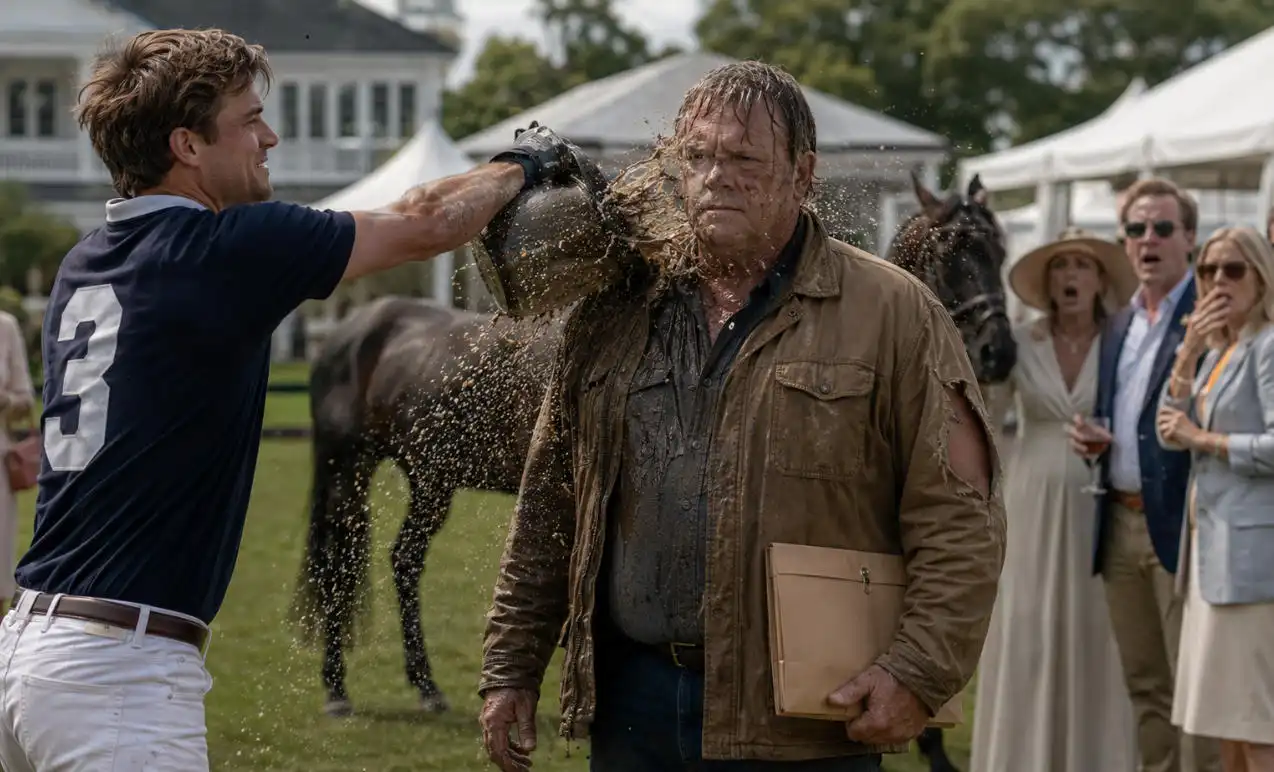
A Rich Polo Player Tore A Hardware Store Owner’s Jacket In Front Of Everyone… Minutes Later, He Was Begging On The Grass
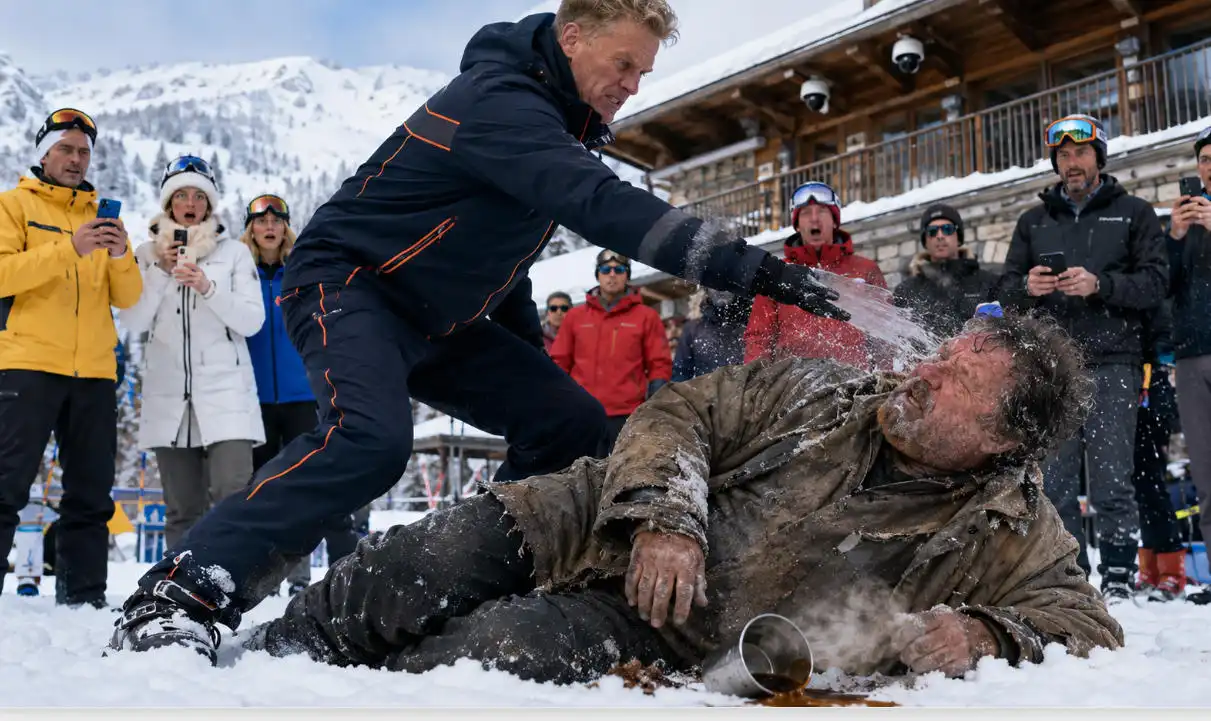
A Round-Bellied Carpenter Was Humiliated by an Elite Ski Coach in Front of Rich Guests… But Sven Had NO IDEA Who Bob Really Was 😳
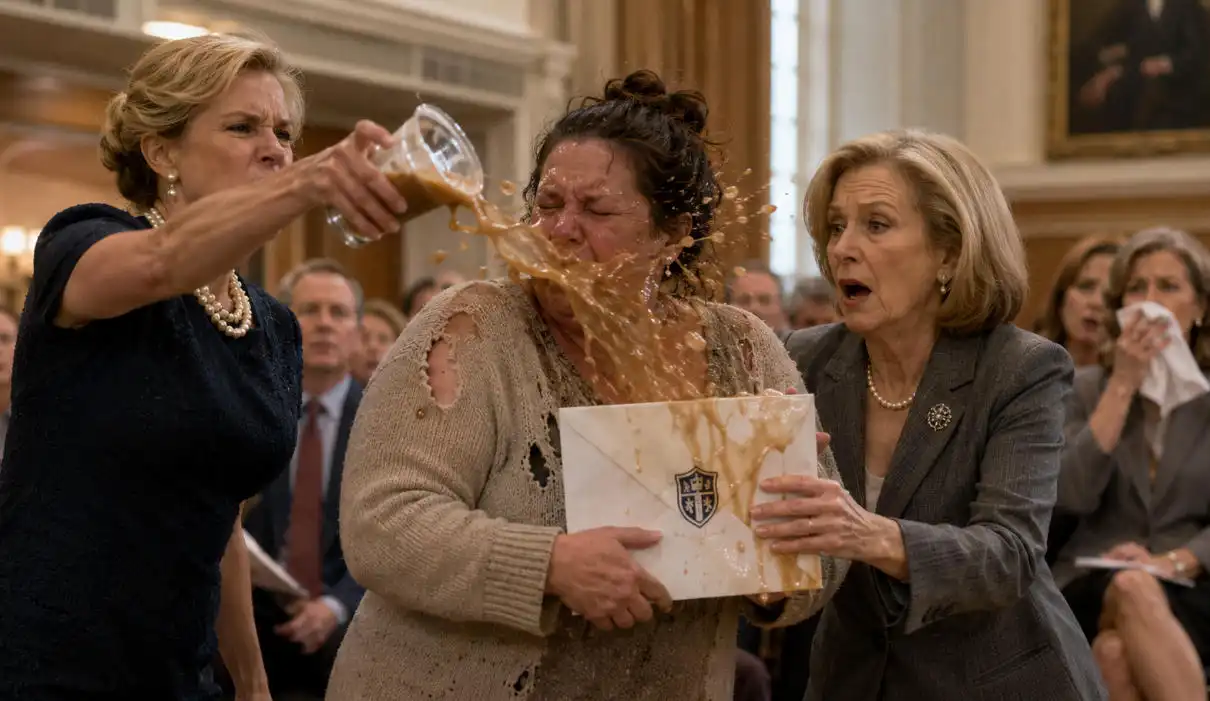
Parents Covered Their Noses When the “Cheap Mom” Walked In… Minutes Later, the PTA Queen Was on Her Knees Begging 😮