
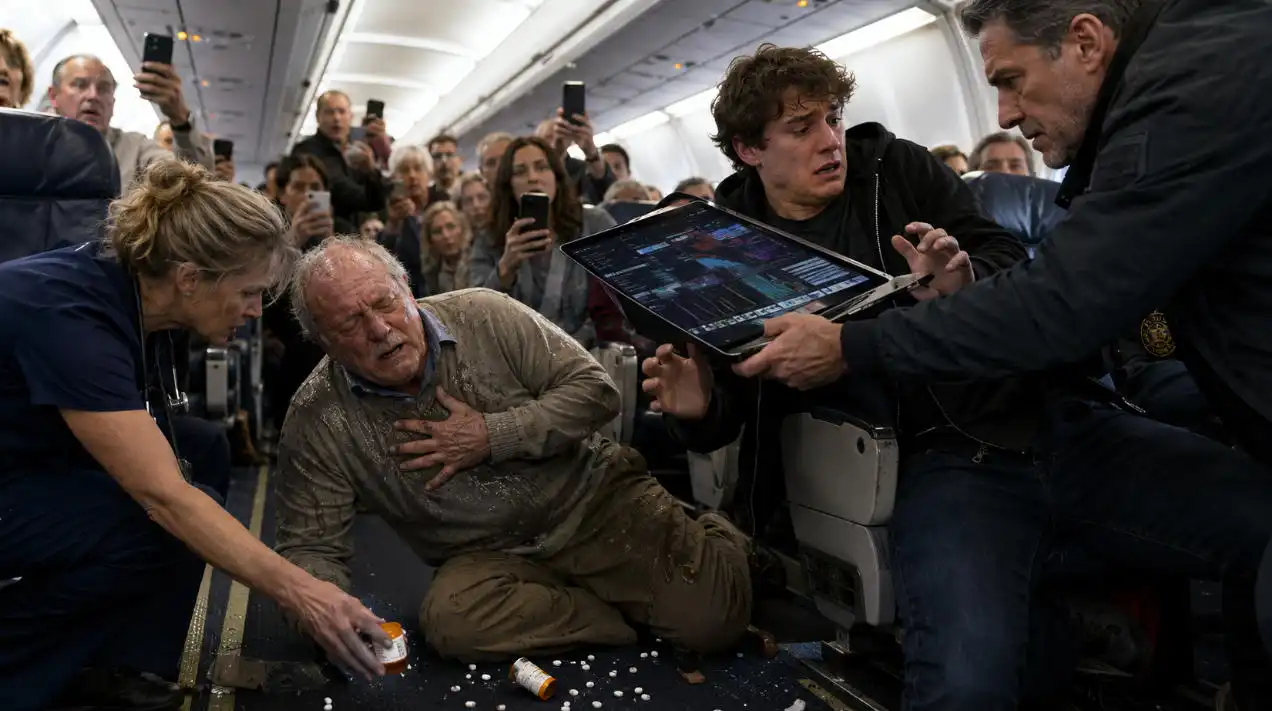
He slapped my heart pills out of my hand because the bottle was “too loud.”
Not in a hallway.
Not in an argument.
On a packed flight to Silicon Valley, while my chest felt like somebody had driven a hot nail through it.
The pills rolled under the seats.
The young man beside me went back to his keyboard like I was a spilled drink.
And three rows behind us, a quiet federal agent finally stood up.
My name is Robert Ellis.
I am sixty-eight years old.
For thirty-nine years, I taught American history to teenagers who thought the world began the day they got their first phone.
I taught them the Constitution.
I taught them about duty.
I taught them that a civilized country survives only when decent people refuse to look away.
That morning, I was flying from Chicago to San Jose to see my granddaughter graduate from college.
She was the first in our family to get into Stanford.
I had a blue tie folded in my carry-on.
I had a card in my jacket pocket.
And I had a little orange bottle of nitroglycerin tablets in the front pouch of my bag, because my cardiologist had said, “Robert, keep these within reach. Not in the overhead bin. Not in checked luggage. Within reach.”
I listened.
Teachers are good at following instructions.
The man in 13C did not like instructions.
His name was Dave Mercer.
At least that was the name printed on his boarding pass.
He was maybe twenty-six.
White hoodie.
Expensive headphones.
A gaming keyboard balanced on the tray table like he owned the row.
Two phones.
One laptop.
One tablet.
Cables everywhere.
He had the entire middle armrest buried under his elbows before I even sat down.
When I reached for my seat belt, he sighed.
When I adjusted the air vent, he muttered, “Great.”
When I coughed into a tissue, he actually paused his game and stared at me.
“Can you not do that the whole flight?”
I blinked at him.
“Do what?”
“Make old man noises.”
The woman in 13A looked up sharply.
She was a nurse. I learned that later.
At the time, I only noticed her kind eyes.
She said, “Excuse me?”
Dave didn’t even glance at her.
“I paid for Wi-Fi. I didn’t pay for a retirement home soundtrack.”
I had spent nearly four decades around teenagers.
I knew insecurity when I heard it.
So I let it pass.
I opened my book.
It was a worn copy of The Federalist Papers, the same one I used to bring to class when I wanted students to understand that power without restraint becomes tyranny.
Dave saw the cover and snorted.
“Homework?”
“Old habit,” I said.
He tapped his keys harder.
“Must be nice having nothing important to do.”
The nurse in 13A said, “Sir, leave him alone.”
Dave gave her a smile that wasn’t a smile.
“Relax. I’m not talking to you.”
The flight attendant came by with drinks.
Her name tag said Megan.
I asked for water.
Dave asked for black coffee, two sugars, and snapped his fingers when Megan didn’t move fast enough.
“Also, can you make sure the Wi-Fi actually works? I’ve got something time-sensitive.”
Megan smiled the way service workers smile when they have been trained to absorb disrespect for a paycheck.
“I’ll check after takeoff.”
Dave leaned back.
“Unbelievable.”
I looked out the window.
Clouds swallowed Chicago beneath us.
For the first hour, I tried to disappear.
Dave’s fingers hammered the keyboard.
Every few minutes, he whispered numbers to himself.
Not game numbers.
Transfer numbers.
Wallet addresses.
Exchange names.
I did not understand most of it.
But I understood tension.
His shoulders were tight.
His jaw never relaxed.
When the plane hit turbulence over Nebraska, his screen flickered, and he slammed his palm on the tray table.
“Come on, come on, come on…”
The nurse looked over.
“Everything okay?”
Dave snapped, “Mind your business.”
Then my chest tightened.
At first, I thought it was indigestion.
A hard pressure under the breastbone.
Then my left arm went cold.
My jaw ached.
The book slipped from my lap.
I reached for the front pocket of my carry-on.
The zipper jammed.
My fingers had gone clumsy.
I could hear my own breathing.
Thin.
Wet.
Wrong.
The nurse saw me first.
“Sir?”
I tried to answer.
No sound came.
Dave yanked one headphone off.
“Oh my God. What now?”
I got the zipper open.
My hand found the orange bottle.
But my fingers were shaking so badly it rattled against the plastic case.
Click-click-click-click.
Dave stared at it like it was a personal insult.
“Are you kidding me?”
The nurse unbuckled.
“Sir, are you having chest pain?”
I nodded.
Her face changed instantly.
Professional.
Focused.
Scared, but controlled.
“Flight attendant!” she shouted. “I need help here!”
Megan hurried down the aisle.
“What’s happening?”
“He may be having a heart attack. Sir, do you have medication?”
I lifted the bottle.
“My… pill…”
Dave groaned.
“This cannot be happening right now.”
The nurse reached for the bottle.
Dave moved faster.
He slapped my hand.
Hard.
The bottle flew.
It hit the aisle carpet and rolled forward under 12D.
The sound of the pills rattling away was louder than any scream.
For one frozen second, nobody moved.
Then the nurse shouted, “What is wrong with you?”
Dave ripped off his headphones.
“He was shaking it right next to my ear!”
“He is having a medical emergency!”
“He’s ruining my connection!”
I grabbed my chest.
The pressure turned sharp.
My vision narrowed.
Megan dropped to her knees, searching under the seats.
“Where did it go? Where did it go?”
The nurse leaned over me.
“Robert, stay with me. What medication was it?”
“Nitro,” I whispered.
Dave grabbed his cup of ice water.
I thought he was moving it out of the way.
He wasn’t.
He dumped it over my lap.
Cold water soaked my trousers and shirt.
The shock stole what little breath I had left.
“Wake up,” he said. “You’re ruining everyone’s flight.”
That was the moment the plane changed.
People stopped being passengers.
They became witnesses.
Phones rose.
A father in 12A said, “Hey! Back off!”
A woman behind us gasped, “He hit an old man!”
A little boy started crying.
The nurse shoved Dave’s arm away.
“Do not touch him again.”
Dave stood halfway, trapped by the seat belt sign and the narrow row.
“You people are dramatic. It’s probably anxiety.”
Megan shouted toward the front.
“Medical emergency! Is there a doctor on board?”
Another flight attendant grabbed the intercom.
A voice crackled.
“Ladies and gentlemen, if there is a doctor or medical professional on board, please press your call button immediately.”
The nurse kept one hand on my wrist.
“Pulse is weak. Robert, look at me. Look at me.”
I tried.
Her face blurred.
Dave bent toward his laptop.
His fingers moved again.
Fast.
Too fast.
The nurse saw him.
“Are you seriously typing right now?”
Dave said, “Some of us have real deadlines.”
Then a man in 16B stood.
He was middle-aged.
White.
Salt-and-pepper hair.
Navy blazer.
No panic.
No theater.
He moved like someone who had spent a lifetime walking into rooms where lying men thought they were the smartest person there.
“Step away from the laptop,” he said.
Dave didn’t look up.
“Sit down, Dad.”
The man reached into his inside pocket.
A badge opened in his hand.
The cabin went silent again.
Not shocked-silent.
Different.
Heavy.
Official.
“My name is Special Agent Mark Callahan,” he said. “Federal Bureau of Investigation, Cyber Division. Take your hands off the keyboard.”
Dave’s face drained.
Only a little at first.
But enough.
Enough for every camera to catch it.
Megan froze with one hand under the seat.
The nurse kept searching with her free hand.
Special Agent Callahan stepped closer.
“Now.”
Dave laughed.
It was a thin sound.
“Is this a joke?”
Callahan looked at the screen.
“No.”
Dave’s right hand twitched toward the trackpad.
Callahan grabbed his wrist and pinned it to the tray table.
Not violently.
Legally.
Cleanly.
“Do not touch that device again.”
Dave said, “You have no warrant.”
Callahan’s eyes did not move from the screen.
“You assaulted a passenger during an in-flight medical emergency, interfered with emergency care, and your open laptop is displaying active financial transfers through known laundering channels. You want to debate probable cause at thirty thousand feet?”
Dave said nothing.
That was the first smart thing he had done all morning.
Megan shouted, “Found it!”
She pulled the orange bottle from under 12D.
The nurse snatched it, read the label, and placed one tiny tablet under my tongue.
“Robert, let it dissolve. Do not swallow it. Stay with me.”
I wanted to thank her.
I wanted to apologize for being trouble.
Old habits.
Teachers apologize for bleeding on the floor.
The pain did not vanish.
But after a minute, it loosened enough for air to get through.
I heard the captain’s voice from the cockpit phone near the galley.
Megan listened, pale.
“Yes, Captain. FBI is involved. Medical emergency. Possible criminal assault. Yes, sir.”
Callahan looked at Dave’s screen.
Then he looked at the passengers filming.
“Anyone who recorded the assault, do not delete it. The crew will take your contact information.”
Dave found his voice.
“You can’t just accuse me of something because I shoved some pills.”
The nurse snapped, “You did not shove pills. You struck a cardiac patient and removed his emergency medication.”
Dave rolled his eyes.
“He’s alive.”
Callahan leaned closer.
“That may be the only reason you are still standing.”
A doctor from first class arrived.
Older man.
Calm hands.
He examined me, checked my blood pressure, asked about my history, and nodded to the nurse.
“We need oxygen. And the AED nearby.”
Megan brought the equipment.
Someone gave up a row so they could lay me partly across the seats.
Through it all, Dave kept talking.
Not loudly now.
Just enough to show he was still trying to win.
“This is a misunderstanding.”
“He was distracting me.”
“You people are overreacting.”
“I didn’t know it was serious.”
Nobody believed him.
Because arrogance has a sound.
And everyone had heard it before.
Callahan asked Megan for zip ties from the crew restraint kit.
Dave’s eyes widened.
“You can’t restrain me.”
Callahan said, “You are detained pending landing.”
“For what?”
“Interference with flight crew, assault aboard an aircraft, obstruction of emergency medical care, and whatever your laptop explains after we preserve it.”
Dave swallowed.
“It’s encrypted.”
Callahan smiled for the first time.
Not a warm smile.
A courtroom smile.
“Then you understand why we preserve devices.”
Dave turned to the aisle.
“Somebody tell him this is illegal.”
The father in 12A said, “Buddy, you hit a man having a heart attack.”
A woman in 15C said, “I got it all on video.”
Another passenger said, “So did I.”
The nurse squeezed my hand.
“Robert, you’re doing great.”
I whispered, “My granddaughter…”
“She’ll see you,” she said. “You hear me? She’ll see you.”
The plane diverted to Denver.
That was the captain’s decision.
Emergency medical landing.
Federal law enforcement request.
Safety of passengers.
For the next forty minutes, the cabin lived in that strange suspended place between crisis and judgment.
I lay there with oxygen under my nose.
The doctor monitored me.
The nurse never left.
Megan brought a blanket and tucked it around me like I was her own father.
Dave sat with his wrists restrained, sweating through his hoodie.
Special Agent Callahan stood beside him, one hand on the laptop bag, one eye on the screen.
But the screen was still open.
And even from where I lay, I could see lines of numbers.
Names.
Transfers.
Timers.
Dave noticed me looking.
For the first time, he spoke directly to me without contempt.
“Don’t say anything.”
His voice was low.
The nurse heard it.
“What did you just say?”
Dave stared at the floor.
Callahan said, “Say that again for the phones.”
Dave shut his mouth.
When we landed in Denver, the plane did not pull to a normal gate.
It stopped on a remote part of the tarmac.
Blue lights flashed outside the oval windows.
People craned their necks.
Megan made an announcement.
“Please remain seated with your seat belts fastened. Medical personnel and law enforcement will board first.”
The door opened.
Paramedics came in.
Behind them came armed federal agents.
Not airport security.
Not a warning.
A wall.
Dave looked at Callahan.
“You called a SWAT team for a laptop?”
Callahan said, “No, Dave. You did.”
That sentence landed harder than the slap had.
The agents removed him in front of everyone.
Hands restrained.
Face gray.
The same passengers he had mocked now watched him shuffle down the aisle.
Phones recorded.
Not because people loved spectacle.
Because people understand evidence.
One agent carried his laptop in a faraday bag.
Another took his phones.
A third read him his rights.
Dave tried one last time.
“That old man caused all of this.”
The nurse stood.
Her voice shook, but it was loud.
“No. You did.”
The cabin applauded.
Not wildly.
Not like a movie.
Just one clap.
Then another.
Then the whole plane.
I was lifted onto a stretcher, embarrassed and alive.
As they wheeled me past Callahan, he leaned down.
“Mr. Ellis, I’m sorry that happened to you.”
I tried to smile.
“Did you get him?”
Callahan glanced toward the agents.
“We got more than him.”
I did not understand what he meant until three weeks later.
By then, I was home.
I had missed my granddaughter’s graduation ceremony in person, but she came straight to my hospital room wearing her cap and gown.
She brought the program.
She brought the tassel.
She brought a photo of her walking across the stage.
I cried harder than I had during the heart attack.
She put the cap on my head and said, “Grandpa, you still made it.”
For a while, I thought the plane incident would become one of those ugly stories families tell quietly at Thanksgiving.
Then Special Agent Callahan called.
“Mr. Ellis,” he said, “I wanted you to hear this before it hits the news.”
I sat down.
My daughter stood beside me.
Callahan told me Dave Mercer was not just a rude passenger.
He was part of a cyber-laundering network that moved stolen money through shell companies, fake gaming accounts, crypto mixers, and overseas banks.
The “game” on his screen had been cover.
The “deadline” was a live transfer.
The money came from ransomware attacks.
Hospitals.
School districts.
Small businesses.
Retirement accounts.
People like me, in other words.
People who spent their lives saving little by little, only to wake up and find their dignity stolen by someone who never had to look them in the eye.
Callahan said Dave had been under investigation, but they had not known he would be on that flight.
He had made a mistake by working in public.
Then he made a bigger mistake by committing a violent act in front of cameras.
The assault gave the crew and federal agents immediate cause to intervene.
The laptop gave them the trail.
The trail led to wallets.
The wallets led to partners.
The partners led to a server farm in Nevada, two apartments in San Francisco, and a private storage unit full of hardware, fake passports, and ledgers.
Within forty-eight hours, twelve people were arrested.
Within a month, the government seized accounts, vehicles, luxury watches, and three properties.
The headlines called Dave a “brilliant coder.”
I hated that phrase.
Brilliance without conscience is just a sharper knife.
At trial, his attorney tried to paint him as an overwhelmed young tech worker who “panicked during an elderly man’s medical episode.”
Then the prosecutors played the videos.
Mine was not the only one.
There were seventeen angles.
Seventeen pieces of truth.
Dave saying, “Can you have your little medical crisis quietly?”
Dave slapping my pills away.
Dave dumping water on me.
Dave saying, “What’s he going to do? Report me to the principal?”
The courtroom went still.
His mother sat behind him.
She cried silently.
I felt no joy in that.
A parent’s grief is still grief, even when the child earned the shame.
Then the prosecution showed the laptop evidence.
The active transfers.
The laundering channels.
The messages.
One message from Dave to a partner read:
“Need five more minutes in air. Can’t stop transfer now.”
Another said:
“Old guy beside me is freaking out. Annoying but harmless.”
Then, after he slapped the bottle away, he had typed:
“Cabin distracted. Pushing final batch.”
That was the part that changed everything.
He had not merely been cruel.
He had used my emergency as cover.
When the nurse shouted for help and passengers turned toward me, Dave tried to finish moving stolen money.
My heart attack became his curtain.
That is why the judge’s face hardened.
Not because Dave was rude.
Not because he was young.
Because he saw human suffering and recognized it as an opportunity.
The jury convicted him on the major counts.
Assault aboard an aircraft.
Interference with emergency medical care.
Cyber laundering.
Conspiracy.
Obstruction.
The attempted murder charge became the moral center of the case. His lawyers fought it hard. The prosecutors argued that knowingly preventing access to life-saving heart medication during an active cardiac event showed reckless disregard so extreme it crossed into intent under the broader charges pursued.
In the end, the combined federal sentence put him away for life.
His assets were forfeited.
The stolen funds that could be traced were redirected into restitution pools.
Not everyone got everything back.
That is not how justice works.
Justice is not a magic wand.
But some hospital systems recovered money.
A school district got enough back to reopen its technology program.
A retired couple in Ohio recovered part of their stolen savings.
And my granddaughter’s university started a small cybersecurity ethics scholarship after hearing the story.
They asked to name it after me.
I said no.
I asked them to name it after the nurse.
Her name was Angela Brooks.
She was the one who put the pill under my tongue.
She was the one who held my hand.
She was the one who shouted when the rest of the cabin froze.
So now, every year, a student receives the Angela Brooks Ethics in Technology Award.
My granddaughter spoke at the first ceremony.
She said, “My grandfather taught history. That day, strangers taught me citizenship.”
I could not have said it better.
As for Dave, he left the courtroom the same way he left the plane.
Watched.
Recorded.
No longer in control.
But the moment I remember most is not his sentencing.
It is not the agents.
It is not the applause.
It is a moment after the plane landed, before they carried me off.
Megan, the flight attendant, bent down and pressed my little orange pill bottle into my hand.
“I’m sorry,” she whispered.
I looked at the nurse.
At the doctor.
At the father in 12A.
At the passengers who filmed not for gossip, but because truth sometimes needs witnesses.
Then I looked at Megan and said what I had told thousands of students over the years.
“Decent people did not look away.”
That is why I am alive.
Not because one man with a badge stood up.
Because a cabin full of ordinary people finally decided cruelty was not entertainment.
It was evidence.
And when cruelty met evidence, Dave’s whole world collapsed.
So choose a side.
Stand with Robert, the nurse, the crew, and every passenger who refused to look away.
Or stand with Dave, who thought an old man’s life was less important than his laptop.
If you believe people like Dave should face the full weight of the law, share this story. ⚖️
Disclaimer: Mention of any brand or trademark is for identification only and does not imply partnership or endorsement
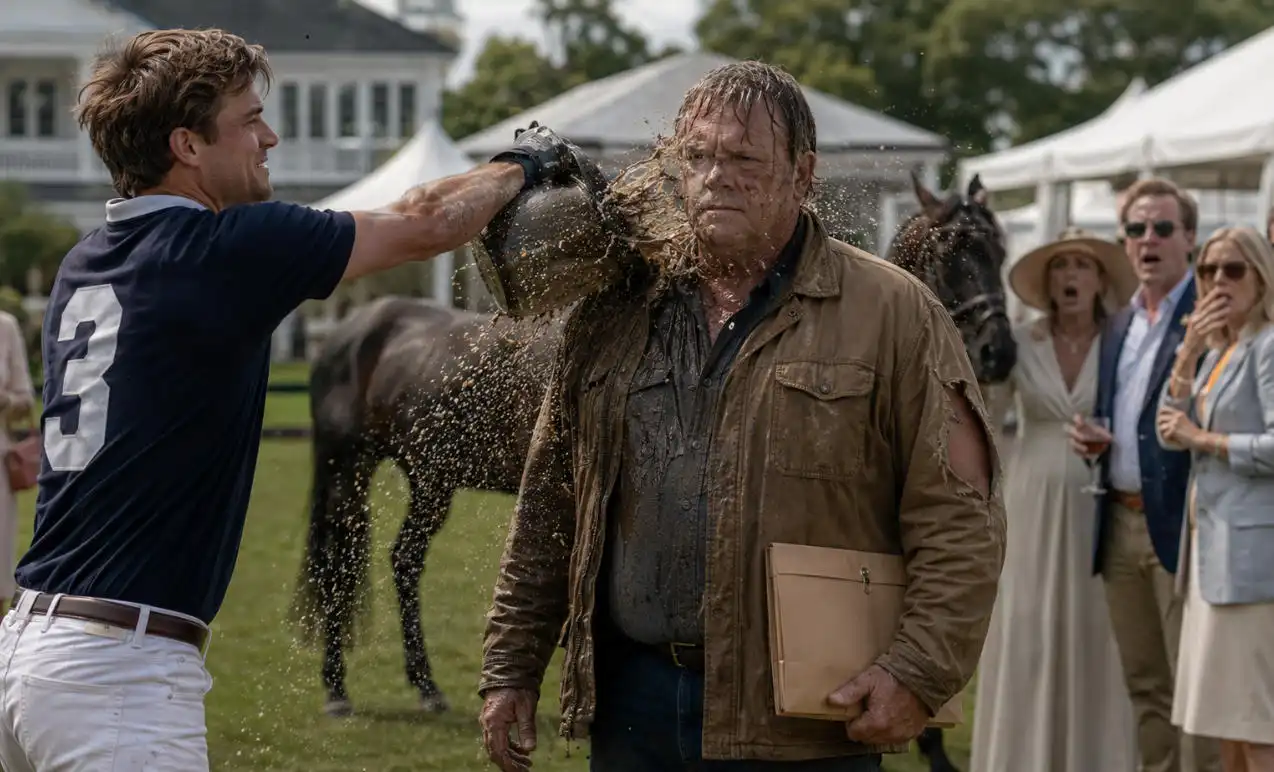
A Rich Polo Player Tore A Hardware Store Owner’s Jacket In Front Of Everyone… Minutes Later, He Was Begging On The Grass
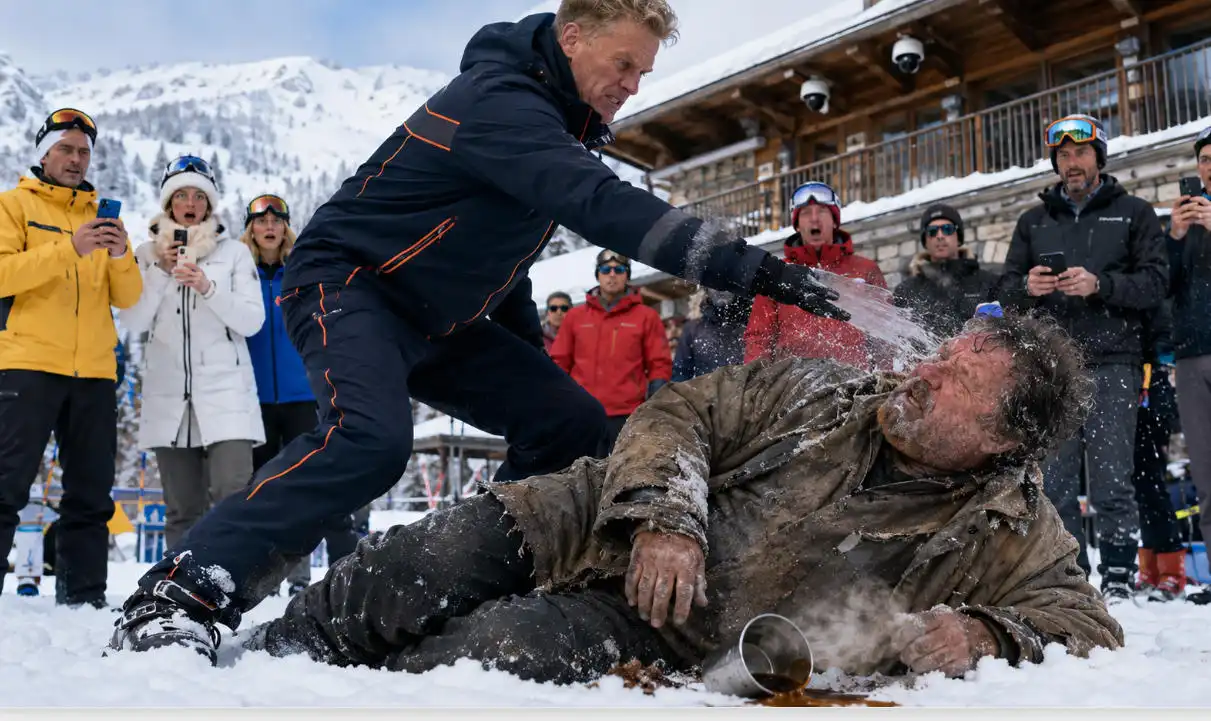
A Round-Bellied Carpenter Was Humiliated by an Elite Ski Coach in Front of Rich Guests… But Sven Had NO IDEA Who Bob Really Was 😳
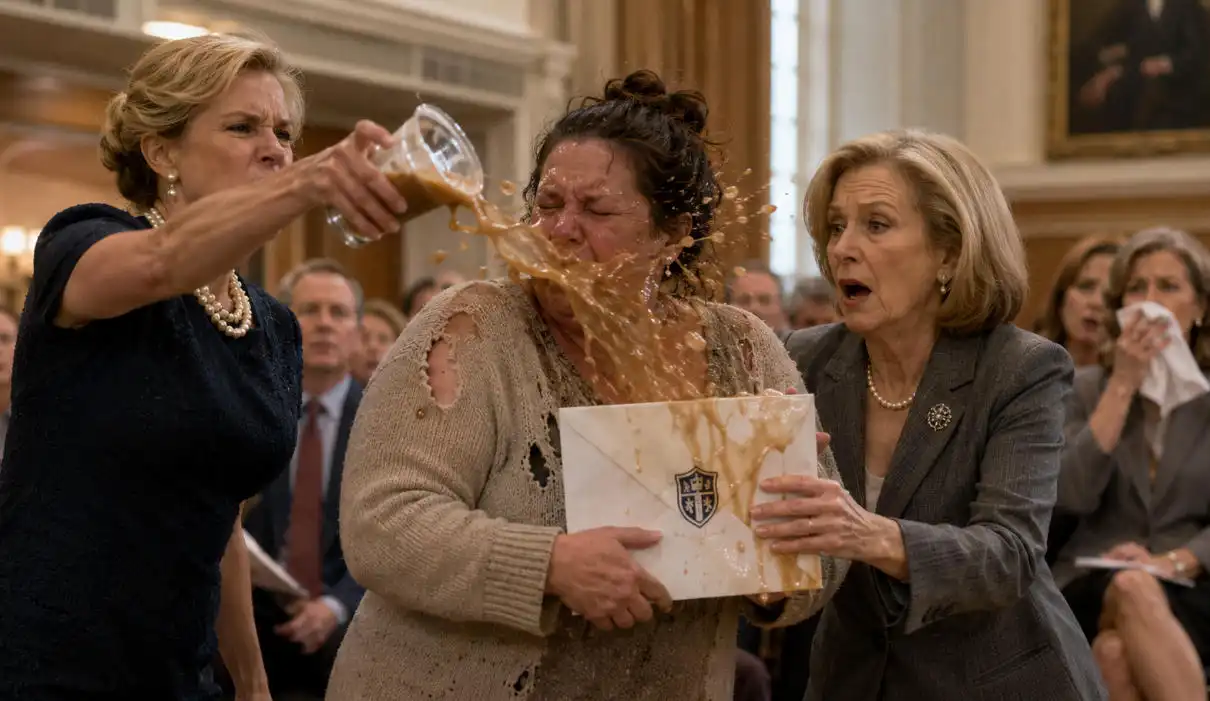
Parents Covered Their Noses When the “Cheap Mom” Walked In… Minutes Later, the PTA Queen Was on Her Knees Begging 😮