
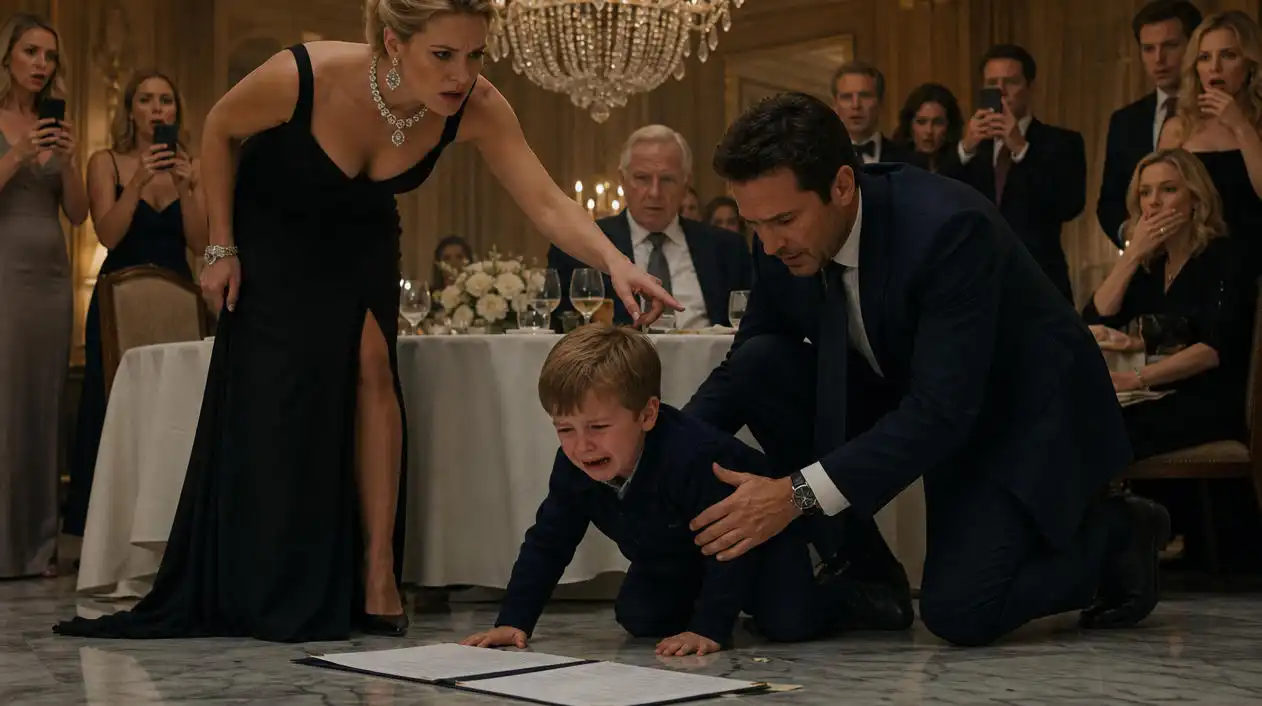
And I opened the first page of the contract.
Madison’s smile did not disappear all at once.
It cracked slowly.
First at the corners of her mouth.
Then in her eyes.
Then in the way her fingers tightened around the back of the dining chair, as if the same marble floor she had pushed my son onto was suddenly tilting beneath her.
My son Noah was still shaking against my chest.
His little hand was buried in my jacket.
His face was wet.
His wooden airplane was still under the dessert cart.
And Madison, who had just shoved a 4-year-old child to the floor in front of three generations of relatives, was staring at the papers on the table like they had grown teeth.
“What is that supposed to be?” she asked.
Her voice was still sharp, but the room had changed.
Nobody was laughing now.
Nobody was whispering behind napkins.
Nobody was pretending they hadn’t seen what happened.
Because the first page on the table carried three things Madison recognized immediately.
Her husband’s company name.
A federal court stamp.
And my signature.
Ethan Cole.
Senior Managing Partner.
Harrington, Vale & Cole.
For most of my family, that name meant almost nothing.
To them, I was just the quiet widower who didn’t talk much at reunions.
The single father who left early because his son got tired.
The man who drove a plain black SUV instead of flashing a sports car.
The cousin who never bragged about money, clients, or courtrooms.
Madison had built an entire personality around assuming that silence meant weakness.
And for years, I had let her.
Not because I was afraid of her.
Because I had a son to raise.
Because I had buried my wife, Claire, and learned that peace was more valuable than proving a point to people who measured human worth by jewelry, table placement, and Instagram photos.
But that night, Madison crossed a line no decent person crosses.
She put her hands on my child.
She humiliated him in public.
Then she tried to use his dead mother as a weapon.
So I did not raise my voice.
I did not threaten her.
I simply turned the page.
Madison’s husband, Brent, stood so fast his chair screeched backward.
“Ethan,” he said, his face turning gray. “Let’s not do this here.”
Madison snapped her head toward him.
“Do what here?”
Brent didn’t answer.
That was the first time all evening I saw real fear in his eyes.
Charles Whitaker stood at the end of the table, silent and still.
For three hours, Madison had treated him like a golden ticket.
She had laughed at jokes he hadn’t made.
She had told him her daughter was “born for elite rooms.”
She had mentioned Brent’s company so many times the chef probably knew its revenue projections by dessert.
“Charles,” she said suddenly, trying to smile again. “I’m sure this is some misunderstanding. Ethan is emotional. His child fell, and—”
“He didn’t fall,” Charles said.
His voice was calm.
Flat.
Final.
“You shoved him.”
The room went dead quiet.
Madison’s mother, Aunt Patricia, finally lifted her chin.
“Well,” she said weakly, “children do get underfoot at these events.”
I looked at her.
“Patricia, if you finish that sentence, you should understand you are defending an adult woman who shoved a preschooler onto marble.”
Her mouth closed.
Madison’s face reddened.
“Oh, please,” she said. “It was barely a push. He was in the way. We were trying to take a family photo. My daughter deserved the center. She’s the oldest girl in this generation.”
Noah flinched at her voice.
That was enough.
I handed him gently to my assistant, Laura, who had worked beside me for twelve years and knew exactly when not to speak.
“Take him to the sitting room,” I said softly. “Stay with him. Get his knee checked. And find his airplane.”
Noah grabbed my sleeve.
“Daddy, don’t leave.”
I bent down and kissed his forehead.
“I’m right here, buddy. I’m not leaving you. I’m just going to make sure nobody ever thinks they can treat you like that again.”
Laura carried him toward the side room.
As they passed the dessert cart, one of the younger servers crouched and pulled the little wooden airplane from underneath it.
He wiped it carefully with a napkin and handed it to Noah.
Noah hugged it to his chest.
That small kindness did more to steady me than anything else in the room.
Then I turned back to Madison.
She crossed her arms.
“You’re making everyone uncomfortable.”
“No,” I said. “You did that.”
Brent stepped toward me, lowering his voice.
“Ethan, whatever you think you have, we can discuss it tomorrow.”
I tapped the second document.
“We already discussed it. Through counsel. For six months.”
Brent swallowed.
Madison looked between us.
“Six months? What is he talking about?”
I opened the folder wider so everyone at the table could see.
“This is the final acquisition agreement for Whitaker Capital’s purchase of controlling interest in Brent’s logistics company.”
Madison blinked.
Then she laughed too loudly.
“You? You’re involved in that?”
Charles finally moved.
He walked to my side, stood beside my chair, and looked at Madison like she was a stain on the floor.
“Ethan is lead counsel for the acquisition,” Charles said. “He structured the deal. He negotiated the debt cleanup. He also discovered the fraud your husband tried to hide from my firm.”
Brent whispered, “Charles—”
Charles cut him off.
“No.”
One word.
Enough to stop him.
The relatives looked at each other.
Phones were still raised.
The women who had whispered about my son being “unruly” now stared at Brent like he had turned into someone else.
Madison’s diamond bracelet slid down her wrist as her hand began to tremble.
“What fraud?” she asked.
I turned another page.
“Inflated warehouse valuations. Phantom vendor contracts. Payroll routed through shell entities. Two undisclosed lawsuits. And a loan package secured by assets that had already been pledged elsewhere.”
Madison’s mouth opened.
Nothing came out.
Brent tried to recover.
“That’s a business dispute.”
“No,” I said. “A business dispute is when two parties disagree over terms. This is documented misrepresentation tied to an eight-figure financing request.”
Charles looked toward the doorway.
Two men in suits had entered quietly.
Private security.
Behind them stood a uniformed police officer speaking into a radio.
Madison saw them and took one step backward.
“Why are police here?” she demanded.
“For your husband?” Brent said quickly, panic rising in his voice. “Ethan, tell them this is civil.”
I looked at him.
“They’re not here for the acquisition.”
Madison froze.
“They’re here because the dining room has security cameras,” I said. “Because at least nine people recorded you putting your hands on my son. Because he is four years old. Because he hit the floor hard enough to bruise his knee. And because you followed it by calling him a bastard in front of witnesses.”
Her face drained.
“That’s ridiculous. You can’t have me arrested for a family argument.”
“It stopped being a family argument,” I said, “when you assaulted a child.”
Aunt Patricia stood so quickly her pearls bounced against her collarbone.
“Ethan, you are going too far. Madison made a mistake.”
I looked around the table.
At the cousins who had said nothing.
At the uncles who had looked away.
At the women who had whispered that my son deserved discipline.
Then I said the sentence I had waited years to say.
“No. A mistake is spilling wine. A mistake is forgetting someone’s birthday. Shoving a grieving child so your daughter can stand in the center of a photograph is character.”
Madison’s lips shook.
For the first time all night, she looked small.
But not sorry.
Only cornered.
“This is because you hate me,” she said. “You’ve always looked down on us.”
I almost laughed.
Not because it was funny.
Because it was exactly what people like Madison always did.
They built a throne out of cruelty, then called themselves victims the moment anyone removed it.
“I barely thought about you,” I said. “Until you touched my son.”
Brent stepped between us.
“Ethan, please. Madison didn’t know. She didn’t know who you were to Charles.”
That sentence landed harder than he intended.
Because every person in the room heard what it really meant.
She would have behaved differently if she had known I mattered.
She would have been kind only if kindness had financial value.
Charles turned to Brent.
“That is the most honest thing you’ve said tonight.”
Madison grabbed Brent’s arm.
“Fix this.”
He looked at her helplessly.
“I can’t.”
“What do you mean you can’t?”
He pointed at the papers.
“That freeze order is real.”
I nodded once.
“The court granted emergency relief this afternoon after reviewing the evidence. Your accounts tied to the disputed financing are frozen pending further proceedings. Whitaker Capital is withdrawing from the acquisition unless Charles chooses otherwise. Several creditors have already been notified.”
Brent put both hands on the table.
The man who had smirked while my son cried now looked like he might collapse.
“You notified creditors?”
“Yes.”
“You can’t do that.”
“I can,” I said. “I did.”
Madison’s voice turned shrill.
“You ruined us?”
I looked at my son’s empty chair.
At the tiny booster cushion the chef had placed there because Noah was too small for the adult chairs.
Then back at her.
“No, Madison. You exposed yourself. I just stopped protecting the room from the truth.”
That was when the officer entered fully.
He was not dramatic.
He did not shout.
He did not slam anyone against a wall.
He walked with the steady calm of someone who had already seen the video.
“Madison Hale?” he asked.
She backed away.
“No. No, absolutely not. This is insane.”
The officer continued.
“You need to come with us.”
“For what?” she yelled.
He glanced at me, then at the relatives.
“There is a complaint involving assault on a minor child. We’ll discuss the details outside.”
Madison turned to the family.
“Say something!”
No one did.
The silence that had protected her for years finally abandoned her.
Aunt Patricia covered her mouth.
Brent stared at the floor.
Her daughter began crying near the photographer’s backdrop, not because she understood the law, but because she understood the adults were scared.
For half a second, I felt sorry for the child.
Only the child.
Not for Madison.
Because Madison had taught her daughter that love meant taking the center spot by force.
Now the girl was watching what that lesson cost.
The officer took Madison gently but firmly by the arm.
She jerked away.
“Don’t touch me! Do you know who my husband is?”
Charles answered before anyone else could.
“Broke.”
A few people gasped.
Madison’s eyes filled with furious tears.
“You’re all monsters,” she screamed. “He started this! That little brat ruined everything!”
The second she said it, the room shifted again.
Even the relatives who had been too cowardly to defend Noah looked ashamed.
Because there it was.
The truth.
No remorse.
No concern for the child she hurt.
Only rage that consequences had arrived.
Another officer stepped in.
This one carried handcuffs.
Madison saw them and began crying.
Not soft tears.
Ugly, terrified sobs.
“No. Please. Please, Ethan. I’m sorry. I’m sorry, okay? I didn’t mean it.”
I said nothing.
She dropped to her knees right there beside the white tablecloth and crystal glasses.
The same woman who had mocked my son for falling was now kneeling on the same marble floor.
“Please,” she sobbed. “Don’t do this. Tell them it was an accident. Tell Charles to save the deal. We have loans. We have payroll. We have a house payment. Please.”
I walked closer.
Slowly.
Every phone followed me.
I lowered my voice so only the front half of the table could hear.
“When my son was on the floor, did he ask you for mercy?”
She sobbed harder.
“Did you give it to him?”
She covered her face.
The officer lifted her carefully to her feet.
The handcuffs clicked.
No one moved.
No one defended her.
The private chef stood near the kitchen doors, pale and silent.
One of the younger cousins started crying.
Brent whispered, “Madison…”
She turned on him instantly.
“Do something!”
He couldn’t.
His company was frozen.
His investor was gone.
His lies were exposed.
His wife was being led out past the floral centerpiece she had arranged around her daughter’s “center spot.”
Outside, through the tall windows, red and blue lights washed over the driveway.
Madison screamed when the cold air hit her.
Everyone heard it.
Then the doors closed behind her.
For a long moment, nobody spoke.
The room looked exactly the same as it had ten minutes earlier.
Same flowers.
Same candles.
Same expensive plates.
But the illusion was gone.
Luxury had not made them decent.
Money had not made them brave.
A family name had not made them loyal.
And silence had almost made them accomplices.
I turned to Brent.
“You’ll receive formal notice in the morning. Do not contact me directly. Do not contact Noah. Do not contact my office outside counsel.”
He nodded like a man who had aged ten years in ten minutes.
Charles stepped beside me.
“I’m sorry,” he said quietly.
“You didn’t do this.”
“No,” he said. “But I watched her circle me all night. I should have ended it sooner.”
I shook my head.
“She showed us exactly who she was.”
Then I went to the sitting room.
Noah was on a small velvet sofa with an ice pack on his knee.
Laura sat beside him.
The server who had found his airplane had brought him a warm roll and a little dish of butter shaped like a flower.
Noah looked up as soon as I entered.
“Daddy?”
I crossed the room and knelt in front of him.
“I’m here.”
“Is the loud lady mad?”
I brushed his hair away from his forehead.
“She’s going to have to answer for what she did.”
“Did I ruin the picture?”
My chest tightened.
That was the wound Madison had left.
Not the bruise on his knee.
That would heal in days.
But the idea that his small body had been a problem in a room full of adults.
I took his hand.
“Noah, listen to me carefully. You did not ruin anything. You belonged in that room. You belonged in that picture. You belong anywhere I am.”
His lip trembled.
“Even in the middle?”
I smiled through the ache in my throat.
“Especially in the middle.”
He leaned forward and wrapped his arms around my neck.
I held him for a long time.
Behind me, Charles stepped into the doorway but stayed back.
He knew better than to interrupt.
When Noah finally pulled away, he held up his wooden airplane.
“The man found it.”
“I saw.”
“Can we go home?”
I looked through the open doorway at the dining room.
At the relatives pretending to check on each other while avoiding my eyes.
At Aunt Patricia sitting stiffly in her chair, her pearls no longer looking elegant.
At Brent speaking urgently into his phone, probably trying to save a company already slipping through his fingers.
Then I looked back at my son.
“No,” I said gently. “We’re not going home tonight.”
His eyes widened.
“We’re not?”
I shook my head.
“I promised your mom I would take you somewhere warm when you were ready. I think we’re ready.”
Laura smiled because she already knew.
For months, I had kept two open tickets on standby.
A private island resort in the Caribbean where Charles owned a quiet villa.
No cameras.
No cruel relatives.
No family photos where children had to fight for space.
Just blue water, soft sand, and room for a little boy to run without being told he was in the way.
Noah sniffed.
“Can I bring my airplane?”
“You can bring every airplane you own.”
“What about pancakes?”
“We’ll find pancakes.”
“With bananas?”
“With bananas.”
He considered this very seriously.
Then, for the first time since Madison shoved him, my son smiled.
Small.
Tired.
Real.
And that smile was worth more than every contract in the dining room.
By morning, the story had spread through the family faster than any holiday gossip ever had.
But this time, the whispers were different.
The videos made it impossible to rewrite what happened.
Madison had shoved a child.
Madison had insulted his dead mother.
Madison had begged only when her money was threatened.
Brent’s company lost its financing by noon.
Two creditors filed emergency actions within forty-eight hours.
By the end of the week, his board forced him out pending investigation.
The house Madison loved to flaunt went into legal review because several loans had been tied to the same misrepresented assets.
As for Madison, the criminal case did not vanish because she cried on marble.
The video was clear.
The witnesses were clear.
Noah’s bruised knee was documented.
Her words were documented.
Her attempt to blame a 4-year-old was documented.
The prosecutor pursued the case aggressively because the assault happened in a public setting, in front of witnesses, against a child too young to defend himself.
Months later, Madison accepted a plea after her attorneys failed to suppress the recordings.
The sentence was five years, with mandatory counseling and a protective order barring contact with Noah.
When the judge read the decision, Madison cried again.
But this time, I was not in the room for her tears.
I was on a beach with my son.
Noah had built a crooked sand runway for his wooden airplane.
He wore a little sun hat and had banana pancakes that morning, exactly as requested.
Charles visited for two days and brought him a model seaplane.
Laura mailed us the final court notice with a note that said:
He is safe. That is the victory.
She was right.
The real revenge was not Madison in handcuffs.
It was not Brent losing the company he had lied to protect.
It was not the relatives finally apologizing in stiff, embarrassed messages I did not answer right away.
The real victory was watching my son run toward the water without checking to see if anyone thought he was standing in the wrong place.
One evening, as the sun turned the ocean gold, Noah climbed into my lap and rested his head against my chest.
“Daddy?”
“Yeah, buddy?”
“Mommy would like it here.”
I looked at the waves.
At the sky.
At the little airplane in his hands.
“She would love it here.”
“Would she be mad at the loud lady?”
I thought about Claire.
Kind, patient Claire.
Claire, who had believed in second chances but never in letting cruelty call itself honesty.
“Yes,” I said. “She would be mad.”
Noah nodded.
“Would she be proud of you?”
That one took me a moment.
I held him closer.
“I hope so.”
Noah patted my arm like he was the parent.
“I think she is.”
I closed my eyes.
For the first time in years, the grief did not feel like a stone in my chest.
It felt like a hand on my shoulder.
Warm.
Steady.
Letting me move forward.
The last message I received from that side of the family came from Aunt Patricia.
It was long.
Careful.
Full of words like “unfortunate,” “misunderstanding,” and “family healing.”
At the bottom, she asked whether Noah and I would consider attending the next holiday dinner.
I sent back one sentence.
“Noah will never again be asked to earn a place in a family that watched him cry.”
Then I blocked the thread.
That Thanksgiving dinner had shown me something I needed to see.
Not every blood relative is family.
Not every elegant room has class.
And not every quiet father is powerless.
Sometimes the calmest person at the table is quiet because he already knows where the legal hammer is buried.
Madison wanted the center of the family photo.
She got it.
Just not the way she planned.
In the final photo anyone remembers from that night, she is not smiling beside her daughter.
She is crying in handcuffs under the chandelier, while the little boy she shoved is safely in his father’s arms.
And the next photo that mattered?
Noah on a Caribbean beach.
Bare feet in the sand.
Wooden airplane in one hand.
Banana pancake syrup on his shirt.
Smiling like the world had made room for him again.
So choose a side and say it clearly: a child’s dignity comes before family pride, every single time. Share this if you believe no adult should ever get a free pass for humiliating someone too small to fight back.
Disclaimer: Mention of any brand or trademark is for identification only and does not imply partnership or endorsement
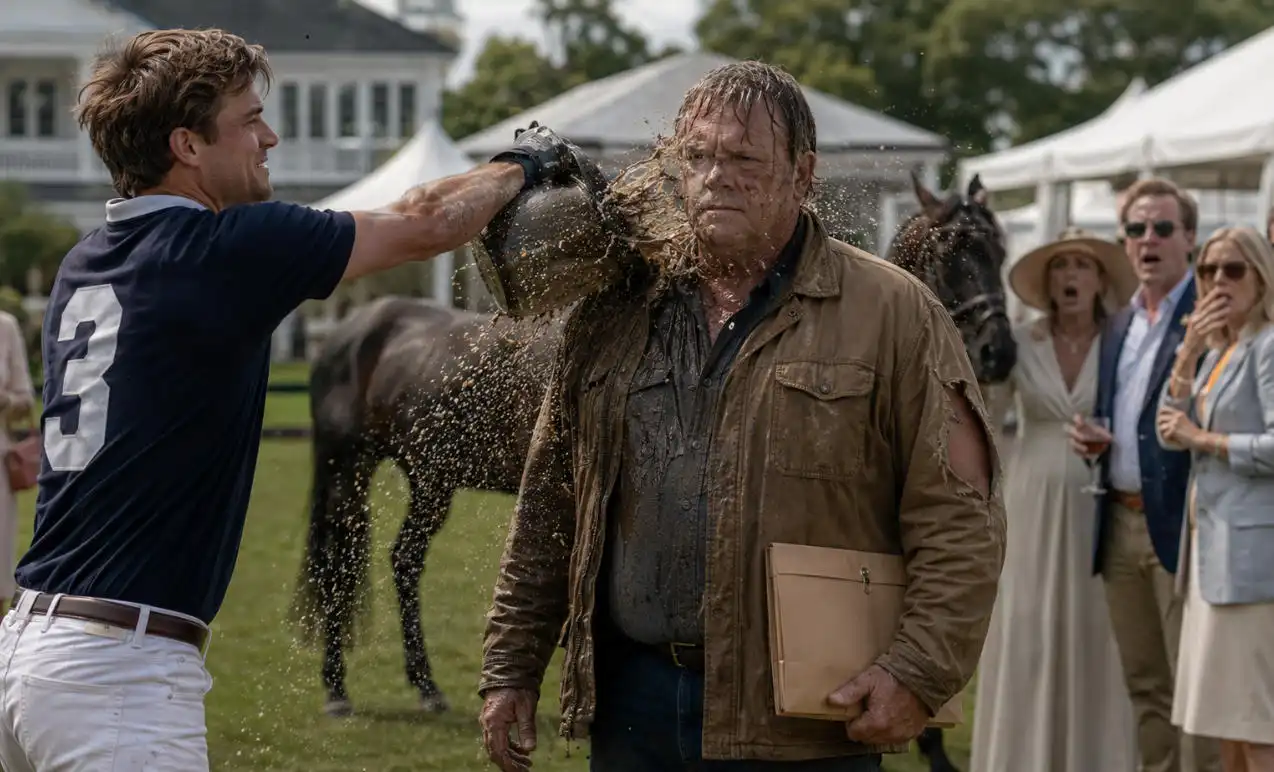
A Rich Polo Player Tore A Hardware Store Owner’s Jacket In Front Of Everyone… Minutes Later, He Was Begging On The Grass
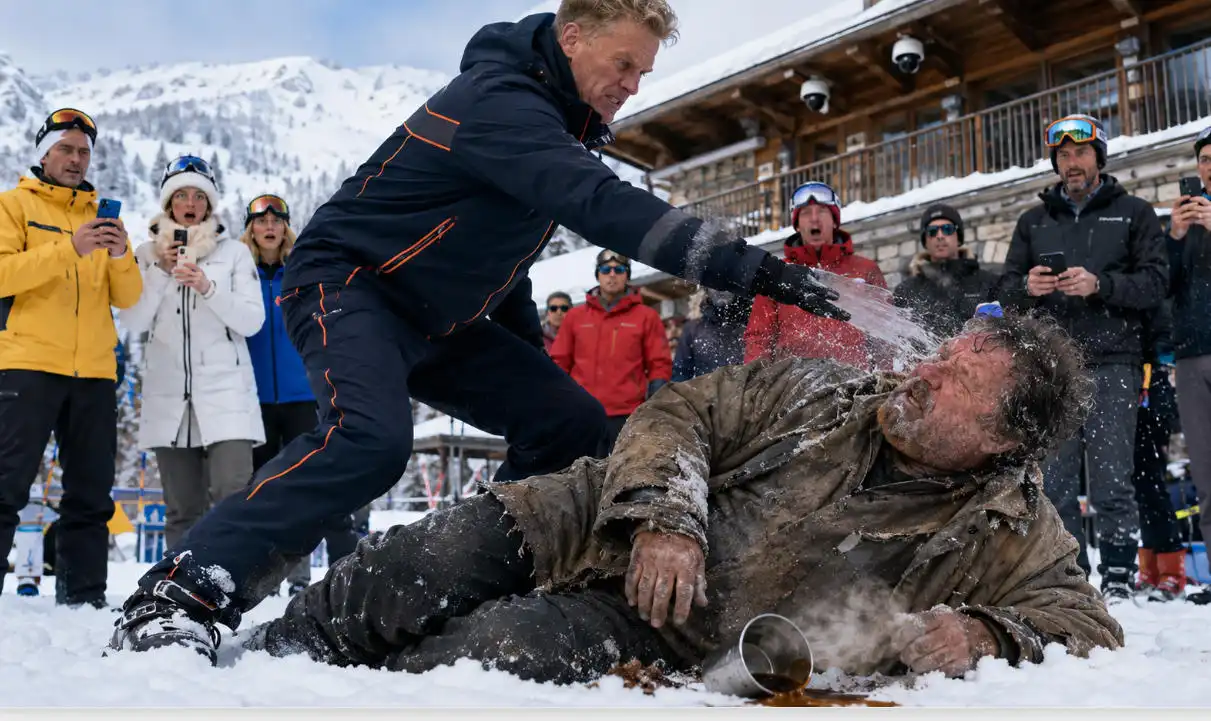
A Round-Bellied Carpenter Was Humiliated by an Elite Ski Coach in Front of Rich Guests… But Sven Had NO IDEA Who Bob Really Was 😳
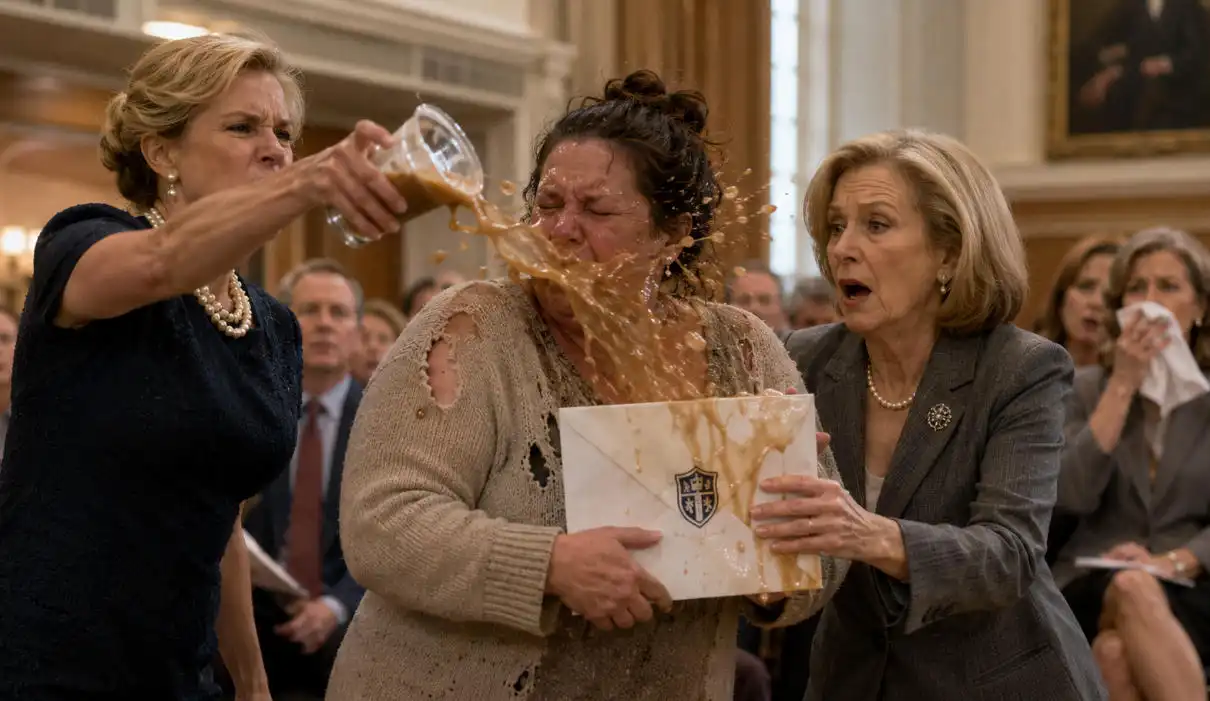
Parents Covered Their Noses When the “Cheap Mom” Walked In… Minutes Later, the PTA Queen Was on Her Knees Begging 😮