

The board members lined up in front of me.
Then they bowed.
Not a polite little nod.
Not some fake school ceremony bow.
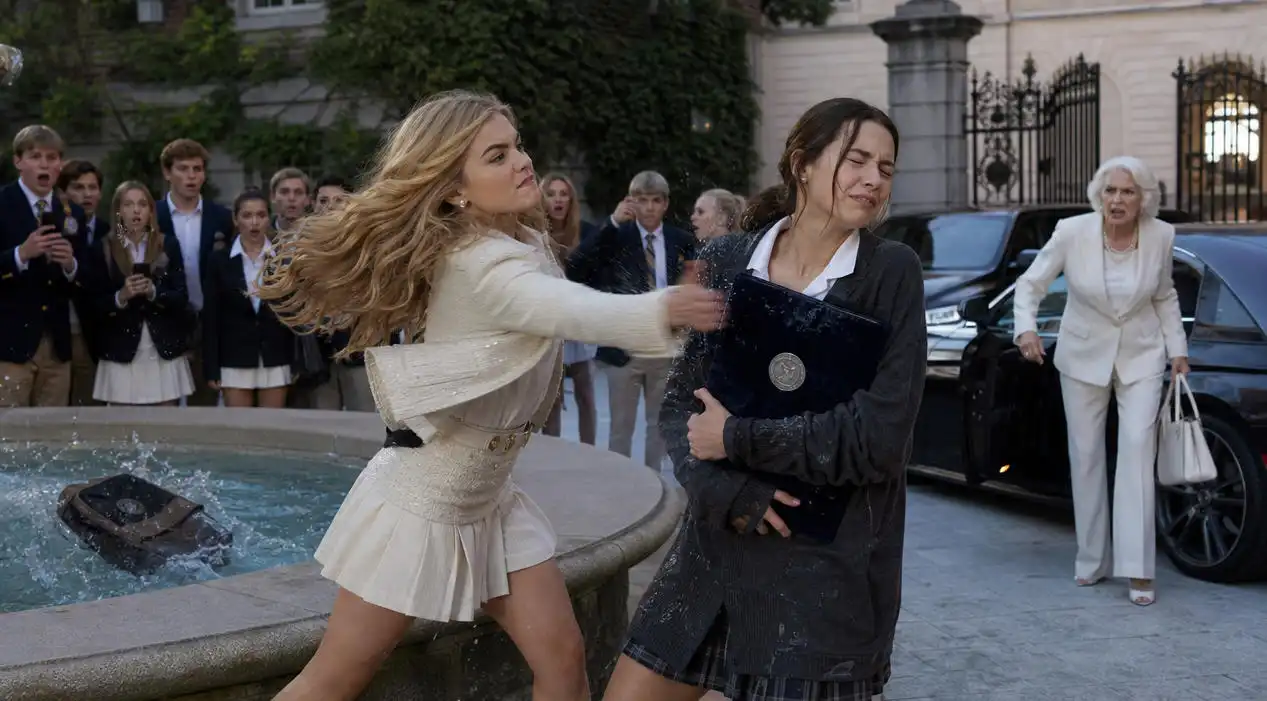
They bent at the waist in front of the girl everyone had just watched get slapped beside the fountain.
And Lexi, the mayor’s daughter, looked like the ground had disappeared under her designer shoes.
My grandmother didn’t walk fast.
She never had to.
She crossed the courtyard in a white suit, silver hair pinned neatly at the back of her head, one gloved hand resting on a black cane with a pearl handle.
Behind her stood six drivers.
Two attorneys.
And the head of security from Meridian Oceanic Group.
The company name was stitched in small letters on his jacket.
Most students didn’t know what it meant.
But the principal did.
The board did.
And judging from the way Lexi’s face drained of color, her father had probably said that name at dinner more than once.
Grandmother stopped beside me.
She didn’t look at Lexi first.
She looked at my cheek.
Then at the red mark forming there.
Then at the water dripping from my sleeves.
Then at my backpack floating in the fountain like trash.
Her mouth tightened.
“Mia,” she said softly. “Are you hurt?”
I wanted to say no.
That was my habit.
No, I’m fine.
No, don’t make trouble.
No, it doesn’t matter.
But my cheek was burning.
My hands were shaking.
My sketchbooks were ruined.
And the whole courtyard was watching me like I was no longer a person, but the final scene of a movie they had accidentally walked into.
So I said the truth.
“Yes, Grandma.”
Her eyes closed for half a second.
When she opened them, they were ice.
She turned to Lexi.
“Who are you?”
Lexi swallowed.
Nobody spoke.
The same boys who had been whistling were now lowering their phones.
One girl whispered, “Is that Eleanor Voss?”
Another whispered, “My dad works for her shipping company.”
Lexi tried to recover. She had spent her whole life performing confidence in public.
She lifted her chin.
“I’m Lexi Whitmore,” she said. “My father is Mayor Whitmore.”
Grandmother looked unimpressed.
“I did not ask who your father is.”
A few students gasped.
Lexi blinked like she had never heard that sentence before.
“I asked who you are.”
Lexi’s lips parted.
No answer came.
Because without her father’s name, without her mother’s charity galas, without the theater wing her family had paid to put their name on…
Lexi had no idea how to introduce herself.
The principal finally rushed forward.
“Mrs. Voss, please, let’s go inside. I’m sure this is all a misunderstanding.”
My grandmother looked at him.
He stopped walking.
“It was not a misunderstanding when she threw my granddaughter’s belongings into that fountain.”
The principal’s mouth opened.
“It was not a misunderstanding when she struck her twice.”
His face went gray.
“And it was not a misunderstanding when you stood behind that glass wall and did nothing.”
A silence fell so hard you could hear water dripping from my backpack.
Lexi turned toward the principal with panic in her eyes.
“Dr. Harlan, tell her. Mia started it.”
That was when I finally spoke.
“No, I didn’t.”
My voice was quiet.
But it carried.
Maybe because everyone had stopped breathing.
Lexi snapped her head toward me.
“You liar.”
I reached into the soaked velvet folder and pulled out a plastic sleeve.
The edges were wet, but the papers inside were dry.
My grandmother had always made me put important documents in waterproof protection.
“Good habits,” she used to say, “are quiet until the day they save you.”
Inside the sleeve was the letter that had brought me back to Saint Marlow Academy.
Not a scholarship letter.
Not a financial aid form.
A trustee reentry agreement.
Signed by the school board.
Countersigned by Grandmother’s legal team.
And at the bottom, under a silver seal, was one clause the school had begged my family not to make public:
My return was part of a private review of donor abuse, student harassment, and administrative negligence.
I had not dropped out because I was weak.
I had left because, the year before, a group of students had destroyed my mural project, posted videos mocking my mother’s death, and called me “charity leftovers” for three straight months.
Lexi had led them.
The school had called it “social conflict.”
My grandmother had called it “a pattern.”
And she had sent me back with one instruction:
“Do not fight them in the mud, Mia. Let them show everyone who they are.”
So I did.
For three weeks, I walked those halls silently.
I sat in art class.
I ate lunch alone.
I listened while Lexi told people I had come back because “public schools wouldn’t even take me.”
I watched the principal shake Mayor Whitmore’s hand at morning events like nothing was wrong.
I saved screenshots.
I recorded hallway conversations where legally allowed.
I kept every anonymous message.
Every threat.
Every edited photo.
Every teacher who looked away.
Every staff member who said, “Just ignore her. Graduation is soon.”
The old me wanted to disappear.
The new me documented.
Lexi didn’t know that.
She thought my silence was fear.
She thought my cheap-looking backpack meant I had no one.
She thought the quiet girl with paint on her shoes had wandered into a world that belonged to her.
Grandmother turned to one of her attorneys.
“Mr. Reed.”
The attorney stepped forward.
“Yes, Mrs. Voss.”
“Begin with the school.”
The principal flinched.
“Begin what?” he asked.
Mr. Reed opened a leather folder.
“Saint Marlow Academy entered a compliance agreement with the Voss Family Trust after documented allegations of repeated harassment, administrative failure, and donor influence in disciplinary decisions.”
The board chair, Mrs. Calloway, nodded quickly.
“Yes. That is correct.”
The principal looked like he wanted to crawl into the fountain.
Mr. Reed continued.
“Today’s incident was witnessed by students, staff, security cameras, and multiple personal recordings. The aggressor physically assaulted Miss Mia Voss in a public school courtyard after destroying personal property, including protected trust documents.”
Lexi’s eyes widened.
“Voss?”
The name finally landed.
Not Mia Carter, the name I used at school after my mother remarried.
Not “that quiet art girl.”
Voss.
The last name painted across half the ships in three major ports.
The last name on logistics contracts, museum endowments, hospital wings, and maritime foundations.
The last name my grandmother had let me hide because I begged her.
I didn’t want people to treat me like money.
I wanted to know who they were when they thought I had none.
Lexi took a step back.
“No,” she whispered.
Grandmother looked at her.
“Yes.”
One of the boys near the fountain muttered, “Bro, her grandma owns Meridian?”
His friend whispered, “My uncle said Meridian can freeze a port contract with one phone call.”
Grandmother’s cane tapped once on the stone.
“Everyone who filmed my granddaughter’s humiliation may continue filming. I want an accurate public record.”
Phones went up again.
But this time, not for Lexi.
For the consequences.
Lexi looked around, realizing the audience she had invited was no longer hers.
“Delete those,” she hissed at the students. “Delete them!”
Nobody moved.
The same crowd that had cheered for her was now hungry for the part where the queen fell.
The principal tried again.
“Mrs. Voss, please. We can handle this internally.”
Grandmother’s laugh was soft.
Terrifyingly soft.
“You had a year to handle this internally.”
He said nothing.
“You handled my granddaughter’s grief by asking her to be quieter. You handled donor misconduct by calling it teenage drama. You handled assault by watching through glass.”
The words hit him one by one.
“And now,” she said, “I will handle it externally.”
That was when Mayor Whitmore arrived.
I don’t know who called him.
Maybe Lexi.
Maybe the principal.
Maybe fear itself picked up the phone.
His black SUV pulled up fast, tires squealing near the front drive.
He climbed out in a navy suit, smiling before he even understood the scene.
That was his gift.
He could smile through anything.
“Eleanor,” he called warmly, arms open like they were old friends. “Let’s not make a spectacle out of a children’s disagreement.”
Grandmother did not move.
“This became a spectacle when your daughter made it one.”
His smile tightened.
Lexi ran to him.
“Dad, she’s lying! She set me up! She came here pretending to be poor!”
That sentence changed the air.
Even Mayor Whitmore knew it.
He turned slowly.
“Lexi.”
“What?” she cried. “She did! She tricked everyone!”
Grandmother’s eyes narrowed.
“My granddaughter existing without announcing her net worth is not a trick.”
A few students murmured.
Someone said, “Exactly.”
Lexi’s face twisted.
“She doesn’t belong here!”
I finally looked at her.
Really looked.
For the first time, she looked less like a villain and more like a terrified little girl who had been taught that kindness was weakness and money was permission.
But pity did not erase what she had done.
Mayor Whitmore stepped closer to my grandmother.
“Eleanor, let’s be reasonable. My family has supported this institution for years.”
“And mine just purchased its outstanding debt.”
The mayor froze.
The board chair cleared her throat.
“Mrs. Voss’s foundation finalized emergency acquisition of the academy’s debt instruments this morning.”
The courtyard went silent again.
This morning.
Before Lexi touched my bag.
Before the slap.
Before the fountain.
Grandmother had already moved.
Not because she knew what Lexi would do that day.
Because she knew what the school had allowed for years.
The principal whispered, “You bought the debt?”
Grandmother didn’t look at him.
“I bought the leverage you used to sell children’s dignity to donors.”
That sentence ended Dr. Harlan’s career.
You could see it happen on his face.
Mayor Whitmore’s voice dropped.
“You are making a mistake.”
Grandmother tilted her head.
“Am I?”
His smile vanished.
“You don’t want a fight with city hall.”
One of Grandmother’s attorneys stepped forward.
“Mayor Whitmore, before you continue, you should know this conversation is occurring in a public place and is being recorded by at least fifty independent witnesses.”
The mayor looked around.
Every phone was pointed at him now.
He adjusted his jacket.
“Fine,” he said. “Then let’s discuss this inside.”
Grandmother looked at me.
“Mia, do you want to go inside?”
I looked at the fountain.
At my ruined backpack.
At the students.
At Lexi’s red face.
At the principal’s glass hallway.
Then I said, “Yes.”
Not because I was afraid.
Because the next part deserved a room with a table.
The principal’s panoramic office overlooked the entire campus.
I had been there once before.
Last year.
My mother had just died, and Lexi’s group had printed a picture of me crying at the funeral and taped it to my locker with the words “Orphan Art Sale.”
I reported it.
Dr. Harlan sat behind that same polished desk and told me, “Mia, sometimes students from different social backgrounds struggle to connect.”
Different social backgrounds.
That was what he called cruelty.
Now he sat on the other side of the office while my grandmother stood at the window, looking down at the fountain.
Lexi sat beside her father, trembling.
Two board members stood near the wall.
Mr. Reed placed documents on the desk.
My folder.
Printouts.
USB drives.
Security stills.
Screenshots.
Witness statements.
And a thick packet labeled: Whitmore Civic Holdings — Exposure Report.
Mayor Whitmore noticed it immediately.
“What is that?”
Grandmother turned from the window.
“Your family’s business interests.”
His jaw clenched.
“My private business has nothing to do with a schoolyard incident.”
“Your private business,” Mr. Reed said calmly, “has benefited from municipal pressure, school development contracts, and donor-linked procurement arrangements. Those arrangements became relevant when your family used influence to protect your daughter from disciplinary action.”
The mayor stood.
“That is defamatory.”
“No,” Grandmother said. “It is documented.”
Lexi began crying.
Not the kind of crying that comes from remorse.
The kind that comes from losing control of the room.
“Dad, make them stop.”
But for the first time all day, her father couldn’t.
Mrs. Calloway, the board chair, stepped forward.
“Effective immediately, Dr. Harlan is suspended pending formal review.”
The principal stared.
“What?”
“Your access to school systems will be disabled,” she said. “Security will escort you out.”
His lips moved, but nothing came out.
Grandmother looked at Lexi.
“Miss Whitmore is expelled under the conduct clause regarding assault, harassment, property destruction, and retaliatory bullying.”
Lexi shot out of her chair.
“You can’t expel me! My name is on the theater!”
Mrs. Calloway swallowed.
“The board has voted to remove the Whitmore name from campus pending legal review.”
Lexi screamed.
Actually screamed.
“No! That’s my building!”
My grandmother’s voice was flat.
“It was never your building. It was a sign your father paid for.”
Mayor Whitmore slammed a hand on the desk.
“This is war.”
Grandmother finally smiled.
It was not warm.
“No, Mayor. War requires two sides with equal footing. This is accountability.”
Then Mr. Reed’s phone buzzed.
He glanced at it.
“Mrs. Voss, the financial exposure notice has been filed. Meridian partners have begun pulling pending contracts from Whitmore Civic Holdings.”
Mayor Whitmore turned pale.
“You did what?”
Grandmother tapped her cane once.
“You built your family’s empire on borrowed confidence. Confidence is fragile.”
Another phone buzzed.
Then another.
The mayor pulled out his own phone.
His face changed as he read.
First confusion.
Then disbelief.
Then panic.
Lexi saw it.
“Dad?”
He didn’t answer.
Because calls were coming in faster than he could silence them.
Investors.
Partners.
Lenders.
Reporters.
The city ethics office.
A text flashed across his screen:
Margin position under review.
Then another:
Whitmore Civic stock halted pending investigation.
Mr. Reed checked his watch.
“Thirty minutes,” he said quietly.
Grandmother nodded.
I did not cheer.
I did not laugh.
I thought I would feel big and powerful watching them fall.
Instead, I felt something heavier.
I felt all the days I had gone home and cried quietly.
All the lunches I skipped because I couldn’t face the cafeteria.
All the times adults told me to be mature while they protected the loudest bully in the room.
I felt my mother.
She had raised me before cancer took her.
She used to say, “Mia, never become cruel just because someone else is.”
That was the line I held onto.
So when Lexi collapsed into the chair, sobbing, I didn’t insult her.
I only said, “You didn’t hate me because I was poor.”
She looked up, mascara streaking down her cheeks.
“You hated me because you thought I was safe to hurt.”
No one spoke.
That was the truth in the room.
The entire ugly truth.
Some people are not cruel to everyone.
They are cruel to the people they believe cannot fight back.
Grandmother came to my side.
“Are you ready to leave?”
I nodded.
But before I walked out, I turned to the board.
“I want the art room reopened after school. Not just for students whose parents donate. For anyone who needs a quiet place.”
Mrs. Calloway blinked.
Then nodded.
“Done.”
“And I want every bullying report from the past five years reviewed by someone outside this school.”
Grandmother looked pleased.
Mrs. Calloway nodded again.
“Done.”
“And I want my backpack replaced.”
For some reason, that made one of the attorneys smile.
Lexi stared at me like she couldn’t understand why I wasn’t asking for more.
But I was.
I was asking for the thing she had never valued.
A place where quiet kids could exist without asking permission.
When we stepped back into the courtyard, the whole school was waiting.
News had already spread.
Dr. Harlan was escorted out through the side entrance.
The Whitmore theater sign was being covered.
Lexi walked behind her father with her head down, no longer surrounded by girls laughing on command.
Outside the front gate, two men in suits were already waiting for Mayor Whitmore.
Debt representatives.
Then came reporters.
Then came someone from the city.
Then came the sight nobody forgot.
Lexi’s mother arrived wearing sunglasses and a cream coat, shouting into her phone that this was “a misunderstanding.”
But the creditors didn’t care about her sunglasses.
They didn’t care about her charity board.
They didn’t care about the designer handbag on her arm.
By the time the family reached their SUV, one of the lenders had already served notice on the vehicle tied to a business line of credit.
Lexi clutched her purse.
A woman from collections reached for the branded shopping bags in the trunk.
Lexi screamed, “You can’t take that!”
The woman said, “Ma’am, these are listed assets under secured recovery.”
The courtyard watched as the rich girl who had mocked my old backpack tried to stop strangers from removing boxes of designer clothes from her own car.
It would have been easy to enjoy it.
A small part of me did.
I’m human.
But the bigger part of me felt tired.
Grandmother squeezed my shoulder.
“Do not look too long at someone else’s ruin,” she said softly. “Take your dignity and go.”
So I did.
The board members stood near the entrance.
Students lined both sides of the walkway.
Some looked ashamed.
Some looked afraid.
Some looked like they wanted to apologize but didn’t know how.
One by one, they bowed their heads.
Not because I demanded it.
Because the world had shifted and they could feel it.
I walked past them with my wet sleeves, my ruined sketchbooks, and my grandmother beside me.
I did not look back.
Not when Lexi started crying harder.
Not when Mayor Whitmore shouted into his phone.
Not when the sign with his family name came down.
At the gate, Grandmother’s driver opened the door.
Before I got in, I looked at Saint Marlow Academy one last time.
A school that had taught me pain.
A school that would now be forced to teach accountability.
Two weeks later, the official notices came.
Dr. Harlan resigned before the review finished.
Three staff members were terminated.
The school created an independent student safety board.
The art room was reopened every afternoon.
The Whitmore family faced multiple civil claims from families who had stayed silent for years because they thought nobody would believe them.
Whitmore Civic Holdings filed for restructuring after losing its largest contracts.
The mayor announced he would not seek another term.
Lexi disappeared from campus completely.
I heard she transferred to a small private program out of state.
I don’t know if she changed.
I hope she did.
Not because she deserved my forgiveness.
But because the world has enough people who confuse status with worth.
As for me, I kept painting.
Grandmother replaced my backpack with one that cost more than my first car would have.
I hated it.
So I bought another canvas one from a local thrift shop.
Then I drew flowers on it.
The first afternoon the art room reopened, twelve students showed up.
By the third week, there were forty.
Some were scholarship kids.
Some were rich kids.
Some were kids nobody noticed.
One freshman girl sat in the corner and cried over a sketch she didn’t want anyone to see.
I sat beside her.
I didn’t ask what happened.
I just handed her a pencil.
She whispered, “People are mean here.”
I looked around the room.
At the new cameras.
At the open door.
At the posted policy that said every harassment report would be reviewed externally.
Then I said, “They used to be protected here.”
She looked at me.
I smiled.
“They’re not anymore.”
That was my ending.
Not Lexi fainting.
Not her family losing everything.
Not the school board bowing.
The real ending was a quiet room full of students who finally had somewhere safe to breathe.
Still, people argue about what happened.
Some say Lexi was just a teenager and the punishment was too much.
Some say her family got exactly what they had built for themselves.
I know what I believe.
A person’s true character shows when they think nobody important is watching.
Lexi thought she was humiliating a powerless girl.
Instead, she exposed every powerful adult who had been helping her.
So pick a side and share this:
Was Mia right to let Lexi face every consequence — YES or NO?
Disclaimer: Mention of any brand or trademark is for identification only and does not imply partnership or endorsement
A Rich Polo Player Tore A Hardware Store Owner’s Jacket In Front Of Everyone… Minutes Later, He Was Begging On The Grass

A Round-Bellied Carpenter Was Humiliated by an Elite Ski Coach in Front of Rich Guests… But Sven Had NO IDEA Who Bob Really Was 😳
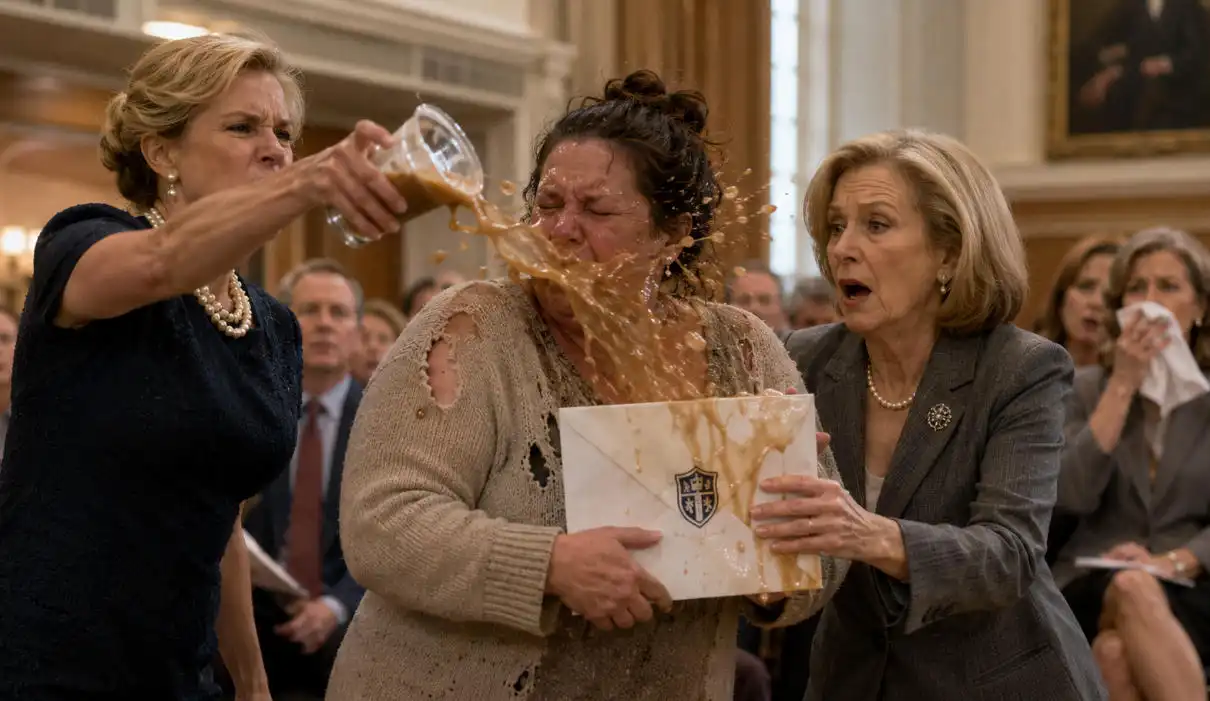
Parents Covered Their Noses When the “Cheap Mom” Walked In… Minutes Later, the PTA Queen Was on Her Knees Begging 😮