



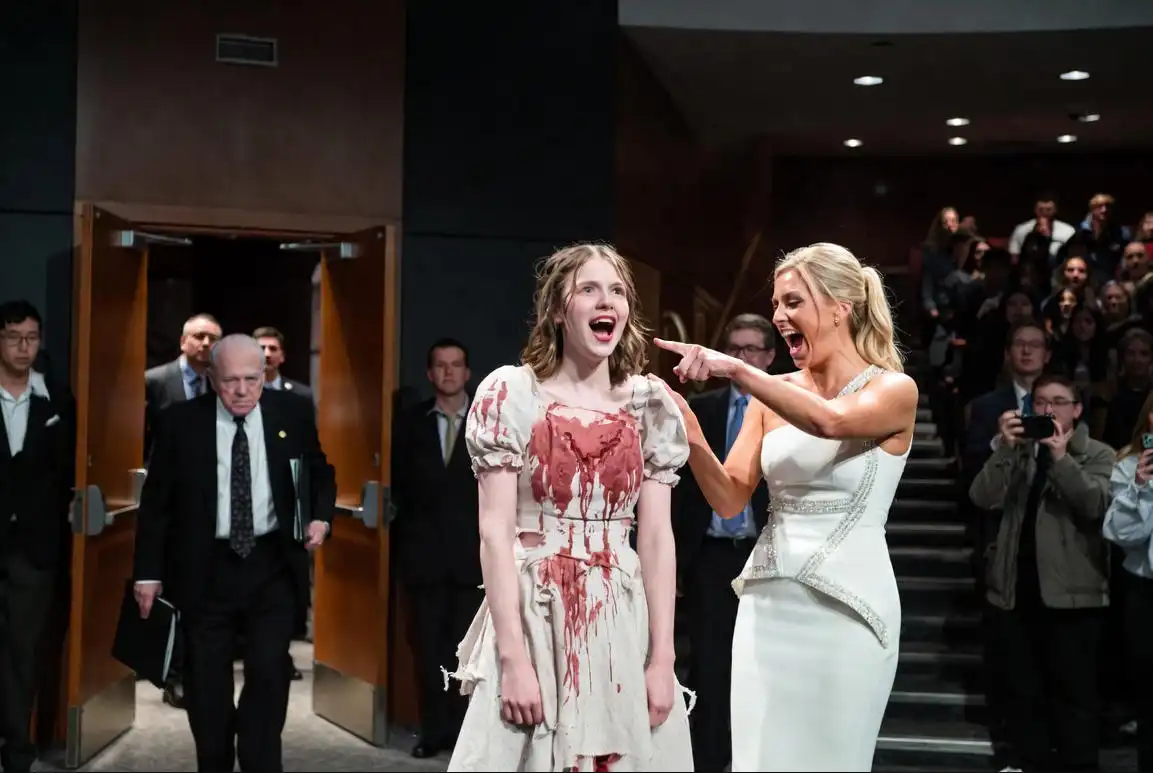
Lexi made me walk onto a thousand-seat stage with my dress sliced open and red ink dripping down my chest—then told everyone, “This is what happens when charity cases forget their place.”
The entire auditorium went quiet.
Then someone laughed.
Then another.
Phones came up.
Whispers spread through the rows of students, parents, donors, and town officials.
“Isn’t she the library assistant?”
“That’s Sophia.”
“She works the front desk.”
“She shouldn’t have come here dressed like that.”
Lexi stood near the stage steps in a white designer dress, smiling like she had just won a trophy.
Her father was the mayor.
Her mother chaired the scholarship committee.
And me?
I was the quiet girl who shelved books after class.
The one who wore plain flats.
The one who never corrected anyone when they assumed I was poor, powerless, and alone.
Lexi leaned close enough for only the front rows to hear.
“You really thought you were going to win tonight?”
I looked down at the red ink soaking into my thrift-store dress.
Twenty minutes earlier, my dress had been hanging in the changing room.
By the time I found it, the seams had been cut.
The back had been ripped.
And someone had poured red ink across the front like a warning.
Lexi didn’t even deny it.
She just tilted her head and said, “Oops. Guess the library girl had an accident.”
Her friends giggled.
A few students pointed.
One whispered, “Why doesn’t she just leave?”
Because I had learned one thing working inside that library:
People tell the truth when they think nobody important is listening.
And Lexi had been careless.
So had her parents.
So had the scholarship board.
For six months, I had watched files disappear.
Donation records change.
Deserving students get rejected.
And one last name kept appearing where it didn’t belong.
Lexi.
That night, she thought the red ink was her final humiliation.
She didn’t know it was also evidence.
She didn’t know every hallway camera had already backed up to a private server.
She didn’t know the “old man” who came to the library every Tuesday was not just a lonely retiree reading financial newspapers.
And she definitely didn’t know why I stopped crying the moment the auditorium doors opened.
Because when the doors burst inward, the laughter died.
A line of private security walked in.
Behind them came attorneys carrying sealed folders.
And behind them…
Was the man Lexi’s father had spent twenty years trying to impress.
He looked at me.
Then he looked at the red ink on my dress.
Then he said one sentence that made Lexi’s smile disappear:
“Who touched my granddaughter?”
👇 Full Story is in the comments.
But be honest first:
If someone publicly destroyed your clothes and tried to steal your future, would you forgive them… or let the law finish what they started?
Score: 116/120
【C】— REELS + TEXT-TO-VIDEO / IMAGE PROMPTS 12s SORA2 VIDEO PROMPT
VIDEO PROMPT: A hyper-realistic American drama short for Facebook Reels, 12 seconds, cinematic handheld camera, no special effects. Inside a packed thousand-seat college auditorium during an awards ceremony. Sophia, a plain 26-year-old white library assistant in a damaged thrift-store dress, stumbles from a backstage changing room, red ink dripping down her chest. Lexi, a polished 24-year-old mayor’s daughter in a white designer dress, shoves Sophia’s shoulder and sneers, “Charity girls don’t belong on this stage.” Students gasp, laugh, point, film on phones. Sophia grips a torn sleeve, humiliated but silent. Lexi laughs loudly. Suddenly the auditorium doors slam open. A powerful elderly Wall Street billionaire in a black suit enters with serious private security and attorneys. He says coldly, “Who touched my granddaughter?” Lexi’s smile collapses. Realistic lighting, intense facial emotion, no text, no watermark.
REELS COVER IMAGE PROMPT
IMAGE PROMPT: Hyper-realistic 16:9 American college awards auditorium, a plain young white library assistant in a torn thrift-store dress stands onstage covered in red ink, shocked but holding herself together. A polished blonde mayor’s daughter in a white designer dress points and laughs beside her. In the background, an elderly billionaire in a black suit enters through open doors with attorneys, carrying sealed folders. Students watch and film on phones. Cinematic handheld feel, intense faces, one red-stained dress as evidence, no text, no watermark.
【D】— FULL STORY
Lexi’s smile disappeared the second the old man spoke.
“Who touched my granddaughter?”
No one moved.
Not the students filming from the aisle.
Not the donors in the front row.
Not the mayor, who had been sitting under the golden lights with a proud little smile on his face just five seconds earlier.
I stood on the stage in a ruined dress, red ink dripping from my sleeves onto the polished wood.
My name was Sophia Bell.
To that town, I was just the quiet library assistant.
The girl who checked out books.
The girl who wore plain shoes.
The girl who said “yes, ma’am” and “no, sir” even when people treated me like I was furniture.
Lexi Whitmore was the mayor’s daughter.
She was beautiful in the way expensive things are beautiful.
Perfect blonde hair.
White designer dress.
Diamond earrings.
A smile that looked sweet until you were the one standing beneath it.
The awards ceremony was supposed to be the biggest night of the year at Halston Community College.
A thousand-seat auditorium.
Parents in church clothes.
Students whispering in the aisles.
Local business owners shaking hands.
The scholarship board lined up onstage like royalty.
And Lexi stood in the middle of it all like she owned the room.
Maybe she thought she did.
Her father was Mayor Whitmore.
Her mother chaired the Whitmore Educational Foundation.
Her family name was on half the buildings in town.
Mine was on a timecard in the library basement.
That was the difference between us.
At least, that was the difference everyone thought they saw.
Twenty minutes before I was called to the stage, I had gone into the small changing room behind the auditorium.
My navy dress was hanging from a hook.
It wasn’t fancy.
I had bought it secondhand and sewn the loose hem myself.
But it was clean.
It fit.
And for once, I had felt like I might belong.
When I returned from the restroom, the door was cracked open.
The dress was on the floor.
The back seam had been cut open with scissors.
The left sleeve was sliced nearly off.
Across the front, red ink had been poured in a thick, ugly splash.
For a moment, I just stared.
My hands went cold.
Then I heard laughter behind me.
Lexi stood in the doorway with two of her friends.
One of them held up her phone.
Lexi looked at the ruined dress and made a sad little face.
“Oh no,” she said. “Looks like the scholarship girl had an accident.”
I looked at her.
“Why would you do this?”
She stepped closer.
Because people like Lexi never whisper when they think they are untouchable.
“Because you were becoming annoying,” she said. “You smiled too much around the donors. You answered questions too well. And you actually thought that little essay of yours was going to beat mine.”
“It did beat yours,” I said.
That was when her smile sharpened.
“For about ten minutes.”
Her friend laughed.
Lexi reached down, picked up the ruined dress with two fingers, and pressed it into my arms.
“Put it on.”
I backed away.
“No.”
She glanced toward the hallway.
“You can wear it, or you can miss the ceremony. Either way, you lose. But if you miss it, everyone will just assume the poor little library girl got scared.”
I should have walked out.
I should have called someone.
I should have done anything except what I did.
But I had spent months being invisible.
Months watching.
Months waiting.
And I knew something Lexi didn’t.
Her little act of cruelty had just become the final piece.
So I put on the dress.
My hands shook while I fastened what was left of it.
The fabric gaped at the back.
The red ink was still wet.
When the announcer called my name, the room went quiet in that awful way people go quiet before deciding whether to laugh.
“Sophia Bell, finalist for the Whitmore Merit Scholarship.”
I stepped out.
The first gasp came from the right side of the auditorium.
Then a student in the back snorted.
Then phones lifted.
By the time I reached the center of the stage, Lexi was already there, standing beside the podium like the queen of the town.
She covered her mouth.
Not in shock.
In performance.
“Oh, Sophia,” she said loudly enough for the front rows to hear. “You could’ve asked my mother for help before coming out looking like that.”
A few people laughed.
Someone whispered, “That’s so embarrassing.”
Another voice said, “She works at the library, right?”
I felt every stare.
Every camera.
Every smirk.
My cheeks burned so badly I thought I might faint.
Lexi leaned close.
“Smile,” she whispered. “This is the closest you’ll ever get to standing beside me.”
That was when I stopped crying.
Because the old man in the back row had stood up.
He had been coming to the library every Tuesday for almost a year.
Gray hair.
Dark coat.
Old leather briefcase.
He always sat by the finance section and read The Wall Street Journal.
Most people ignored him.
Lexi had once called him “the dusty old stock guy.”
I knew him as Grandpa Nathan.
But the world knew him as Nathaniel Bell.
Retired Wall Street titan.
Founder of Bellmont Capital.
A man who had once moved markets with one phone call.
A man who had disappeared from public life after my mother died and my father abandoned me.
A man who found me again through a legal notice buried in an old county record.
A man who had spent the past year sitting quietly in that library, not because he was lonely…
But because he was watching.
Watching the town.
Watching the Whitmores.
Watching me.
The auditorium doors opened hard.
Two private security officers in black suits entered first.
No weapons.
No shouting.
Just presence.
The kind that makes liars suddenly remember their manners.
Behind them came three attorneys.
One carried a sealed folder.
Another carried a tablet.
The third carried a small evidence box.
And behind them came my grandfather.
His face was calm.
That was what scared people.
Not anger.
Not yelling.
Calm.
He walked down the center aisle while every whisper in the auditorium died one by one.
Mayor Whitmore stood.
“Nathaniel,” he said, his voice cracking just enough for people to notice. “What a surprise. We weren’t expecting—”
My grandfather didn’t look at him.
He looked at me.
At the red ink.
At the cut fabric.
At my hands gripping the torn sleeve.
Then he asked the question that froze the room.
“Who touched my granddaughter?”
Lexi laughed once.
It was small and nervous.
“Granddaughter?”
My grandfather turned toward her.
His eyes did not blink.
“Yes.”
Lexi looked at me like I had turned into someone else.
“No,” she said. “No, she’s the library assistant.”
“I am,” I said quietly.
The microphone picked it up.
The whole room heard.
“I’m also Sophia Bell.”
You could feel the air change.
A sound moved through the auditorium.
Not a gasp.
Not a whisper.
Something heavier.
Recognition.
Because the Bell name meant something to the adults in that room.
It meant old money.
Real money.
Quiet money.
The kind that didn’t need its name on a banner.
Lexi’s mother stood near the scholarship table, gripping her pearls.
“This is inappropriate,” she said. “This is a student ceremony.”
One of my grandfather’s attorneys opened the folder.
“So was stealing scholarship funds,” she said.
The room went dead silent.
Mayor Whitmore’s face changed.
Just a flicker.
But everyone saw it.
My grandfather nodded to the attorney.
“Proceed.”
The attorney stepped to the podium.
“My name is Elaine Porter. I represent Bell Family Holdings and Miss Sophia Bell. We have spent six months reviewing the Whitmore Educational Foundation, the scholarship selection process, and related donor fund transfers.”
Lexi’s father forced a laugh.
“This is absurd. You can’t just walk into a public event and make accusations.”
Elaine tapped the tablet.
A screen behind the stage lit up.
That screen had been prepared for winner photos.
Now it showed a spreadsheet.
Rows of donations.
Scholarship accounts.
Transfers.
Names.
Dates.
The first name highlighted was Lexi Whitmore.
Elaine continued.
“In February, Miss Whitmore was added as a scholarship finalist despite missing two mandatory academic requirements.”
Murmurs spread.
“In March, three qualified applicants were removed from the finalist pool after their essays were marked incomplete. The original files were later found in a deleted folder on the foundation’s shared drive.”
One of the students in the third row stood up.
“That was me,” he said. “They told me my application was missing pages.”
Another voice shouted from the left.
“Mine too.”
Lexi’s mother shook her head.
“Administrative errors happen.”
Elaine clicked again.
The screen changed.
Email records.
Subject lines.
Names.
A message from Lexi to her mother appeared.
Elaine read it out loud, calmly.
“Mom, make sure the library girl doesn’t get the final spot. Daddy said the donors will understand if I’m the face of the foundation.”
Lexi lunged toward the podium.
“Turn that off!”
A security officer stepped between her and the screen.
The auditorium erupted.
People stood.
Parents turned toward the mayor.
Students started recording again, but this time nobody was laughing at me.
Lexi’s mother shouted, “Those emails are private!”
Elaine looked at her.
“Not when they are part of a court-authorized forensic review involving donor fraud.”
That was the first hammer.
The legal one.
The second came from my grandfather.
He raised one hand.
The room slowly quieted.
“Three years ago,” he said, “I created an anonymous donor fund for students in this county. The condition was simple. The money was to go to students with financial hardship, strong academic records, and community service.”
His voice stayed even.
“Not political families.”
Mayor Whitmore swallowed.
“I had no idea—”
My grandfather looked at him then.
“You signed the compliance forms.”
No one breathed.
Elaine clicked again.
A signed document appeared.
Mayor Whitmore’s signature sat at the bottom.
Then another.
And another.
My grandfather continued.
“You certified that no board member’s immediate family would receive preferential treatment. You certified that all finalists were reviewed blind. You certified that donor funds were not being redirected into administrative accounts controlled by your wife.”
Lexi’s mother sat down hard.
The woman beside her moved away slightly, as if scandal could stain fabric.
Lexi looked at her parents.
“Daddy?”
But the mayor was staring at the screen like it might disappear if he hated it hard enough.
It didn’t.
Elaine clicked once more.
Now the screen showed security footage.
The hallway outside the changing room.
Lexi entering with her friends.
Lexi holding scissors.
One friend carrying a bottle of red ink from the art department.
The timestamp was clear.
The angle was clear.
The whole auditorium watched her destroy my dress.
Not a rumor.
Not gossip.
Not my word against hers.
Proof.
Lexi whispered, “No.”
The footage continued.
It showed her laughing.
Holding up the dress.
Pressing it into my arms.
Her own voice came through the auditorium speakers.
“Put it on, or everyone will assume the poor little library girl got scared.”
A woman in the audience gasped, “How dare she.”
That sentence broke something open.
People started talking all at once.
“She did that on purpose?”
“To that poor girl?”
“In front of everyone?”
“After stealing the scholarship?”
Lexi spun toward the crowd.
“You don’t understand! She was trying to take something from me!”
I looked at her.
For the first time all night, my voice did not shake.
“I earned it.”
She sneered.
“You shelve books.”
“I also carry a 4.0 GPA.”
That hit harder than I expected.
The room quieted again.
“I work thirty hours a week,” I said. “I tutor veterans on Saturdays. I wrote my essay between closing shifts. And when your mother’s committee erased my file, I didn’t scream. I saved the rejection email. I requested the access logs. I printed every version history the library server backed up.”
Lexi stared at me.
“You did what?”
My grandfather’s mouth barely moved.
“She learned patience.”
Elaine lifted the evidence box.
“This contains the original ink bottle, the scissors, the damaged dress, authenticated file logs, donor records, and sworn statements from two foundation staff members who were pressured to alter applicant rankings.”
Lexi’s two friends began crying.
One of them pointed at Lexi.
“She told us it was just a prank.”
Lexi turned on her.
“Shut up!”
Her father finally snapped.
“Lexi, stop talking.”
But it was too late.
For all of them.
Two men in suits entered from the side aisle.
Not bodyguards.
Federal financial crimes investigators.
The mayor’s knees seemed to weaken before the rest of him did.
Elaine spoke again.
“Formal complaints have been filed regarding donor fraud, document falsification, misuse of educational funds, retaliation against a scholarship applicant, and destruction of personal property.”
Lexi’s mother whispered, “Nathaniel, please. We can fix this privately.”
My grandfather looked at her for the first time.
“You made it public when you let my granddaughter stand on that stage covered in ink.”
That line landed like thunder.
The audience clapped once.
Then again.
Then the whole room erupted.
Not for revenge.
For justice.
Lexi covered her ears.
“No! Stop!”
Her mother rushed toward my grandfather.
She didn’t quite kneel at first.
She bent.
Then folded.
Then ended up on the floor beside the stage steps, crying.
“Please,” she said. “Think of our family.”
My grandfather looked at me.
Not at her.
At me.
And for a second, I was not on a stage.
I was eight years old again, sitting on the steps outside a foster office with a plastic bag of clothes.
I was twelve, learning not to ask why my father never came.
I was nineteen, working double shifts so I could pay for night classes.
I was every version of myself that had learned to stay quiet because loud people always seemed to win.
My grandfather’s voice softened.
“Sophia decides whether we settle the property damage and harassment claims privately.”
Every eye turned to me.
Lexi stared like she finally understood I was not furniture.
I looked at the ruined dress.
The red ink.
The phones.
The students who had laughed because it was safer than defending me.
Then I looked at Lexi.
She whispered, “Sophia, please.”
Not “I’m sorry.”
Not “I was wrong.”
Just please.
Because consequences had finally entered the room.
“No,” I said.
One word.
Clean.
Calm.
Free.
Elaine nodded.
“Then we proceed.”
The next week, everything fell faster than anyone in that town believed possible.
The Whitmore Foundation was frozen pending investigation.
The donors pulled out.
The scholarship board resigned.
The mayor’s family business, Whitmore Development Group, lost two major contracts after investors learned foundation money had been routed through consulting fees tied to their real estate arm.
Their stock in a related public company plunged.
Lines of credit were suspended.
Two properties connected to fraudulent filings were seized by court order.
For the first time in her life, Lexi’s last name could not buy silence.
Her father resigned before the council could remove him.
Her mother was charged in the financial scheme.
Lexi faced charges connected to harassment, destruction of property, conspiracy to falsify records, and participation in the scholarship fraud.
When reporters caught her leaving the courthouse, she was not wearing diamonds.
She was wearing yesterday’s makeup and the expression of someone who had confused popularity with power.
She saw me across the steps.
For a moment, she looked like she might shout.
Then her lawyer grabbed her arm.
She lowered her head.
That was the closest thing to humility I ever saw from her.
But the part people remember most did not happen at the courthouse.
It happened one month later, back at the college.
The ceremony was held again.
This time, the auditorium was full for a different reason.
Not gossip.
Not scandal.
Witness.
The scholarship had been renamed the Bell Integrity Scholarship.
The selection process was made blind, audited, and public.
Every student whose application had been erased was reinstated.
Three received full awards.
The boy from the third row won one of them.
So did the single mother who had cried when she learned her essay had never been read.
And then my name was called.
“Sophia Bell.”
I walked onto the stage in a midnight blue couture gown my grandfather had sent to my room that morning.
Not because I needed expensive fabric to have worth.
But because, as he wrote in the note:
“You were never plain. You were simply surrounded by people too shallow to recognize grace.”
I kept that note folded inside my purse.
My grandfather stood in the front row.
He did not clap loudly.
He simply placed one hand over his heart.
That nearly broke me.
The applause rose around me.
Students stood.
Parents stood.
Even the staff stood.
I accepted the award, but I did not give the speech people expected.
I did not call Lexi evil.
I did not say I hoped she suffered.
I looked out at the same auditorium that had watched me bleed red ink onto a stage.
And I said:
“Humiliation only works when good people agree to watch quietly.”
The room went still.
I continued.
“If you laughed that night, I hope you become braver. If you filmed, I hope next time you help. If you stayed silent because you were afraid, I understand. I was afraid too.”
My voice shook then.
But I kept going.
“And if you have ever been treated like you were invisible, I want you to know something. Sometimes silence is survival. But it does not have to be surrender.”
People cried.
I did too.
After the ceremony, my grandfather took my hand and led me outside.
A helicopter waited on the athletic field.
The whole thing was ridiculous.
Loud.
Dramatic.
Exactly the kind of exit Lexi would have dreamed of.
But this time, it wasn’t vanity.
It was closure.
As we crossed the wet grass, rain began to fall.
Light at first.
Then harder.
Behind the police barrier near the parking lot, Lexi stood with her attorney.
No designer dress.
No laughing friends.
No crowd obeying her.
Just mud splashing onto her shoes while reporters shouted questions she was not allowed to answer.
Our eyes met.
For a second, I saw the girl beneath the costume.
Angry.
Terrified.
Empty.
She mouthed something.
Maybe “sorry.”
Maybe not.
I did not stop to find out.
My grandfather helped me into the helicopter.
The blades roared above us.
The blue gown moved around my knees.
Below, the town grew smaller.
The auditorium lights blurred in the rain.
And for the first time in my life, I did not feel like someone waiting to be chosen.
I had chosen myself.
Months later, the court cases moved forward.
The Whitmores lost their influence.
Their properties remained tied up in civil claims.
The foundation was rebuilt under independent oversight.
Lexi eventually accepted a plea connected to the destruction of evidence and fraud participation.
She did not disappear into a cartoon villain ending.
She entered the real world.
The one with bills.
Records.
Consequences.
My grandfather asked me once if I regretted refusing the private settlement.
We were sitting in the library, at the same table where he had pretended to be a lonely old man reading finance news.
I thought about Lexi’s face.
Her mother crying.
The crowd gasping.
The ruined dress sealed in an evidence bag.
Then I thought about the students whose futures had almost been stolen quietly.
“No,” I said.
He nodded.
“Good.”
I smiled.
“You knew I’d say that.”
“I hoped you would.”
The old red ink stain never fully came out of the stage floor.
The college tried cleaning it twice.
Eventually, they covered that section with a small brass plaque.
Not with my name.
I asked them not to.
The plaque reads:
Dignity is not granted by the powerful. It is defended by the brave.
Every year, new students walk past it.
Some know the story.
Some don’t.
But I do.
I remember the laughter.
I remember the silence.
I remember the exact moment the doors opened and the people who thought I was nobody learned the truth.
I also remember something more important.
My grandfather did not save me because I was rich.
He stood beside me because I had already saved myself with patience, proof, and courage.
That is the part Lexi never understood.
Power is loud.
But truth waits.
And when truth finally walks into the room…
Even a thousand people stop laughing.
⚖️ So pick a side:
Team Sophia: Let the law expose every lie. Team Lexi: It was “just a prank” and went too far.
Share this if you believe public humiliation deserves public accountability.
Disclaimer: Mention of any brand or trademark is for identification only and does not imply partnership or endorsement
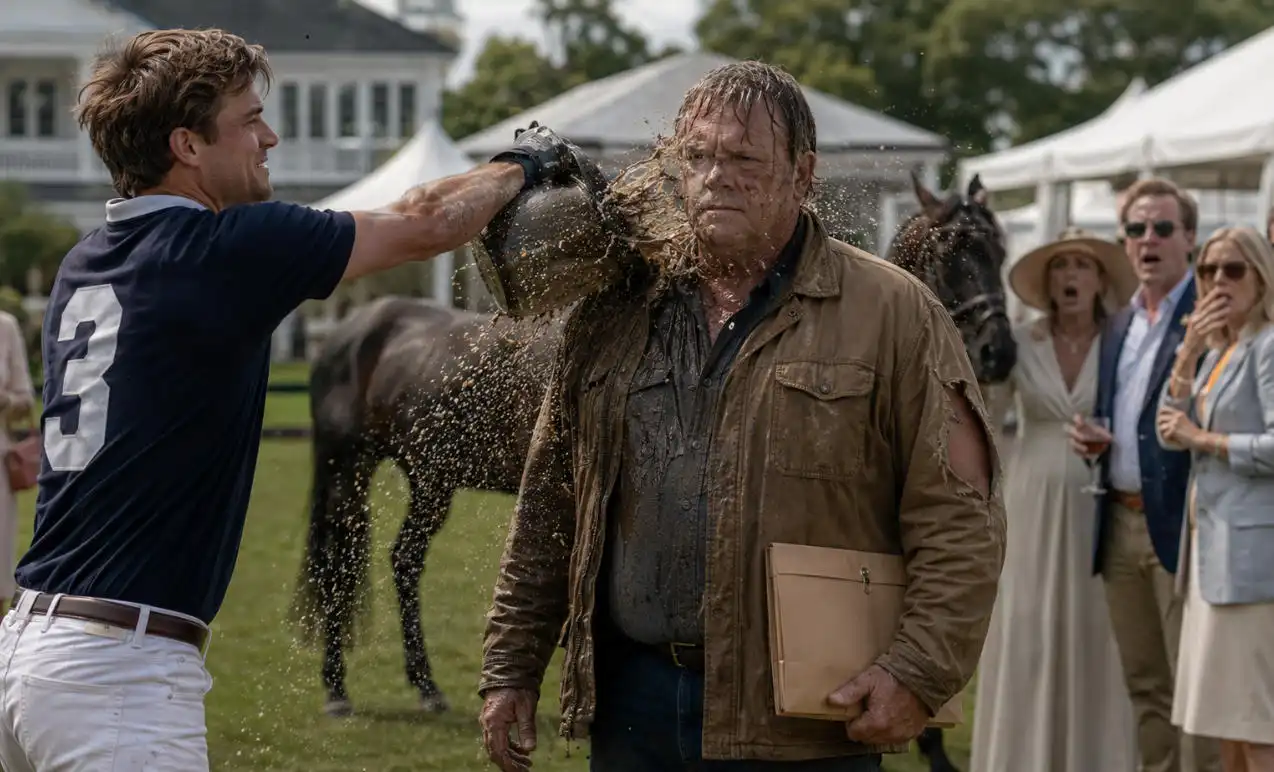
A Rich Polo Player Tore A Hardware Store Owner’s Jacket In Front Of Everyone… Minutes Later, He Was Begging On The Grass

A Round-Bellied Carpenter Was Humiliated by an Elite Ski Coach in Front of Rich Guests… But Sven Had NO IDEA Who Bob Really Was 😳

Parents Covered Their Noses When the “Cheap Mom” Walked In… Minutes Later, the PTA Queen Was on Her Knees Begging 😮