

“Sir, do you want wireless… or command?”
That was all Hobber said.
No anger.
No trembling voice.
No dramatic speech.
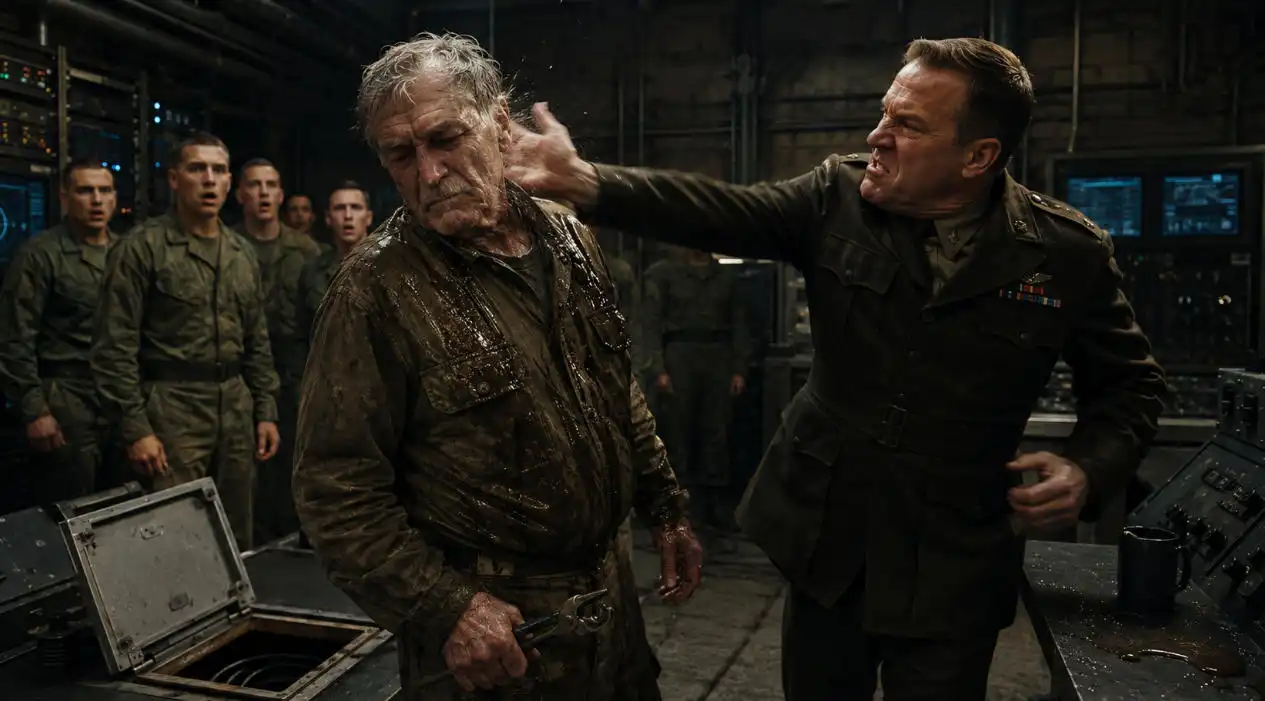
Just seven words from an old cable-laying soldier with coffee running down his uniform and a red mark spreading across his cheek.
Major David Cole stood frozen in the center of the underground communications room.
Five minutes earlier, he had been smiling for visiting officers, bragging about his satellite mesh, his wireless relay towers, his electronic warfare dashboard, and his “future-proof command network.”
Five minutes earlier, he had called Hobber a relic.
Five minutes earlier, he had slapped him in front of everyone.
Now every screen was black.
The command room looked like a church after the candles had gone out.
No uplink.
No backup radio.
No secure satellite channel.
No clean signal from the field training grid.
Just static, dead monitors, and the sound of men realizing their expensive toys had stopped obeying them.
A young communications private sat at Console Four with both hands shaking.
“Major,” he said, barely above a whisper, “we lost external relay.”
David snapped, “Then reroute through the mobile array.”
“Already tried.”
“Then use the airborne repeater.”
“Dead too, sir.”
“Then stop staring at me and fix it.”
The private looked at the black screen.
“There’s nothing to fix on this end, sir. There’s nothing coming through.”
The visiting colonel at the rear of the room slowly turned toward David.
“You told us this system had four layers of redundancy.”
David swallowed.
“It does.”
Hobber stood near the maintenance hatch, still holding those old iron pliers.
He was not impressive to look at.
His boots were scuffed.
His hands were scarred.
His hair was gray and cut short, the way old soldiers keep it even after the war is done with them.
His name tape said HOBBER.
Most of the young soldiers only knew him as the old infrastructure guy who smelled like dust, copper, machine oil, and rain.
He laid cable.
He inspected conduit.
He crawled into places nobody else wanted to crawl.
He was the man people called when the glamorous systems had to touch the real world.
And that was exactly why David hated him.
Major David Cole was the kind of officer who liked glass walls, bright screens, and language that made ordinary men feel stupid.
He loved saying things like “legacy dependency,” “obsolete physical burden,” and “wireless dominance architecture.”
He never said “cable.”
He said “residual infrastructure.”
He never said “old soldier.”
He said “institutional drag.”
That morning, when Hobber entered the training camp communications room carrying a tool roll and a coil tag, David had laughed in front of the whole team.
“Well, look who crawled out of the Cold War.”
A few younger soldiers laughed too.
Not because it was funny.
Because David was powerful.
Because David wrote evaluations.
Because David had a way of ruining careers with a sentence.
Hobber had only nodded.
“Morning, Major.”
David looked at the iron pliers in Hobber’s hand.
“You still using those museum pieces?”
“They still cut when asked.”
David smirked.
“So does a rock, Sergeant.”
Hobber had retired from active combat years earlier, then returned as a base infrastructure specialist because nobody knew the underground lines like he did.
Technically, he was not a sergeant anymore.
But old habits stuck.
So did old respect.
Except David had none to spare.
The trouble began when several trainees reported flickering signal loss from the lower relay bay.
Hobber checked the floor markings and saw the problem immediately.
The new wireless cabinet had been bolted over the old conduit map.
Someone had routed equipment through a restricted physical access lane.
Someone had ignored the orange tags.
Someone had treated the underground backbone like junk because it didn’t blink or beep.
Hobber said quietly, “Major, you’re sitting on a critical physical route.”
David looked up from his tablet.
“I’m sitting on the future.”
“No, sir. You’re sitting on the emergency hardline.”
The room went still.
David’s smile sharpened.
“Are you correcting me in my own command center?”
“No, sir. I’m telling you what the floor says.”
That was when David picked up the paper cup of coffee.
He did not throw it like a man losing control.
He poured it slowly.
Right down Hobber’s chest.
The coffee darkened the old soldier’s jacket and dripped onto his boots.
A few soldiers looked away.
One of them actually raised a phone, then lowered it when David saw him.
David stepped close.
“You know what your problem is, Hobber?”
Hobber said nothing.
“You people mistake age for wisdom. You mistake habit for value. You mistake dirt under your nails for expertise.”
Then he slapped him.
The sound cracked off the concrete walls.
Nobody moved.
David pointed at the cable bundle near Hobber’s feet.
“Cut every physical line connected to this room.”
Hobber blinked once.
“Sir, that would violate emergency continuity protocol.”
David’s face flushed.
“My protocol is modern warfare.”
“Sir—”
“Cut them.”
Hobber did not.
He lowered his eyes to the old markings on the floor.
Blue.
Yellow.
Gray.
One gray path disappeared beneath a sealed hatch stamped with faded letters:
FEDERAL CONTINUITY LINE — AUTHORIZED ACCESS ONLY
David saw him looking.
“Oh, now you’re reading floor paint like scripture?”
Hobber said, “Some paint was written in blood.”
That got a bigger laugh from David.
“Listen to the poet with pliers.”
Then the sky outside went strange.
Nobody saw the solar storm directly from the underground room.
They felt it in pieces.
First, the overhead lights buzzed.
Then the wall clock jumped backward.
Then one monitor flickered white and died.
Then another.
Then the satellite status panel dropped from green to amber to red.
A corporal muttered, “That’s not part of the drill.”
Within ninety seconds, the proud wireless command network was a field of black screens.
David barked orders.
People typed.
People unplugged and plugged.
People rebooted systems that had nothing left to receive.
Every expensive backup David had bragged about depended on signals moving through air, relays, exposed towers, or electronically vulnerable paths.
And the storm did not care how polished his briefing slides were.
The colonel stepped to the emergency red phone.
He lifted it.
No tone.
A second senior officer entered from the side hall.
“We just lost upper command sync.”
David snapped, “That’s impossible.”
The officer looked at him coldly.
“It is happening.”
The room filled with the kind of silence that only appears when trained people understand the size of a mistake.
This was a training camp.
But the continuity link was not a toy.
That line existed for a reason.
When every elegant system failed, a hardened physical path still had to carry priority command traffic.
Not because it was glamorous.
Because it was stubborn.
Because it was buried.
Because physics does not care about pride.
David turned toward Hobber.
For the first time that morning, he did not look amused.
“Hobber.”
The old soldier did not move.
David’s jaw tightened.
“Can you restore the physical route?”
Hobber glanced at the coffee stain on his chest.
Then at the young soldiers who had laughed.
Then at the sealed hatch.
He said, “I can inspect it.”
The colonel cut in.
“Do it.”
David said quickly, “Colonel, with respect, we don’t know if he’s current on—”
The colonel stared at him.
“Major, your system is dead.”
That ended the debate.
Hobber knelt by the hatch.
His knees cracked when they touched the floor.
Two privates rushed forward.
He held up one hand.
“Slow.”
They stopped.
He pointed to the gray conduit.
“Not that latch. The rear one.”
One private frowned.
“How do you know?”
Hobber looked at him.
“Because the front latch was replaced after the ’91 flood and never aligned right.”
The private’s mouth opened.
David looked uncomfortable.
The colonel noticed.
“You knew that?”
Hobber did not answer.
He opened his tool roll.
Inside were not fancy devices.
Just hand tools, tape, tags, a small inspection light, and those iron pliers.
David whispered, “This is absurd.”
Hobber heard him.
He said, “So is slapping the man who knows where your command line runs.”
No one laughed this time.
The hatch opened with a long metal groan.
A damp breath came up from below.
The underground communications well was narrow, ugly, and completely unworthy of a recruitment commercial.
It smelled like dust, old insulation, concrete, and history.
Hobber climbed down without asking for help.
A corporal tried to follow.
Hobber said, “You stay where I can hear you.”
“What do you need?”
“Light on my left. Read the tag numbers back when I call them.”
David hovered above the hatch.
The colonel stood behind him.
The young soldiers gathered around, not laughing now, not smirking, not filming.
Just watching.
Hobber’s voice echoed from below.
“Gray line is pinched.”
David said, “Pinched?”
Hobber called back, “By your new cabinet anchor.”
The room froze.
The colonel turned slowly toward David.
David’s face drained.
“That installation was approved.”
Hobber’s voice rose from the darkness.
“By who?”
Nobody answered.
The colonel looked at the operations log.
A captain pulled it up on a local tablet that still had battery.
The installation approval had David’s digital signature.
The emergency hardline clearance warning had been marked “nonessential legacy conflict.”
David had personally overridden it.
The colonel’s expression changed.
Not loud.
Worse.
Official.
“Hobber,” he said, “can it be restored?”
There was a pause below.
Then the old veteran answered.
“Yes, sir. But I need the room quiet.”
For ten minutes, nobody breathed wrong.
Hobber worked below them in the old well with a flashlight beam shaking across conduit walls.
He did not explain every move.
He did not perform for the room.
He used the calm rhythm of a man who had fixed things while people screamed, while engines burned, while dust fell from ceilings, while younger men prayed.
One private whispered to another, “How does he know this stuff?”
The colonel heard.
“He was there when the first hardened routes were laid.”
Another soldier said, “I thought he was just maintenance.”
The colonel looked down the hatch.
“That word has saved more lives than most medals.”
Below, Hobber’s hand closed around a damaged section.
He remembered another place.
Another sky.
Another day when a communication line went dead in gunfire and men started shouting into radios that could not answer.
He had been younger then.
Stronger.
More afraid than he ever admitted.
A fiber line had been severed between two blasted walls.
No one could get a spool through the open lane.
So Hobber crawled.
Not because he was brave in the way movies sell bravery.
Because a trapped unit needed coordinates.
Because dead silence kills.
Because somebody had to carry the line.
He had wrapped the broken end in his bare hands, dragged it under fire, and held it steady while another soldier tied the connection back together.
He lost two fingernails that day.
He kept the pliers.
He never told the story unless paperwork forced him to.
That was the thing men like David never understood.
The quietest people in a room are often quiet because they have already heard worse.
Back in the training camp, the colonel checked his watch.
“Seven minutes.”
David whispered, “This can’t possibly work.”
Hobber’s voice came from below.
“It doesn’t need your faith, Major.”
A few soldiers looked down to hide their faces.
The old man was not shouting.
That made it better.
He was simply done being small.
At nine minutes and forty seconds, Hobber called up.
“Console Four. Check continuity.”
The private at Console Four stared at his dead screen.
“Sir, I don’t—”
“Check it.”
The private switched to the local diagnostic panel.
A tiny green light appeared.
Then another.
Then a line of text blinked onto the black screen.
PHYSICAL CONTINUITY PATH DETECTED
The private’s eyes widened.
“I have signal.”
The room snapped awake.
The colonel stepped forward.
“What kind?”
The private’s hands flew over the keys.
“Priority hardline. Buried route. Direct command channel is responding.”
A second console beeped.
Then a third.
A secure indicator flashed green.
The red phone rang.
No one moved for half a second.
Then the colonel picked it up.
“Training Camp Delta continuity room. Receiving.”
His face changed.
The whole room watched him listen.
“Yes, sir. Physical path restored.”
He looked down into the hatch.
“By Specialist Hobber.”
David closed his eyes.
The colonel listened again.
“Yes, sir. I understand.”
He hung up slowly.
Then he faced the room.
“Continuity signal has been preserved. Command confirms receipt.”
Nobody cheered at first.
The moment was too heavy.
Then the youngest private began clapping.
One clap.
Then another.
Soon the whole room was applauding.
Not loud like a party.
Deep like relief.
Hobber climbed out of the well with dust on his sleeves, coffee dried on his chest, and a small line of blood on one knuckle.
The colonel stepped toward him.
“Hobber.”
“Sir.”
“Your report.”
Hobber handed him three things.
A damaged tag from the restricted conduit.
A photo from his inspection light showing the cabinet anchor crushing the route.
And a printed emergency protocol David had ordered removed from the wall two months earlier.
David stared at the paper.
“You printed that?”
Hobber looked at him.
“I document what people try to bury.”
The colonel took the papers.
Then he turned to David.
“Major Cole, you overrode a protected physical continuity line.”
David spoke fast.
“Sir, the network modernization timeline required—”
“You humiliated the technician who warned you.”
“Sir, I did not intend—”
“You ordered critical emergency lines cut.”
“That was before the storm escalated.”
The colonel stepped closer.
“You poured coffee on a subordinate in a command room and struck him in front of witnesses.”
David’s mouth opened.
No words came out.
The young soldiers were watching now.
All of them.
The same eyes that had looked away when Hobber was slapped were fixed on David as his authority drained from him.
That was the first punishment.
The legal hammer came next.
The colonel ordered the room log preserved.
Phones were collected for evidence.
Security footage was pulled.
The installation approval was locked.
The override memo was traced.
David had not merely been arrogant.
He had lied.
Two months earlier, Hobber had filed a warning that the new wireless cabinet placement violated underground route clearance.
David had buried the warning because it threatened his modernization showcase.
He had marked it as “resolved.”
It was not resolved.
He had called the physical line obsolete.
It was not obsolete.
He had told visiting officers the room was fully redundant.
It was not.
The investigation moved fast because the evidence was clean.
And because everyone had watched him do it.
By nightfall, Major David Cole was removed from command duties pending formal review.
By the end of the week, his promotion packet was withdrawn.
By the end of the month, he was transferred out of strategic communications entirely.
The official wording was dry:
Reassigned to remote monitoring duty at a joint Arctic forward station pending separation review.
The soldiers had another name for it.
Siberia.
Not literally, perhaps.
But cold enough.
Far enough.
Quiet enough.
And there were no shiny briefing rooms there.
No audience to impress.
No young soldiers to bully.
No coffee to pour on an old man who had already carried worse through gunfire.
He was never approved again for command communications authority.
As for Hobber, the apology came in stages.
First came the young private from Console Four.
He found Hobber outside the underground bay, cleaning his pliers with a rag.
“Sir?”
Hobber looked up.
“I’m not a sir.”
The private swallowed.
“I laughed this morning.”
Hobber said nothing.
“I shouldn’t have.”
“No.”
The private nodded, ashamed.
“No, I shouldn’t have.”
Hobber studied him for a moment.
Then handed him the rag.
“Clean tools after use. Apologies are better when your hands are doing something useful.”
The private took the rag.
“Yes, Specialist.”
Then came the colonel.
He did not make a speech in private.
He made it in front of the whole room.
Because the insult had been public.
So the correction had to be public too.
“Specialist Hobber warned this command of a critical vulnerability and was ignored,” the colonel said. “He maintained discipline under humiliation. He restored continuity under pressure. And he reminded this room of something we forgot.”
He looked across the young faces.
“Technology is only as strong as the people who understand what holds it up.”
Then he turned to Hobber.
“Effective immediately, you are granted highest-level technical expert status for this command region. Full access. Full authority over hardened physical continuity infrastructure. No modernization project touches those routes without your signature.”
Hobber blinked.
For the first time all day, he looked caught off guard.
“Sir, I just did my job.”
The colonel nodded.
“That is exactly why you are getting the authority.”
The room applauded again.
This time Hobber looked down.
Not embarrassed.
Not proud.
Something older than both.
Maybe grief.
Maybe relief.
Maybe the strange ache of finally being seen after years of being useful in silence.
The next morning, a new sign appeared above the underground hatch.
Not fancy.
Not dramatic.
Just a clean metal plate:
PHYSICAL CONTINUITY ACCESS SPECIALIST HOBBER AUTHORIZATION REQUIRED
A young soldier taped a smaller handwritten note beneath it before anyone could stop him:
ASK THE MAN WITH THE PLIERS.
Hobber saw it.
He stared at it for a long second.
Then he shook his head and kept walking.
But the corner of his mouth moved.
Just a little.
Weeks later, during a training review, a new class of communications soldiers sat in the same room.
The monitors were bright again.
The wireless systems worked.
The satellite panels glowed green.
The young instructor pointed toward the sealed hatch.
“Before we discuss advanced electronic relay structures, who can tell me what happens when every signal in the air fails?”
A hand went up.
“You use the buried physical path.”
“Correct. And who authorizes work near it?”
The whole class answered together.
“Specialist Hobber.”
At the back of the room, Hobber stood with his tool roll under one arm.
His iron pliers hung from his belt.
Nobody laughed.
Nobody called them junk.
One young soldier looked at him with the kind of respect that does not need decoration.
“Specialist,” she asked, “is it true you once carried a severed line under fire?”
Hobber paused.
The room went quiet.
He could have turned it into a legend.
He could have made himself bigger.
Instead, he said, “A lot of people carried something that day.”
Then he pointed at the floor markings.
“Now learn these colors. They matter.”
That was Hobber.
No speech.
No revenge dance.
No cruelty.
Just the steady dignity of a man who had been underestimated and still chose duty before ego.
David wanted the room to see Hobber as outdated.
Instead, the room saw David as dangerous.
David wanted the cables cut.
Instead, his own career got cut from command.
David wanted wireless glory.
Instead, an old buried line saved the day.
And the old veteran with coffee on his uniform walked away with the one thing proud men can never fake:
earned authority. ⚡
So choose a side:
Team David: modern systems matter more than old methods. Team Hobber: never humiliate the person who knows what keeps the world connected.
Share this if you believe respect should come before rank.
Disclaimer: Mention of any brand or trademark is for identification only and does not imply partnership or endorsement
The Tavern Owner Set A Trap To Make Paul Drink Again… But He Had NO IDEA The Entire Town Was Watching 👀
They Laughed When Mark Announced He Was Running for Office… Then One Sealed Envelope Made the Whole Room Go Silent 😳

My Stepdaughter Thought Her Real Father Paid for Her Golf Club Wedding… Then I Showed the Guests the Letter He Sent Me