



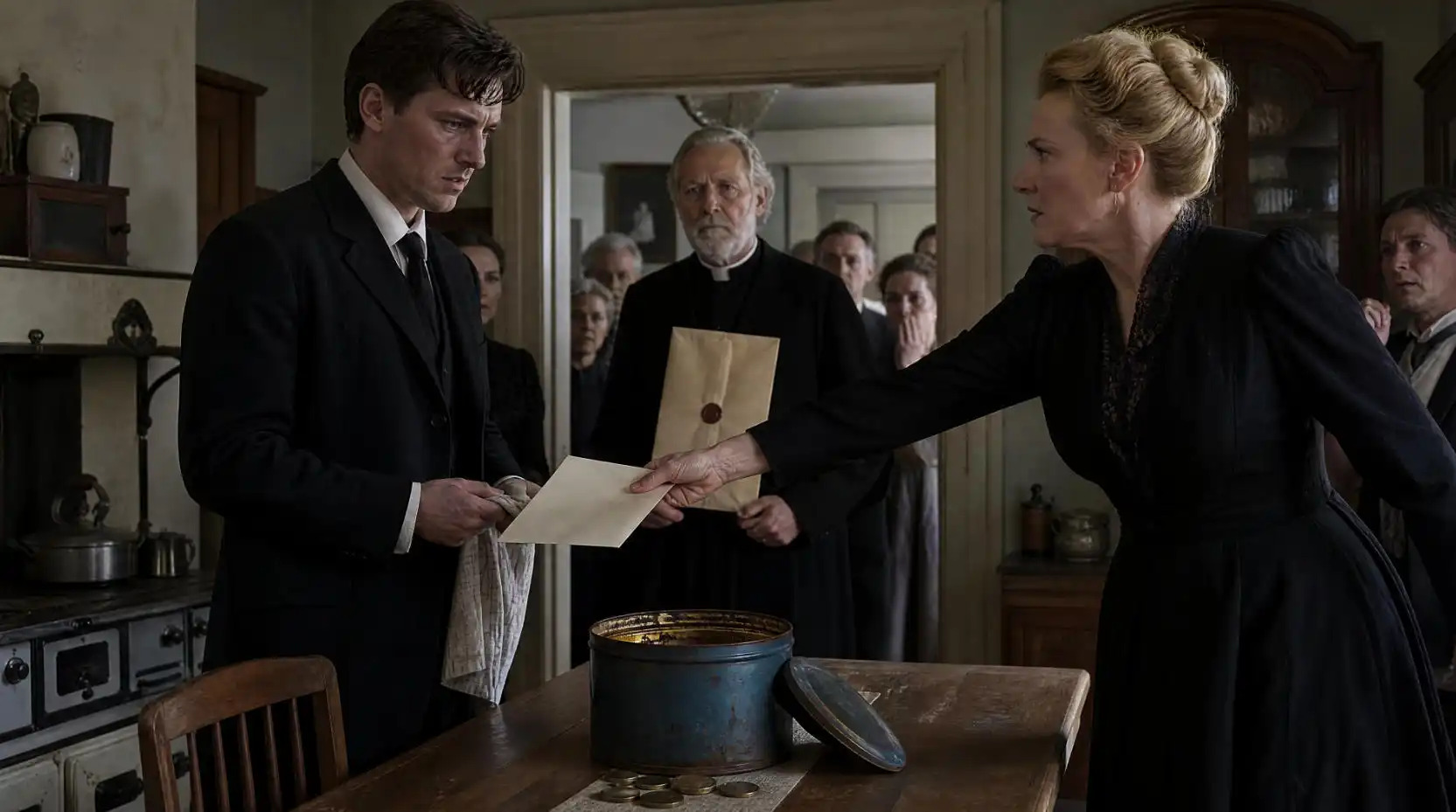
The judge cleared his throat and read the first line aloud.
Brenda Mallory was still smiling.
She thought this was another small-town sentimental performance.
She thought the old priest, the baker, and a tired civil judge had arrived to bless the sale of my mother’s house.
Then Judge Whitaker lifted the sealed envelope higher and said, “This covenant was recorded twenty-nine years ago.”
Brenda’s smile vanished.
I stood in my mother’s kitchen, holding a damp dish towel like a child who had been caught too late.
My name is Steven Caldwell.
To the outside world, I was Dr. Steven Caldwell, headmaster of Hawthorne Preparatory Academy, one of the most respected private schools in the state.
I wore tailored suits.
I shook hands with donors.
I gave speeches about discipline, leadership, and family values.
But that afternoon, in my dead mother’s kitchen, I was just the son who had not come home for fifteen years.
And Brenda Mallory made sure everyone knew it.
“You hear that?” she said loudly when the judge paused. “Twenty-nine years ago. Ancient history. That house is falling apart, Judge.”
She turned to the people crowded near the back door.
There were church ladies in black dresses.
Two neighbors from Maple Street.
My mother’s cousin June.
A young man from the funeral home, still holding a folded flower stand.
Everyone had followed me back after the burial because Mrs. Bell had insisted we should “not let Steven face that empty house alone.”
Brenda had followed for a different reason.
She wanted my mother’s land.
Not later.
Not tomorrow.
Right then.
On the same day my mother was lowered into the ground.
She looked around the kitchen as if she were touring a condemned motel.
“Grease on the stove,” she said.
She dragged one finger along the windowsill.
“Dust.”
Then she pointed at the chipped yellow tiles under my shoes.
“And this floor? Steven, your mother lived like this because she refused help.”
That stung worse than I expected.
Because my mother had called.
So many times.
I knew she had.
I knew because when I opened the rusty blue cookie tin, beneath the eight old coins and the folded will, I found a small diary.
Not a dramatic diary.
Not a confession.
Just dates.
Hundreds of them.
June 4 — called Steven, hung up before it rang.
June 19 — wanted to ask if he was eating well, did not call.
July 2 — saw his picture in the education section. Cut it out.
July 11 — called school office, secretary said he was in meetings.
August 1 — proud of my boy. Do not bother him.
Page after page.
Year after year.
Two thousand four hundred little records of a mother picking up the phone, then putting it down because she was afraid her own son was too busy to love her back.
I had read only three pages before Brenda arrived.
She did not knock.
She came through the kitchen door with an appraiser, a leather folder, and a voice sharp enough to cut meat.
“Perfect,” she said. “Everyone’s here. Witnesses are good.”
I looked up.
“Brenda, not today.”
“Oh, especially today,” she said. “Your mother is gone. The house has no protector. You don’t want it. The town doesn’t need another abandoned property.”
“It’s not abandoned,” I said.
She laughed.
“Steven, don’t embarrass yourself. You abandoned it first.”
The room went quiet.
I could feel everyone watching me.
Mrs. Bell, the baker, stood beside the sink with both hands folded over her purse.
Her eyes were red.
She had brought cinnamon rolls because that was what my mother used to bake for every grieving family in town.
Now she was watching me get carved open in the kitchen where my mother had fed half of Maple Street.
Brenda placed a contract on the table.
“Sign this. I’ll pay twelve percent under land value.”
The appraiser coughed.
“Actually, given demolition costs, that’s generous.”
“Demolition?” I said.
Brenda smiled.
“Steven. Look around. This is not a home. It’s a liability.”
She tapped the cookie tin.
“And all this little junk? I can have a cleanout crew here by Monday.”
Before I could move, she picked it up.
Something in me snapped, but not outwardly.
Not yet.
My mother had kept that tin above the stove for as long as I could remember.
When I was a boy, I thought it held cookies.
When I was a teenager, I thought it held coupons.
When I became a man too busy to visit, I stopped wondering what it held at all.
Brenda flipped the lid open.
Eight old coins rolled across the table.
A folded will slid out beneath them.
The sound was small.
Tiny.
Metal against wood.
But it silenced the whole room.
Mrs. Bell covered her mouth.
Father Thomas, our old parish priest, appeared in the doorway at that exact moment.
He was in his black suit and white collar, still damp from the rain at the cemetery.
Behind him stood Judge Whitaker.
And behind the judge was Mr. Hayes, the clerk from the county records office, holding a flat archival case.
Father Thomas looked at the open tin.
Then at Brenda.
“You shouldn’t have touched that box.”
Brenda scoffed.
“Father, with respect, I’m conducting a lawful property negotiation.”
Judge Whitaker stepped inside.
“No,” he said. “You are interrupting the reading of a recorded estate condition.”
Brenda’s appraiser stiffened.
I stared at the judge.
“Estate condition?”
The judge looked at me, and for the first time that day, his voice softened.
“Steven, your mother asked me years ago not to discuss it unless this exact situation occurred.”
“What situation?”
He glanced at the contract on the table.
“Someone trying to force the house out of your hands before you understood what she protected.”
Brenda crossed her arms.
“This is ridiculous.”
Mrs. Bell finally spoke.
“No, Brenda. What’s ridiculous is you standing in Ruth Caldwell’s kitchen on the day of her funeral, calling her home trash.”
Brenda turned on her.
“Stay out of this, Martha. You sell bread for a living.”
Mrs. Bell’s face changed.
Not angry.
Disappointed.
The kind of disappointed that makes an entire room lean in.
“I sold bread,” she said quietly, “and Ruth bought the day-old loaves for herself so she could put fresh ones in the church pantry.”
No one moved.
Mrs. Bell took one step forward.
“She wore the same winter coat for twelve years because she was saving money.”
Brenda rolled her eyes.
“For what? This dump?”
Mrs. Bell looked at me.
“For him.”
My throat tightened.
The judge unfolded the will.
Father Thomas placed the sealed envelope on the table.
Mr. Hayes opened the archival case and removed a map.
An old map.
Not just of my mother’s house.
Of the whole block.
Maple Street.
The bakery corner.
The church parking lot.
The empty lot behind the senior center.
Even Brenda’s side garden.
I frowned.
“What is this?”
Judge Whitaker said, “Your mother’s land.”
Brenda laughed once.
Too loudly.
“That’s impossible.”
The judge did not blink.
“Ruth Caldwell inherited the original tract from her grandfather. Over the years, several parcels were leased, divided, or occupied under agreements most residents forgot existed. She never evicted anyone. She never raised hardship rents. She quietly renewed use rights so families could stay.”
The room began to murmur.
Brenda’s appraiser reached for the map.
Mr. Hayes pulled it back.
“County-certified copy,” he said. “No handling.”
Brenda’s voice sharpened.
“My property is mine.”
Judge Whitaker nodded.
“Your house is yours. The ground under several improvements, however, includes a reversion covenant tied to the Caldwell Community Trust.”
Brenda went pale.
I felt the kitchen tilt slightly.
“My mother owned the land?”
Father Thomas answered this time.
“Your mother owned more than land, Steven. She owned responsibility. And she carried it without applause.”
I looked at the eight coins on the table.
Each one had a tiny strip of paper taped beneath it.
I picked up the first.
In my mother’s handwriting, it said:
For the first loaf Martha gave us when Steven was six.
I picked up the second.
For Father Thomas fixing the porch step and pretending it was nothing.
The third.
For the winter Mrs. Alvarez paid rent with tomatoes.
The fourth.
For the day Steven won his first scholarship.
My hands started shaking.
The eight coins were not valuable.
They were markers.
Little witnesses.
Eight moments when my mother had been helped, humbled, or proud.
And she had saved them like holy things.
Brenda snapped, “This does not change my offer.”
Judge Whitaker looked at her.
“It changes everything.”
He opened the recorded covenant.
“Ruth Caldwell established the Caldwell Community Trust twelve years ago. The trust controls multiple land parcels on Maple Street. The sole successor trustee is Steven Caldwell, provided he satisfies the stewardship clause.”
Brenda immediately seized on that.
“Provided,” she said. “There it is. He hasn’t. He abandoned her.”
A few people looked at me.
I deserved that look.
I had abandoned visits.
Birthdays.
Christmas dinners.
I had sent checks instead of showing up.
I had mailed flowers and called it love.
Brenda smiled again, smelling blood.
“Tell them, Judge. Tell them the perfect son failed the condition.”
Judge Whitaker read from the page.
“To inherit authority over the trust, my son, Steven, must return to my kitchen after my passing, open the blue tin, read the names attached to the eight coins, and clean the kitchen table and floor with his own hands before any contract of sale may be considered.”
A stunned silence filled the room.
Then Brenda laughed.
She actually laughed.
“That’s it? A grown man has to mop?”
Father Thomas looked at her coldly.
“No. A proud man has to serve.”
That sentence broke me.
Not because it was harsh.
Because it was true.
All my life, I had taught boys to honor their families.
I had written speeches about humility.
I had stood under chandeliers at fundraising dinners talking about character while my mother sat in this small kitchen cutting out newspaper clippings and whispering, “That’s my boy,” to no one.
And now the last thing she asked of me was not to defend her.
Not to avenge her.
Not to prove I was important.
Just to clean the room where she had loved me.
I set the will down.
I removed my suit jacket.
Brenda stared.
“What are you doing?”
I rolled up my sleeves.
No one spoke.
I took the bucket from under the sink.
The handle was worn smooth from my mother’s hand.
Mrs. Bell began to cry silently.
I filled the bucket.
I found the lemon soap.
The smell hit me so hard I had to grip the counter.
Suddenly I was eight years old again, sitting at that table with scraped knees while my mother sang badly and packed my lunch.
I was seventeen, angry and embarrassed, telling her not to wave from the porch when my friends picked me up.
I was thirty-two, ignoring her call because a donor was in my office.
I was forty-eight, standing in her kitchen too late.
Brenda tried to recover control.
“This is theater,” she said. “Judge, this cannot be enforceable.”
Judge Whitaker answered calmly.
“It is not a moral test for ownership of a private home. It is a condition attached to acceptance of trustee authority. He may refuse. If he refuses, the trust goes to the secondary board.”
Brenda’s eyes flickered.
She knew about the board.
That was my first clue.
Judge Whitaker saw it too.
“Mrs. Mallory,” he said, “interesting reaction.”
Brenda said nothing.
I knelt.
On that chipped yellow tile.
In front of neighbors, mourners, an appraiser, a judge, an old priest, and a woman who had come to buy my mother’s life at a discount.
I scrubbed.
At first, I did it because the will required it.
Then I saw the dark line under the stove where my mother’s hands could no longer reach.
I scrubbed harder.
I saw the chair leg where she had tied a loose ribbon so it would not wobble.
I scrubbed there too.
I saw a small brown stain near the pantry door and remembered dropping hot cocoa in third grade. She had laughed and said, “Every kitchen needs a memory.”
I pressed the rag to that spot and finally started crying.
Not dramatic crying.
Not movie crying.
The kind of crying you try to stop because people are watching, but your body knows it has been lying for too long.
No one mocked me.
No one filmed anymore.
Even the funeral home assistant lowered his phone.
Brenda whispered to her appraiser, “This is absurd.”
He whispered back, “I think we should leave.”
“No,” Judge Whitaker said. “You should stay.”
That was when Father Thomas opened the second envelope.
Brenda froze.
The priest said, “Ruth left another instruction if anyone attempted to coerce Steven into a sale before the stewardship clause was complete.”
Coerce.
The word sat in the room like thunder.
Brenda’s face hardened.
“I did not coerce anyone.”
Mr. Hayes placed three documents beside the map.
“One unsolicited purchase offer sent to Mrs. Caldwell six months ago.”
Another.
“One complaint filed by Mrs. Mallory alleging blight.”
Another.
“And one petition submitted to the redevelopment committee requesting emergency acquisition.”
I stopped scrubbing.
Brenda’s mouth opened.
Mrs. Bell said, “You tried to have Ruth’s house condemned?”
Brenda snapped, “It was unsafe.”
Father Thomas turned to me.
“Your mother stopped inviting people in during the last year because Brenda kept photographing the porch, the gutters, the old stove. Ruth was ashamed. She thought you would be embarrassed if you knew.”
I looked at Brenda.
The grief in me changed shape.
It became steady.
Cold.
Useful.
“You harassed my mother?”
Brenda lifted her chin.
“I pursued lawful development.”
Judge Whitaker said, “Then you will appreciate lawful consequences.”
He turned to me.
“Steven, under the trust terms, once you complete the stewardship clause, you may reject pending offers, revoke bad-faith access agreements, and initiate review of any party who attempted fraudulent pressure against the trust.”
Brenda’s appraiser whispered, “Fraudulent?”
Mr. Hayes removed one more paper.
“This valuation report lists the Caldwell property as a single distressed residential lot.”
He tapped the map.
“But Mrs. Mallory’s private redevelopment proposal values the combined land corridor at eleven million dollars.”
The kitchen exploded in whispers.
Eleven million.
I looked at Brenda.
She did not deny it.
She couldn’t.
Mrs. Bell’s voice shook.
“You offered Steven twelve percent under value because you knew the whole corridor was worth millions?”
Brenda pointed at me.
“He didn’t even know what he had!”
Father Thomas said, “That does not make theft holy.”
Brenda’s mask slipped completely.
“Oh, please. Ruth was sitting on land she didn’t use. Steven ran a school for rich people and couldn’t bother to visit. Don’t stand here pretending this is some sacred little kitchen.”
I stood slowly.
My hands were wet.
My knees hurt.
The floor was cleaner.
Not perfect.
But honest.
Judge Whitaker looked at Father Thomas.
The priest nodded.
Mrs. Bell stepped forward and placed the eight coins in a row on the table.
The judge signed the witness line.
“So recorded,” he said. “Steven Caldwell has accepted stewardship.”
Brenda grabbed her contract.
“Fine. Don’t sell. Let this place rot.”
I picked up her contract before she could pull it away.
For fifteen years, I had avoided hard conversations.
I had let assistants take calls.
I had let distance become a personality.
But my mother’s kitchen had just made me small enough to be decent again.
I tore the contract in half.
Then in quarters.
The sound was soft.
But Brenda flinched like it had slapped her.
“No sale,” I said.
Her face reddened.
“You’ll regret this.”
“No,” I said. “I already regret the part that mattered.”
Then I turned to Judge Whitaker.
“What legal options do I have?”
The judge closed the covenant.
“Several.”
Brenda tried to leave.
Mr. Hayes stepped into the doorway.
“Mrs. Mallory, the county ethics office has already requested your communications with the redevelopment committee.”
Her appraiser backed away from her.
“I was not aware of the corridor valuation discrepancy,” he said quickly.
Brenda spun on him.
“Coward.”
Judge Whitaker continued.
“If Mrs. Mallory used false blight complaints to depress valuation, if she misrepresented parcel value, or if she coordinated pressure on an elderly property owner, the trust may bring civil action.”
Father Thomas added, “And if any committee member helped her, they answer too.”
Brenda looked around for support.
She found none.
Not one neighbor.
Not one cousin.
Not one person in that kitchen would meet her eyes.
Because everyone there had eaten my mother’s food.
Borrowed her sugar.
Accepted her quiet mercy.
And Brenda had mistaken quiet mercy for weakness.
I looked at the map again.
The land was not just wealth.
It was a record of all the ways my mother had protected people without needing them to know.
The bakery corner existed because she had extended Martha Bell’s lease for one dollar during a recession.
The church parking lot existed because she had donated use rights after a storm destroyed the old gravel lot.
The senior center garden existed because she had refused to let developers pave it.
And Brenda had planned to roll all of it into a luxury retail strip with her name on the entrance sign.
Mallory Square.
That was written on the redevelopment proposal.
My mother’s block.
My mother’s people.
Brenda’s name.
That detail finished the room.
Mrs. Bell whispered, “She wanted to erase Ruth.”
Brenda’s voice cracked.
“This town needs progress.”
I said, “Progress doesn’t require stealing from widows.”
She went silent.
By sunset, Judge Whitaker had advised me to retain counsel.
By Monday, the Caldwell Community Trust filed an injunction stopping all redevelopment actions connected to Brenda’s proposal.
By Wednesday, the county opened a review into the false blight complaints.
By Friday, the appraiser submitted a sworn statement saying Brenda had instructed him to “keep the number low because the son is emotionally vulnerable.”
That sentence became the hammer.
Not gossip.
Not revenge.
Evidence.
Emails followed.
So did meeting notes.
A redevelopment committee member resigned.
Brenda’s brokerage license came under investigation.
Her bank froze financing on the Mallory Square proposal.
And then came the part she never saw coming.
My mother’s trust had a family investment clause.
Brenda was not just my neighbor.
She was a distant cousin through marriage, and years earlier my mother had allowed her small participation in a legacy family fund because, as the letter said, “Everyone deserves one chance to become better than their appetite.”
But the clause was clear.
Any beneficiary who knowingly attempted to defraud or coerce the trust forfeited all future distributions.
I did not yell when I signed the petition.
I did not curse her.
I did not celebrate when her attorney called mine and asked for “a quiet settlement.”
I simply said no.
Brenda had wanted my mother’s kitchen cleaned out.
Instead, her own paper trail cleaned her out of the family fund.
The court did not send her to prison.
This was not that kind of case.
But it took her reputation.
Her redevelopment deal.
Her seat on the local business council.
Her access to the trust.
And the public image she had polished for thirty years.
For someone like Brenda Mallory, that was a sentence she felt every morning.
The day the final order came through, I went back to the kitchen alone.
The house was quiet.
The old stove still leaned slightly to the left.
The yellow tiles were still cracked.
The blue cookie tin sat in the center of the table.
Inside were the eight coins, the diary, the will, and every clipping my mother had saved about me.
There were so many.
My first teaching award.
My appointment as assistant principal.
The charity gala where I gave a speech about educational access.
The yearbook photo where I stood beside students whose names I remembered better than my own mother’s last Christmas invitation.
I read until dark.
Then I called Hawthorne Preparatory.
Not my assistant.
Not the board chair.
I called them myself.
Two weeks later, I resigned from the daily headmaster role and accepted a smaller advisory position.
People called it shocking.
Some called it noble.
It was neither.
It was overdue.
I moved back to Maple Street.
At first, the town did not know what to do with me.
People were polite in the careful way they are polite to someone who has returned late to a funeral and stayed.
But Mrs. Bell kept bringing bread.
Father Thomas kept finding “small repairs” that required two cups of coffee.
And Judge Whitaker stopped by once with a stack of community trust documents and said, “Your mother was better at paperwork than most lawyers.”
That made me laugh for the first time in weeks.
The kitchen became the first project.
Not a museum.
Not a shrine.
A working kitchen.
We repaired the stove.
We replaced the unsafe wiring.
We kept the yellow tiles, cracks and all.
On the wall, I hung a framed copy of my mother’s handwritten line:
Every kitchen needs a memory.
Then we opened the Caldwell Community Kitchen.
Three nights a week, seniors came for supper.
On Saturdays, teenagers from Hawthorne Prep drove in to volunteer, awkward in their expensive sneakers, learning how to chop onions beside men who had worked factories longer than their fathers had owned businesses.
Mrs. Bell taught baking classes.
Father Thomas washed dishes badly and insisted he was improving.
Judge Whitaker handled napkins like a man drafting legal briefs.
And me?
I scrubbed tables.
I swept floors.
I learned the names of people my mother had loved when I was too busy being impressive.
One rainy evening, a little boy asked why there were eight old coins in a shadow box near the pantry.
I told him, “Those are reminders.”
“Of what?”
I looked around the kitchen.
At the steam on the windows.
At Mrs. Bell laughing by the oven.
At Father Thomas pretending not to steal a roll.
At the old people eating slowly because nobody was rushing them out.
“At what money can’t buy,” I said.
A month later, Brenda walked past the kitchen window.
She did not come in.
She paused on the sidewalk.
For one second, she looked smaller than I remembered.
Not poor.
Not broken.
Just stripped of the power she thought made her untouchable.
Mrs. Bell saw her and asked, “Do you want me to lock the door?”
I shook my head.
“No. My mother wouldn’t.”
That did not mean forgiveness.
Not yet.
Maybe not ever.
But it meant Brenda would not decide what kind of man I became next.
The legal case had taken from her what she tried to take from us.
The kitchen gave back what I had lost in myself.
On the first anniversary of my mother’s passing, we held a supper in her honor.
No speeches under chandeliers.
No donors.
No polished stage.
Just soup, bread, coffee, and a room full of people who had once been quietly protected by a woman the world almost mistook for ordinary.
I stood at the stove and read one page from her diary.
Not the painful pages.
Not the 2,400 calls she never completed.
One near the end.
Steven became a great man, I think. I hope someday he becomes a happy one too.
I had to stop reading.
Mrs. Bell finished it for me.
If he ever comes home, I hope he starts in the kitchen. That is where love is easiest to find.
That was my mother’s final lesson.
Not that land matters.
Not that money matters.
Not even that justice matters, though it does.
Her lesson was this:
Do not wait until a funeral to become humble.
Do not confuse a quiet parent with an empty life.
And never let a greedy person tell you the place where you were loved is worthless.
So here is the side I chose.
I did not forgive Brenda quickly.
I did not sell the house.
I did not turn my mother’s kitchen into a monument to guilt.
I turned it into a table big enough for the people she never stopped feeding.
Some people said tearing up Brenda’s contract was cruel.
Some said removing her from the family fund was too much.
But I say when someone tries to steal from a dead woman before her kitchen floor is even dry, mercy can wait until justice has finished its work. ⚖️
Choose a side: was Steven right to destroy Brenda legally, or should he have walked away and “been the bigger person”?
Share this with someone who still understands that family, dignity, and a mother’s quiet sacrifices are never for sale.
Disclaimer: Mention of any brand or trademark is for identification only and does not imply partnership or endorsement
The Tavern Owner Set A Trap To Make Paul Drink Again… But He Had NO IDEA The Entire Town Was Watching 👀

They Laughed When Mark Announced He Was Running for Office… Then One Sealed Envelope Made the Whole Room Go Silent 😳

My Stepdaughter Thought Her Real Father Paid for Her Golf Club Wedding… Then I Showed the Guests the Letter He Sent Me