

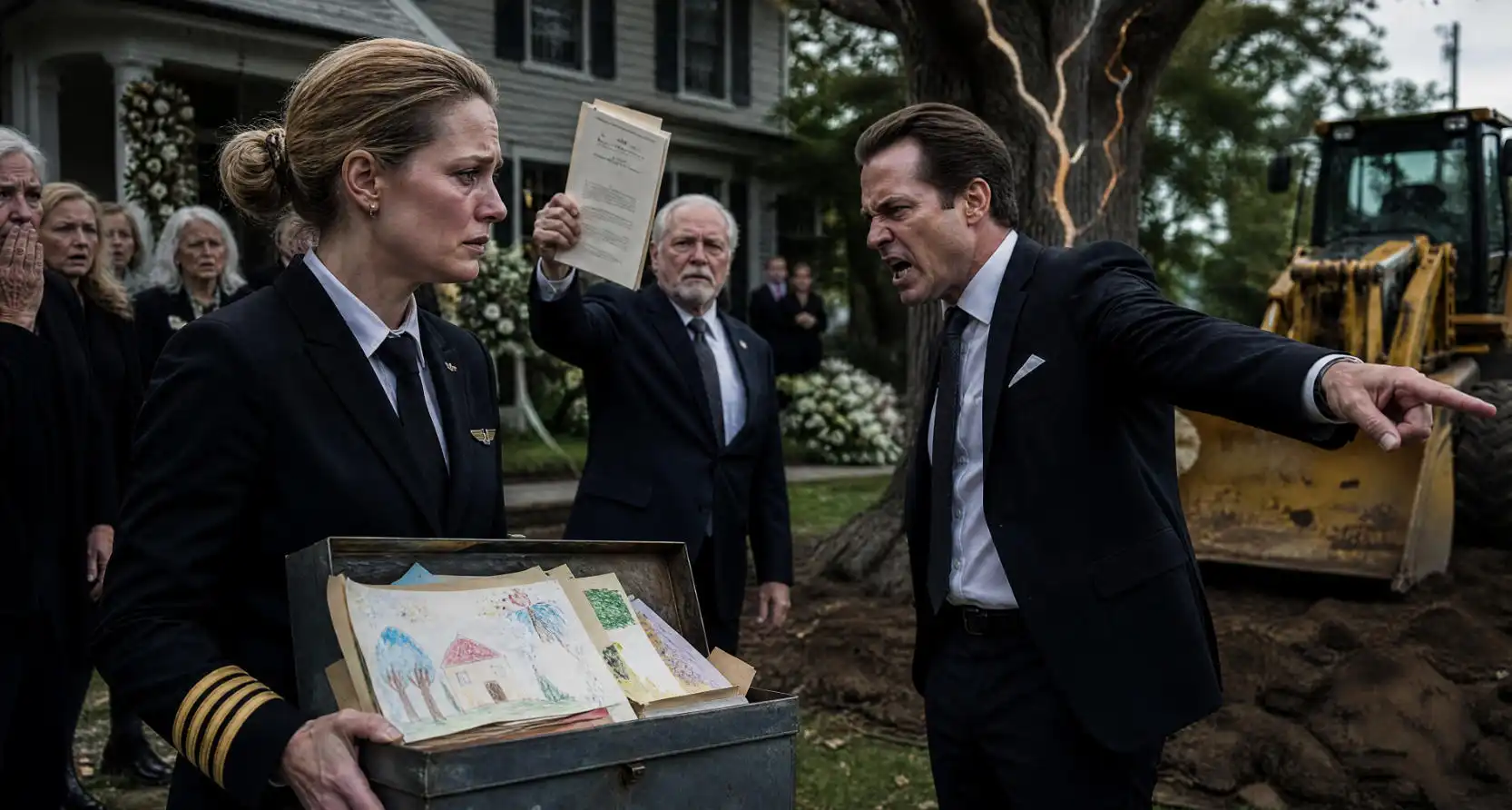
The bulldozer engine died so suddenly that the whole front yard seemed to stop breathing.
The developer’s smirk faded.
The old lawyer stood between the machine and my father’s maple tree with one hand raised, as if he were stopping traffic instead of stopping a demolition crew.
And I stood there with my father’s toolbox open in my arms, staring at the seal on the document like it had been sent from another lifetime.
The debt collector recovered first.
“Cute performance,” he snapped. “But I have a lien file, a purchase agreement, and a crew billing by the hour.”
The lawyer didn’t blink.
“And I have a federal preservation order.”
The words hit the yard like thunder.
Neighbors who had been whispering went dead quiet.
Even the bulldozer driver leaned out of the cab and said, “Federal what?”
My name is Karen Whitaker.
For twenty-one years, I have flown commercial aircraft through storms, crosswinds, engine warnings, angry passengers, and Christmas Eve delays.
I have landed planes when grown men in the cabin were praying.
I have spoken calmly while lightning crawled across the windshield.
But nothing in my life prepared me for standing in my dead father’s front yard while a greedy man tried to flatten the only place that had ever loved me without applause.
My father, Raymond Whitaker, was not famous.
Not to strangers.
He was a carpenter.
A millworker.
A man with cracked hands, a straight back, and a voice that could stop a room without getting loud.
He raised me in that little wooden house outside a small Virginia town, the kind of place where people still wave from pickup trucks and casseroles appear before anyone asks.
He also raised me with rules.
Too many rules, I thought.
Homework before television.
Church shoes polished on Saturday night.
No quitting halfway through a project.
No talking back to teachers.
No blaming other people for your own laziness.
And the one rule I hated most:
“If you want wings, Karen, you better build the runway first.”
At eighteen, I thought that sentence meant he was trying to control me.
At twenty-two, I thought it meant he didn’t believe in me.
At twenty-seven, I stopped coming home.
At thirty-one, I stopped answering his letters.
By forty-three, I had convinced myself that silence was easier than reopening an old argument.
Then the county coroner called.
A heart attack.
Quick.
Alone.
My father had died in the kitchen of the house he built with his own hands.
The funeral was small.
That was my fault.
He had no wife.
No other children.
No fancy professional circle.
Just old neighbors, former carpenters, two church ladies, a retired school principal, and me.
The daughter who flew strangers safely across the country but could not drive three hours to see her own father while he was alive.
After the burial, everyone returned to the house.
The front yard looked smaller than I remembered.
The porch sagged a little.
The fence needed paint.
The old maple tree in the front yard had a black scar running down one side from a lightning strike years earlier.
But it was still alive.
Dad used to say, “Anything worth keeping learns how to heal around the damage.”
I sat beneath that tree after the guests drifted toward the porch.
Someone had set funeral flowers on the steps.
Someone had covered the old outdoor table with foil pans.
Someone had placed Dad’s work gloves beside a framed picture of him holding a hammer.
I wanted to cry, but grief was stuck somewhere behind my ribs.
Then Mr. Dawson, Dad’s neighbor from two houses down, came over and put a rusty metal toolbox at my feet.
“Your dad asked me to make sure you got this,” he said.
I looked at it.
It was dented blue steel, the same box Dad carried to job sites when I was little.
“I don’t need his tools,” I said quietly.
Mr. Dawson’s eyes softened.
“He said you’d say that.”
That annoyed me, even then.
My father still knowing me after thirteen years of silence felt unfair.
I flipped the latch.
Inside were no hammers.
No chisels.
No wrenches.
Only paper.
Stacks and stacks of it.
Crayon drawings.
Pencil sketches.
Napkins.
Graph paper.
Construction paper faded at the corners.
My childish handwriting was everywhere.
“Karen’s Dream House.”
“Airport Hotel For Pilots.”
“Tree House With Big Windows.”
“Dad’s Workshop But Better.”
I froze.
I remembered drawing them.
I remembered leaving them on the kitchen table.
I remembered thinking he threw them away because he never said much.
But he had saved every single one.
Under the drawings was a manila bank envelope.
My name was written across the front in Dad’s block handwriting.
Inside were statements.
Years of them.
A workers’ compensation settlement account opened after Dad injured his shoulder on a job when I was seventeen.
He had never touched it.
Not once.
The balance was enough to pay for architecture school three times over.
I covered my mouth.
For years, I had told people my father crushed my dream.
For years, I believed he cared only about discipline, bills, and hard work.
For years, I thought he wanted me to be practical because he did not understand imagination.
But the truth was sitting in my lap.
He had been saving for the future I accused him of stealing.
That was when the engines arrived.
Three black pickup trucks pulled along the curb.
A white SUV followed.
Then a flatbed trailer carrying a yellow bulldozer groaned to a stop in front of the house.
People on the porch turned.
Mrs. Bell, who had brought potato salad, whispered, “Not today.”
A man in a tailored gray suit stepped out of the SUV.
He had silver hair, expensive sunglasses, and the kind of smile that never reached his eyes.
Behind him came two men with clipboards and hard hats.
The suited man looked at the house like it was already rubble.
“Raymond Whitaker’s heir?” he called.
I stood slowly, still holding the toolbox.
“I’m his daughter.”
He looked me up and down.
Black funeral dress.
Dust on my knees.
Old papers in my hands.
No pilot’s uniform.
No badge.
No polished authority.
To him, I was just a grieving woman in a yard he wanted.
“Leonard Vale,” he said. “Vale Urban Development.”
Mr. Dawson stepped forward. “This is a private funeral gathering.”
Vale smiled.
“Not anymore.”
That was the first moment people began taking out their phones.
One of Dad’s former coworkers, an elderly man named Hank, said, “You couldn’t wait one day?”
Vale didn’t even look at him.
“Business doesn’t pause for sentiment.”
Then he turned to me and held out a folder.
“Your father had outstanding debt tied to property improvements, unpaid legal fees, and municipal penalties. My company acquired the debt. We have initiated redevelopment proceedings.”
I stared at the folder but did not take it.
“This house isn’t for sale.”
Vale laughed.
Not loudly.
Worse.
Softly.
Like I had said something childish.
“Captain, waitress, cashier, whatever you are,” he said, “you clearly don’t understand how distressed property works.”
A murmur went through the neighbors.
My cheeks burned.
I had been called worse things in airports by drunk passengers.
But this was different.
This was my father’s yard.
These were the people who had brought him soup, fixed his fence, checked on him after storms.
This was public.
And Vale wanted it that way.
He raised his voice so everyone could hear.
“Your father was sitting on land he could not afford. We are offering the community something useful. Retail space. Offices. A parking structure.”
Mrs. Bell snapped, “This is a home.”
Vale pointed at the sagging porch.
“This is an obstacle.”
Then he looked at the old maple.
“And that comes down first.”
The bulldozer driver climbed into the machine.
The engine roared.
My hand tightened around the toolbox handle.
Mr. Dawson stepped in front of the yard.
Hank joined him.
Then two more elderly men.
Then Mrs. Bell, still holding a casserole dish like a shield.
Vale’s face hardened.
“Move them.”
One of his crewmen hesitated.
“They’re seniors, sir.”
“They’re trespassing on an active redevelopment site,” Vale said.
I took one step forward.
“This is still my father’s property.”
Vale leaned close enough for me to smell mint on his breath.
“Your father should have signed when I offered him money. Instead, he wasted everyone’s time pretending this shack mattered.”
My throat closed.
He smiled.
“Don’t make the same mistake.”
Then he reached toward the toolbox.
“What’s that? More junk?”
I pulled it back.
His fingers brushed the drawings and one slipped loose.
It landed in the dirt.
A crayon house with a huge tree in front.
Vale glanced down and chuckled.
“Well, that explains the problem. Your family has always confused doodles with value.”
Something in the crowd shifted.
A low, angry sound.
But I did not shout.
I did not slap him.
I did not give him the messy scene he wanted on video.
I bent down, picked up the drawing, brushed dirt from the corner, and put it back into the toolbox.
Then I said, “You’re going to want your attorney here.”
Vale grinned.
“I am the attorney’s problem, sweetheart.”
That was when the black sedan arrived.
It pulled in behind the bulldozer with calm precision.
The driver door opened.
An elderly man stepped out.
Tall.
Thin.
White hair combed neatly back.
Dark suit.
Leather briefcase.
Everyone seemed to recognize him before I did.
Mr. Dawson whispered, “Good Lord. That’s Samuel Whitcomb.”
The name meant nothing to me at first.
Then Hank muttered, “He handled the courthouse restoration. And the railroad depot case.”
Vale’s expression flickered.
Just once.
The old lawyer walked across the grass without hurry.
“Mr. Vale,” he said.
Vale took off his sunglasses.
“Samuel. You’re late to the circus.”
“No,” the lawyer said. “You arrived early to your own mistake.”
A few neighbors made sounds they tried to hide.
Vale’s jaw tightened.
“This property is encumbered.”
Mr. Whitcomb opened his briefcase.
“This property is protected.”
Vale laughed.
“By whom? The Garden Club?”
Mr. Whitcomb removed a sealed packet.
The bulldozer idled behind him.
The maple leaves stirred in the exhaust.
My father’s funeral flowers trembled on the porch railing.
Mr. Whitcomb looked at me.
“Captain Karen Whitaker, your father instructed me to read this only if Mr. Vale attempted forced demolition before probate review.”
My lips parted.
Before probate review.
Dad knew.
He had known Vale would come.
Vale snapped, “Raymond Whitaker was a stubborn old carpenter with debt.”
Mr. Whitcomb’s eyes sharpened.
“Raymond Whitaker was the lead restoration carpenter on three federally recognized historic structures in this county. His private residence contains original timber, millwork, and design elements salvaged and documented from the old East Rail Workers’ Hall after the 1978 fire, with county permission and archival record.”
The neighbors murmured.
I looked at the house.
The porch beams.
The window trim.
The carved brackets under the eaves.
Dad had always said, “Old wood remembers hands.”
I thought he was being poetic.
Mr. Whitcomb continued.
“Two years ago, Mr. Whitaker filed a preservation petition to protect this residence, the front yard, and the lightning-struck maple tree as a cultural craft site connected to regional labor architecture.”
Vale’s face had gone pale around the mouth.
“That petition was preliminary,” he said.
“It was finalized six weeks ago,” Mr. Whitcomb replied.
Then he unfolded the document.
The paper was thick.
Cream-colored.
Stamped.
Signed.
Official in a way that made even the bulldozer driver sit back.
“This is a certified federal preservation order,” Mr. Whitcomb said, loud enough for every phone recording to catch. “The property may not be demolished, altered, seized through private redevelopment pressure, or damaged pending transfer to the named preservation steward.”
Vale swallowed.
“And who is that?”
Mr. Whitcomb turned to me.
“Karen Elaine Whitaker.”
The yard blurred.
I heard Mrs. Bell gasp.
Mr. Dawson whispered, “He left it to her.”
Mr. Whitcomb removed another document.
“There is also a preservation fund attached to the property. Substantial. Released upon Mr. Whitaker’s death to the steward for restoration, public education, and craft training purposes.”
Vale’s crewmen looked at each other.
The bulldozer driver shut off the engine completely.
The sudden silence was enormous.
Vale forced a laugh.
“You expect me to believe a dead carpenter outmaneuvered a development firm?”
Mr. Whitcomb looked directly at him.
“No. I expect you to understand that he documented every contact you made.”
Then he took out a flash drive.
Vale stopped smiling.
“For eighteen months,” Mr. Whitcomb said, “your representatives pressured an elderly injured property owner to sell protected materials, misrepresented municipal penalties, acquired questionable debt through a shell company, and attempted demolition before probate notice could be served.”
Vale’s hard hat crew stepped backward.
One of them whispered, “Shell company?”
Mr. Whitcomb looked at the phones recording from the sidewalk.
“Several of Mr. Vale’s communications were sent in writing. Some were recorded legally during meetings in this very yard.”
Vale lunged for the papers.
Not far.
Not dramatically.
Just one desperate grab.
Mr. Dawson blocked him with surprising speed.
Hank stepped forward too.
Then three more old workers formed a line in front of the lawyer.
White hair.
Bent shoulders.
Work boots.
Men who had built half the town and were tired of being treated like leftover lumber.
Vale snarled, “Get out of my way.”
Hank said, “You first.”
For the first time that day, Vale looked surrounded.
Not by police.
Not yet.
By witnesses.
By neighbors.
By the kind of people men like him forget still matter.
I finally found my voice.
“Mr. Vale.”
He turned.
I took one step toward him.
“I’m going to ask you something once. Did you know this property was under federal preservation review when you brought that bulldozer here?”
His eyes flashed.
“That’s none of your—”
“Yes or no?”
He looked at Mr. Whitcomb.
Then at the phones.
Then at the silent bulldozer.
No answer.
That was answer enough.
I had spent my adult life in command.
Not loud command.
Real command.
The kind that comes from knowing checklists matter, documentation matters, timing matters, and panic kills judgment.
So I did what my father had trained me to do without either of us knowing it.
I built the runway first.
I called the airline’s legal liaison, a woman named Denise who owed me nothing except professional respect.
I said, “I need referrals for land-use counsel and federal preservation enforcement. Emergency.”
She heard my voice and asked, “Are you safe?”
“I’m in my father’s yard,” I said. “And a developer just tried to bulldoze a protected historic property during a funeral gathering.”
There was a pause.
Then she said, “Send me everything.”
Mr. Whitcomb handed me copies.
Neighbors sent videos.
Mr. Dawson gave me a recording of Vale’s project manager visiting Dad three months earlier and saying, “Old men lose paperwork all the time.”
Mrs. Bell had saved a voicemail where Vale’s assistant warned Dad that “accidents happen to empty houses.”
Hank had photographs of survey stakes appearing in the yard before any legal notice.
By sunset, the county preservation office had been notified.
By Monday morning, the city building department had opened an emergency review.
By Tuesday, Vale Urban Development’s active permit applications were frozen.
By Friday, their demolition subcontractor sent a sworn statement saying they had been told the property was “cleared and vacant.”
It had not been vacant.
It had been grieving.
And Vale knew.
The city hearing happened in a packed municipal chamber.
People came who had not attended the funeral.
Carpenters.
Teachers.
Flight attendants from my airline.
Young architecture students from a nearby college.
Reporters.
The old neighbors sat in the front row like a jury.
Vale arrived in a navy suit, flanked by lawyers.
He looked annoyed, not afraid.
Men like him do not get afraid until the rules stop bending.
The city building commissioner began with a flat voice.
“Mr. Vale, did your company attempt to commence demolition at 114 Maple Road on the afternoon of Raymond Whitaker’s funeral?”
Vale’s attorney stood.
“My client disputes the emotional framing.”
The commissioner looked over her glasses.
“The question was not emotional.”
A video played.
There he was.
On the chamber screen.
Pointing at the tree.
Saying, “That comes down first.”
Then came his other line.
“Your family has always confused doodles with value.”
A low sound moved through the room.
Not outrage exactly.
Disgust.
My face burned again hearing it.
But this time I was not alone in the yard.
Mr. Whitcomb presented the preservation order.
He presented the petition timeline.
He presented certified receipts showing Vale had been notified of pending review months before the attempted demolition.
Then came the financial documents.
The so-called debt was real only in the way a trap is real.
Dad had owed a small contractor balance from roof repairs after a storm.
Vale’s company had acquired it through a related entity.
Then they layered on administrative “fees,” inflated penalties, and redevelopment charges Dad had never agreed to.
They had not planned to collect money.
They had planned to scare him.
An elderly man.
Living alone.
Recovering from injuries.
Protecting a house full of historic craftwork and a tree tied to a preservation filing.
Vale sat very still while the commissioner read the findings.
“Your firm failed to disclose conflict of interest.”
“Your firm submitted incomplete site status paperwork.”
“Your firm attempted physical mobilization before final legal clearance.”
“Your firm exposed protected materials and a registered cultural landscape to imminent harm.”
The commissioner removed her glasses.
“Effective immediately, Vale Urban Development’s city demolition and redevelopment privileges are suspended pending full investigation.”
Vale’s attorney whispered harshly into his ear.
The commissioner continued.
“All current permit applications are revoked without prejudice to enforcement review.”
A reporter typed fast.
Phones rose.
Vale’s face changed color.
That was the first fall.
The second came in federal court.
Mr. Whitcomb connected me with a preservation litigation team.
I used my savings.
Then I used the preservation fund exactly the way Dad intended: to protect the property, not to enrich myself.
We filed for damages.
Attempted interference with protected historic property.
Fraudulent pressure tactics.
Bad-faith debt acquisition.
Emotional distress tied to the funeral-day demolition attempt.
Vale’s lawyers tried to settle quietly.
I refused the quiet part.
Not because I wanted revenge for myself.
Because my father had spent his last years being bullied by men who assumed old working people had no paper trail, no witnesses, no power, and no daughter who would finally come home.
During discovery, the full story came out.
Vale had known about the preservation petition.
His internal emails called it “the old man’s tree problem.”
One manager wrote, “If he dies before final transfer, the daughter may not know enough to stop us.”
Another replied, “She hasn’t visited in years. Move fast.”
I read that sentence three times.
She hasn’t visited in years.
They had counted on my absence.
They had weaponized my failure as a daughter.
That hurt more than any insult in the yard.
For a few days, I could barely sleep.
I kept replaying my father alone at the kitchen table, saving my drawings, filing legal papers, protecting a future for a daughter who would not answer his mail.
One night, I found a final envelope taped inside the lid of the toolbox.
I had missed it the first time.
It was addressed simply:
Karen, when you’re ready.
Inside was one page.
Dad’s handwriting.
Not perfect.
His shoulder injury had made his letters uneven.
Karen,
If you’re reading this, you came back.
That’s enough.
I know you thought I was hard on you.
I was.
Maybe too hard.
I didn’t know how to raise a girl with more sky in her than fear.
I saved your drawings because you saw homes where other people saw boards.
I saved the settlement because I wanted you to build something.
When you became a pilot, I told everyone at the diner my daughter learned the sky instead.
I was proud.
Even when you were gone.
Especially then.
Don’t let anyone tell you old things have no future.
Old wood can hold new dreams.
The maple is yours.
So is the work.
Love, Dad
I cried so hard that night I had to sit on the kitchen floor.
Not pretty crying.
Not movie crying.
The kind of crying that makes you apologize to an empty room.
“I’m sorry,” I said out loud.
Again.
And again.
And again.
The house did not answer.
But the wind moved through the maple outside, and for one foolish second, I let myself believe he heard me.
Vale’s final fall came eight months later.
The court approved a settlement and penalties large enough to end his local expansion plans.
His firm lost investors.
The city referred the permit misconduct for further state review.
His shell company structure became public.
Two executives resigned.
The demolition contractor sued him separately for misrepresentation.
And the old debt claim against my father’s estate was dismissed.
The day the dismissal came through, Mr. Whitcomb called me.
came through, Mr. Whitcomb called me.
“It’s done,” he said.
I was sitting on the porch with paint on my jeans.
By then, the restoration had begun.
We repaired the porch beams with reclaimed timber.
We restored the old window trim.
We reinforced the foundation.
We treated the maple tree with the help of an arborist, who smiled and said, “She’s tougher than she looks.”
I laughed.
“For once, I think Dad would’ve liked that.”
But I did not turn the house into a museum where people whispered and walked around ropes.
That would not have been Dad.
He believed tools were meant to be used.
Wood was meant to be shaped.
Mistakes were meant to be corrected by doing better work.
So we opened the Raymond Whitaker Craft & Design House.
A nonprofit incubator for young architects, preservation students, and trade apprentices who could not afford fancy unpaid internships.
The first class had twelve students.
Some wanted to design homes.
Some wanted to restore barns.
Some wanted to build community centers.
One young woman arrived with a folder full of sketches and apologized for them.
“They’re just doodles,” she said.
I nearly lost my breath.
I took the folder gently and said, “Don’t ever let anyone use that word to make your future smaller.”
We hung one of my childhood drawings in the workshop.
Not the best one.
The crooked one.
The one with the giant maple tree and a house too wide on one side.
Under it, we placed Dad’s note:
Old wood can hold new dreams.
Every year now, on the anniversary of my father’s funeral, the neighbors gather under that tree.
Not for grief.
For lunch.
Hank tells the same story about blocking Vale and makes himself two inches taller every time.
Mrs. Bell still brings potato salad.
Mr. Dawson sits on the porch and pretends not to cry when students thank him for keeping the toolbox safe.
And I come home between flights.
Not as often as I should have before.
But often enough now to know the sound of the porch boards again.
A few months ago, I received a letter from Leonard Vale.
Not handwritten.
Typed.
Carefully lawyered.
He said he regretted “the distress caused by the timing of redevelopment efforts.”
Not an apology.
Not really.
He blamed market pressure.
Staff miscommunication.
Procedural ambiguity.
He never once wrote my father’s name.
I folded the letter and brought it to the workshop.
One of the students asked, “Are you going to respond?”
I thought about it.
The old me might have written a perfect, cold, devastating reply.
Captain Karen Whitaker could do that.
She could land through turbulence and speak calmly to men who underestimated her.
But Raymond Whitaker’s daughter had learned something else.
Not everything deserves your voice.
Some things deserve your work.
So I placed Vale’s letter in a file cabinet labeled “Resolved.”
Then I walked outside and helped a student measure the porch railing.
The maple leaves were bright green overhead.
The scar from the lightning strike was still there.
It always would be.
But around it, the bark had thickened.
Healed.
Stronger in the broken place.
People like Vale thought value came from glass towers, parking structures, and contracts written to frighten people who could not afford lawyers.
My father knew better.
Value can be a tree planted for a child.
A toolbox full of drawings.
A settlement saved quietly for a dream.
A house protected not because it was grand, but because honest hands had made it matter.
I lost thirteen years with my father.
No court could give that back.
No settlement could fix it.
No public victory could erase the empty chair at the kitchen table.
But his last gift was not money.
It was not even the house.
It was the chance to finally understand him.
He had not been standing in front of my dream.
He had been building underneath it.
So yes, I used every legal tool available.
Yes, I let the city revoke Vale’s permits in public.
Yes, I took him to federal court.
Yes, I made sure every investor, contractor, and official learned what he tried to do in that yard.
And no, I do not feel guilty.
Because mercy is not the same as letting powerful people erase the quiet lives that came before them.
That old maple still stands.
The cabin still stands.
My father’s name is on the workshop door.
And every time a young architect sits under that tree with a sketchbook, I think:
Dad, you were right.
Old things do have a future. 🍁
So pick a side:
Was Karen right to legally destroy the developer’s career after what he did at her father’s funeral…
Or should she have accepted his apology and moved on?
Share this if you believe family legacy is worth defending.
Disclaimer: Mention of any brand or trademark is for identification only and does not imply partnership or endorsement
The Tavern Owner Set A Trap To Make Paul Drink Again… But He Had NO IDEA The Entire Town Was Watching 👀
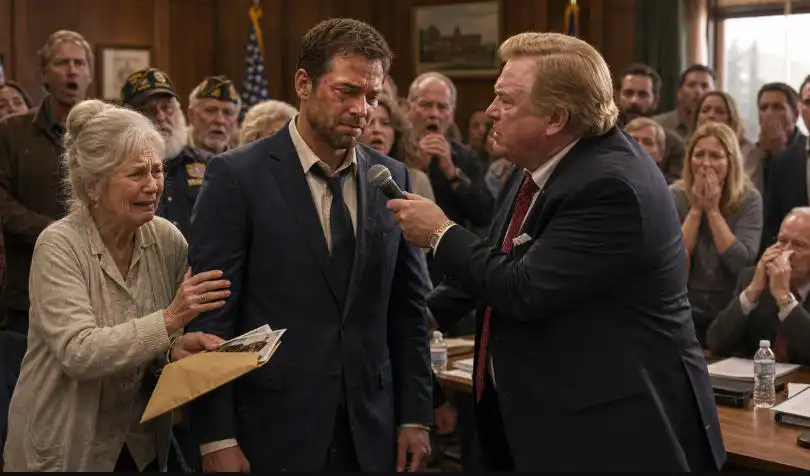
They Laughed When Mark Announced He Was Running for Office… Then One Sealed Envelope Made the Whole Room Go Silent 😳

My Stepdaughter Thought Her Real Father Paid for Her Golf Club Wedding… Then I Showed the Guests the Letter He Sent Me