

When I pulled back that curtain, Megan’s smile died before the room even moved.
The sheriff didn’t shout.
He didn’t need to.
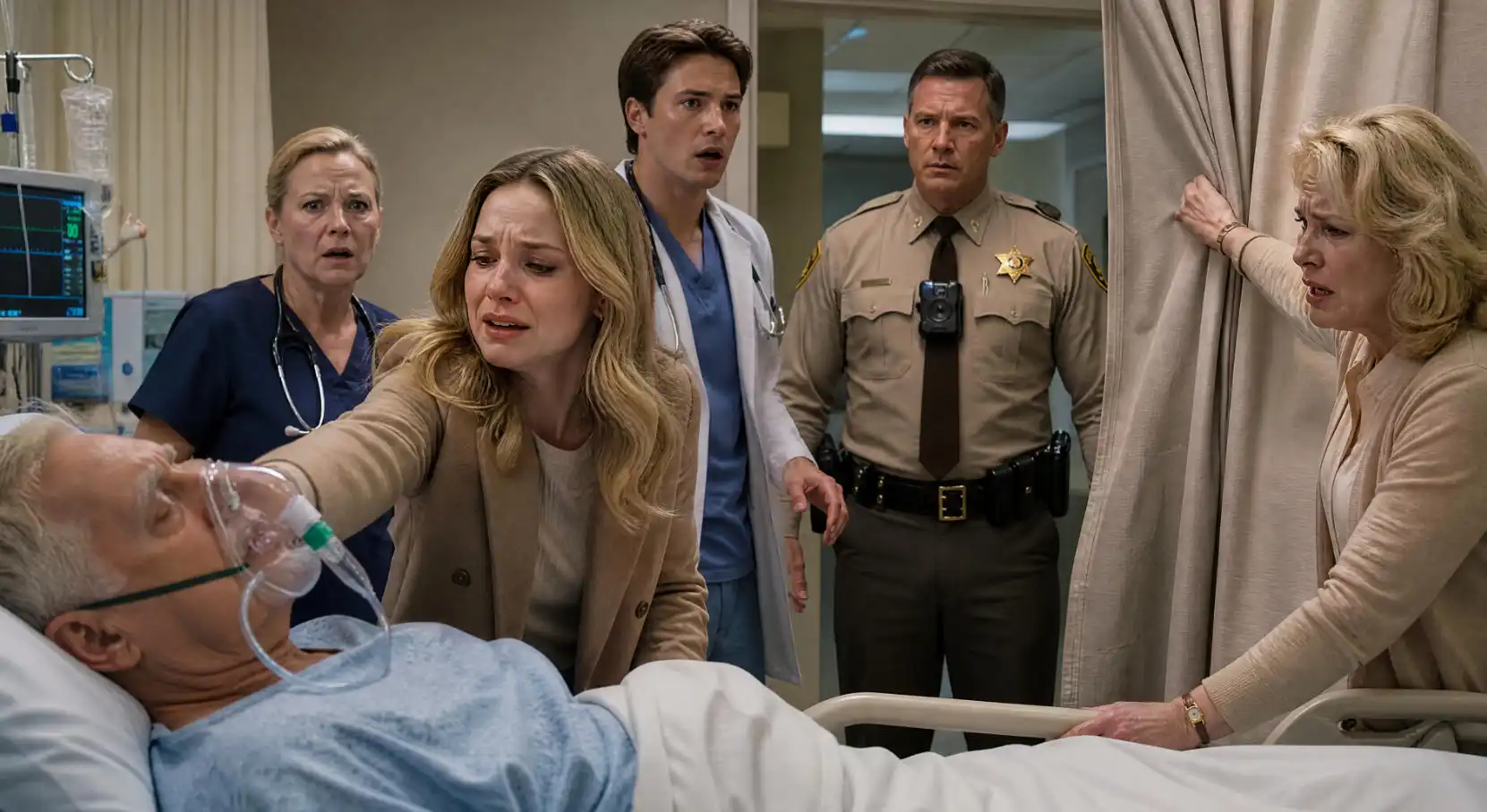
His body camera blinked red in the quiet hospital room while my husband’s oxygen mask kept fogging with every fragile breath.
Megan’s hand was still hovering inches from the strap.
And for the first time since she walked in, she looked at me like I was real.
My name is Dorothy Hale.
I was sixty-one years old, a retired elementary school secretary, and the second wife of a man named Charles Hale.
To Megan, I was never her stepmother.
I was “that woman.”
“The replacement.”
“The hospice wife.”
She said it once at Thanksgiving, loud enough for the kitchen staff to hear.
I had gone to the sink to rinse gravy from a serving spoon, and she stood behind me with a wineglass in one hand.
“You know everyone feels sorry for Dad,” she said. “You’re sweet, Dorothy. But don’t confuse useful with important.”
I didn’t answer then.
That was my mistake for years.
I thought kindness could soften contempt.
I thought patience could survive cruelty.
I thought if I loved Charles well enough, Megan would eventually see I wasn’t there to steal anything.
But hatred does not always come from misunderstanding.
Sometimes it comes from greed wearing perfume.
Charles was seventy-four when he collapsed at home.
One minute he was sitting at the breakfast table, reading the local paper and arguing with the crossword puzzle.
The next, his spoon hit the floor.
I still remember the sound.
Metal on tile.
Small.
Sharp.
Wrong.
“Charlie?”
He didn’t answer.
His face had gone gray.
I called 911 with one hand and held his head with the other.
By the time the paramedics arrived, I had already called Megan three times.
She didn’t pick up.
At the hospital, everything moved too fast.
White lights.
Blue gloves.
A nurse asking me questions I could barely understand.
“History of heart disease?”
“Yes.”
“Medication list?”
“In my purse.”
“Next of kin?”
“I’m his wife.”
The nurse looked at my shaking hands and softened.
“We’re going to take care of him, ma’am.”
For six hours, I sat outside the ICU step-down room with Charles’s jacket folded across my lap.
It smelled like cedar and wintergreen mints.
Megan arrived at 8:20 that night.
Not running.
Not crying.
Walking.
Her heels clicked down the hallway like she owned the hospital.
Behind her came two people from her world: a private wealth advisor named Bryce and a woman I recognized from charity photos, Candace, who chaired the museum gala every spring.
Megan wore cream wool, gold buttons, and grief that looked expensive but unused.
The first thing she said was not, “How is Dad?”
It was, “Why wasn’t I called first?”
I stood up.
“I called you as soon as he collapsed.”
She looked me up and down.
My sweater was old.
My hair had fallen loose.
There was coffee on my sleeve.
She smiled slightly.
“That’s what you claim.”
Bryce cleared his throat.
“Megan, maybe we should—”
“No,” she said. “This is exactly the time to clarify things.”
A nurse nearby looked up from her computer.
Megan noticed.
Good.
She always performed better with an audience.
“My father is vulnerable,” Megan said, raising her voice just enough. “He has been influenced by a woman who entered his life late and isolated him from his real family.”
I felt heat rise in my face.
“That is not true.”
Candace put a manicured hand to her chest.
“Dorothy, this is a hospital. Please don’t make a scene.”
I almost laughed.
I wasn’t the one making it.
A man waiting for an elevator glanced over.
Two nurses slowed near the station.
An intern doctor holding a tablet stood frozen by the supply cart.
Megan stepped closer to me.
“You will not make medical decisions for him.”
“I am listed on his advance directive.”
Her expression tightened.
“And I am his daughter.”
The word daughter came out like a crown.
“I know you are,” I said quietly. “I’ve never tried to take that from you.”
“No,” she said. “You just took everything else.”
That was the first public humiliation of the night.
It would not be the last.
A nurse named Maria came over and asked us to lower our voices.
Megan turned instantly sweet.
“I’m so sorry,” she said. “We’re just concerned about elder exploitation.”
Elder exploitation.
That was the phrase she chose.
She said it loudly enough for the hallway to hear.
My throat closed.
Charles had been the one to ask me to marry him.
Charles had been the one to sell the lake house because it was too hard for him to manage stairs.
Charles had been the one to rewrite his will after Megan tried to pressure him into transferring investment accounts “for tax reasons.”
But none of that mattered in a public hallway.
A well-dressed daughter looked believable.
A tired second wife looked guilty.
Maria looked at me, then at Megan.
“We’re focused on the patient,” she said carefully.
Megan smiled.
“Exactly. Then keep her away from him.”
That was when Head Nurse Evelyn Shaw appeared.
She was in her late fifties, steel-gray hair, calm eyes, and the kind of posture that made nonsense lower its voice.
“Mrs. Hale is authorized to be with the patient,” Evelyn said.
Megan’s smile thinned.
“For now.”
Those two words stayed with me.
For now.
At 10:05 p.m., Charles stabilized.
They moved him into a private monitored room on the cardiac floor.
He was unconscious, but breathing with oxygen support.
The doctor said the next twenty-four hours mattered.
“He can hear familiar voices,” she told me. “Talk to him. Keep him calm.”
So I did.
I sat beside his bed and held his hand.
I told him the crossword puzzle was still waiting.
I told him the dog had tried to eat his slipper again.
I told him I loved him.
Around midnight, his eyelids fluttered.
Just once.
“Dor…” he whispered.
I leaned close.
“I’m here.”
His fingers moved weakly against mine.
“Drawer,” he breathed.
“What drawer?”
His lips barely moved.
“Blue folder.”
Then he drifted again.
I knew exactly what he meant.
The blue folder in his desk at home.
Charles had shown it to me six months earlier after a terrible argument with Megan.
Inside were copies of his will, medical directive, trust documents, and one sealed letter addressed to Sheriff Alan Pike.
I had asked him why the sheriff.
Charles looked tired that day.
“Because Alan knew me before I had money,” he said. “And because if Megan ever tries something, she’ll smile while doing it.”
I told him that was too harsh.
He looked at me with sad eyes.
“Dorothy, some people don’t want inheritance. They want control.”
I didn’t want to believe him.
Not fully.
No mother wants to believe a child can become dangerous.
Even when that child is not hers.
Even when the warning signs are stacked like stones.
At 1:10 a.m., Megan returned.
Alone this time.
No Bryce.
No Candace.
No audience she had invited.
Just the hospital staff, a few family members in nearby rooms, and me.
She closed the door behind her.
But not all the way.
That detail saved us.
She walked in slowly, her phone in her hand.
“You look awful,” she said.
I didn’t respond.
She came to the foot of the bed and stared at Charles.
There was no tenderness in her face.
Only calculation.
“Did he wake up?”
“A little.”
“What did he say?”
I looked down at my husband’s hand.
“My name.”
Megan’s jaw shifted.
“Nothing else?”
“No.”
That was the first lie I told that night.
And I do not regret it.
She walked around the bed.
The intern doctor from earlier stepped in with a medication scanner.
He was young, maybe twenty-six, with kind eyes and panic written all over him.
“Just checking vitals,” he said.
Megan turned on him.
“Are you the doctor in charge?”
“No, ma’am. I’m assisting—”
“Then assist quietly.”
His face went red.
I saw his eyes flick toward Charles’s oxygen mask.
Then to Megan.
Then to me.
He knew the room felt wrong.
But hospitals teach young staff to be careful around rich families.
Especially loud rich families.
Especially ones who say “lawsuit” before they say “please.”
Megan pointed at a chair near the wall.
“Sit down, Dorothy.”
I stayed standing.
She gave a small laugh.
“You really do think that ring means something.”
“It does.”
“No,” she said. “It meant something when Dad was lonely. It means nothing when he’s unconscious.”
The intern froze.
Outside the cracked door, I saw Nurse Maria pause.
Megan leaned closer to me.
“You are not blood. You are not legacy. You are a signature mistake in orthopedic shoes.”
The words hit harder than I expected.
Not because they were clever.
Because they were meant to erase nine years of love.
Nine years of doctor appointments.
Nine years of making Charles laugh when his arthritis ruined his golf game.
Nine years of sleeping in chairs beside hospital beds.
Megan saw my face and smiled.
“There she is,” she whispered. “The poor little wife.”
Then she raised her voice.
“You will sign a statement tomorrow confirming Dad wanted me in control of all medical and estate matters.”
I stared at her.
“I will not.”
“You will.”
“No.”
Her eyes sharpened.
“Dorothy, don’t be stupid. I can make people believe anything about you.”
I believed that.
That was the worst part.
She could walk into any room and make herself the victim.
She had done it for years.
When Charles refused to buy her a vacation house, she told relatives I had made him paranoid.
When he changed accountants, she told people I was isolating him.
When he donated to the children’s hospital instead of funding her boutique nonprofit, she said I had “manipulated a confused old man.”
Each accusation was polished.
Soft.
Socially acceptable.
Never ugly enough to be questioned.
But tonight, the ugliness finally showed its teeth.
Megan stepped toward the oxygen tubing.
I moved between her and the bed.
She looked amused.
“What are you going to do? Fight me?”
The intern doctor swallowed.
“Ma’am, please don’t touch any equipment.”
Megan turned slowly.
“What’s your name?”
He looked down at his badge.
“Dr. Aaron Bell.”
“Intern?”
“Resident intern, ma’am.”
“How brave.” She smiled. “Do you want your first week here to be your last?”
His mouth opened.
No sound came out.
That was when Head Nurse Evelyn appeared in the doorway.
“Megan,” she said, her tone flat. “Step away from the patient.”
Megan’s face changed.
Not fear.
Annoyance.
Like a servant had spoken out of turn.
“This is a family matter.”
“It is a patient safety matter,” Evelyn said.
Megan laughed.
“You people love feeling important.”
The hallway had gone quiet.
A respiratory therapist stood outside holding a clipboard.
Maria was behind Evelyn.
A man from the room across the hall peeked through his open door.
Public pressure.
Exactly the kind Megan usually controlled.
But this time, it was not her audience.
It was ours.
Megan looked around and adjusted her coat.
Then she moved fast.
She brushed past me hard enough that my shoulder hit the rolling tray.
A plastic cup fell to the floor.
Water spilled across my shoes.
“Oops,” she said.
A cheap little word.
A deliberate little cruelty.
I grabbed the bed rail to steady myself.
The intern doctor stepped forward, then stopped again.
Evelyn’s hand moved near the wall.
I saw her thumb press the silent alarm.
Megan did not.
She leaned over Charles.
“Dad,” she said loudly. “If you can hear me, I’m fixing this.”
His eyes did not open.
His oxygen mask fogged weakly.
I said, “Megan, step away from his oxygen.”
She looked back at me.
And that was when she said it.
“Dorothy, you are NOTHING. Not his wife. Not my family. Not even worth calling security for.”
Every word rang down the hallway.
No one moved.
Then she lowered her voice, but not enough.
“When he’s gone, I decide what happens. You don’t sign. You don’t speak. You don’t inherit.”
I whispered, “Please don’t do this.”
She smiled.
“A natural passing would be easier for everyone.”
That sentence changed everything.
Not because it shocked me.
Because it confirmed what Charles had feared.
I could have screamed.
I could have grabbed her.
I could have begged the staff to drag her out.
Instead, I remembered Charles’s words.
Don’t argue.
Let the law hear her.
So I stepped aside.
Megan mistook silence for surrender.
People like Megan always do.
She reached toward the oxygen strap.
And I pulled back the privacy curtain.
Sheriff Alan Pike stood behind it in a dark jacket, one hand near his radio, body camera recording.
Beside him stood a hospital security officer and a second deputy.
Megan’s fingers stopped in midair.
The room seemed to shrink around her.
The sheriff said, “Ma’am, don’t move.”
For one second, Megan looked confused.
Then furious.
“Who let you in here?”
“I did,” I said.
Her head snapped toward me.
The sheriff stepped forward.
“Ms. Hale, we have recorded statements regarding threats, coercion, and interference with patient care.”
Megan laughed.
It was thin now.
Ugly.
“You can’t be serious.”
Evelyn spoke from the doorway.
“The patient’s oxygen support was not to be touched. You were warned by medical staff.”
The intern doctor finally found his voice.
“I witnessed her approach the oxygen equipment after making threatening statements.”
Megan turned on him.
“You witnessed nothing.”
His face was pale, but he stood straighter.
“I witnessed enough.”
That was the first brave thing he said.
I will remember it forever.
Sheriff Pike looked at Megan.
“Place your hands where I can see them.”
She lifted her chin.
“My father is Charles Hale.”
“I know who your father is.”
“Then you know who I am.”
The sheriff’s expression did not change.
“Yes, ma’am. That is why I was called before you arrived.”
Her face flickered.
Before.
That word hit her.
Because now she understood.
This was not luck.
It was not panic.
It was preparation.
Megan looked at me with pure hatred.
“You set me up.”
I shook my head.
“No. I believed you might still choose mercy.”
Her lips parted.
Nothing came out.
Sheriff Pike reached into his jacket and removed a sealed envelope.
Blue ink.
Charles’s handwriting.
My knees nearly buckled.
He had actually done it.
The sheriff opened the envelope and read just enough aloud for the room to understand.
“If my daughter Megan attempts to pressure Dorothy Hale regarding medical decisions, inheritance, or my end-of-life care, I request that law enforcement be notified. Dorothy is my lawful wife, medical proxy, and primary beneficiary. Megan has no authority to alter my care.”
Megan’s mouth twisted.
“That letter is fake.”
The sheriff looked at her.
“It was delivered to my office by your father three months ago. Witnessed. Logged. Notarized.”
That was the legal hammer.
Not shouting.
Not revenge.
Documentation.
Megan stepped backward.
The security officer blocked the door.
Candace appeared in the hallway, drawn by the commotion, one hand over her mouth.
Bryce was behind her, white as paper.
Megan saw them.
Her performance instinct returned.
She raised her voice.
“This woman has poisoned my father against me!”
Nobody moved to comfort her.
Nobody rushed to agree.
That was when she truly began to lose.
Because rich bullies can survive accusations.
They can survive gossip.
They can survive whispers.
What they cannot survive is an audience that stops clapping.
The sheriff said, “Ms. Hale, you are being detained pending investigation for attempted interference with life-sustaining medical care, coercion, and threats. Further charges may follow after review by the district attorney.”
Megan’s eyes widened.
“No. No, you don’t understand. I didn’t touch him.”
Evelyn said, “Because she stopped you.”
Megan pointed at me.
“She provoked me!”
The intern doctor said quietly, “She asked you to step away.”
Maria added, “Twice.”
The respiratory therapist said, “I heard the statement about a natural passing.”
One by one.
Not dramatic.
Not loud.
Just facts.
Facts are heavy when everybody carries one.
Megan tried one last time.
“Dorothy,” she said, suddenly softer. “Tell them this was a misunderstanding.”
I looked at Charles.
His chest rose.
Fell.
Rose again.
For years, I had made myself small to keep peace.
I had accepted cold seats at family dinners.
I had smiled through insults wrapped in concern.
I had let Megan tell people I was temporary.
But there, in that hospital room, with my husband fighting to breathe, peace was no longer holy.
Truth was.
I said, “No.”
One word.
Clean.
Final.
The sheriff nodded to the deputy.
Megan jerked back as the deputy took her arm.
“Don’t touch me! Do you know what this will do to my reputation?”
Sheriff Pike said, “Ma’am, that is no longer the hospital’s concern.”
Candace stepped away from Megan like scandal was contagious.
Bryce stared at the floor.
The intern doctor moved to Charles’s bedside and checked the oxygen seal with careful hands.
Evelyn came to me and put her arm around my shoulders.
“You did right,” she whispered.
But I didn’t feel victorious.
Not yet.
I felt hollow.
Because the woman being led down that hallway was still Charles’s daughter.
And no matter what she had become, a part of me mourned for the father who would have to wake up and learn it.
Megan did not go quietly.
As the deputy escorted her past the nurses’ station, she shouted, “She’s lying! That old gold digger trapped me!”
Patients’ relatives came out of rooms.
A janitor stopped pushing his cart.
Candace began crying—not for Charles, I think, but for the public embarrassment.
Someone whispered, “That’s Charles Hale’s daughter.”
Another said, “Did she really go after his oxygen?”
Megan heard it.
Her face crumpled in rage.
That was her real punishment beginning.
Not the handcuffs.
The witnesses.
The same social world she used as a weapon had turned into a mirror.
At 3:40 a.m., the district attorney’s office was notified.
By sunrise, the hospital had preserved security footage.
Nurse Evelyn had documented the silent alarm.
The body cam footage was secured.
The intern doctor gave a written statement.
So did Maria.
So did the respiratory therapist.
So did I.
I told the truth plainly.
No extra drama.
No revenge language.
Just what happened.
Megan had threatened me.
She had tried to coerce control of Charles’s medical and estate decisions.
She had approached his oxygen support after saying a natural passing would be easier.
She had done it in front of witnesses.
By noon, the charges escalated.
The prosecutor filed attempted first-degree murder, attempted elder abuse, coercion, and obstruction related to patient care.
At the initial hearing, Megan’s attorney argued she was “emotionally overwhelmed.”
The prosecutor played eight seconds of body camera audio.
Just eight.
“A natural passing would be easier for everyone.”
The courtroom changed after that.
Even the judge’s face hardened.
Megan stood in a navy dress, no pearls this time, staring straight ahead.
The prosecutor argued she was a flight risk because she had access to money, social connections, and had attempted to influence witnesses.
The judge denied bail.
No dramatic speech.
Just a gavel.
Denied.
Megan turned then.
For one moment, her eyes found mine.
I expected hatred.
I saw panic.
And I felt something I did not expect.
Pity.
Not forgiveness.
Not softness.
Pity for a woman who had everything but could not bear that someone else was loved.
Charles woke fully two days later.
I had rehearsed how to tell him.
I had prayed for the right words.
But when his eyes opened and focused on me, the first thing he did was squeeze my hand.
Weak.
But certain.
“You called Alan,” he whispered.
Tears ran down my face.
“Yes.”
“Good girl,” he said.
I laughed and cried at the same time.
“I’m sixty-one, Charlie.”
“Still my girl.”
The doctor told us he had a long recovery ahead.
But he was alive.
He was alert.
And he knew enough to ask the question I dreaded.
“Megan?”
I sat beside him and told him everything.
Not cruelly.
Not gently enough to hide the truth.
When I finished, he turned his face toward the window.
The room was quiet for a long time.
Finally he said, “I kept hoping I was wrong.”
“I know.”
“I’m sorry she hurt you.”
I shook my head.
“She hurt you more.”
He closed his eyes.
“No. She tried. But she didn’t get to decide the ending.”
That sentence stayed with me.
Megan did not decide the ending.
The trial took eleven months.
Her legal team tried every angle.
They claimed stress.
They claimed misunderstanding.
They claimed Dorothy Hale had manipulated an old man, a sheriff, nurses, an intern doctor, hospital security, and a body camera.
The jury did not buy it.
The evidence was too clean.
The blue folder.
The notarized letter.
The hospital footage.
The silent alarm report.
The body cam.
The witnesses.
And Megan’s own words.
When the verdict came, the courtroom was full.
Former charity friends sat in the back, not beside her.
Bryce testified under immunity that Megan had asked him how quickly assets could move if Charles “passed before Dorothy got organized.”
Candace admitted Megan had told her, “Once Dad is gone, the old woman is finished.”
No one looked elegant saying those things under oath.
The jury found Megan guilty on the major counts.
Attempted first-degree murder.
Coercion.
Attempted elder abuse.
Interference with medical care.
The judge called her actions “calculated, predatory, and carried out against a vulnerable patient in a place of healing.”
She was sentenced to spend the rest of her life in a maximum-security women’s prison, with no meaningful chance of release.
Her name disappeared from charity boards within a week.
The museum removed her from its donor wall.
The country club suspended her membership before the ink dried on the verdict.
Everything she thought made her untouchable vanished.
Not because I cursed her.
Because truth reached the public before her lies could dress themselves.
Six months after the trial, Charles came home.
He walked slowly.
He needed oxygen at night.
He complained about the walker like it had personally betrayed him.
But he was home.
On a Sunday afternoon, Sheriff Pike came by with Evelyn, Maria, and Dr. Aaron Bell.
I thought they were there to check on Charles.
Instead, the mayor came too.
So did half the neighborhood.
They held a small ceremony in our front yard.
Nothing fancy.
A folding table.
Lemonade.
A flag by the porch.
The mayor gave me a civilian commendation for preventing harm, preserving evidence, and cooperating with law enforcement.
I did not want to stand in front of people.
My knees shook.
Charles sat in a chair near the roses, clapping like I had won the Olympics.
When they pinned the medal to my blue cardigan, I nearly broke down.
Not because of the medal.
Because for once, people saw me clearly.
Not as “the second wife.”
Not as “the woman who came later.”
Not as “nothing.”
As the person who stayed.
Charles changed his estate again after Megan’s conviction.
Not because I asked.
I begged him not to do it while he was emotional.
He smiled and said, “Dorothy, I have never been more clear.”
He left the house, accounts, and family foundation to me.
He also created a scholarship fund in Nurse Evelyn’s name for young medical staff who speak up under pressure.
Dr. Aaron Bell was the first keynote speaker at the scholarship dinner.
He stood at the podium, still nervous, and said, “That night taught me that silence can become permission. I’ll never forget it.”
Neither will I.
Charles lived three more years.
Good years.
Gentle years.
We watched old movies.
We argued about whether soup counted as dinner.
He finished hundreds of crossword puzzles and still insisted the editors were getting worse.
When he passed, it was peaceful.
Natural.
The word Megan had used so coldly finally belonged to something sacred.
I held his hand.
No one threatened me.
No one shoved me.
No one told me I was nothing.
At the funeral, people stood in a long line to hug me.
Sheriff Pike came in uniform.
Evelyn came with Maria.
Dr. Bell came too, now a real doctor with steadier eyes.
Candace sent flowers.
I donated them to the hospital chapel.
Megan wrote once from prison.
Three pages.
No apology.
Mostly blame.
She said I had “taken her father.”
I folded the letter and placed it in a drawer.
Not the blue folder drawer.
A different one.
Then I went outside and planted lavender by Charles’s roses.
Some endings do not need shouting.
Some justice arrives in a courtroom.
Some healing arrives years later, when the house is quiet and you realize you are no longer afraid of footsteps in the hall.
Megan wanted me erased.
Instead, every record, every witness, every camera, every nurse, every legal document said the same thing:
Dorothy Hale mattered.
Charles knew it.
The law knew it.
And finally, I knew it too.
So choose a side:
Was Dorothy right to stay silent until the sheriff recorded everything…
Or should she have stopped Megan the second she reached for that oxygen mask?
Share this if you believe quiet people are not weak — they are often the ones holding the strongest evidence. ⚖️
Disclaimer: Mention of any brand or trademark is for identification only and does not imply partnership or endorsement
The Tavern Owner Set A Trap To Make Paul Drink Again… But He Had NO IDEA The Entire Town Was Watching 👀
They Laughed When Mark Announced He Was Running for Office… Then One Sealed Envelope Made the Whole Room Go Silent 😳
My Stepdaughter Thought Her Real Father Paid for Her Golf Club Wedding… Then I Showed the Guests the Letter He Sent Me