
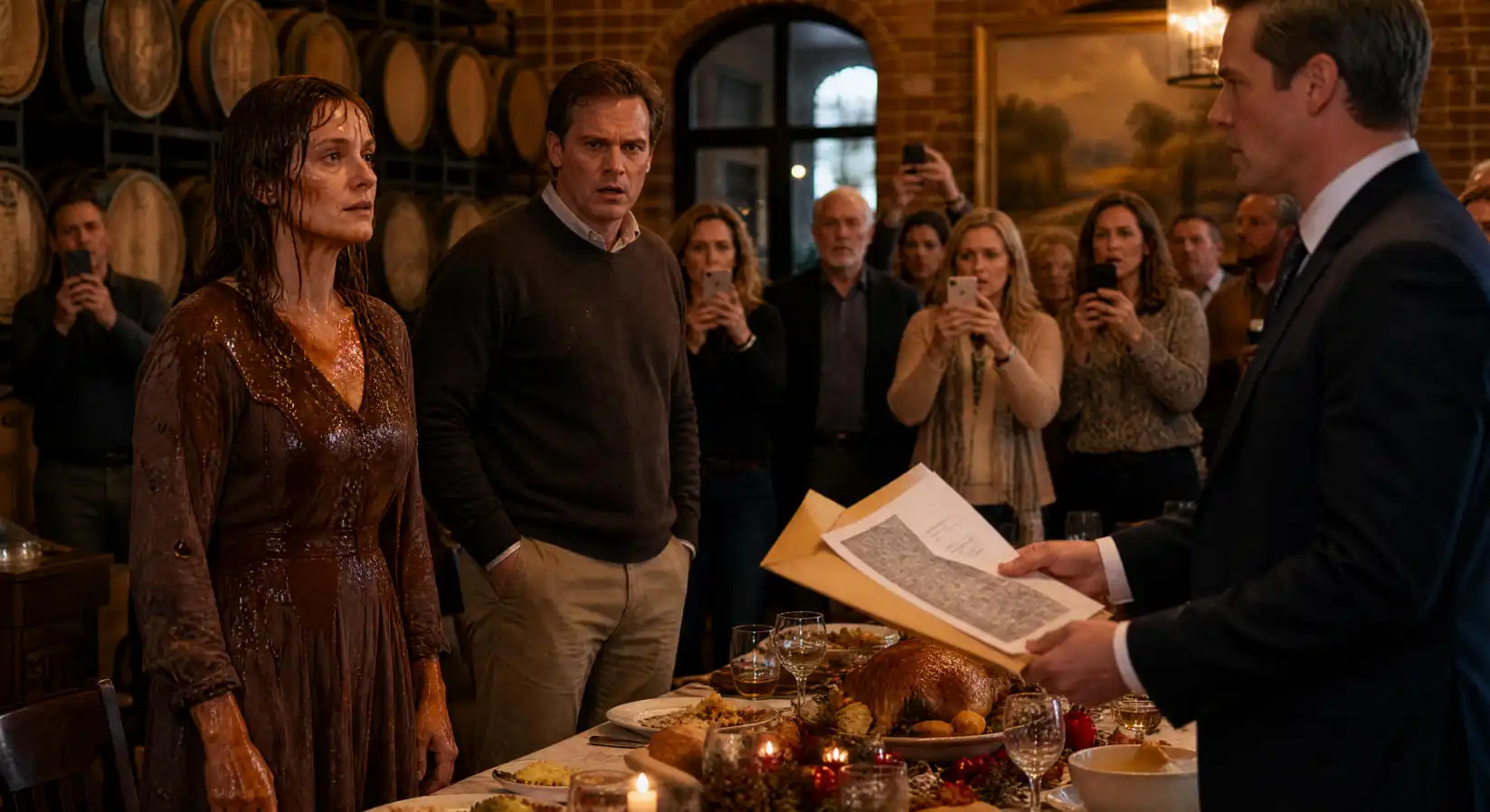
The dining room went quiet when the black SUVs rolled up outside the distillery windows.
Not curious quiet.
Afraid quiet.
The kind of quiet that happens when people realize the person they just humiliated might not be helpless after all.
I stood there with cinnamon soup dripping from my hair onto my old denim shirt while my brother Tanner still held the empty serving bowl in both hands.
His mouth was open.
For once, nothing came out.
The man in the charcoal suit stepped through the dining room doorway first. Behind him came two others: one carrying a metal case, the other carrying a weathered leather folder I recognized immediately.
Grandpa’s folder.
The one he used to keep locked in the bottom drawer of his desk.
Tanner tried to recover his smile.
He always did that when money was in the room.
“Gentlemen,” he said, smoothing the front of his blazer. “This is a family matter. We’re in the middle of Thanksgiving dinner.”
The man in the charcoal suit looked at the soup on my clothes.
Then he looked at Tanner.
“I can see that.”
My cousin Madison lowered her phone but didn’t stop recording.
Aunt Carol pressed her napkin against her lips.
One of Tanner’s investors, a man with a silver watch and a face that had been bored all evening, suddenly leaned forward like he had just smelled smoke.
Tanner pointed toward the front hall.
“We can talk outside.”
“No,” the man said. “We will talk right here.”
He turned to me.
“Miss Whitaker, are you all right?”
That question almost broke me more than the soup did.
Not because it was dramatic.
Because it was the first kind thing anyone had said to me all night.
I nodded.
“I’m fine, Mr. Bell.”
Tanner’s eyes snapped toward me.
“You know him?”
Mr. Bell didn’t wait for me to answer.
“I’m Daniel Bell, senior counsel for Red Cedar Resource Group. With me are Dr. Elaine Porter, geological survey director, and Mr. Grant Hollis, trust compliance officer.”
The room shifted.
Not physically.
Socially.
The people who had spent the evening treating me like furniture suddenly sat up straighter.
Tanner laughed once.
A small, fake laugh.
“Well, wonderful. Then you can explain to my sister that we’re preparing to sell a distressed property. She’s emotional. She gets attached to old things.”
My cousin Brett snickered.
“She talks to whiskey barrels like pets.”
A few people laughed too quickly.
The kind of laugh people use when they are scared and trying to stay on the winning side.
I didn’t speak.
I had learned a long time ago that silence scares arrogant people more than shouting.
Tanner tapped the stack of papers on the table.
“All she has to do is sign. This land has been a burden for years.”
“A burden?” Mr. Bell asked.
“Yes,” Tanner said. “A family burden.”
He turned to the room, performing again.
“My sister means well. But she’s single, she’s alone, and she has no real business sense. She’s been playing frontier queen out here while the rest of us have been trying to make rational decisions.”
I felt the soup cooling against my neck.
My hands were sticky.
My pride burned worse than my skin.
But I still didn’t answer.
Because Tanner was doing exactly what I had hoped he would do.
He was saying it all in front of witnesses.
Again.
Ten years of it had led to this room.
Ten years of being called “the leftover daughter.”
“The free babysitter.”
“The one who never left home.”
“The old maid in work boots.”
When my parents died, Tanner moved to Dallas and said he had “real opportunities.”
When Grandpa got sick, everyone agreed I was “best suited” to stay behind.
Not because I was trusted.
Because I was convenient.
I learned the payroll system.
The grain contracts.
The aging schedules.
The state licensing rules.
The repair history of every copper still in the building.
I learned which barrels expanded in July heat and which warehouse door stuck after rain.
I hosted tastings.
Balanced debt.
Fought insurance increases.
Begged a retired master distiller named Walt to come back three days a week.
And every Thanksgiving, the family came home and called me lucky.
“Must be nice,” Madison once said, “living rent-free in Grandpa’s house.”
Rent-free.
In the house where I changed Grandpa’s sheets.
Counted his pills.
Listened to him cry when he forgot Grandma was already gone.
Tanner visited twice that year.
Both times, he asked where Grandpa kept the land deeds.
Grandpa knew.
He was frail, not foolish.
Three weeks before he died, he held my wrist and said, “Jess, when they finally see value here, they’ll call it family property. Until then, they’ll call it your problem.”
I thought he meant the distillery brand.
The land.
The buildings.
I didn’t know he meant something buried far deeper.
That changed six months before that Thanksgiving.
A survey team had come through the county after a regional infrastructure project opened old mineral maps to private review.
One of them stopped by the distillery asking permission to inspect a dry ridge beyond Warehouse Three.
I nearly said no.
We were busy that day.
A pump had failed.
A distributor in Tulsa was late on payment.
A tourist bus had canceled.
But the young geologist looked nervous in a way that made me pay attention.
“Ma’am,” he said, “this could be significant.”
Significant became confidential.
Confidential became attorneys.
Attorneys became sealed reports.
And sealed reports became one very quiet meeting in Oklahoma City where I learned two things.
First, the land under our old distillery sat on a rare mineral and energy formation worth more than anyone in my family could imagine.
Second, Grandpa had not left the property to the family.
He had placed it in an irrevocable trust twenty years earlier.
And I was the sole beneficial owner.
Not Tanner.
Not the cousins.
Not the relatives who showed up every holiday with empty hands and expensive opinions.
Me.
The quiet aunt.
The woman they thought would sign anything if they made her feel small enough.
Mr. Hollis, the trust compliance officer, placed Grandpa’s leather folder on the Thanksgiving table.
The same table where my cousins had dumped trash near my chair earlier.
The same table where Tanner had told me I was “one signature away from finally being useful.”
He opened the folder.
Tanner’s face tightened.
“Where did you get that?”
“From the trust archive,” Mr. Hollis said.
“That folder belongs to our family.”
“It belongs to the trust.”
Tanner pointed at me.
“She stole it.”
I finally spoke.
My voice came out softer than I expected.
“No, Tanner. Grandpa protected it from you.”
His fiancée, Brooke, went pale.
Brooke had spent the evening showing everyone her engagement ring and calling the distillery “rustic in a tragic way.”
Her father, Mr. Langford, was the investor Tanner had been trying to impress.
He had arrived in a black Mercedes and spent fifteen minutes telling me that “sentiment is the enemy of wealth.”
Now he looked at Tanner.
“What exactly did you tell me you owned?”
Tanner’s jaw moved.
No sound came out.
Mr. Bell opened the metal case.
Inside was a clean copy of the geological report.
Maps.
Core sample summaries.
Valuation projections.
Legal boundaries.
He set the first page on the table.
“The mineral rights, surface rights, operating rights, and trust-controlled commercial rights are held under the Whitaker Heritage Trust. Jessica Whitaker is the sole controlling beneficiary.”
Madison whispered, “Sole?”
Brett said, “That can’t be right.”
Aunt Carol reached for the nearest chair like her knees had suddenly remembered her age.
Tanner slammed his hand on the table.
“No. Grandpa would never cut out his own grandson.”
Mr. Hollis turned one page.
“He didn’t cut you out.”
Tanner exhaled.
“Exactly.”
“He removed you after you attempted to pressure him into a land sale while he was under medical care.”
The room froze again.
This time, it was colder.
Tanner’s eyes flashed.
“That is a lie.”
Mr. Hollis removed another document.
“Your grandfather documented the incident with his attorney. He also added a no-contest provision and a coercion clause. Any family member who attempted to force, threaten, defraud, or publicly pressure Jessica Whitaker into transferring trust property would be permanently barred from any related distribution, licensing benefit, or family commercial claim.”
Aunt Carol gasped.
Madison whispered, “Publicly pressure?”
Mr. Bell looked at the soup bowl.
Then at the phones still recording.
Then at the transfer papers.
“Yes,” he said. “That would be relevant.”
Tanner’s face changed.
For years, my brother had worn confidence like a tailored suit.
Now it looked too tight.
He turned on me.
“You set me up.”
“No,” I said. “I invited you to Thanksgiving.”
“You brought lawyers!”
“You brought transfer papers.”
“You embarrassed me!”
That made me laugh once.
Not because it was funny.
Because I was standing in front of twenty relatives with soup in my hair, and Tanner still believed he was the victim.
Brooke stepped away from him.
“Tanner,” she said carefully, “you told my father the land was already yours.”
“It was going to be.”
“You said Jessica was an employee.”
The room went silent.
That one hurt.
Not because it surprised me.
Because it explained the way Brooke had looked at me all evening.
Like hired help who had wandered into the wrong room.
Mr. Langford stood.
He wasn’t a warm man.
But he was a businessman, and businessmen recognize fraud faster than family recognizes cruelty.
“You used my firm’s preliminary financing letter to pressure her?”
Tanner swallowed.
“Walter, don’t overreact.”
Mr. Langford’s voice dropped.
“You represented that you held controlling ownership.”
“I had family consensus.”
“No,” Mr. Bell said. “You had a table full of relatives without authority and a beneficiary under duress.”
Brett pushed back his chair.
“Wait. We didn’t sign anything.”
Madison pointed toward Tanner.
“He said it was basically done.”
Aunt Carol started crying.
Not for me.
For the money.
That was the strangest part of the night.
Nobody asked if I was burned.
Nobody asked if I needed a towel.
They asked what would happen to their shares.
Shares they never had.
Madison stood.
“Jessica, honey, we didn’t know. Tanner told us you were being selfish.”
I looked at her.
Earlier that evening, she had dropped a crumpled napkin and an empty plastic cup beside my boot.
“Since you’re already cleaning up,” she had said.
Now she called me honey.
I wiped soup from my cheek with the towel Walt handed me from behind the kitchen door.
Walt was seventy-one, with hands permanently stained by oak and copper.
He had worked for Grandpa for forty years.
He had seen more of my tears than my family ever had.
“You want me to call the sheriff?” he asked.
Tanner scoffed.
“For what? Soup?”
Mr. Bell answered.
“For potential assault, attempted coercion, fraudulent inducement, misrepresentation to investors, and attempted interference with trust property.”
Tanner’s smile died completely.
The room became a different kind of theater.
No one laughed now.
No one whispered about my dress.
No one asked why I never married.
They were too busy calculating how close they had stood to Tanner when he poured the soup.
Brooke removed her engagement ring.
Slowly.
Deliberately.
The tiny sound it made hitting the table was louder than the gasp that followed.
“Tanner,” she said, “my father’s legal team will be contacting you.”
His face went red.
“Brooke, don’t be ridiculous.”
She shook her head.
“You lied to me. You lied to my family. You tried to build our future on stolen land.”
“Stolen?” he snapped. “It’s my bloodline.”
“It’s her property.”
Those three words landed harder than any speech.
It’s her property.
Not the family’s.
Not Tanner’s.
Not the cousins’.
Mine.
For a moment, I saw Grandpa as clearly as if he were standing by the fireplace.
His suspenders.
His tired eyes.
His hand on my wrist.
“When they finally see value here,” he had said, “they’ll call it family property.”
He had known.
He had known all of them.
Mr. Bell placed one final document on the table.
“This is formal notice. Red Cedar Resource Group is prepared to enter exclusive negotiations with Miss Whitaker only. Any person attempting unauthorized sale, lien, lease, or transfer of this property will be referred for civil and criminal action.”
Tanner whispered, “Jessica.”
That was new.
Not Jess.
Not little sister.
Not useless.
Jessica.
Respect always arrives late when money gets there first.
He stepped toward me.
I stepped back.
Walt stepped between us.
“Don’t,” Walt said.
Tanner looked around for allies.
He found none.
Brett was pretending to read the wall.
Madison was deleting something from her phone.
Aunt Carol was clutching her pearls.
Mr. Langford was already speaking quietly to his attorney near the window.
And Brooke was walking out without looking back.
Tanner’s entire world was leaving the room in pieces.
His fiancée.
His investor.
His false deal.
His control.
His story.
He turned desperate.
“Jess, come on. We’re family.”
I looked at the transfer papers.
At the soup bowl.
At the cousins who had laughed.
At the investors who had watched me be humiliated and waited to see which side was profitable.
Then I looked at my brother.
“No,” I said. “We’re relatives. Family doesn’t do this.”
He flinched like I had slapped him.
I didn’t need to.
The law did the striking from there.
The sheriff arrived twenty minutes later.
Not with sirens.
Not with drama.
Just two deputies walking into a room full of overdressed people who suddenly became very interested in innocence.
Statements were taken.
Videos were preserved.
The transfer papers were collected.
Mr. Langford’s attorney handed over emails Tanner had sent claiming ownership he did not possess.
Brooke sent screenshots before midnight.
By Monday morning, Tanner’s proposed sale collapsed.
By Wednesday, his business partners withdrew.
By the next month, he was named in a civil fraud action by the investors he had misled.
The family group chat, which had been full of insults before Thanksgiving, became very quiet.
Then came the apologies.
Not real ones.
Strategic ones.
Madison wrote: “I’m sorry if you felt unsupported.”
Brett wrote: “We were all under pressure.”
Aunt Carol wrote: “Your grandfather would want peace.”
I didn’t answer the first two.
To Aunt Carol, I wrote back one sentence.
“Grandpa wanted the truth protected.”
Then I blocked the thread for a while.
I wish I could say I felt victorious immediately.
I didn’t.
That night, after everyone left, I stood alone in the dining room.
The table smelled like cinnamon, turkey, and old wood polish.
The soup had dried in my hair.
My shirt was ruined.
There were footprints on the floor from lawyers, deputies, cousins, and people who had mistaken my silence for permission.
Walt brought me a mug of coffee.
No whiskey.
Just coffee.
“You all right, kid?” he asked.
I was 42.
He still called me kid.
That was the first time I cried.
Not loud.
Not pretty.
Just tired.
Ten years of tired.
Ten years of being useful but never valued.
Ten years of hearing that a woman without a husband must be waiting for someone else’s life to begin.
Walt sat across from me and said nothing.
That was his gift.
He didn’t fill pain with advice.
The next morning, I washed my hair three times.
Then I drove to the county office and signed the documents Mr. Bell had prepared.
Not to sell the distillery.
To protect it.
We created a new operating structure.
The distillery stayed open.
The workers got raises.
Walt got a formal advisory title and a retirement fund he pretended not to cry over.
The old barrelhouse was restored.
A portion of future mineral revenue was set aside for local scholarships in Grandpa’s and Grandma’s names.
Not because I was saintly.
Because wealth without roots becomes the same sickness Tanner had.
And I had seen enough of that sickness at my own table.
The geological deal took months.
Real deals do.
There were environmental reviews, county hearings, attorneys, engineers, and more paperwork than any Facebook post could make sound glamorous.
But every signature was mine.
Every meeting had my name on the agenda.
Jessica Whitaker.
Not Tanner’s sister.
Not the old maid.
Not the caretaker.
Not the family maid.
The controlling owner.
The first time I walked into a formal negotiation room, one executive looked past me and asked, “Are we waiting for Mr. Whitaker?”
I smiled.
“No. You’re looking at her.”
He never made that mistake again.
As for Tanner, the fall was not instant, but it was complete.
That matters.
Real consequences usually arrive through envelopes, court dates, canceled partnerships, and people refusing to return calls.
His investor lawsuit drained him.
Brooke’s family cut ties publicly.
His Dallas friends stopped inviting him to events.
The relatives who had cheered him on suddenly claimed they had “always been uncomfortable” with his behavior.
He sold his house.
Then his truck.
Then the watch he used to tap against the table when he wanted people to feel poor.
The last I heard, he was living in a rented room outside Tulsa and doing odd jobs under a contractor who didn’t care about his last name.
Some people said I should help him.
“Be the bigger person,” Aunt Carol told me through a new phone number after I blocked the old one.
I thought about that phrase.
The bigger person.
Funny how people only ask the wounded to grow.
Nobody asked Tanner to be bigger when he poured soup over my head.
Nobody asked Madison to be bigger when she treated me like staff.
Nobody asked the family to be bigger when they tried to take what Grandpa had protected.
So I chose something better than being the bigger person.
I chose being a lawful one.
I did not ruin Tanner.
I refused to rescue him from the consequences of trying to ruin me.
There is a difference.
Two years after that Thanksgiving, I attended the North American Heritage Spirits Foundation gala in Chicago.
The invitation had my full name embossed in gold.
Jessica Whitaker, Chairwoman, Whitaker Heritage Distilling.
I wore a deep green gown that cost more than the “decent dress” my cousin once said I could never afford.
Not because I needed to prove anything.
Because I liked it.
And because sometimes healing looks like walking into a room wearing the color you were once told you had no right to touch.
I didn’t go alone.
Daniel Bell came with me.
Yes, that Daniel Bell.
It did not happen like a movie.
He didn’t sweep me away after Thanksgiving.
He stayed professional through every legal matter.
Months later, after the trust issues were settled, he sent me a handwritten note congratulating me on the scholarship fund.
I wrote back.
Then we had coffee.
Then dinner.
Then, slowly, something gentle grew where humiliation had once tried to harden me.
At the gala, cameras flashed.
People asked about the distillery’s preservation work.
A journalist asked how it felt to become one of the most influential women in American heritage spirits and mineral-rights development.
I thought about giving a polished answer.
Something about resilience.
Legacy.
Responsible stewardship.
Instead, I looked at Daniel, then at the room full of people waiting for a quote.
“It feels,” I said, “like my grandfather kept his promise.”
Later that night, a photo of me appeared online.
Green gown.
Daniel beside me.
My hand resting lightly on his arm.
A headline called me “Oklahoma’s quiet distillery queen.”
I laughed when I saw that.
Queen sounded dramatic.
But quiet?
That part was true.
I am still quiet.
I still prefer barrelhouses to ballrooms.
I still know which warehouse door sticks after rain.
I still keep Grandpa’s photo above the fireplace.
But now, when relatives come around with sweet voices and careful compliments, they are greeted by a locked gate, a receptionist, and a legal office that knows exactly what to do.
The Thanksgiving table was replaced.
The old one had too many stains.
The new one is smaller.
On holidays, I invite the people who stayed when there was no money to admire.
Walt.
The distillery crew.
Two neighbors who checked on me after Grandpa died.
A widowed teacher who now helps run the scholarship fund.
Daniel, who still asks if I’m all right and waits for the real answer.
We eat.
We laugh.
No one drops trash near my chair.
No one calls dignity selfish.
No one confuses silence with weakness.
And every year, before dessert, I raise a glass to Grandpa.
Not for making me rich.
For making sure the truth had paperwork.
Because in the end, that is what saved me.
Not revenge.
Not shouting.
Not luck.
A trust.
A record.
A witness.
A law strong enough to stand between one quiet woman and a table full of greedy people.
So choose a side:
Jessica was right to let Tanner lose everything he tried to steal.
Or Jessica should have forgiven him because “family is family.”
I know which side Grandpa would have chosen. 🥃
Disclaimer: Mention of any brand or trademark is for identification only and does not imply partnership or endorsement
The Tavern Owner Set A Trap To Make Paul Drink Again… But He Had NO IDEA The Entire Town Was Watching 👀
They Laughed When Mark Announced He Was Running for Office… Then One Sealed Envelope Made the Whole Room Go Silent 😳
My Stepdaughter Thought Her Real Father Paid for Her Golf Club Wedding… Then I Showed the Guests the Letter He Sent Me