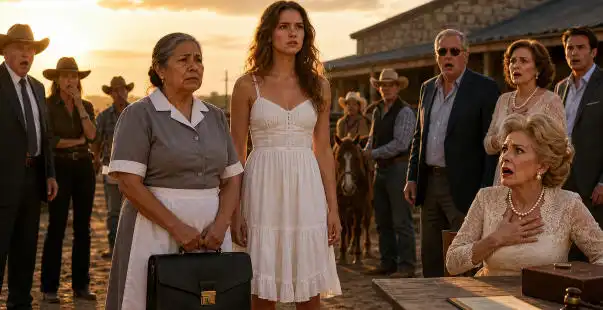

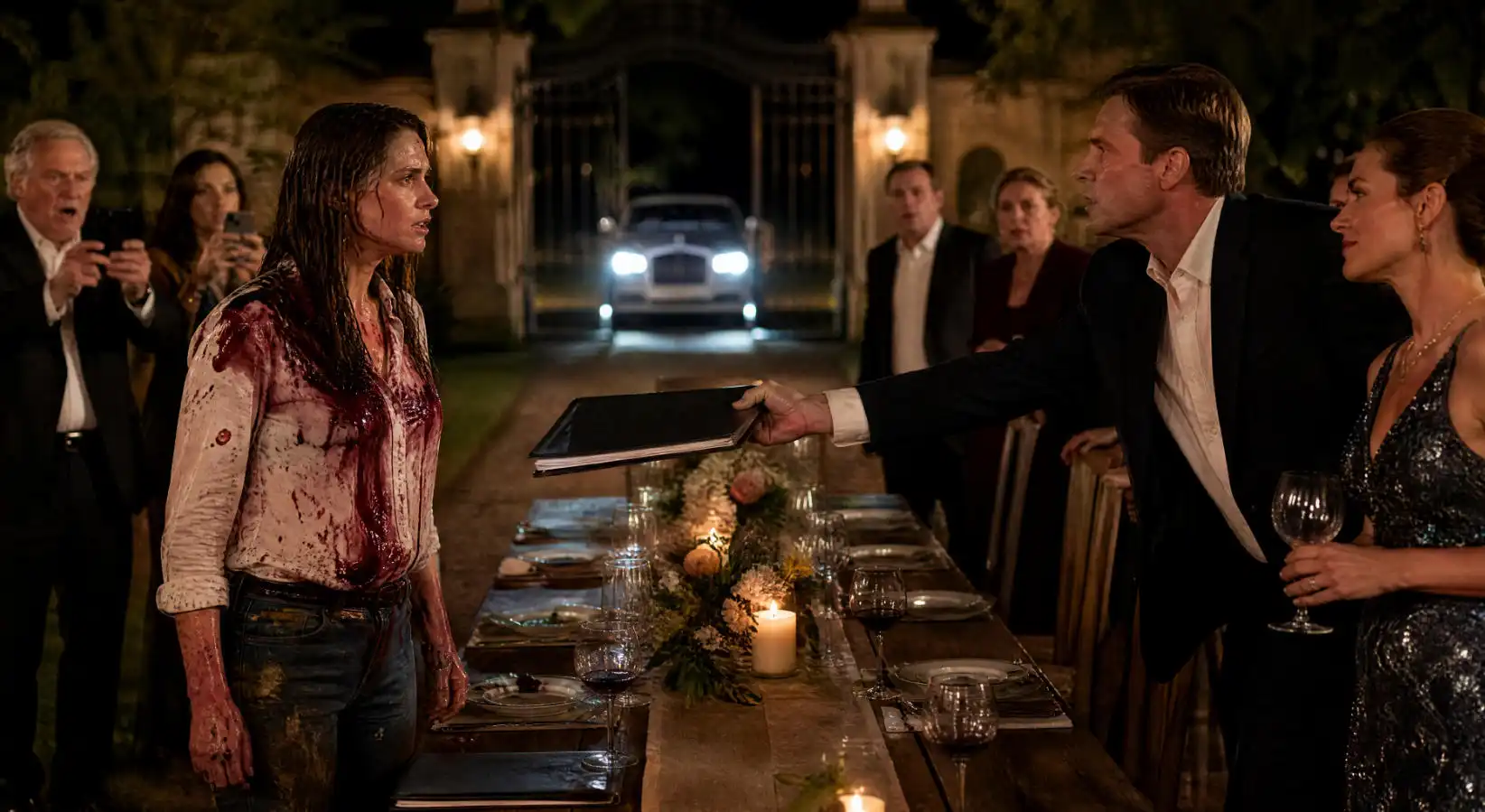
The man in the dark coat placed the black legal folder on the auction table.
Nobody moved.
Not Tucker.
Not Marissa.
Not even Cousin Dale, who had been recording my humiliation thirty seconds earlier with the same grin he used at football games.
The red wine was still dripping from my chin onto the front of my faded denim shirt.
And the only sound in the barn was gravel crunching outside as more black cars rolled through the nursery gate.
My brother Tucker stared at the man like he had seen a ghost wearing a tailored suit.
“Who are you?” Tucker demanded.
The man didn’t look at him.
He looked at me.
“Laura,” he said quietly. “Are you all right?”
That was the first time all night anyone had asked me that.
I wiped the wine from my mouth with the napkin Marissa had thrown at me like I was a waitress.
“I’m fine, Everett.”
Marissa’s face twitched.
“Everett?” she repeated. “As in Everett Caldwell?”
A few relatives turned.
One of the appraisers whispered, “Caldwell Capital?”
That was when the barn changed.
A minute earlier, I was just Laura Whitcomb.
Forty-three.
Single.
The woman who had stayed behind in the Texas hill country after Daddy died.
The woman who woke up at 4:45 every morning to check irrigation lines, prune live oaks, deal with contractors, and keep our family’s landscape nursery from going under.
To my relatives, I was the convenient one.
The unmarried one.
The one who could be called on to host Thanksgiving, watch the kids, care for sick aunts, handle property taxes, and “just sign” whatever paper Tucker put in front of me.
Tucker, on the other hand, was the successful son.
At least, that was the story he liked to tell.
He lived in Austin.
He wore Italian shoes.
He talked loudly about “urban development” and “private equity,” even though most of his companies were little more than rented office addresses, borrowed cars, and big promises.
His wife Marissa loved that life.
She showed up to the nursery that Thanksgiving wearing a cream designer dress and a diamond bracelet that caught the barn lights every time she lifted her glass.
She looked at my hands before she looked at my face.
“Still using your nails as gardening tools?” she said when she arrived.
I smiled and took her coat.
That was the part nobody understood.
They thought my silence meant weakness.
It didn’t.
It meant I was keeping records.
For ten years, I had kept that nursery alive.
Not Tucker.
Not the cousins who showed up twice a year and complained about bugs.
Not the uncles who called it “the dirt farm.”
Me.
When Daddy had his stroke, Tucker said he would come home “next month.”
He never did.
When the freeze killed three greenhouses, I slept in the office for nine nights and saved what I could.
When the bank threatened to call the loan, I sold my own truck and negotiated a new payment schedule.
When landscapers from Houston and Dallas started asking for native trees in bulk, I built the nursery into the most reliable supplier in three counties.
But Tucker had always believed one thing:
If he made enough noise, people would assume he was in charge.
That Thanksgiving, he decided to make his move.
He called it a “family strategy dinner.”
I knew what it was.
An ambush.
He had invited distant relatives, two auction appraisers, one local real estate broker, and a notary he introduced as “a family friend.”
Then he waited until the turkey was carved and everyone had wine in their hands.
He stood at the head of the long table under the barn rafters.
“As most of you know,” Tucker said, tapping his glass, “the Whitcomb land has been mismanaged for years.”
My fork stopped halfway to my plate.
He smiled at me like he was being kind.
“Laura did her best, bless her heart. But sentiment does not pay real money.”
Marissa gave a little laugh.
Several relatives avoided my eyes.
Tucker continued.
“I’ve secured an offer from a developer. Luxury townhomes. Retail space. A boutique hotel. This dusty nursery can finally become something valuable.”
Aunt Mae set her napkin down.
“Your father wanted that land kept together.”
Tucker’s smile tightened.
“Dad wanted the family to prosper. Not rot in potting soil because Laura can’t move on.”
Then he slid the papers toward me.
“Sign the transfer of operational control. Tonight.”
I looked at the top page.
It was not just operational control.
It was a full transfer.
The land.
The inventory.
The water rights.
The equipment.
Everything.
My relatives didn’t know that because Tucker had only handed them a glossy one-page summary full of words like “legacy payout” and “equal distribution.”
I had the real documents because his own paralegal had accidentally copied me on an email three weeks earlier.
That was Tucker’s first mistake.
His second mistake was assuming I had done nothing with it.
I folded my hands.
“No.”
The barn went quiet.
Tucker blinked.
“No?”
“No.”
Marissa leaned back in her chair.
“Oh, this is precious.”
Tucker’s jaw moved.
“Laura, don’t embarrass yourself.”
“I’m not signing.”
“Then you are stealing from this family.”
That got the whispers going.
Cousin Dale muttered, “She always was selfish.”
Someone else said, “She lives there rent-free, doesn’t she?”
I heard it all.
I had heard versions of it for years.
That I was lucky.
That I had no husband, so I had no real expenses.
That the nursery was not a business but a place I “played farmer.”
Then Marissa stood.
She picked up the small trash bag from the dessert table. Napkins. paper plates, empty cups.
She walked over and dropped it at my boots.
“Then start with what you’re actually qualified for,” she said. “Clean up.”
A few people laughed nervously.
Not because it was funny.
Because cruelty makes weak people look around for permission.
I looked down at the trash.
Then at her.
“Marissa, don’t do that.”
She smiled.
“Or what?”
Tucker pointed at the papers.
“Sign.”
“No.”
That was when Marissa reached for her wine.
Aunt Mae whispered, “Tucker, don’t let her—”
The wine hit my face.
Cold.
Sharp.
Red across my cheek, my mouth, my collar.
Phones lifted.
The notary froze.
The appraisers looked away.
Tucker leaned over me.
“You are an unwanted single woman living on dead plants,” he said. “You don’t get to hold this family hostage.”
I did not slap him.
I did not scream.
I did not throw the glass back.
I wiped my cheek.
And I looked toward the gravel road.
Because I had heard the engines.
Not one.
Many.
Headlights appeared between the rows of magnolia trees.
Black Rolls-Royces.
One after another.
They moved slowly through the main gate, past the live oaks I had planted myself, past the old wooden sign that still read WHITCOMB LANDSCAPE NURSERY.
Marissa lowered her glass.
“What is that?”
Tucker frowned.
The first car stopped near the barn entrance.
A chauffeur stepped out and opened the rear door.
Everett Caldwell stepped into the light.
Tall.
Calm.
Silver at the temples.
Dark coat.
No flashy watch.
No need to prove anything.
Most of my family recognized the last name before they understood the man.
Caldwell Capital was not just rich.
It was the kind of money that banks answered on the second ring for.
The kind of money that bought distressed companies, funded hospitals, saved airports, and ended bad deals before lunch.
But to me, Everett was the man who once showed up at my nursery eight years earlier in an old pickup truck, asking whether I had drought-resistant trees for a veterans’ housing project.
He did not introduce himself as an heir.
He introduced himself as “Everett, a guy trying not to ruin a landscaping order.”
I had laughed.
I had helped him choose the trees.
When his project ran over budget, I quietly donated half the order.
He found out.
He came back.
Then he kept coming back.
Over the years, we became friends.
Then something deeper.
Not flashy.
Not public.
Not the kind of romance Marissa would understand.
Everett had once told me, “The world worships loud people because quiet people are harder to measure.”
I never forgot that.
And while my family was calling me useless, I had been using my profits to support small veteran housing projects, church gardens, and school restoration programs through a private foundation Everett helped structure.
That foundation had grown.
So had the nursery.
So had the value of the land.
And Tucker had no idea.
Everett walked into the barn with two attorneys, a senior trust officer, and a woman from a forensic accounting firm.
He placed the black folder on the auction table.
“Before anyone signs anything,” he said, “you should know who already controls this land.”
Tucker forced a laugh.
“This is a private family matter.”
Everett finally looked at him.
“No. It is a legal matter now.”
Marissa stepped forward.
“Excuse me, you can’t just walk into our Thanksgiving dinner with a parade of cars and threaten people.”
Everett nodded once.
“You’re right. Threats are unnecessary. Documentation is enough.”
One of the attorneys opened the folder.
I saw Tucker’s face change as soon as he saw the first page.
It was the trust document.
Daddy had signed it six months before his stroke.
Not because he did not love Tucker.
Because he knew Tucker.
The land had never been left equally for liquidation.
It had been placed into a family conservation and business trust.
The trustee?
Me.
The operating authority?
Me.
The sale restrictions?
No sale without my consent, approval from the trust board, and confirmation that proceeds would preserve the nursery’s original purpose.
Tucker had known there was a trust.
He had not known I had the updated version.
He had found an older unsigned draft in Daddy’s files and built his entire scheme around convincing everyone that the land was still open for family vote.
The attorney read the key line aloud.
“The trustee has sole operational authority and may reject any sale or transfer that threatens the preservation covenant.”
Marissa whispered, “That can’t be real.”
The trust officer answered, “It is real. Recorded with the county. Verified this morning.”
Tucker’s neck turned red.
“You had no right to hide that!”
I looked at him.
“You had no right to forge a transfer packet.”
The barn erupted.
Aunt Mae stood so quickly her chair scraped the concrete.
“Forge?”
Tucker pointed at me.
“She’s lying.”
The forensic accountant stepped forward.
“No, Mr. Whitcomb. The documents distributed to family members tonight omitted four pages, altered valuation tables, and misrepresented the buyer entity.”
The local broker went pale.
Everett’s attorney placed another set of papers beside the folder.
“The buyer entity is linked to three shell companies owned by Tucker Whitcomb and his wife. The proposed sale would have moved the land into their control at a suppressed valuation, then resold it to a development group at nearly six times the price.”
Marissa’s mouth opened.
Nothing came out.
The relatives who had laughed at me stopped breathing so loudly.
Cousin Dale lowered his phone.
I almost smiled.
Almost.
Because this was not luck.
This was the legal hammer I had spent weeks preparing.
When I received that accidental email, I did not confront Tucker.
I copied everything.
I sent the packet to the trust attorney.
I asked Everett’s team to review the buyer entity.
I pulled county filings.
I checked tax IDs.
I matched signatures.
I had the irrigation invoices.
The nursery contracts.
The buyer emails.
The altered appraisals.
I even had the voicemail where Tucker told the broker, “Don’t worry about Laura. She’s lonely and tired. We’ll shame her into signing.”
That was the one that hurt.
Not because it surprised me.
Because it didn’t.
Everett’s attorney turned to the notary.
“Were you aware the signature page you brought tonight was attached to a materially false packet?”
The notary shook his head.
“No. I was told this was a family consent form.”
Tucker snapped, “Shut up.”
Everett’s attorney looked at him calmly.
“You should not instruct witnesses to stop speaking.”
Marissa reached for Tucker’s arm.
“Tucker, fix this.”
But the fixing was over.
The county sheriff’s deputy entered next.
Not with sirens.
Not with drama.
Just boots on concrete and a face that said he had seen rich men panic before.
“Mr. Whitcomb,” the deputy said, “we need to speak with you outside.”
Tucker looked at me.
For the first time in my life, my brother looked afraid of me.
“You called the police on your own blood?”
“No,” I said. “I called the attorney. The attorney called the proper authorities after reviewing the documents.”
“That’s the same thing!”
“No, Tucker. It’s called evidence.”
Marissa turned on me.
“You smug little—”
Everett stepped between us.
“Careful.”
He did not raise his voice.
He didn’t have to.
Marissa looked around the barn and saw every camera pointed at her now.
That was the justice of it.
She had wanted an audience for my humiliation.
She got one for her exposure.
The deputy escorted Tucker to the side of the barn.
He wasn’t dragged.
He wasn’t beaten.
He simply walked past the same relatives he had tried to impress, while they stared at him like he had become contagious.
Marissa tried to follow, but the attorney stopped her.
“Mrs. Whitcomb, you are named in the civil complaint as a participating officer in two of the buyer entities. You should retain counsel.”
“My husband handled all that.”
The forensic accountant tilted her head.
“Then why is your signature on the formation documents?”
Marissa looked like someone had slapped the air out of her.
Aunt Mae began to cry.
Not loudly.
Just enough that I heard it.
“I told your father Tucker would do something like this,” she said.
I went to her.
She took my wine-stained hands in hers.
“I’m sorry, Laura. I should have stood up sooner.”
That almost broke me.
Not the wine.
Not the trash.
Not the insult.
That apology.
Because for years, silence had done more damage than Tucker’s cruelty.
People think betrayal is always loud.
Sometimes betrayal is a room full of relatives watching you get destroyed because speaking up would make dinner awkward.
Everett asked one of his assistants to bring a garment bag from the car.
Inside was a clean navy blazer.
He helped drape it over my shoulders.
Marissa stared at the gesture like it offended her.
“So what?” she said, voice shaking. “You have a rich boyfriend? That doesn’t make you better than us.”
I looked at her.
“You’re right. Money doesn’t make anyone better.”
Then I picked up the trash bag she had dropped at my feet.
“But cruelty makes people smaller.”
I set the bag on the table beside the forged papers.
Then Everett gave the second announcement.
Not to punish them.
To protect the nursery.
Caldwell Capital’s conservation division had purchased the surrounding mountain acreage that developers had been circling for years.
Not the nursery itself.
That stayed with the trust.
But the entire ridge, the access road, and the adjacent parcels were now protected under an eco-tourism and native restoration plan.
Everett had not bought my life.
He had helped protect what I had already built.
The project would turn our town into a high-end ecological retreat with native gardens, walking trails, restored cabins, a veterans’ horticulture training center, and long-term contracts for local workers.
The nursery would supply the trees.
The town would benefit.
The land would remain alive.
The relatives went silent.
Because suddenly the “dirt farm” was the center of the largest private restoration investment our county had ever seen.
And Tucker had tried to steal it for townhomes and a sports car.
Then came the business consequences.
Everett did not “destroy” Tucker illegally.
He didn’t need to.
His attorneys sent formal notices to lenders, investors, and vendors attached to Tucker’s shell companies.
Those notices included documented allegations of fraud, undisclosed conflicts of interest, and forged or altered transaction materials.
Within ten minutes, Tucker’s main lender froze a credit line pending investigation.
A private investor requested immediate review of all capital calls.
A vendor canceled an equipment contract after discovering the buyer entity was under legal scrutiny.
The broker withdrew from the land deal.
The auction appraisers left.
The notary gave a written statement.
It was not revenge outside the rules.
It was accountability inside them.
And that is much harder to escape.
Tucker came back into the barn twenty minutes later with his tie loosened and his face gray.
The deputy had not arrested him yet, but he had been informed that a fraud complaint was being referred for investigation.
He walked straight to me.
“Laura,” he said quietly, “we can settle this.”
That made Marissa whip around.
“What are you doing?”
Tucker ignored her.
“Please. We’re family.”
I almost laughed.
Family.
The word people use when they want forgiveness without confession.
“Were we family when you called me unwanted?”
His mouth trembled.
“I was angry.”
“Were we family when you tried to trick Aunt Mae into voting for a fake sale?”
No answer.
“Were we family when Marissa poured wine on me and everyone recorded it?”
Cousin Dale put his phone away like it had burned him.
Tucker looked down.
“I’m sorry.”
“No,” I said. “You’re scared.”
That landed harder than shouting ever could.
Then Marissa did the thing I never expected.
She grabbed Tucker’s sleeve.
“Don’t beg her. She’s still Laura.”
Everett looked at her.
“And that is exactly why you lost.”
Tucker pulled away from his wife.
For the first time all night, he saw her clearly.
Saw the performance.
The entitlement.
The way she had pushed him toward greed and then stepped back when consequences arrived.
But I did not let him hide behind her.
Tucker had chosen this.
Every paper.
Every lie.
Every insult.
Every attempt to make me feel too small to defend what Daddy left in my hands.
The civil case moved quickly after that.
The trust filed suit to block the fraudulent transfer.
The shell companies were exposed.
Tucker’s investors demanded records.
Marissa’s boutique “consulting firm” collapsed when clients learned it had been used to route fees connected to the attempted land deal.
Tucker eventually entered a settlement that required repayment of diverted funds, resignation from the family trust advisory role he had invented for himself, and cooperation with the investigation into the altered documents.
There were legal penalties.
There were financial penalties.
There were social ones too.
In a town like ours, people remember who poured the wine and who stood still.
As for the family?
Aunt Mae called a meeting two weeks later.
Not in the barn.
In Daddy’s old office.
She brought the original family Bible, the one with generations of births and marriages written inside the cover.
She did not erase Tucker’s name.
That would have been cruel.
But she did remove him from every informal family committee, every property discussion, every holiday rotation, every legacy fund decision.
“Blood gives you history,” she said. “It does not give you permission.”
Some relatives apologized.
Some disappeared.
Cousin Dale sent a text that said, “Sorry things got awkward.”
I did not answer.
Awkward is spilling gravy.
Watching a woman be publicly humiliated and saying nothing is a choice.
A year later, the nursery looked different.
Not polished.
Not fake.
Alive.
Rows of native trees stretched down the hill.
Veterans trained in greenhouse management.
Local teenagers worked summer jobs tagging plants.
Visitors came from Dallas, Austin, and Houston to walk the restored trails and stay in the cabins along the ridge.
The town café hired six more people.
The old feed store reopened as a garden market.
The church ladies planted a memorial grove for Daddy.
And every Thanksgiving now, we eat outside under the live oaks.
No auction papers.
No fake smiles.
No one who thinks kindness is weakness.
Everett still visits in that old pickup sometimes.
He says the Rolls-Royces make people behave too politely.
Last Thanksgiving, he helped me set out folding chairs while Aunt Mae fussed over pies.
He looked at the nursery lights glowing across the hill and said, “You know they call you the woman who saved the mountain.”
I shook my head.
“I just refused to sign.”
He smiled.
“Sometimes that’s how saving starts.”
Later that evening, a little girl from town ran up to me with muddy boots and a paper cup full of cider.
“Miss Laura,” she said, “my mom says this whole place exists because you were brave.”
I knelt down and wiped dirt from her sleeve.
“No, sweetheart,” I said. “It exists because I stayed.”
That was the truth.
I stayed when it was hard.
I stayed when they laughed.
I stayed when people called me lonely, useless, too old, too plain, too stubborn.
And the land remembered.
The town remembered.
Eventually, even the people who had ignored me had to remember.
Tucker moved away from Austin after his companies folded.
Marissa left him before the second court hearing.
Last I heard, he was working under someone else’s name in a business he did not own, trying to rebuild without the family reputation he once used like a credit card.
I do not celebrate that.
But I do not rescue him from it either.
There is a difference between forgiveness and handing the knife back.
The red wine stain never came out of that denim shirt.
I kept it.
It hangs in the nursery office beside Daddy’s old hat and the first contract I ever signed with a major landscaping company.
People ask why I keep something so ugly.
I tell them it is not ugly.
It is proof.
Proof that humiliation can become evidence.
Proof that silence can be strategy.
Proof that the person everyone underestimates may be the only one holding the keys.
So pick a side and say it clearly:
Laura was RIGHT to cut them off and protect the land — or Laura should have forgiven Tucker because he was family.
Share this with someone who knows what it feels like to be underestimated. 🌲
Disclaimer: Mention of any brand or trademark is for identification only and does not imply partnership or endorsement
The Tavern Owner Set A Trap To Make Paul Drink Again… But He Had NO IDEA The Entire Town Was Watching 👀
They Laughed When Mark Announced He Was Running for Office… Then One Sealed Envelope Made the Whole Room Go Silent 😳
My Stepdaughter Thought Her Real Father Paid for Her Golf Club Wedding… Then I Showed the Guests the Letter He Sent Me