



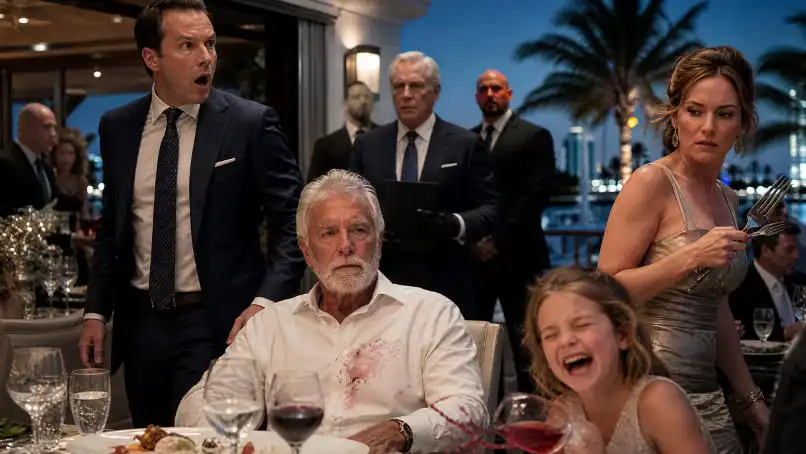
They took my fork before I even got one bite.
Not quietly.
Not politely.
In front of the entire family.
My daughter-in-law, Vanessa, reached across the white linen table, lifted my knife and fork beside my plate, and held them like they were evidence from a crime scene.
“Arthur,” she said, smiling with that soft, polished cruelty people learn in expensive country clubs, “let’s not embarrass anyone tonight.”
I looked at her hand.
Then at the table.
Twenty-one relatives.
Three family investors.
Two attorneys.
A private July 4th dinner room at the Harrington Yacht Club in Miami, where the palm trees swayed outside the glass wall and fireworks waited in boxes near the marina.
Every chair was filled except the one nobody wanted me to sit in.
Mine.
My oldest son, Julian, leaned back in his chair.
Navy suit.
Gold cufflinks.
Wall Street confidence.
The kind of son who stopped calling me Dad the moment he learned to call himself Managing Director.
“Don’t look so wounded,” Julian said. “You know this table is for people who are helping the family move forward.”
“I founded the company,” I said.
A few people looked down.
Not because they felt shame.
Because they were tired of hearing the truth.
Julian smiled.
“You founded a machine shop in 1978. I turned it into a modern holdings company.”
“You turned it into debt.”
His smile disappeared for half a second.
Then Vanessa laughed.
“Oh, Arthur. Always so dramatic.”
She gestured toward the kitchen door.
“The staff has leftovers. I’m sure they’ll make you a plate back there.”
My sister-in-law Diane covered her mouth.
My nephew Brad chuckled.
My granddaughter Madison, twenty-three years old and already fluent in cruelty, raised her wineglass toward me.
“Grandpa, honestly, the kitchen lighting might be kinder to that shirt.”
The table laughed.
I had worn my best white dress shirt.
It was old, yes.
The collar had softened.
One button had been replaced with a slightly different shade.
But it was clean.
Pressed.
Respectful.
My wife, Eleanor, had bought it for me before she passed. She said it made me look like the man she married.
Madison’s eyes flicked to Julian.
He gave her the smallest nod.
Then her hand tilted.
Red wine spilled across my chest.
Cold first.
Then sticky.
Then humiliating.
“Oh no,” Madison said, pretending to gasp. “I’m so sorry.”
But she was laughing before the sentence ended.
The room joined her.
All except one busboy near the wall. A kid no older than nineteen. He looked like he wanted to disappear.
Julian leaned forward.
“See? This is exactly why we tried to avoid a scene.”
I took the napkin beside my empty plate and pressed it against my shirt.
The stain spread wider.
Red over white.
Like a wound.
A man at the next table, separated from our private room by a half-open partition, lifted his phone and started filming.
Vanessa noticed.
Instead of stopping, she sat straighter.
That was Vanessa.
Always ready for an audience.
Julian tapped a folder in front of him.
“Dad, let’s stop pretending this is about dinner.”
He slid the papers across the table.
The top page read:
RELEASE AND TRANSFER OF RESIDENTIAL ESTATE INTEREST.
My father’s house.
The old Whitmore home.
Four acres near Coconut Grove before that land became the kind of place people whispered about at auctions.
My father had built the first porch himself.
My mother planted the orange trees.
Eleanor and I raised three children there.
Julian took his first steps in that hallway.
He had already sold the future of it to a developer.
He only needed my signature to erase the past.
“No,” I said.
My voice was quiet.
That annoyed him more than anger would have.
“No?” Julian repeated.
He looked around the table, giving everyone permission to be offended.
My younger son Peter shifted in his chair.
“Dad, don’t make this harder.”
“You too?” I asked.
Peter swallowed.
He had always followed the loudest voice in the room.
Julian’s voice was loudest because he paid for everything.
Or at least everyone thought he did.
Mom sat at the far end beside Dad.
Both were in their nineties.
Both had chosen Julian years ago.
Not because he was kind.
Because he looked successful.
My father avoided my eyes.
My mother’s lips trembled, but she said nothing.
Julian pushed a silver pen toward me.
“Sign it.”
“No.”
His fingers curled.
“Dad, I control the board. I control the payroll. I control the legal team. You have a symbolic seat and a sentimental nameplate.”
I looked at the wine stain on my shirt.
Then at my family.
“Is that what you told them?”
“What?”
“That I’m symbolic?”
Vanessa sighed loudly.
“Arthur, you are exhausting.”
Madison leaned toward her cousin and whispered, loud enough for me to hear, “Maybe dementia comes with ego.”
Laughter again.
Julian didn’t stop it.
He enjoyed it.
That was the moment I stopped feeling hurt.
Pain can become something clean when it burns long enough.
Julian stood.
“Let me be clear. You either sign this tonight, or you leave the family home by Monday. I will have security remove you if I have to.”
A hush moved through the room.
Even the investors looked uncomfortable now.
But none of them defended me.
Money makes cowards look practical.
I picked up the pen.
Madison grinned.
Vanessa mouthed, “Finally.”
Julian placed both hands on the table.
“That’s better.”
I held the pen over the paper.
Then I asked, “Julian, did your lawyers ever explain what happens when a trust is frozen but not dissolved?”
He blinked.
“What?”
“The trust,” I said. “Did they explain the difference?”
His jaw tightened.
“There is no trust.”
“That’s not what I asked.”
Vanessa gave a sharp little laugh.
“Oh my goodness. We are not doing one of your old-man riddles tonight.”
I looked at her.
“You should listen too, Vanessa. Your name appears in three wire transfers.”
Her smile faded.
The first crack.
Tiny.
But real.
Julian leaned across the table.
“You’re confused.”
“No,” I said. “For the first time in a long time, I’m the only person in this room who isn’t.”
My phone buzzed against the table.
One message.
Zurich: Arrived. Entering now.
I placed the pen down.
Julian’s face hardened.
“Sign the papers.”
“No.”
He turned toward the yacht club manager standing near the bar.
“Get security.”
I almost smiled.
“Not necessary.”
The double doors opened.
Every head turned.
A silver-haired man entered in a charcoal suit that cost more than Julian’s watch.
Behind him walked two private security officers.
Not yacht club security.
Not bouncers.
Professional.
Quiet.
Armed.
The room changed instantly.
People who had laughed at me seconds earlier sat frozen with forks halfway to their mouths.
The man in the charcoal suit walked straight past Julian.
Past Vanessa.
Past the attorneys.
He stopped beside me.
“Mr. Arthur Whitmore,” he said with a Swiss accent, “I apologize for the delay.”
Julian’s chair scraped back.
“Who are you?”
The man set a black leather folder beside my ruined plate.
“My name is Lukas Keller. Senior Executive Director of Helvetia Banque Suisse.”
Brad whispered, “Swiss bank?”
Keller ignored him.
He opened the folder.
“As of 6:00 p.m. Eastern Time, the final international restriction on the Whitmore Family Preservation Trust has been lifted.”
Julian laughed once.
Too loud.
Fake.
“There is no Whitmore Family Preservation Trust.”
Keller turned one page.
“There is.”
He looked at me.
“Created by Arthur Whitmore and Eleanor Whitmore in 1989. Amended in 2001. Frozen during multi-jurisdictional tax review in 2018. Cleared this morning.”
The attorneys at the table suddenly became very interested in their napkins.
Julian’s mouth opened.
Nothing came out.
Keller continued.
“Mr. Whitmore remains the sole living trustee with full allocation authority.”
My mother gasped.
My father finally looked at me.
I picked up my water glass and took a slow sip.
My hands did not shake anymore.
Julian pointed at the folder.
“How much?”
Keller paused.
I could feel everyone leaning in.
Vanessa whispered, “Julian…”
Keller said, “The liquid balance currently available for allocation is eight billion dollars.”
No one breathed.
Not eight million.
Not eighty million.
Eight billion.
Madison’s face went pale beneath her makeup.
The boy who had been filming at the next table lowered his phone, stunned.
Julian grabbed the back of his chair.
“That’s impossible.”
“No,” Keller said. “It is documented.”
I looked at my son.
“I built more than a machine shop.”
Julian shook his head.
“You hid this from us?”
“I protected it from you.”
His eyes filled with fury.
That was always Julian’s ugliest truth.
He could forgive being wrong.
He could not forgive being excluded.
“You selfish old man,” he hissed. “That money belongs to the family.”
“The trust belongs to the family,” I said. “The authority does not.”
Keller slid another document from the folder.
“Mr. Whitmore, as requested, I have brought the emergency capital allocation forms and the withdrawal directive.”
Julian’s face changed.
The words had reached him.
Emergency capital.
Withdrawal directive.
He looked at the three investors.
Then at the attorneys.
Then back at me.
“What did you do?”
I unlocked my phone.
The quarterly investor call was already open.
Julian had scheduled it for the dinner because he wanted the family investors impressed.
He wanted to announce that the company had secured rescue funding after months of hidden cash-flow problems.
He wanted applause.
He wanted me sitting in the kitchen while he took credit for money I quietly arranged to save the company.
I tapped unmute.
A voice came through the phone.
“Mr. Whitmore? We’re live with the board and lenders.”
I looked at Julian.
He whispered, “Dad.”
Not Arthur.
Not old man.
Dad.
Funny how fast titles return when money walks into the room.
I said into the phone, “This is Arthur Whitmore. As controlling trustee of the rescue capital facility, I am formally withdrawing the full investment package effective immediately.”
Chaos erupted through the speaker.
“Mr. Whitmore, please confirm—”
“I confirm.”
Julian lunged for the phone.
One of the armed guards stepped between us.
Julian stopped so hard he nearly fell backward.
“You can’t do this!” he shouted.
“I just did.”
The investors began standing.
One of them, a gray-haired man named Hollis, turned to Julian.
“You told us the capital was secured.”
“It was,” Julian snapped.
Hollis looked at me.
“Sir, was the funding conditional?”
“Yes,” I said. “On clean financial disclosures, no unauthorized asset transfers, and no attempt to coerce the trustee.”
Keller placed another sheet on the table.
“Those conditions were breached.”
Vanessa’s lips parted.
Madison started crying without tears.
Julian looked at the attorneys.
“Say something.”
One attorney closed his folder.
“Julian, you need independent criminal counsel.”
The room went dead.
That sentence hit harder than any shout.
Julian’s face flushed purple.
“What are you talking about?”
I nodded to Keller.
He removed three sets of documents.
Wire transfers.
Board minutes.
Emails.
Developer contracts.
Fake valuations.
A forged health assessment claiming I was cognitively impaired.
My signature copied onto a preliminary estate consent I had never signed.
And Vanessa’s name appeared exactly where I said it would.
Three wire transfers from the developer’s consulting arm.
Madison’s name appeared too.
A “social media advisory fee.”
For helping create the public image that Grandpa was unstable.
Peter’s hands covered his face.
He had signed one affidavit saying he believed I could no longer handle my affairs.
My mother began to sob.
“Arthur…”
I did not look away from Julian.
“You tried to have me declared incompetent.”
Julian swallowed.
“We were protecting the family.”
“No,” I said. “You were protecting your lifestyle.”
Vanessa found her voice.
“This is ridiculous. Nobody forced him. He’s just bitter.”
Keller calmly placed a small recorder on the table.
A yacht club camera angle had captured Vanessa taking my silverware.
Madison spilling wine.
Julian threatening to remove me by security unless I signed.
Then Keller placed my phone beside it.
“The dinner has been recorded from the moment Mr. Whitmore sat down,” he said. “Florida law allows recording with consent of all parties in certain private contexts, and Mr. Whitmore’s legal team has already secured sworn statements from staff who witnessed coercion and financial threats. The matter will be handled by counsel.”
One of the family investors cursed under his breath.
The yacht club manager stepped backward like the table had caught fire.
Julian tried to laugh again.
It came out broken.
“You planned this?”
I folded my napkin.
“No, Julian. You planned this. I just stopped pretending I didn’t see it.”
For almost two years, I had watched.
I watched Julian move debt between subsidiaries.
I watched Vanessa host charity luncheons with money borrowed against company equipment.
I watched Madison mock employees online while being paid out of a marketing budget she never earned.
I watched Peter sign whatever Julian placed in front of him because courage had never been his strength.
I watched my parents praise the son who arrived in limousines and ignore the one who paid their medical bills anonymously every month.
And I said nothing.
Not because I was weak.
Because every trap needs patience.
The first lender withdrew within six minutes.
The second within twelve.
By the time dessert arrived, Whitmore Coastal Holdings had lost its rescue package, its credit extension, and its acquisition financing.
Julian’s phone rang nonstop.
Board members.
Bankers.
Lawyers.
Developers.
All wanting answers he did not have.
The fireworks began outside over Biscayne Bay.
Red.
White.
Gold.
They lit the room through the glass while my family collapsed in silence.
There is a strange kind of poetry in watching people who laughed at your stained shirt suddenly realize they can’t afford their own dry cleaning.
Julian finally sat down.
His voice dropped.
“Dad, please. Don’t destroy everything.”
I looked at him for a long time.
“I’m not destroying anything. I’m removing my money from the fire you started.”
Vanessa reached for my arm.
“Arthur, we’re family.”
One guard stepped closer.
I looked at her hand until she pulled it back.
“Family doesn’t steal from an old man while laughing at him.”
Madison whispered, “Grandpa, I’m sorry.”
“No,” I said softly. “You’re scared.”
She cried then.
Real tears this time.
Keller closed the folder.
“Mr. Whitmore, federal counsel is prepared. The forensic reports have been delivered. The court orders on luxury asset preservation are being filed tonight.”
Julian stared at him.
“What does that mean?”
“It means,” Keller said, “you should not attempt to sell, transfer, hide, gift, or remove any personal luxury assets tied to the fraud investigation.”
Vanessa gripped the table.
“My jewelry?”
“Potentially,” Keller said.
“My cars?” Julian asked.
“Potentially.”
“My apartment?”
Keller did not answer.
He did not need to.
The next morning, the story broke.
Not from me.
From someone at the yacht club.
The video of the wine hitting my shirt went everywhere.
The headline read:
ELDERLY FOUNDER HUMILIATED AT FAMILY DINNER BEFORE $8 BILLION TRUST REVEAL.
I hated that word.
Elderly.
But I did enjoy the rest.
Within forty-eight hours, Julian resigned from the board.
Within one week, federal investigators opened a fraud case involving false financial disclosures, coercive estate transfer attempts, and forged medical competency documents.
Within three months, Julian was indicted.
His lawyers fought hard.
Money can buy delay.
It cannot buy innocence when emails are printed in black and white.
Vanessa’s handbags were seized first.
Then the watches.
Then the yacht membership.
Then the Miami condo with the glass balcony she loved to photograph.
Madison deleted every post she ever made mocking me.
The internet had already saved them.
Peter came to see me at the old house.
He stood on the porch with a casserole dish and the face of a boy who had broken a window.
“I’m sorry,” he said.
I let him stand there longer than kindness required.
Then I opened the door.
Not because he deserved it.
Because bitterness is a second prison, and I had no interest in living inside one.
My parents were the hardest part.
They had spent decades believing the loudest success was the truest one.
When Julian’s accounts were frozen and their private medical coverage disappeared, they ended up sitting in a community hospital hallway, waiting for approval forms they never thought people like them had to fill out.
My mother called me crying.
“Arthur, we were wrong.”
I drove there myself.
Not in a limo.
In my old Lincoln.
I paid the medical bills.
But I did not move them back into luxury.
Comfort, yes.
Indulgence, no.
There is a difference between mercy and enabling.
Julian eventually received a sentence that could keep him behind bars for up to ten years, depending on restitution and cooperation.
Vanessa avoided prison by testifying, but she lost nearly everything tied to the scheme.
Madison was ordered into repayment and community service.
She spent weekends serving meals to elderly people she once would have mocked for their shoes.
I hope it changed her.
I do not need to know.
Six months after the yacht club dinner, I stood at a press conference in Miami.
Same city.
Different room.
No stained shirt.
I announced the creation of Whitmore Legacy Capital, a new company built to invest in family-owned American businesses whose founders were being pushed aside by greedy successors.
I also announced that the old family home would never be sold.
It became the Eleanor Whitmore House, a retreat for widows, veterans, and grandparents raising grandchildren.
My wife would have liked that.
After the cameras left, I walked through the garden alone.
The orange trees were still there.
Older.
Bent.
Still producing fruit.
Keller called from Zurich.
“Congratulations, Mr. Whitmore.”
“Thank you, Lukas.”
“Do you feel vindicated?”
I looked at the porch where Eleanor used to drink coffee.
“No,” I said. “I feel free.”
That night, a news segment showed two screens.
On one side, I stood beside civic leaders and business owners at the announcement of a new investment fund.
On the other, footage showed my relatives entering a low-rent apartment building with boxes, hiding their faces from cameras.
I did not cheer.
I did not dance.
I simply turned off the television.
Revenge is loud at first.
Healing is quiet.
The next July 4th, I hosted dinner at the old house.
No VIP room.
No white linen meant to impress strangers.
Just long wooden tables under string lights.
Employees came.
Old neighbors came.
The busboy from the yacht club came too.
His name was Miguel.
He had been the one who gave my legal team the first witness statement.
I paid his college tuition through a scholarship fund the next morning.
At dinner, he tried to thank me again.
I handed him a plate.
“Eat first,” I said. “Gratitude can wait.”
Everyone had a seat.
Everyone had silverware.
Nobody ate in the kitchen unless they wanted seconds.
Before the fireworks, Peter stood and raised a glass.
“To Dad,” he said. “For showing us that dignity doesn’t have to shout.”
I looked at him.
Then at the empty chair beside me, where Eleanor would have sat.
I raised my glass.
“To anyone who has ever been laughed at by people who needed them more than they knew.”
The table went quiet.
Not uncomfortable.
Respectful.
That silence felt better than applause.
So here is what I learned:
When people mistake your patience for weakness, let them.
When they mistake your kindness for surrender, let them.
And when they finally place the pen in your hand and demand that you sign away your dignity, remember this—
You are not required to keep peace with people who are stealing your life.
Julian wanted my house.
Vanessa wanted my money.
Madison wanted a laugh.
They all got a lesson.
And I kept the one thing they could never buy back:
My name.
Share this with someone who has been underestimated. And choose a side: was Arthur too harsh, or did his family deserve every consequence? 🇺🇸
Disclaimer: Mention of any brand or trademark is for identification only and does not imply partnership or endorsement
The Tavern Owner Set A Trap To Make Paul Drink Again… But He Had NO IDEA The Entire Town Was Watching 👀
They Laughed When Mark Announced He Was Running for Office… Then One Sealed Envelope Made the Whole Room Go Silent 😳

My Stepdaughter Thought Her Real Father Paid for Her Golf Club Wedding… Then I Showed the Guests the Letter He Sent Me