

She told my father his son belonged on a construction site.
Not in a classroom.
Not at Harvard.
On a construction site.
And she said it in front of four rich kids, two office assistants, the school principal, and me.
My name is Ethan Miller. I was seventeen years old, and until that afternoon, I thought the most embarrassing thing in my life was driving to school in my dad’s dented pickup truck.
I was wrong.
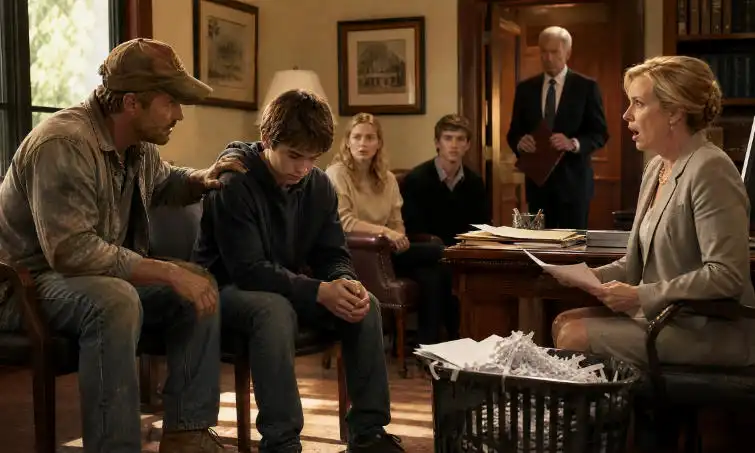
The most embarrassing thing was watching a grown woman in a cream-colored blazer pick up my father’s handwritten recommendation letter and feed it into a paper shredder like it was trash.
The machine growled.
The paper vanished.
And the room laughed.
My dad did not.
He stood there in his old work boots, a faded gray jacket zipped halfway up, and hands so rough they looked like they belonged to a man carved out of oak.
Those hands had built decks, repaired roofs, poured concrete, framed houses, carried steel beams, and fixed our kitchen sink three different times because we could not afford a plumber.
Those hands had also packed my lunch every morning since my mother died.
But Mrs. Whitmore looked at them like they were evidence against him.
“This,” she said, lifting what remained of the letter before shredding it, “is exactly why parents should understand their limits.”
The office went quiet for half a second.
Then one of the rich kids behind me laughed.
His name was Preston Vale. His father owned half the commercial real estate in town, and everyone at school treated him like he was already important.
“Man,” Preston said, “he really thought a construction note was going to get somebody into Harvard.”
His friend Carter leaned back against the wall.
“Maybe Harvard needs janitors.”
The other boys laughed.
I felt my face go hot.
My father looked at me, not them.
Just me.
His eyes said, Stay calm.
That was my father’s way.
Calm when the power bill was late.
Calm when the truck broke down.
Calm when Mom’s hospital bills came in with numbers that looked like phone numbers.
Calm when people treated him like he was invisible.
Mrs. Whitmore was not calm.
She was enjoying herself.
She tapped her manicured nails on my file.
“Ethan, your grades are strong. I won’t deny that. Your test scores are impressive. But Harvard looks at fit.”
She paused, then looked at my dad’s boots.
“And fit includes background.”
My father said, “His background is hard work.”
Mrs. Whitmore smiled.
“That is sweet, Mr. Miller. But admissions committees are not moved by sentiment.”
“My son built a neural mapping prototype in our garage,” Dad said. “He won the state science award.”
“With community college equipment?” she asked.
“With spare parts,” I said before I could stop myself.
She turned to me.
“That is not the defense you think it is.”
Preston whispered, “Garage genius.”
The boys laughed again.
My dad’s eyes moved to the shredder.
“May I ask why you destroyed my letter?” he said.
Mrs. Whitmore folded her hands.
“Because it was misleading. A father’s emotional letter is not an academic recommendation. It could hurt your son’s application.”
“You didn’t read all of it,” my dad said.
“I read enough.”
“No, ma’am. You didn’t.”
That was when her smile thinned.
“Mr. Miller, I have guided students into Ivy League schools for twenty-one years. I know what belongs in a serious application. And I know what does not.”
She held up her hand, pointing at his palm.
“With respect, a man who works with concrete does not get to lecture me about Harvard.”
There it was.
The whole room felt it.
Even the office assistants stopped typing.
The principal, Mr. Alden, shifted uncomfortably near the door, but he did not step in.
That hurt almost as much as the laughter.
Because he knew me.
He had handed me the science trophy at assembly.
He had told my dad, “You must be proud.”
But now, when the counselor was humiliating us in public, he suddenly found the carpet interesting.
Dad nodded slowly.
“I see.”
Mrs. Whitmore looked satisfied.
“I am trying to help your son avoid disappointment.”
“No,” Dad said. “You’re trying to teach him shame.”
The room snapped silent.
Mrs. Whitmore’s face hardened.
“Excuse me?”
“You’re not helping him. You’re showing him where you think people like us belong.”
Preston muttered, “People like us?”
Dad turned his head just enough to look at him.
Preston stopped smiling.
My father was not a big man in the flashy way. He was not loud. He did not wear expensive clothes. But he had spent thirty years lifting things most men needed machines for. When he looked at someone, they usually remembered their manners.
Mrs. Whitmore stood.
“I think this meeting is over.”
“Not yet,” Dad said.
He reached into his jacket and pulled out a folded lanyard.
I had seen it before, hanging from the rearview mirror of his truck, but I had never paid attention to it.
He placed it on the desk.
The plastic badge was scratched, but the words were clear.
HARVARD SCIENCE COMPLEX SENIOR STRUCTURAL CREW FRANK MILLER
Mrs. Whitmore blinked.
Preston leaned forward.
Carter stopped chewing gum.
My dad said, “You should have finished reading the letter.”
Her eyes flicked to the shredder.
For the first time, she looked unsure.
I looked at Dad.
“What is that?” I whispered.
He didn’t answer.
There was a knock at the door.
Three hard taps.
Mr. Alden opened it.
An older man in a dark suit stood outside with two people behind him. One was a woman holding a leather folder. The other was a man from the district office I had seen once at an awards banquet.
The older man stepped inside.
The whole room changed.
You could feel it.
Some people bring noise with them.
This man brought silence.
Mrs. Whitmore’s mouth opened.
“Dr. Halpern?”
Preston’s eyes widened.
I knew the name.
Everyone did.
Dr. Samuel Halpern, president of Harvard University, had been in town that week for a private donor event connected to the new science complex.
I had read about it online.
I never imagined he would be standing in my high school counselor’s office.
He looked at my father first.
Not Mrs. Whitmore.
Not the principal.
My father.
“Frank Miller,” he said.
Dad nodded.
“Dr. Halpern.”
Then the president of Harvard University walked across the office and shook my father’s hand.
Not quickly.
Not politely.
With both hands.
“Good to see you again,” Dr. Halpern said. “I’m sorry it had to be under these circumstances.”
Mrs. Whitmore whispered, “Circumstances?”
Dr. Halpern looked down at the shredded paper in the bin.
“Is that the letter?”
No one spoke.
My father said, “It is.”
Dr. Halpern’s face turned cold.
The woman with the folder stepped forward.
“Mr. Alden, this is now a formal incident. We will need the office security footage preserved immediately.”
Mrs. Whitmore grabbed the edge of her desk.
“Security footage?”
The district official nodded.
“Yes. And the student who was recording on his phone should not delete anything.”
Preston’s face drained of color.
His phone was still in his hand.
My father looked at him.
“Son, I’d put that on the desk.”
Preston obeyed.
No argument.
No smirk.
Just a pale kid in an expensive blazer realizing his family name did not own the room anymore.
Mrs. Whitmore straightened.
“I don’t understand what is happening here.”
Dr. Halpern turned to her.
“I can explain.”
His voice was calm, but every word landed like a hammer.
“Mr. Miller was part of the senior structural crew on Harvard’s new Advanced Neuroengineering Laboratory. His recommendations and field corrections prevented a major structural delay last year. Several of our faculty know him by name.”
Mrs. Whitmore stared.
Dr. Halpern continued.
“During that project, Mr. Miller spoke often about his son, Ethan. One of our visiting faculty later reviewed Ethan’s state science submission and recognized that his prototype addressed a problem very close to ongoing research at our lab.”
I could barely breathe.
Dad had never told me.
He had never said he talked about me at work.
He had never said anyone from Harvard had looked at my project.
Dr. Halpern turned to me.
“Ethan, your work was rough.”
The rich kids exchanged looks.
Then he smiled.
“But it was original. That matters more.”
My throat tightened.
“Sir, I built most of it from donated parts.”
“I know,” he said. “That is one of the reasons we are interested.”
Mrs. Whitmore suddenly found her voice.
“Dr. Halpern, I was only trying to maintain application standards.”
The woman with the folder looked at her.
“By destroying a parent-submitted document in front of students?”
Mrs. Whitmore swallowed.
“It was not an official document.”
My father said quietly, “It had signatures.”
She froze.
Dad looked at the shredder.
“Two signatures on the final page. Mine and Professor Daniel Reeves.”
The room went still.
The woman opened the folder.
Dr. Halpern’s expression sharpened.
Mrs. Whitmore’s voice cracked.
“Professor Reeves?”
Dad nodded.
“He was on site during the Harvard project. He reviewed Ethan’s prototype last month. He asked me to include his note with mine because Ethan was nervous about reaching out directly.”
I felt dizzy.
Professor Daniel Reeves was one of the names I had seen on papers I barely understood.
Dad had not written a father’s emotional letter.
He had written the story of my work.
And attached a note from a Harvard professor.
Mrs. Whitmore had shredded it without reading.
Why?
The district official looked at Mr. Alden.
“Has Mrs. Whitmore handled Ethan Miller’s application before today?”
The principal rubbed his forehead.
“Yes.”
The woman with the folder removed several printed emails.
“We received a forwarded packet this morning from Mr. Miller. It includes screenshots showing that Mrs. Whitmore delayed submission of Ethan’s materials twice, removed his science award from a counselor summary, and marked his application as ‘poor institutional fit.’”
My stomach dropped.
I turned to Mrs. Whitmore.
“You removed my award?”
She did not look at me.
Dr. Halpern did.
“That is why I came personally.”
My dad put a hand on my shoulder.
Only then did I realize he had known more than I did.
He had not been silent because he was weak.
He had been silent because he was building the case.
For weeks, I thought Dad was tired.
He came home late, sat at the kitchen table, and asked me to forward him old emails from the school portal.
I thought he was just trying to understand the application.
He was collecting proof.
Every missing attachment.
Every changed note.
Every strange delay.
Every email Mrs. Whitmore sent telling us not to “overreach.”
My father had saved all of it.
Mrs. Whitmore’s chair scraped the floor.
“This is being taken out of context.”
The woman looked at one email.
“Would you like me to read the context?”
Mrs. Whitmore said nothing.
The woman read anyway.
“Quote: ‘Families without legacy connections often misunderstand where their children belong. Encourage Miller to pursue technical training instead of elite academics.’”
Carter whispered, “Oh my God.”
Dr. Halpern looked disgusted.
The district official turned to Mrs. Whitmore.
“You put that in writing?”
She reached for the desk.
“I meant practical pathways.”
My father said, “You meant my son should know his place.”
For the first time, her eyes met his.
And she looked afraid.
Not sorry.
Afraid.
There is a difference.
Dr. Halpern opened his folder and took out a document with Harvard letterhead.
“Ethan Miller,” he said, “our admissions committee has completed an early special review. Based on your academic record, research promise, and faculty recommendation, Harvard University is offering you admission through a special talent designation.”
The room disappeared.
All I heard was my heartbeat.
Dr. Halpern kept reading.
“This offer includes full tuition, housing, meals, fees, books, research support, and travel assistance.”
My dad’s hand tightened on my shoulder.
“Full cost of attendance,” Dr. Halpern said. “No loans.”
I covered my mouth.
I tried to speak, but nothing came out.
My father did.
“Thank you, sir.”
His voice broke on the last word.
That broke me.
I turned and hugged him right there in front of everyone.
His jacket smelled like sawdust, cold air, and machine oil.
It smelled like every morning he left before sunrise so I could have a future bigger than our bills.
The rich kids did not laugh.
They did not whisper.
They stood against the wall like boys waiting outside the principal’s office.
Preston looked at my father’s hands now.
Not like they were dirty.
Like they were dangerous.
Dr. Halpern placed the acceptance packet on Mrs. Whitmore’s desk.
“I believe Mr. Miller needs a clean surface to sign.”
Mrs. Whitmore moved aside.
Fast.
Dad looked at me.
“This is yours, Ethan.”
“No,” I said. “It’s ours.”
He shook his head.
“You did the work.”
“So did you.”
He looked away, but not before I saw tears in his eyes.
The woman handed him a pen.
My dad stared at it for a second.
His fingers were rough.
His nails were cracked.
There was a thin white scar across his thumb from a saw accident when I was twelve.
Those were the hands Mrs. Whitmore had mocked.
Those were the hands that signed the full scholarship confirmation.
FRANK MILLER.
The pen scratched across the paper.
No one moved.
No one spoke.
When he finished, Dr. Halpern shook his hand again.
“This country was built by hands like yours,” he said. “No institution worth anything should forget that.”
Mrs. Whitmore’s face crumpled.
“Dr. Halpern, please. I have served this school for twenty-one years.”
The district official stepped forward.
“And today you destroyed student material, publicly humiliated a parent, interfered with an application, and created a discriminatory record in writing.”
Mr. Alden finally spoke.
“Mrs. Whitmore, you are being placed on immediate administrative leave pending termination review.”
Her mouth fell open.
“Termination?”
The woman from the district said, “You will leave your office now.”
For twenty-one years, Mrs. Whitmore had decided who was worthy.
That day, she had to pack her framed certificates into a cardboard box while the father she mocked stood beside a Harvard president.
The rich boys tried to slip out.
Dr. Halpern stopped them with one sentence.
“Young men, stay.”
They froze.
He looked at Preston.
“You recorded this?”
Preston nodded.
“Then you will give that recording to the district office.”
“Yes, sir.”
“And you will each write a formal apology to Mr. Miller and Ethan.”
Carter muttered, “Yes, sir.”
Preston looked at my dad.
“I’m sorry.”
Dad studied him.
Then he said, “Don’t be sorry because you got caught. Be different because you were wrong.”
Preston lowered his head.
For once, he had no comeback.
Mrs. Whitmore walked out carrying a box.
No dramatic speech.
No proud exit.
Just the soft sound of expensive heels crossing a floor she had ruled for too long.
After she left, Mr. Alden turned to us.
“Frank, Ethan… I should have stepped in.”
My dad nodded.
“Yes. You should have.”
The principal looked ashamed.
“I’m sorry.”
Dad did not rush to forgive him.
That surprised me.
My father was kind, but he was not weak.
He said, “Apologies matter after accountability.”
Mr. Alden nodded.
“I understand.”
The district official promised a review of every application Mrs. Whitmore had handled that year.
Every student she had discouraged.
Every award she had minimized.
Every family she had made feel too poor, too ordinary, or too invisible to dream big.
That mattered to my dad.
He said, “Make sure Ethan isn’t the only one you fix this for.”
The woman wrote it down.
Outside the office, word had already spread.
Students lined the hallway.
Some had phones out.
Some looked embarrassed.
Some looked amazed.
I heard whispers.
“That’s the Harvard kid.”
“That’s his dad?”
“He built the science building?”
My dad walked beside me like none of it mattered.
But I saw his shoulders straighten.
Not with pride exactly.
With relief.
Like a weight he had carried for years had finally been set down.
When we reached the parking lot, he stopped beside the pickup truck.
The same dented truck I used to hate being seen in.
The same truck with a cracked taillight and a toolbox in the back.
He opened the passenger door for me like always.
I didn’t get in.
Instead, I looked at his hands.
“Dad,” I said, “why didn’t you tell me?”
He leaned against the truck.
“Tell you what?”
“That people from Harvard knew about me. That you were collecting evidence. That you had Professor Reeves sign something.”
He looked toward the school building.
“Because I didn’t want you fighting adults who had already made up their minds about you.”
“So you fought them?”
“No,” he said. “I documented them.”
That was my father.
No shouting.
No threats.
No revenge in the dark.
Just proof.
Rules.
Patience.
A legal hammer dropped in daylight.
“Were you scared?” I asked.
He laughed softly.
“Son, I’m a single father with a mortgage. I’m scared before breakfast.”
I laughed too, but my eyes burned.
He put his hand on my shoulder.
“But I was never scared of them.”
“Why not?”
“Because people like that only have power when you believe their opinion is the truth.”
I never forgot that.
Two weeks later, Mrs. Whitmore was officially terminated.
The district investigation found she had a pattern of steering working-class students away from elite applications while giving extra attention to wealthy families and legacy donors.
Preston Vale’s father tried to make the incident disappear.
He failed.
The video had already been submitted.
The emails were already printed.
The security footage showed everything.
Mrs. Whitmore shredding the letter.
The boys laughing.
My father standing still.
The door opening.
The room changing.
The truth walking in with a folder.
Several families came forward after the review began.
A military mom whose daughter had been told not to apply to Stanford.
A grocery store manager whose son had been pushed toward “realistic options” despite perfect math scores.
A janitor’s granddaughter whose scholarship forms had somehow “gone missing.”
My dad went to two school board meetings after that.
He wore his best shirt.
Still had work boots on.
When he spoke, nobody laughed.
He said, “A child’s future should not depend on whether their parent knows the right vocabulary or wears the right shoes.”
People stood up and applauded.
I watched him from the back row.
For the first time in my life, I understood that dignity is not something rich people hand you.
It is something honest people carry.
Months later, the Harvard acceptance package arrived again, this time framed by my aunt because she said, “A miracle deserves glass.”
Dad hung it in our hallway.
Right beside a photo of Mom.
He touched the frame every morning before work.
Not because Harvard made him proud.
Because proof did.
Proof that his sacrifices had not been invisible.
Proof that a man with cracked hands could still open doors no one expected.
On move-in day, Dad drove me to Cambridge in the pickup.
We crossed onto campus while church bells rang somewhere in the distance.
Students pulled rolling suitcases past old brick buildings.
Parents carried lamps, laundry baskets, mattress toppers, mini-fridges.
Dad parked and stared out the windshield.
“You okay?” I asked.
He nodded too quickly.
“Just checking the structure.”
I laughed.
“Of course you are.”
We walked toward my dorm, and at one point he stopped near the new science complex.
His building.
Glass walls.
Steel beams.
Bright labs.
A place where future doctors, engineers, and scientists would study problems the world had not solved yet.
Dad stood on the sidewalk and looked up.
“I helped set that beam,” he said, pointing.
“Which one?”
“That one.”
I followed his finger.
It looked like every other beam to me.
But to him, it was a signature.
A hidden one.
Built into the bones of the place.
A man in a Harvard facilities jacket recognized him.
“Frank Miller?”
Dad turned.
The man grinned.
“You’re a legend around here. Heard your boy got in.”
Dad smiled.
“He earned it.”
The man shook my hand.
“You take care of him,” he said.
I thought he meant me.
Then I realized he meant Harvard.
That night, after Dad helped me unpack, he sat on the edge of my dorm bed.
The room was small.
Two desks.
Two closets.
A window looking over a courtyard.
He looked around like he was memorizing it.
“You need anything else?” he asked.
I wanted to say no.
I wanted to be strong.
But I looked at him and suddenly I was six years old again, standing beside Mom’s hospital bed, holding his hand while the world changed.
“I’m going to miss you,” I said.
His face folded.
“Yeah,” he whispered. “Me too.”
We hugged for a long time.
When he pulled away, he wiped his eyes and pretended there was dust in the room.
“Listen to me,” he said. “There will be people here with names on buildings. Don’t let that shrink you.”
“I won’t.”
“There will be kids who speak like they were born knowing the answer.”
“I know.”
“And there will be rooms where you feel like you don’t belong.”
I nodded.
He pointed to my chest.
“When that happens, remember this. You don’t have to look like the door to have earned the key.”
I wrote that down after he left.
I still have it.
Years later, people would ask me what motivated me through long nights in the lab.
They expected me to say ambition.
Or competition.
Or curiosity.
The truth was simpler.
I remembered a shredder.
I remembered laughter.
I remembered my father’s calloused hand signing a scholarship form on a desk that had been used to humiliate him.
I remembered that he did not win by becoming cruel.
He won by telling the truth so completely that the lie had nowhere left to stand.
Mrs. Whitmore lost her job.
The rich boys lost their smirks.
The school changed its application review process.
And my father, the man they said belonged on a job site, became the reason a whole district had to rethink how it treated working families.
As for me?
I kept the shredded strips of that recommendation letter.
Dr. Halpern’s assistant collected them from the bin that day and mailed them back in a sealed envelope.
I taped one strip inside my first lab notebook.
It only had three words visible.
“My son deserves…”
That was enough.
Because he did.
And so does every kid whose parent comes home tired, dirty, underpaid, and still believes their child can rise higher.
So choose a side:
Stand with the father who built the future with his bare hands, or stand with the counselor who tried to shred a dream because the paper came from the wrong kind of family.
Share this if you believe respect should never depend on money, clothes, or clean hands. ✊
Disclaimer: Mention of any brand or trademark is for identification only and does not imply partnership or endorsement
The Tavern Owner Set A Trap To Make Paul Drink Again… But He Had NO IDEA The Entire Town Was Watching 👀
They Laughed When Mark Announced He Was Running for Office… Then One Sealed Envelope Made the Whole Room Go Silent 😳
My Stepdaughter Thought Her Real Father Paid for Her Golf Club Wedding… Then I Showed the Guests the Letter He Sent Me