
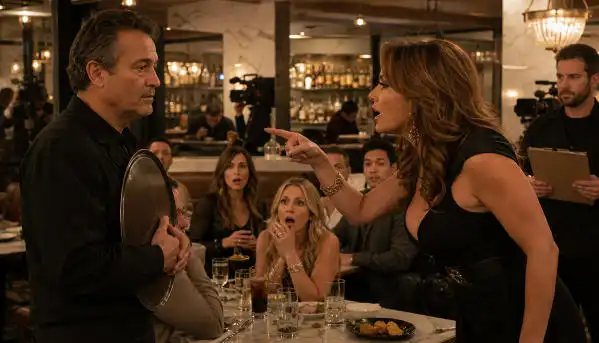
The second he said “Roll the hidden clip,” the restaurant went dead silent.
Not polite silent.
Not awkward silent.
Dead silent.
The kind of silence that makes a rich woman suddenly remember every poor person she laughed at.
Vanessa Vale stood in the middle of the studio restaurant with one hand still clenched around the camera card she had tried to steal.
Her perfect red nails pressed into the plastic like she could crush the truth if she squeezed hard enough.
The director, Paul Mercer, didn’t raise his voice.
That was what scared her.
He just looked at the control booth window above the fake wine wall and repeated, “Roll it.”
A red light blinked.
The wall-mounted screens that usually showed fake restaurant ambience went black.
Then Vanessa’s own voice filled the room.
“People like you are why luxury spaces need standards.”
A few guests looked down.
One woman covered her mouth.
The young busboy beside the kitchen door swallowed hard.
Vanessa’s face twitched.
“That was taken out of context,” she said.
Nobody answered.
On the screen, there she was.
Same designer dress.
Same diamond earrings.
Same smile she used in interviews when she talked about kindness, gratitude, and “staying grounded.”
Only now, the smile was gone.
The clip showed her snapping her fingers at me.
“Water. Still. Not tap. And try not to touch the glass with those hands.”
Then the camera angle changed.
A hidden lens inside the centerpiece caught her leaning toward me.
“Who dressed you? A bargain bin with depression?”
Her entourage laughed on the screen.
In the real room, they stopped laughing.
One of them slowly stepped away from her.
Vanessa turned toward Paul.
“You can’t air that.”
Paul looked at the card in her hand.
“You signed a conduct waiver.”
“I signed a release for the show.”
“You signed a release for the test.”
She froze.
The word test landed harder than any shout could have.
That was when I finally set the tray down.
Carefully.
Quietly.
I had carried trays in real diners before. I knew how to lower one without rattling the glasses, even when my hands wanted to shake.
But that night, I wasn’t there to serve her dinner.
I was there to see who she became when she thought the person in front of her had no power.
My name is Samuel Reed.
Most people in that room knew me as “Sam,” the gray-haired waiter with old shoes and a patient face.
Vanessa knew me as nobody.
That was her mistake.
Three months earlier, the network had asked me to join a new reality project called America’s Golden Table.
It was supposed to be a big-hearted competition show where celebrities visited ordinary workplaces and surprised overlooked employees with life-changing opportunities.
At least, that was the pitch.
But the network had a problem.
Vanessa Vale had been chosen as the host.
She was famous.
She was polished.
She had millions of followers.
She cried on cue.
She knew how to make a camera love her.
But behind the scenes, the rumors were ugly.
Makeup artists said she called them “help.”
Production assistants said she threw coffee when her almond milk was wrong.
One former driver said she left him standing in the rain because he “looked too tired for her brand.”
Still, rumors are not proof.
And in television, proof matters.
So the network created one final test.
A full restaurant set.
Hidden cameras.
A fake private dinner.
A handful of extras.
A director nearby pretending to manage B-roll.
And one mystery guest dressed as a waiter.
Me.
I had worked in broadcast television for thirty years.
I started as a floor assistant when cameras were still heavy enough to hurt your shoulder.
I learned lighting.
Then sound.
Then production.
Eventually, I became the quiet man executives called when they needed to know whether a show had a soul or just a budget.
I was not a celebrity.
I did not have Vanessa’s face.
But I had final approval power over the new series.
The contract was clear.
If the host failed the ethics test, the network could terminate the agreement before public launch.
No payout.
No press tour.
No second chance hidden behind a crisis manager.
Vanessa did not know that.
She only saw a waiter.
And that was the point.
When I first walked to her table that evening, I had already decided I would give her every chance to be decent.
She was seated under the warmest light in the room.
The kind of light that makes cheekbones look expensive.
Her assistant, Chloe, sat to her left, thin and nervous, tapping notes into a phone.
Two influencer friends sat beside her, both smiling too hard.
A producer played the part of a restaurant manager near the host stand.
The place looked real.
White tablecloths.
Low music.
Candles.
Silverware polished until you could see your mistakes in it.
Vanessa didn’t look up when I approached.
“Good evening,” I said. “Welcome. Can I get you started with water?”
She kept scrolling.
“Sparkling. Lime. No seeds.”
“Yes, ma’am.”
I turned.
“And walk faster,” she added.
A few people nearby glanced over.
I heard Paul shift by the bar.
That was the first strike.
Not cruelty yet.
Just entitlement.
The kind rich people sometimes mistake for personality.
When I returned with the water, she looked at the glass like I had handed her a dead insect.
“What is this?”
“Sparkling water with lime.”
She lifted the glass.
“There’s condensation.”
I waited.
“On the outside,” she said slowly, like she was teaching a child. “Do I look like someone who wants wet fingers?”
Her friends chuckled.
Chloe did not.
“I can replace it,” I said.
Vanessa leaned back.
“Can you replace yourself?”
The table laughed.
It wasn’t the loudest laugh I had ever heard.
But it had a sharpness to it.
A permission.
Once one powerful person laughs at you, everyone else in the room has to decide whether to join or become the next target.
That is how public humiliation works.
It recruits cowards.
I nodded.
“I’ll bring another glass.”
I could have ended it there.
The director could have stopped the test.
But the network did not want one rude sentence.
They needed pattern.
They needed intent.
They needed the kind of evidence that could survive lawyers, fans, spin, and tears on morning television.
So I stayed quiet.
I brought the second glass.
Then the appetizer.
Then the salad.
Every time, Vanessa found something new.
The plate was too plain.
The fork was too close to her hand.
The bread “looked like something from a church basement.”
Then she noticed my shoes.
They were real shoes.
My own.
Old black service shoes, polished but creased at the sides.
I wore them on purpose.
My father had worn the same kind during his twenty-two years waiting tables at a hotel in St. Louis.
He used to tell me, “Son, the way a person treats the man bringing dinner tells you more than the prayer they say before eating it.”
Vanessa pointed down.
“Oh my God. Are those orthopedic?”
Her friend laughed into her napkin.
I looked at the floor.
“They’re comfortable.”
“For what? Retiring badly?”
More laughter.
The busboy, Miguel, looked like he wanted to disappear.
He was nineteen.
An actual young actor hired to play restaurant staff, but his mother really did clean offices at night.
He told me earlier he was proud to get his first speaking role, even if it was just “Yes, chef.”
Vanessa snapped her fingers at him.
“You. Busboy.”
Miguel stepped forward.
“Yes, ma’am?”
“Is he your supervisor?”
“No, ma’am.”
“Good. Because that would be depressing.”
His ears turned red.
My jaw tightened.
That was the first moment I almost broke character.
Not for me.
For him.
But I remembered the contract.
I remembered the hidden cameras.
I remembered that the punishment had to be clean.
Inside the rules.
No shouting.
No threats.
No revenge that could be twisted into a scandal.
Just truth.
So I did what my father taught me.
I stood straight.
I breathed once.
And I kept serving.
Vanessa wanted attention more than food.
That became clear by the main course.
She had begun glancing toward Paul by the bar.
“Are we getting behind-the-scenes content tonight?” she asked loudly.
Paul smiled without warmth.
“Just atmosphere.”
“Make sure you catch my good side.”
“We’re catching everything we need.”
She didn’t understand the warning.
People like Vanessa never do.
They think warnings are for other people.
When I brought her entrée, she stared at it.
“What is this?”
“Pan-seared salmon with roasted vegetables.”
She wrinkled her nose.
“Who plated it?”
“The kitchen.”
“No. Who approved it?”
I said nothing.
She pushed the plate toward me with two fingers.
“Do you think this looks expensive?”
“It looks well-prepared.”
“That’s not what I asked.”
The room quieted again.
She lifted a carrot with her fork and dropped it back onto the plate.
“Look at this. This is why people like you don’t understand taste. Taste is not just food. It’s class. It’s breeding. It’s knowing what belongs in front of a woman like me.”
I heard someone whisper, “Wow.”
Vanessa smiled.
She liked that.
Shock was applause to her.
Then she picked up the plate and shoved it toward my chest.
Not hard enough to injure me.
Hard enough to make the sauce slide.
Hard enough to make the rim hit my vest.
Hard enough for everyone to see.
“Take it back,” she said. “And bring me something that doesn’t look like it was designed by a man who shops at clearance racks.”
The plate bumped the tray.
A glass tipped.
Water spilled over my sleeve.
A fork clattered onto the floor.
Miguel stepped forward instinctively.
Vanessa turned on him.
“Don’t hover. It makes you look desperate.”
He stopped.
My sleeve dripped.
The guests stared.
And for one second, I felt exactly like I had when I was twelve years old watching a businessman throw a napkin at my father because his steak was “too patient.”
My father had picked up the napkin.
Smiled.
And said, “I’ll get that fixed for you, sir.”
Later, in the car, I asked him why he didn’t yell back.
He said, “Because one day, you’ll learn the difference between dignity and volume.”
That night in the studio restaurant, I finally understood.
Dignity can be quiet.
But it is not weak.
I looked at Vanessa.
“Yes, ma’am.”
She smiled like she had won.
That was the clip that ruined her.
Not because she spilled water.
Not because she disliked food.
Because when she believed a man was beneath her, she enjoyed making him feel it.
Paul gave the smallest nod toward the control booth.
The cameras kept rolling.
Dessert never came.
Before it could, Vanessa’s assistant Chloe leaned close to her and whispered something.
I didn’t hear all of it.
But I heard enough.
“Hidden mics.”
Vanessa’s face changed.
Only for half a second.
Then she laughed too loudly.
“What hidden mics?”
Chloe’s eyes darted toward the flowers on the table.
Vanessa followed her gaze.
There, tucked between white roses, was a pinhole microphone.
A cheap one would have been invisible.
This one was visible if you knew where to look.
That was also on purpose.
The test was not just whether Vanessa would be cruel.
It was whether she would try to cover it up once she realized she had been caught.
She reached for the centerpiece.
Paul stepped forward.
“Vanessa.”
She froze.
He said her name gently, but the whole room heard the warning.
“This is ridiculous,” she said. “I did not agree to be secretly recorded.”
Paul lifted his clipboard.
“You did.”
“No, I agreed to controlled promotional footage.”
“You agreed to a behavioral evaluation under studio conditions.”
Her mouth opened.
Closed.
Chloe stared at the floor.
Vanessa turned to her.
“You knew?”
Chloe whispered, “Your manager got the paperwork.”
“My manager signs a hundred things.”
“That doesn’t make them disappear,” Paul said.
Vanessa stood.
Her chair scraped the floor.
“Turn the cameras off.”
Paul didn’t move.
“Not yet.”
“I said turn them off.”
“And I said not yet.”
That was the first time the room saw Vanessa Vale without editing.
No soft music.
No confession booth lighting.
No producer feeding her a redemption line.
Just a powerful woman furious that the people she treated like furniture had turned out to be witnesses.
She walked to the side table where a small camera rig had been placed after a previous setup.
A memory card case sat beside it.
It was not the only card.
It was not even the important card.
It was bait.
Vanessa grabbed it.
Chloe whispered, “Don’t.”
Vanessa hissed, “Shut up.”
That did more damage than she knew.
Because Chloe had been loyal for two years.
She carried Vanessa’s bags.
She rewrote apology captions.
She reminded her of names before charity events.
She absorbed insults with a blank smile because the paycheck helped her younger brother through community college.
But that “shut up” cracked something.
Chloe lifted her face.
“No,” she said.
Vanessa turned slowly.
“What did you say?”
Chloe’s voice shook, but she did not lower it.
“I said no.”
The room shifted.
Sometimes a single word can move more air than a scream.
Vanessa stepped toward her.
“You work for me.”
“I worked for the company,” Chloe said. “And I documented everything they asked me to document.”
Vanessa went pale.
Paul looked at Chloe.
“You’re sure?”
Chloe nodded.
Then she reached into her bag and pulled out a small folder.
Not dramatic.
Not flashy.
Just paper.
But Vanessa stared at it like it was a weapon.
Inside were incident reports.
Coffee thrown near a production assistant.
A stylist called “rental-class.”
A driver docked pay because Vanessa claimed he “smelled like fast food.”
A handwritten note from Chloe describing how Vanessa instructed staff to keep “ordinary-looking employees” away from fan photos.
Every page had dates.
Names.
Times.
Witnesses.
The legal hammer did not fall with thunder.
It fell with documentation.
Vanessa looked at me then.
Really looked.
For the first time all night, I was not a waiter to her.
I was a problem.
“Who are you?” she asked.
I took off the stained service jacket.
Underneath, I wore a simple navy button-down.
Nothing fancy.
Nothing dramatic.
Paul answered before I did.
“This is Samuel Reed. Senior ethics consultant for the network. Executive review authority on America’s Golden Table.”
Vanessa blinked.
Her lips parted slightly.
I had seen that expression before.
On contestants who realized the game had rules they hadn’t bothered to read.
“You?” she said.
I nodded.
“Me.”
“You’re kidding.”
“No.”
She looked around for someone to laugh with.
Nobody did.
Her friends avoided her eyes.
The extras stayed still.
Miguel stood taller by the kitchen door.
The older waitress who had told me not to react wiped her eyes with the back of her hand.
Vanessa’s voice dropped.
“Sam, listen.”
There it was.
Not Mr. Reed.
Not sir.
Sam.
The sudden intimacy powerful people use when fear teaches them manners.
“I was playing a role,” she said.
“No,” I replied. “You were revealing one.”
Her eyes flashed.
“You people set me up.”
Paul stepped in.
“We gave you a waiter, a busboy, a meal, and an evening without public cameras. You chose the rest.”
“That’s entrapment.”
“No,” he said. “It’s television.”
A few people almost laughed.
Vanessa heard it and snapped.
“You think this is funny? Do you have any idea what I’m worth to this network?”
Paul’s face hardened.
“That was the question.”
The control booth door opened.
Marcy Bell, the network’s standards executive, walked in.
She was sixty-one, silver-haired, calm, and feared by every agent in Los Angeles because she could kill a deal with a sentence.
Vanessa saw her and tried to smile.
“Marcy. Thank God. These people are being insane.”
Marcy looked at the stained jacket hanging over my arm.
Then at Miguel.
Then at Chloe’s folder.
Then at Vanessa.
“I watched from the booth,” Marcy said.
Vanessa swallowed.
“All of it?”
“All of it.”
“I can explain.”
“You already did.”
Marcy took the folder from Chloe and opened it.
Vanessa’s voice sharpened.
“You can’t use private employment materials against me.”
Chloe stepped back.
Marcy did not even glance up.
“These are workplace conduct reports created under company policy. And your agreement allows termination for behavior that damages the network’s reputation before launch.”
Vanessa lifted the camera card.
“I have the footage.”
Paul almost smiled.
“That card is empty.”
For the first time all night, Vanessa had nothing to say.
The card slipped from her fingers and hit the floor.
Tiny sound.
Huge ending.
Marcy turned to me.
“Samuel?”
That was my cue.
I looked at Vanessa.
I did not feel joy.
People imagine justice feels like fireworks.
Sometimes it feels like setting down a heavy box you never wanted to carry.
I said, “My recommendation is termination for cause. Immediate. No hosting credit. No launch appearances. No severance package beyond what is legally required. Full report to legal and affiliate relations.”
Vanessa stared at me.
“You can’t do that.”
“I just did.”
She looked at Marcy.
Marcy closed the folder.
“The network accepts the recommendation.”
Vanessa staggered back a step.
Her friends moved farther away.
Chloe started crying quietly, not from sadness, I think, but from relief.
Miguel looked at me with wide eyes.
The older waitress whispered, “Amen.”
Vanessa tried one last time.
She softened her face.
Her voice trembled.
“I made a mistake.”
I waited.
“I was stressed,” she said. “I’m under pressure. Everyone expects perfection from me.”
I said, “You mocked a young man for standing near a table.”
She glanced at Miguel.
“I didn’t mean—”
“You shoved a plate into my chest.”
“It was not a shove.”
“It was recorded.”
Her mouth closed.
“You called staff desperate, cheap, depressing, and beneath luxury standards.”
“I was frustrated.”
“No,” I said. “You were comfortable.”
That sentence landed.
Maybe because it was true.
Cruelty looks different when it is accidental.
Accidental cruelty is rushed.
Careless.
Ashamed when confronted.
Vanessa’s cruelty had been relaxed.
Practiced.
Almost bored.
She had done it the way some people stir sugar into coffee.
Without thinking.
Because it was part of her day.
Marcy turned toward security.
“Please escort Ms. Vale to her dressing room. She can collect personal belongings with a representative present.”
Vanessa snapped back to life.
“You’re firing me in front of waiters?”
Miguel answered before anyone else could.
“We’re people.”
The room went still again.
Vanessa looked at him like she had forgotten he could speak.
Then something happened I will never forget.
One of the extras began clapping.
Just once.
Then another person joined.
Then the older waitress.
Then Chloe.
Then half the room.
It was not wild applause.
It was not celebration.
It was recognition.
A room full of people saying, without words, that they had seen enough.
Vanessa’s face crumpled with rage.
Not remorse.
Rage.
She pointed at me.
“You think America will side with you? They love me.”
Paul stepped forward.
“They love who we edited you to be.”
Security guided her toward the side exit.
She pulled her arm away.
“I’ll sue.”
Marcy said, “Have your attorney call ours.”
“I’ll ruin this network.”
“You tried to ruin a waiter over salmon,” Marcy said. “Let’s not overestimate your reach.”
That line traveled faster than any official statement.
By midnight, someone in standards had prepared a legal package.
By morning, Vanessa’s agency had been notified.
By noon, affiliates had received the replacement host announcement.
The network planned to bury the footage at first.
Not to protect Vanessa.
To protect the show.
Executives hate mess.
Even righteous mess.
But Vanessa made that impossible.
At 1:17 p.m., she posted a video from inside a luxury SUV.
No tears, but close.
She said she had been “ambushed by a hostile production team.”
She said the so-called waiter was “a planted aggressor.”
She said she had always respected service workers because her grandmother once “owned a kitchen.”
That sentence did not help.
Then she said the network was trying to silence a strong woman.
That was when legal approved the clip.
Not the whole night.
Not every insult.
Just ninety-two seconds.
Enough.
The video aired during the network’s evening entertainment segment with a short statement:
“America’s Golden Table was built on dignity, gratitude, and respect for working people. After a pre-production conduct review, Vanessa Vale is no longer associated with the program.”
Then came the clip.
The finger snap.
The glass.
The shoes.
The jacket insult.
The plate into my chest.
Miguel being told not to hover.
The moment Vanessa grabbed the empty card.
And finally, Paul’s voice:
“Roll the hidden clip.”
By the next morning, Vanessa Vale’s perfect image had cracked wide open.
Sponsors paused campaigns.
Her agency “reassessed representation.”
The network officially terminated her.
The streaming partner removed her from promotional art.
Her upcoming guest spot on a family holiday special disappeared from the schedule.
But the part that mattered most to me was not her downfall.
It was what happened to everyone she thought did not matter.
Miguel got a real role in the first episode.
Not as “Busboy #2.”
As himself.
The opening segment showed him talking about his mother, his first paycheck, and how people in uniforms learn to read a room faster than anyone else.
Chloe was offered a position in production compliance.
She accepted.
On her first day, she sent me an email that said only:
“Thank you for waiting until I was ready to say no.”
I printed it.
I still have it.
The older waitress, whose real name was Diane, had worked as a background actor for fifteen years.
Paul cast her in a recurring segment where she surprised restaurant workers with paid vacations.
She cried when she signed the contract.
Not because it was huge money.
Because someone finally wrote her name on a door.
And me?
I kept the stained service jacket.
The wardrobe department offered to clean it.
I told them no.
The stain reminded me of my father.
Not the humiliation.
The lesson.
Two weeks after the footage aired, I drove to St. Louis and visited his grave.
I brought coffee in a paper cup, the way he liked it.
Two sugars.
Too much cream.
I sat beside the stone and told him the story.
I told him about Vanessa.
About the tray.
About the hidden cameras.
About how badly I wanted to answer her with anger.
Then I told him I didn’t.
I told him I had finally learned the difference between dignity and volume.
The wind moved through the grass.
For a second, I imagined him laughing.
Not a big laugh.
Just that quiet little breath he used when he was proud but didn’t want to make a speech.
The show premiered six weeks later with a new host.
Not as famous.
Much kinder.
The first episode opened inside a real diner in Ohio.
A waitress named Barbara had raised three grandchildren on double shifts and still remembered every regular’s birthday.
At the end of the episode, Miguel walked in carrying flowers.
Diane followed with an envelope.
Chloe stood behind the cameras, wearing a headset and smiling.
And I sat in the back booth, watching Barbara realize the diner’s mortgage had been paid for a year.
She cried into her apron.
America cried with her.
The ratings were enormous.
Not because of scandal.
Because people are tired.
Tired of cruelty dressed as confidence.
Tired of fame without character.
Tired of being told that kindness is weakness and decency is boring.
Vanessa gave the country a villain.
But Barbara gave it a reason to believe people still care.
A month later, Vanessa tried one more comeback interview.
The host asked her if she wanted to apologize to the waiter.
Vanessa smiled tightly and said, “I apologize if he felt offended.”
That was the end of it.
Not legally.
Not officially.
But in the way that matters.
People know the difference between an apology and a performance.
The comments filled with working people.
Servers.
Nurses.
Janitors.
Drivers.
Teachers.
Cashiers.
Men and women who had swallowed insults because rent was due, because kids needed shoes, because dignity sometimes has to wear a name tag.
One comment stayed with me.
It said:
“My dad waited tables for 40 years. He deserved a hidden camera too.”
I read that one three times.
Then I closed my laptop and sat quietly for a long while.
Because that was the real story.
Not that a star got fired.
Not that a network protected itself.
Not even that a rude woman finally met consequences.
The real story was that, for once, the room did not look away.
The room watched.
The room listened.
And when the truth came on screen, the room stood with the person holding the tray.
So pick a side:
Share this if you believe respect should never depend on someone’s uniform.
Stay silent if you think fame gives people the right to humiliate workers. 👇
Disclaimer: Mention of any brand or trademark is for identification only and does not imply partnership or endorsement
The Tavern Owner Set A Trap To Make Paul Drink Again… But He Had NO IDEA The Entire Town Was Watching 👀
They Laughed When Mark Announced He Was Running for Office… Then One Sealed Envelope Made the Whole Room Go Silent 😳
My Stepdaughter Thought Her Real Father Paid for Her Golf Club Wedding… Then I Showed the Guests the Letter He Sent Me