
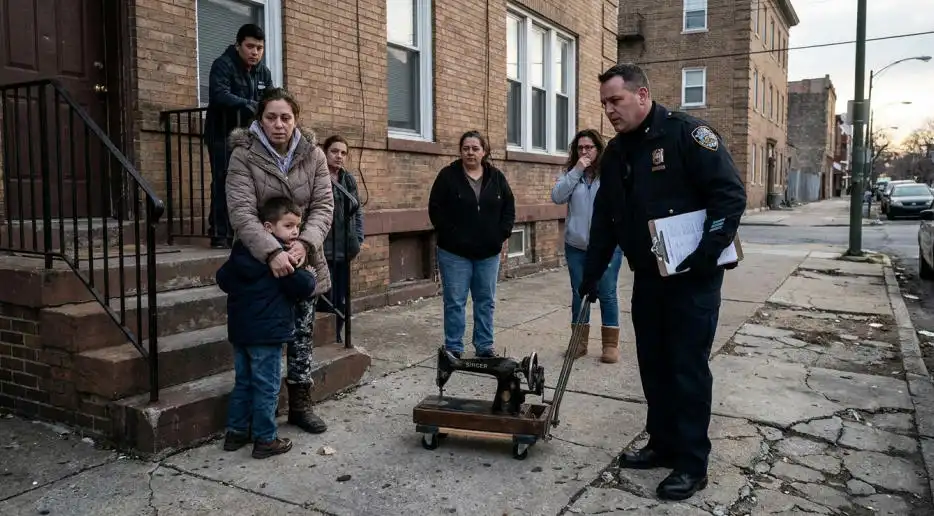
Grant Whitaker’s hand landed hard on the clipboard, pinning it against the old sewing machine.
For one second, nobody moved.
Megan Ellis stared at the paper under his palm, at the crooked handwritten names, at the little dollar amounts beside them.
Her son, Noah, clutched her coat and whispered again, “Mom… that’s Grandma’s machine.”
Grant’s jaw tightened.
He looked at the neighbors, then at Megan.
“You done making a scene?” he said. “Because I can write this up as refusal to comply.”
Megan didn’t answer.
That made him angrier.
He wanted her to cry. He wanted her to beg. He wanted everyone to see him as the man restoring order to a messy apartment entrance.
Instead, Megan just stood there in her faded library cardigan, one hand on her son’s shoulder, her eyes fixed on that clipboard.
Mrs. Alvarez from 2B stepped forward.
“Officer, she never blocked the door,” she said. “She only sets up after the kids get home from school.”
Grant turned on her fast.
“Ma’am, step back.”
“She fixes clothes for half this building,” another neighbor said.
Grant pointed at the sewing machine.
“And half this building can learn what a code violation looks like.”
Megan finally spoke.
Quietly.
“May I have the citation number?”
Grant blinked.
“What?”
“If you’re removing my property for a violation,” Megan said, “I need the citation number, the storage location, and the inventory receipt.”
The sidewalk went silent.
Grant gave a short laugh, but it didn’t sound as confident now.
“Listen to the librarian quoting rules.”
Megan lifted her chin.
“I work at the community library. People ask me for help with forms every day. I know what a property receipt is.”
A couple of neighbors murmured.
Grant looked down at the machine.
Then at the clipboard.
Then back at Megan.
“You’ll get your paperwork when I’m finished.”
“No,” Megan said. “I need it before you leave with my machine.”
Her voice didn’t shake.
That bothered him more than yelling would have.
Grant snatched the clipboard up, but the paper clipped to it fluttered loose.
One corner lifted in the wind.
Mrs. Alvarez caught it before it hit the sidewalk.
She looked down.
Her face changed.
“Wait,” she said. “These are our names.”
Grant reached for it.
“Give me that.”
But Mrs. Alvarez stepped back.
“Alvarez, twenty dollars. Parker, fifteen. Simmons, ten.”
Another neighbor leaned over.
“That’s my name.”
Then another.
“That’s mine too.”
Megan looked confused now.
“No,” she whispered. “What is that?”
Grant’s face went red.
For the first time, he looked trapped.
He had made one fatal mistake.
He humiliated her in public with the evidence still sitting on his clipboard.
Mrs. Alvarez kept reading.
“Community sewing repair fund. Replacement parts. Belt. Needle plate. Motor cleaning. Cabinet refinishing.”
Megan’s lips parted.
Noah looked up at her.
“Mom?”
Grant rubbed a hand over his mouth.
“It wasn’t supposed to come out like this.”
Megan stared at him.
“What wasn’t?”
Grant looked around at the neighbors who had gone from angry to confused.
Then a calm voice came from the apartment entrance.
“Officer Whitaker, you should probably explain before this gets worse.”
It was Elaine Brooks, the community library manager.
She had been standing just inside the doorway with two donation envelopes in her hand.
Megan turned.
“Elaine?”
Elaine’s eyes were wet.
“Megan, the machine wasn’t being confiscated.”
Grant exhaled sharply.
“It was blocking the entrance,” he muttered, like he was still trying to hold on to the first lie.
Elaine stepped forward.
“No. You told me you needed a reason to pick it up without spoiling the surprise. I told you not to embarrass her.”
The neighbors stared at Grant.
Megan’s face tightened.
“You planned this?”
Grant looked at the machine, then at the cracked sidewalk.
“I saw you using it three weeks ago,” he said. “The belt was slipping. The motor was smoking. You were holding that thing together with tape.”
Megan swallowed.
“So you took it?”
“I asked around,” Grant said. “I asked who you helped. And everybody had a story.”
Mrs. Alvarez nodded.
“She fixed my church dress after my surgery.”
A young father near the stairs said, “She patched my daughter’s backpack and wouldn’t take money.”
Mr. Parker from the first floor said, “She mended my late wife’s quilt. Sat with me while she did it.”
Megan looked down, overwhelmed.
Grant’s voice dropped.
“I started the list. Anonymous. I didn’t want you to feel like charity was being shoved in your face.”
Elaine held up the envelopes.
“The library staff added more. The neighbors added more. The repair shop agreed to rush it.”
Megan’s eyes went back to Grant.
“Then why talk to me like that?”
That question hit harder than yelling.
Grant had no clean answer.
Because he had let the uniform do too much.
Because he had thought playing the tough officer would make the surprise smoother.
Because he had forgotten that humiliation does not become kindness just because the ending is good.
He looked at Noah.
Then at Megan.
“I messed up,” he said.
The neighbors waited.
Megan didn’t soften.
“Not just with me,” she said. “You said ‘you people.’ You said work belongs in a business. You made my son watch you treat his grandmother’s machine like garbage.”
Grant’s face fell.
The legal hammer came from Elaine.
She opened a folder and pulled out a printed permit.
“Megan has permission from the building owner to use this space between 3:30 and 6:00 p.m. as long as the doorway stays clear,” Elaine said. “I helped her file it after someone complained last month.”
Grant froze.
Megan looked at Elaine.
“You did?”
Elaine nodded.
“I kept a copy at the library. The landlord signed it. The community board approved it as a resident service table.”
Mrs. Alvarez held up the donation list.
“And he wrote down every donor himself.”
Elaine pointed to the sewing machine.
“So here is the chain, Officer. The machine is Megan’s property. The permit makes her table allowed. The donation list proves the neighbors were paying for repairs, not asking you to seize it. And every person here just watched you threaten her without giving an inventory receipt.”
Grant’s shoulders dropped.
He knew exactly what that meant.
Not jail.
Not some dramatic movie arrest.
Something worse for a man who cared about his badge.
A formal complaint.
Witness statements.
Body camera review.
Misuse of authority.
Public humiliation of a resident who had legal permission to be there.
His captain arrived twenty minutes later.
By then, the whole sidewalk had changed.
Nobody was shouting anymore.
They were writing statements.
Elaine had the permit.
Mrs. Alvarez had the donation list.
Mr. Parker had recorded Grant saying, “You people always think rules don’t apply to you.”
Grant stood beside the patrol car, quiet now.
His captain read the permit, looked at the donation sheet, then turned to him.
“You removed property from an approved resident service space without completing a receipt?”
Grant said nothing.
“And you staged it as a surprise?”
Grant’s mouth opened.
The captain cut him off.
“You’re off patrol pending review.”
Megan didn’t smile.
She didn’t gloat.
She just held Noah close while the captain ordered the machine loaded back into Elaine’s van instead of the patrol car.
The repair shop owner was waiting two blocks away.
That part was real.
The fundraiser was real.
The new motor, new belt, polished cabinet, and fresh case of needles were all real.
But the public cruelty had been real too.
Three days later, Grant came to the community library without his patrol hat.
Megan was in the small meeting room, setting up the sewing machine.
It looked beautiful.
The black metal shined. The old gold lettering had been cleaned. The wooden cabinet smelled faintly of lemon oil.
Noah ran his hand over the edge.
“Grandma would like it,” he said.
Megan nodded, wiping her eyes fast.
Grant stood in the doorway.
“I’m not here to ask you to drop the complaint,” he said.
Megan looked at him.
“Good.”
“I deserved it,” he said. “I got pulled from neighborhood patrol. I have to attend community conduct review and retraining. The captain also made the body cam part of the department meeting.”
The room went quiet.
Grant looked at Noah.
“What I said was wrong. How I did it was wrong. I thought the good part would erase the ugly part.”
Megan’s voice was steady.
“It doesn’t.”
“I know.”
He held up a folded paper.
“This is a written apology. One for you. One filed with the department.”
Megan took it.
Then Elaine walked in carrying a sign.
MENDING HOURS TUESDAY & THURSDAY PAY WHAT YOU CAN
Megan stared at it.
Elaine smiled.
“The library board approved it. You can teach sewing classes here twice a week. Officially.”
Noah grinned.
“Mom, you got a class?”
Megan pressed a hand over her mouth.
Mrs. Alvarez entered next with a basket of fabric.
Then Mr. Parker with old shirts.
Then three teenagers from the building with ripped jeans.
The room filled with people who had once watched her be shamed on the sidewalk.
Now they were there to learn from her.
Grant stayed near the door.
Megan saw him looking at the machine.
“You know how to sew, Officer?”
He shook his head.
“No, ma’am.”
Noah looked up.
“Then you should learn. So you don’t think it’s junk next time.”
A few people laughed softly.
Grant took the hit.
“Yes,” he said. “I should.”
Megan studied him for a long second.
Then she pointed to the first chair.
“Sit down.”
Grant sat.
The first thing Megan taught him was how to thread a needle.
His hands were clumsy. His face burned. But this time, nobody mocked him.
Megan guided the thread through and said, “Slow down. Pull too hard, and it breaks.”
Grant looked at the thread.
Then at her.
“I understand.”
Months later, the apartment entrance was no longer messy.
There was a small approved table, a clean sign, and a line of neighbors who paid what they could.
The sewing machine did more than mend clothes.
It mended pride.
It mended trust.
It gave Megan steady income, a library program, and a room full of people who finally saw her work for what it was.
Not a nuisance.
Not junk.
A service.
A skill.
A lifeline.
And every Tuesday evening, Officer Grant Whitaker sat in the front row of her sewing class, quietly stitching crooked seams, learning the lesson he should have known before he ever touched that machine:
Kindness done with cruelty is still cruelty.
Respect has to come first.
Megan never became rich. She never became famous. She didn’t need to.
She got her machine back.
She got her dignity back.
And her son got to watch a whole neighborhood stand up for his mother.
So tell me honestly: did Megan do the right thing by still filing the complaint, even after learning the officer had tried to help? Share this if you believe good intentions never excuse public humiliation.
Disclaimer: Mention of any brand or trademark is for identification only and does not imply partnership or endorsement

A RURAL TEXAS DOCTOR Poured Ice Water on a Plus-Size Dispatcher in Front of State Inspectors. He Had NO IDEA What She’d Been Recording for Years 😱
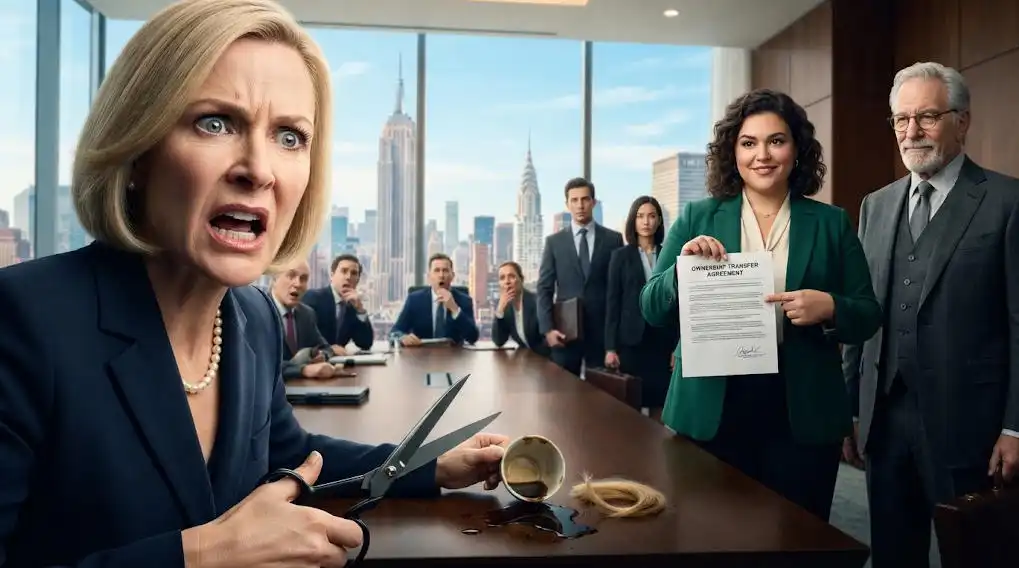
She Cut the Plus-Size Assistant’s Hair and Dumped Coffee on Her in Front of Manhattan’s Executives. She Had NO IDEA Who Maya Really Was... 😱

A Chicago Finance Director Poured HOT COFFEE on His Plus-Size Analyst in Front of the Entire Team. He Had NO IDEA What Her Data Could Prove... 😱