



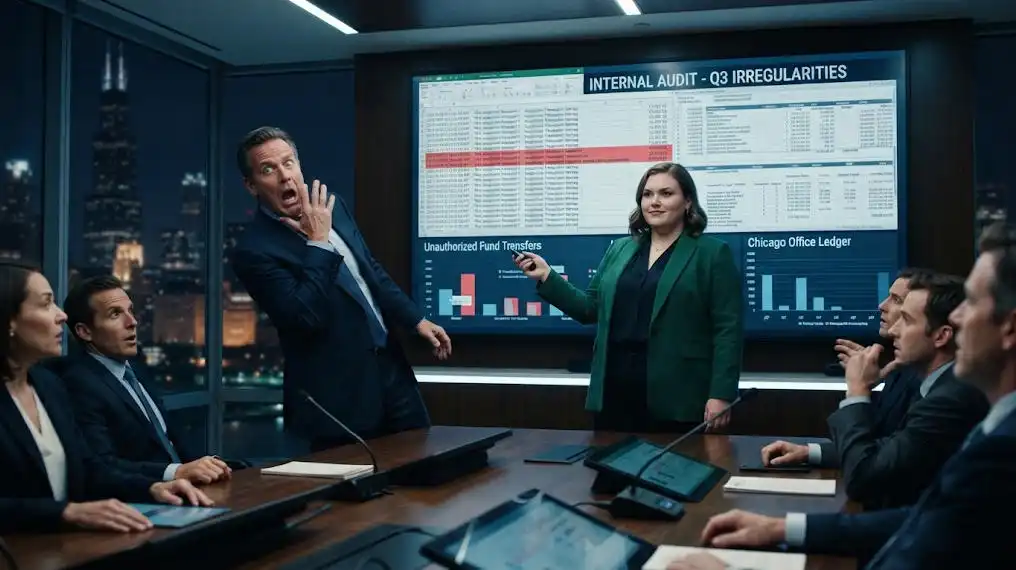
The director was still shouting when the boardroom doors opened.
Lauren Bennett stood outside with a folder pressed against her chest.
Inside, Grant Mercer was telling the board that the company's financial problems were the result of one incompetent analyst.
He had no idea that the evidence was already verified.
He had no idea that the records he had tried to erase had been preserved.
And he had no idea that the woman he had humiliated in front of thirty employees was about to dismantle his entire defense, one transaction at a time.
Three days earlier, Lauren had been standing in the conference room of Northbridge Financial Advisory in downtown Chicago when Grant threw hot coffee in her face.
She remembered the heat first.
Then the sting.
Then the silence.
Thirty employees sat around the long conference table, watching the coffee run down her cheek and soak into the collar of her blouse.
Grant stood in front of the presentation screen, holding the empty paper cup.
“Honestly, Lauren, how many times do we have to discuss your performance?”
Lauren blinked through the pain.
“Grant, you asked me to explain the discrepancy in the quarterly report.”
“I asked you to explain why your numbers are wrong.”
“They aren't wrong.”
His expression hardened.
“What did you just say?”
Lauren's fingers tightened around her notebook.
“The reconciliation matches the original transaction records. The difference comes from payments that were approved but don't appear in the supporting documentation.”
Grant laughed.
It was a sharp, ugly sound.
“Listen to yourself. You're a senior analyst, and you can't even understand a basic expense report.”
A few employees stared at the table.
Grant turned toward the room.
“This is what happens when we put the wrong people on critical projects. They get overwhelmed, make mistakes, and expect everyone else to clean up after them.”
Then he looked directly at Lauren.
“And frankly, your appearance doesn't exactly inspire confidence in front of clients. You're clumsy, you're slow, and you don't belong on the core team.”
Nobody spoke.
Lauren could feel every pair of eyes on her.
She was thirty-two years old, significantly overweight, and painfully aware of how often people judged her before she said a word.
She had spent years working twice as hard to earn half the recognition.
She had earned a degree in statistics, mastered financial modeling, and become the person other analysts quietly approached when their numbers refused to reconcile.
But Grant never acknowledged her expertise.
He mocked her lunches.
He commented on her clothes.
He made jokes about whether she could fit comfortably into the chairs in the executive conference room.
Whenever she presented an analysis, he interrupted her.
Whenever a male colleague repeated the same finding, Grant praised his insight.
And when the company's financial reports began showing unexplained discrepancies, Grant found a convenient person to blame.
Lauren.
He knew she was supporting her family.
Her parents had accumulated debt after years of financial hardship, and Lauren had been helping cover their expenses while paying her own mortgage and bills.
She could not afford to walk away from a steady paycheck.
Grant understood that.
He had turned her financial vulnerability into a weapon.
“Security can escort you out if you can't behave professionally,” he said.
Lauren reached for a napkin.
“My face is burning.”
“Then go wash it off. We have actual work to do.”
For a moment, Lauren imagined throwing the notebook at him.
Instead, she put it into her bag.
She walked out without another word.
In the restroom, she examined the redness on her cheek and neck. Her hands trembled as she ran cool water over the affected skin.
She wanted to cry.
Not because Grant had insulted her body. She had heard those insults before.
She wanted to cry because she had spent years making herself smaller in every possible way, hoping that if she became quiet enough, useful enough, and agreeable enough, people like Grant would eventually leave her alone.
They never did.
Her phone vibrated.
It was a message from her mother.
Honey, the mortgage payment went through. Thank you. I know things have been hard for you lately.
Lauren stared at the screen.
She couldn't lose her job.
But she couldn't keep living like this, either.
She dried her face, took a photograph of the visible redness for the workplace incident report, and contacted the company's designated employee-relations representative.
Then she returned to her desk.
She opened the spreadsheet Grant had accused her of mishandling.
And she started checking the numbers again.
Not to prove that she deserved his approval.
To find out why the numbers didn't add up.
For three months, Lauren had been investigating discrepancies in the company's internal financial records.
At first, they had seemed ordinary.
A reimbursement entered twice.
A vendor invoice that didn't match its purchase order.
An expense approval recorded under an executive's credentials at a time when the executive had been traveling.
Each discrepancy could have been explained individually.
Together, they formed a pattern.
Lauren's work required her to compare financial summaries against source records, so she began with the official accounting exports available to her.
She checked invoice numbers, payment dates, approval histories, and vendor details.
She found repeated payments to companies that had submitted almost identical invoices.
She discovered reimbursements that exceeded the documented project expenses.
She found several entries in which the approved amount differed from the amount originally submitted.
Every time she raised a question, Grant told her to stop wasting time.
“It's administrative noise,” he said during one meeting. “We're consultants, not detectives.”
But Lauren knew the difference between a rounding error and a pattern.
She also knew better than to accuse someone without evidence.
So she followed the company's established audit procedures.
She recorded the discrepancies in a controlled working file.
She documented where each record came from and when she accessed it.
Then she used her authorized access to preserve the relevant original server logs in the company's read-only audit archive.
The archive generated a timestamped preservation record.
Lauren documented the file references and integrity checks so that an independent reviewer could confirm the records had not been altered after preservation.
She did not copy restricted client information to a personal device.
She did not break into Grant's account.
She did not change a single transaction.
She simply preserved the records she was authorized to examine and documented what they showed.
The final step was the company's confidential compliance-reporting mechanism.
Lauren submitted her findings through that channel and received a case reference.
She included the source records, the relevant timestamps, the discrepancies she had identified, and the location of the preserved server logs.
She asked for an independent review.
Then she waited.
She did not know whether anyone would take her report seriously.
She only knew that the numbers were real.
And Grant had no idea how much she had already documented.
The morning after the coffee incident, Lauren arrived early.
Her cheek was still tender, and the collar of her blouse had been stained beyond repair.
She changed into a spare shirt she kept in her desk drawer.
Then she opened her email.
A message from the compliance office appeared near the top of her inbox.
Your report has been assigned for independent review. Please preserve all relevant working records and refrain from discussing the matter with anyone who may be involved.
Lauren read it twice.
Someone was finally looking.
She closed the message and continued working.
By noon, Grant had heard that the compliance office had requested records relating to several expense accounts under his supervision.
He summoned Lauren to his office.
“Did you file a complaint?”
She kept her expression neutral.
“I reported discrepancies through the company's established process.”
His jaw tightened.
“You think you're clever, don't you?”
“I think the numbers need to be reconciled.”
He leaned across his desk.
“You're a senior analyst because I allowed it. Don't confuse access to a spreadsheet with authority over this department.”
Lauren said nothing.
Grant pointed toward the door.
“Get back to work.”
She returned to her desk.
Ten minutes later, a company-wide calendar invitation arrived.
The board had scheduled an extraordinary financial review for Friday afternoon.
The compliance office had also requested that Lauren prepare a factual presentation of her analysis.
She would not be presenting accusations.
She would be presenting records.
That distinction was the only thing keeping her calm.
On Thursday morning, Grant appeared at her workstation without warning.
He looked at her monitor.
“What are you working on?”
“The reconciliation requested by compliance.”
“Show me.”
Lauren turned the monitor slightly so he could see the approved summary, not the protected working materials.
His eyes narrowed.
“Where are the original logs?”
“Preserved in the designated audit archive.”
“Give me your laptop.”
“Why?”
“Because I said so.”
He reached across the desk.
Lauren pulled the laptop toward herself.
Grant's face reddened.
“You ungrateful little—”
He stopped when two employees looked over.
“You have no idea what you've done,” he whispered.
Then he walked away.
Lauren's hands were shaking.
She immediately documented the interaction and reported it to the compliance officer handling her case.
Within an hour, the officer confirmed that the relevant records were preserved and that the independent review was proceeding.
The laptop contained her working analysis.
It was not the only copy of the evidence.
The original records remained in the controlled archive, where access and changes were logged.
Grant could intimidate Lauren.
He could insult her.
He could try to take her computer.
But he could not erase a properly preserved audit trail simply by grabbing the device from her desk.
On Friday afternoon, Lauren entered the boardroom.
Grant was already there.
He wore a charcoal suit and a confident smile.
The company's chairwoman, Evelyn Shaw, sat at the head of the table. Beside her were two board members, the chief financial officer, the head of compliance, and an independent forensic auditor.
Grant had spent the first fifteen minutes explaining that the financial discrepancies resulted from a junior-level reporting failure.
He referred to Lauren's analysis as incomplete.
He described the preserved records as confusing.
He even suggested that she had misunderstood routine accounting adjustments because she lacked the experience to interpret them.
Lauren sat quietly, her folder resting on her lap.
When Grant finished, Evelyn turned toward her.
“Ms. Bennett, would you walk us through your findings?”
Lauren stood.
Her knees felt weak.
She placed her folder on the table and connected her laptop to the presentation system.
The first slide showed the original accounting entries and their corresponding invoice references.
The second showed the discrepancies between the submitted expenses and the approved payments.
The third displayed the server audit records.
Lauren explained each record's source, the date it had been preserved, and the steps used to verify its integrity.
She showed how the same vendor appeared repeatedly in reimbursement records that did not match the supporting documentation.
She demonstrated that several approvals had been recorded under Grant's executive credentials.
Then she displayed the original transaction history alongside the altered reporting summaries.
The differences were unmistakable.
“This entry was originally recorded at the amount shown on the left,” Lauren explained. “The later report contains a different amount. The audit log identifies the credential used for the change and the timestamp. The corresponding approval record does not support the revised figure.”
Grant shifted in his chair.
Lauren continued.
“These entries follow the same pattern. The payments were routed through vendors whose invoices contain repeated discrepancies. The amounts were then presented in internal reports as legitimate project expenses.”
The forensic auditor opened a separate report.
“We independently reproduced Ms. Bennett's reconciliation using the company's preserved records,” she said. “Our findings are consistent with her analysis.”
Evelyn looked toward Grant.
“Do you have an explanation for these discrepancies?”
Grant stood.
“This is absurd. She's taken routine adjustments out of context. She has been trying to undermine me for months.”
Lauren felt her pulse pounding in her ears.
For years, Grant had made her doubt herself.
Now he was trying to do it in front of the entire board.
But she had learned something important.
Confidence was not the same as certainty.
She did not need to sound louder than Grant.
She needed to show her work.
“I've provided the source records, the reconciliation steps, the preservation references, and the independent verification,” she said. “Anyone on this board can reproduce the analysis.”
Grant turned toward her.
“You think you're better than me because you can make a spreadsheet?”
“No,” Lauren replied. “I think the records should speak for themselves.”
😱
Evelyn raised a hand.
“Mr. Mercer, please sit down.”
He remained standing.
“You cannot take the word of an employee who has repeatedly demonstrated poor judgment over the judgment of a director.”
The forensic auditor closed her report.
“We aren't relying on her word. We're relying on the original records, the access history, the supporting invoices, and our independent examination.”
Grant's expression changed.
He looked at the screen again.
For the first time, he seemed to understand that his position would not protect him.
Evelyn asked the compliance officer to summarize the investigation.
The officer explained that the review had established a documented chain of evidence.
The original accounting records had been obtained from the company's financial systems.
Lauren had identified the discrepancies during routine reconciliation.
The relevant server logs had been preserved in the designated read-only audit archive.
Her confidential report had triggered an independent review.
Finally, the forensic auditor had cross-checked the transaction history, approval records, vendor documentation, and payment records.
The findings supported a conclusion that the discrepancies were not innocent accounting mistakes.
Grant had used his position to manipulate expense approvals and conceal improper payments through questionable vendors.
The evidence also showed that Lauren had not authorized the transactions attributed to her work.
Her reports had identified the discrepancies rather than caused them.
The room remained silent.
Then Grant lunged toward Lauren's laptop.
“Turn it off!”
A security officer stepped between him and the table.
“Sir, step back.”
Grant tried to reach around him.
“You have no right to show those records!”
Evelyn's voice cut through the room.
“Mr. Mercer, the board authorized this review. The records have been independently verified. Your conduct is now part of the investigation.”
Grant stopped moving.
His eyes darted from the board members to the screen.
Then he looked at Lauren.
“You did this to me.”
Lauren felt the old instinct to apologize rise in her chest.
For years, she had accepted blame simply to keep the peace.
This time, she let the feeling pass.
“No, Grant,” she said. “I documented what happened. You made the decisions.”
Evelyn instructed security to escort Grant from the room while the company completed the formal employment process.
He was placed on immediate administrative suspension, his access was restricted under the company's preservation procedures, and the board directed that the findings be referred to the appropriate authorities.
He left the room without another word.
Lauren remained standing beside the screen.
Her hands were still trembling.
She had imagined this moment many times, but she had never imagined how exhausting it would feel to face the person who had spent years convincing her that she was powerless.
Evelyn closed the folder.
“Ms. Bennett, on behalf of the board, I want to apologize for the way you were treated. Your report was professional, your analysis was sound, and you should never have been subjected to what happened in that department.”
Lauren swallowed.
“Thank you.”
“We will also conduct a formal review of the department's workplace conduct and reporting procedures. No employee should have to choose between reporting a financial concern and keeping a job.”
For the first time in months, Lauren felt her shoulders relax.
The investigation continued for several weeks.
The independent forensic team expanded its review to additional expense accounts and vendor payments.
The company confirmed that Grant had manipulated approvals, concealed improper transactions, and attempted to shift responsibility for the discrepancies onto Lauren.
The findings were documented and referred to the relevant authorities for further action.
After the formal investigation, Grant was terminated for serious misconduct. The evidence was also referred for legal proceedings concerning the suspected financial wrongdoing.
Lauren's employment record was corrected, and the company formally cleared her of responsibility for the transactions she had reported.
But the board's decision did not end with an apology.
Evelyn asked Lauren to lead the financial project restructuring that Grant had left in disarray.
Lauren accepted.
She rebuilt the reporting process, established clearer reconciliation procedures, and introduced additional independent checks for expense approvals.
She required that material adjustments be documented with traceable source records.
She also worked with compliance to ensure employees could report suspected misconduct without having to confront the people they were reporting.
The project had once been used to undermine her.
Now it became the strongest financial control system in the department.
Three months later, Evelyn called Lauren into her office.
“We'd like you to become deputy director of financial analytics.”
Lauren stared at her.
“Me?”
“You've demonstrated technical excellence, sound judgment, and the courage to report what you found. More importantly, you've shown that you understand the responsibility that comes with authority.”
Lauren felt tears gather in her eyes.
For years, she had wanted someone to recognize her work.
She had never expected the recognition to come after such a painful ordeal.
“I accept,” she said.
When she walked back into the department, her colleagues stood to congratulate her.
Some apologized for remaining silent during Grant's abuse.
Lauren accepted their apologies, but she did not pretend that their silence had been harmless.
“I understand that people are afraid of losing their jobs,” she told them. “I was afraid, too. But nobody should have to endure humiliation to earn a paycheck.”
That sentence became the principle she carried into her new position.
She also began making changes in her personal life.
For years, stress had left her exhausted. She often skipped proper meals, worked late into the night, and treated rest as something she had to earn.
With a more stable routine, she began taking regular walks, improving her eating habits, and working toward a healthier weight at a pace she could maintain.
The change was gradual.
Some weeks were easier than others.
She did not measure her progress by whether strangers approved of her appearance.
She measured it by her energy, her consistency, and how much more comfortable she felt in her own life.
Over the following year, she lost a significant amount of weight.
But the greatest transformation had happened long before the number on the scale changed.
She stopped apologizing before speaking.
She stopped shrinking herself to make arrogant people comfortable.
And she stopped confusing another person's contempt with a measure of her own worth.
One afternoon, nearly a year after the coffee incident, Lauren stood before the department in a tailored navy suit.
The financial restructuring project had been completed successfully. The board had approved the new controls, and the company's reporting process was more transparent than it had been in years.
Evelyn introduced Lauren as the newly appointed deputy director.
The room filled with applause.
Lauren smiled.
Not the nervous smile she used to offer when she hoped people would leave her alone.
A real smile.
After the meeting, she returned to her office and found a small package on her desk.
Inside was a framed copy of the board's formal recognition of her work.
Beneath it was a handwritten note from one of the junior analysts.
Thank you for showing us that doing the right thing matters, even when it is frightening.
Lauren read the note twice.
Then she placed it beside the framed recognition.
She thought about the woman who had stood in the restroom almost a year earlier, staring at a coffee-stained blouse and wondering how she could survive another day.
She wished she could go back and tell that woman something.
You do not have to become thinner to deserve respect.
You do not have to become wealthy to deserve dignity.
And you do not have to become fearless before you stand up for the truth.
You only have to stop believing that the person hurting you gets to decide what you are worth.
Grant had once poured hot coffee on Lauren because he believed his title made him untouchable and her circumstances made her disposable.
In the end, it was not her appearance, her anger, or her ability to humiliate him in return that changed anything.
It was the evidence.
It was the process.
It was the courage to preserve the truth when staying silent would have been easier.
Lauren had entered that first meeting believing she had to endure everything to keep her job.
She left the final board meeting knowing she could protect both her dignity and her professional future by refusing to participate in a lie.
And when she walked through the glass doors of the Chicago office that evening, her reflection followed her across the polished lobby.
She paused for a moment.
Then she lifted her chin and smiled at the woman looking back.
She was no longer waiting for permission to belong.
Choose your side: LAUREN WAS RIGHT TO EXPOSE THE FRAUD, even at the risk of her livelihood, or EMPLOYEES SHOULD STAY SILENT to protect their jobs.
Comment your choice and share this story with someone who believes that professional respect should be earned through integrity, not granted according to appearance or rank.
Disclaimer: Mention of any brand or trademark is for identification only and does not imply partnership or endorsement

A RURAL TEXAS DOCTOR Poured Ice Water on a Plus-Size Dispatcher in Front of State Inspectors. He Had NO IDEA What She’d Been Recording for Years 😱

She Cut the Plus-Size Assistant’s Hair and Dumped Coffee on Her in Front of Manhattan’s Executives. She Had NO IDEA Who Maya Really Was... 😱

The Girl They Called “FAT” Was Drenched in Red Wine by Her Former Prom Queen at Their Reunion. Jessica Had NO IDEA Who She’d Just Humiliated... 😱