
For one long second, nobody moved.
Dr. Grant Mercer adjusted his cuffs as though the reviewer had asked him to sign an ordinary form. Claire Bennett stood at the end of the conference table, exhausted from a night of emergency calls and rescue work.
The state accreditation team had listened to the radio traffic throughout the crisis. They had seen the response records, the route changes, and the desperate calls for help.
Yet Mercer still wore the expression of a man certain that his title made him untouchable.
Then the reviewer opened the packet.
“Let's begin with the first command recorded at 8:17 p.m.,” she said.
Mercer leaned back in his chair.
“Excellent,” he replied. “That should clear up the confusion.”
Claire said nothing.
She had learned that when someone was determined to ignore the truth, raising her voice rarely helped. Evidence was harder to shout down.
And she had brought plenty of it.
Six years earlier, Claire had joined Pine Creek County EMS in rural Texas. She was thirty-one now, with an active paramedic certification, a sharp memory for emergency details, and an unusual ability to recognize patterns hidden inside hundreds of routine dispatch reports.
She could hear a caller describe a wreck on a rain-soaked highway and immediately remember three earlier incidents at the same bend.
She knew which roads became dangerous after heavy rain. She remembered which intersections caused delays when school traffic overlapped with evening commuters. She could identify a staffing shortage before it appeared on the monthly report.
Her colleagues often joked that Claire had the entire county memorized.
But they didn't always appreciate what that meant.
Claire had a metabolic disorder that made weight management difficult. Some days, fatigue made even ordinary tasks harder. She had also spent years helping her family manage mounting medical expenses.
She worked long shifts, took extra assignments when possible, and watched bills pile up on her kitchen counter.
She didn't ask anyone to feel sorry for her.
She wanted to do her job well enough that nobody could dismiss her contributions.
Unfortunately, Dr. Grant Mercer had decided what kind of person she was before he examined what she could do.
Mercer was the center's medical director and a respected physician at the county's emergency department. He wore expensive suits to administrative meetings, spoke confidently in front of officials, and knew how to make every decision sound like his own.
When Claire suggested a safer ambulance route, he called her timid.
When she identified a recurring dispatch delay, he said she was overthinking a simple problem.
When her analysis helped the county reduce unnecessary delays, he presented the findings to the board as the result of his leadership.
The first time it happened, Claire corrected him privately.
The second time, she sent him the original records.
The third time, he called her into his office.
“Your job is to answer calls and dispatch units,” he told her. “Not to make yourself look like the smartest person in the building.”
“I wasn't trying to take credit,” Claire replied. “I just wanted the report to identify where the data came from.”
Mercer smiled without warmth.
“Then learn your place.”
After that, Claire stopped arguing.
She continued documenting everything through the county's official systems. She maintained her case-analysis database, linked incidents to verified road-closure notices, and recorded the applicable standard operating procedures.
She never altered a timestamp or removed an inconvenient entry.
She simply kept the records accurate.
That discipline would eventually save lives.
But first, Mercer would make an example of her.
The county's annual accreditation review was approaching. The center's funding and reputation depended on demonstrating that it could handle emergencies safely, maintain accurate records, and follow established procedures.
Claire had been asked to help prepare the supporting documentation.
During one meeting, she discovered that Mercer's draft report used an outdated routing map. The map showed the western low-water crossing as an available route even during conditions when the county had issued closure notices.
“I think we need to correct this before the reviewers examine it,” she told him.
Mercer glanced at the page.
“It's a standard route.”
“Under normal conditions, yes. But the closure records show several periods when it was impassable.”
“Those were exceptional circumstances.”
“That's why the emergency plan includes an alternate route.”
He stared at her.
“You're a dispatcher, Claire. You don't set medical policy.”
“I know. I'm pointing out the documented road closures and the existing emergency procedure.”
That should have been the end of the discussion.
Instead, Mercer waited until the next accreditation meeting, when state reviewers, senior paramedics, administrative staff, and county officials had gathered around the conference table.
He raised the disputed report.
“Apparently,” he announced, “we have a member of staff who believes she knows better than the medical director.”
Several people shifted in their seats.
Claire felt every pair of eyes turn toward her.
“I only asked that we verify the source records,” she said.
Mercer gave a theatrical sigh.
“Of course you did. You always have an excuse.”
Then he reached for a pitcher of ice water.
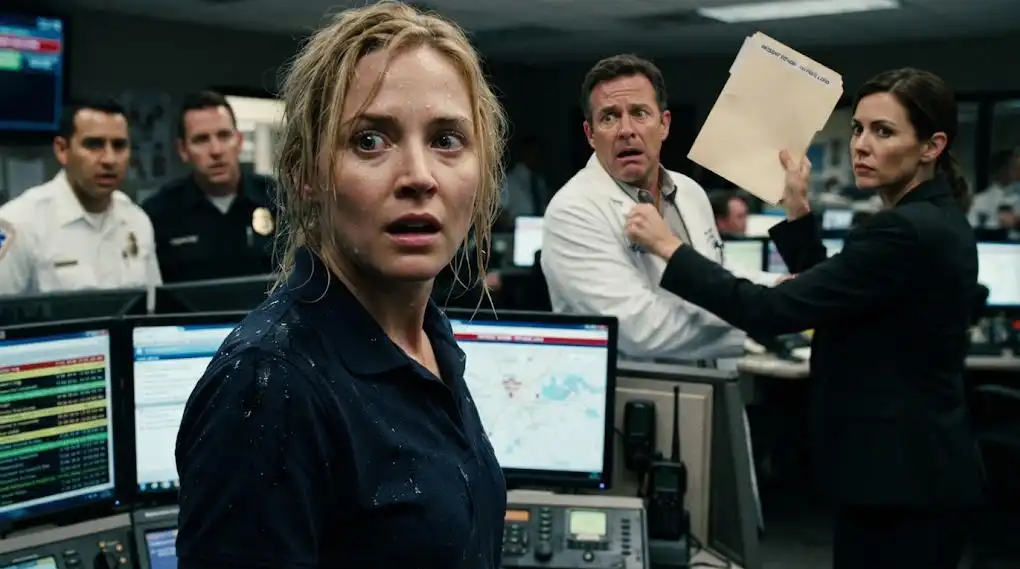
Before Claire could react, he tipped it over her head.
Cold water splashed across her face, hair, and uniform. It ran down her collar and dripped onto the papers in front of her.
Someone gasped.
Mercer set the empty pitcher down.
“If you can't even take care of yourself,” he said loudly, “don't tell trained doctors how to save lives.”
For a moment, Claire couldn't move.
She could hear water dripping onto the floor.
She could feel the heat rising in her face, even as the water chilled her skin.
A young paramedic started to stand, but another employee touched his arm, silently warning him not to get involved.
The reviewers exchanged uncomfortable glances.
Mercer looked pleased with himself.
He expected tears. An angry outburst. Something he could later describe as proof that Claire was unprofessional.
Instead, she picked up a towel.
She wiped her face, gathered the wet pages, and placed them inside a clear document sleeve.
Then she returned to her console.
She did not retaliate.
She did not threaten him.
She did not delete a single record.
She waited.
At 8:17 that evening, the storm arrived.
Rain battered the center's windows. Thunder rolled over the county, and hail rattled the roof hard enough to interrupt conversations.
Then the emergency lines began lighting up.
A truck had jackknifed on a rural highway. Several cars had collided behind it. More vehicles were sliding into the wreckage as drivers approached the scene with limited visibility.
The first caller was screaming.
The second could barely speak.
The third reported that someone was trapped inside a crushed vehicle.
Within minutes, dispatch had reports of eleven injured people, including several in critical condition.
Claire's console filled with incoming calls, radio traffic, and location updates.
She recognized the area immediately.
The main western approach ran past a low-water crossing. Under ordinary conditions, it was a useful shortcut for ambulances coming from the county's western station.
But the county had already issued a closure alert because rising water had made the crossing unsafe.
The eastern access road was longer, but it remained open.
Claire pulled up the official closure notice and checked the timestamp.
Then she checked her case database.
The pattern was unmistakable. During previous storms, the western route had become impassable, forcing emergency vehicles to turn around. The county's mass-casualty standard operating procedure specifically required dispatch to use the alternate eastern approach and request neighboring-county support when local resources were insufficient.
Claire reached for the radio.
“Pine Creek units, use the eastern access road. Western crossing is closed. Repeat, use eastern access.”
Mercer's voice cut across the channel.
“Negative. Send the first ambulances west.”
Claire checked the closure notice again.
“Doctor, the crossing is under an active closure order.”
“I heard you.”
“It's unsafe. The eastern route is open.”
“I'm directing the medical response. Use the western route.”
Claire looked at the screen. Another caller reported a critically injured passenger. A firefighter requested additional rescue equipment.
Every second mattered.
“Doctor, we need to activate the mass-casualty plan and request mutual aid.”
“Absolutely not,” Mercer snapped. “The accreditation team is still here. We are not going to make this look like a failure of our staffing.”
Claire stared at the radio.
People were trapped in crushed vehicles.
Ambulances were waiting for directions.
And the man responsible for medical leadership was worried about how the incident might look in a report.
For the first time that night, Claire felt her fear turn into something colder and steadier.
She opened the approved contingency procedure.
The authority was already there in writing. Under the center's emergency dispatch protocol, the shift supervisor could activate the mass-casualty plan, redirect units around a confirmed road closure, and request mutual aid when the situation exceeded local capacity.
Claire was the designated shift supervisor.
She didn't need Mercer's permission to follow an existing safety procedure.
She keyed the radio.
“Pine Creek dispatch is activating the approved mass-casualty protocol. All units use eastern access. Neighboring-county mutual aid requested. Fire and rescue, establish staging at the eastern entrance.”
Mercer interrupted her.
“Claire, cancel that order immediately!”
She recorded his instruction.
Then she recorded her response.
“Unable to cancel. Active closure notice and mass-casualty criteria are confirmed. All actions are being logged.”
The room fell silent around her.
Luis Ortega, the senior dispatcher at the neighboring console, glanced over.
“You need me to take your position?”
Claire nodded.
“Keep the radio traffic moving. Don't lose a single timestamp.”
She grabbed her response jacket.
Because Pine Creek was a small rural service, Claire retained her paramedic certification and served as a designated backup field officer. She had moved primarily into dispatch work when her health made repeated full field shifts difficult, but she had continued her training and remained qualified to assist when needed.
Now the center needed every capable responder.
She climbed into the county's response vehicle and headed toward the eastern staging area.
The storm was brutal.
Rain swept across the road in sheets. Visibility dropped with every burst of hail. Branches lay scattered along the shoulder, and emergency lights flashed through the darkness ahead.
At the western crossing, the first ambulance encountered rising water and debris. Its crew followed the closure instructions and turned back before attempting to cross.
They lost precious minutes reaching the alternate route.
But they did not become additional casualties.
Claire's decision had prevented a dangerous situation from becoming worse.
At the eastern entrance, firefighters were already working to reach the trapped passengers. Paramedics moved between vehicles, identifying the most critically injured patients and preparing them for transport.
Claire stepped into the response.
A lead paramedic was treating a truck driver whose breathing was deteriorating. The patient needed immediate advanced airway management.
“Tell me what you need,” Claire said.
The paramedic recognized her.
“Help me secure the airway. We've got seconds.”
Claire knelt beside him in the freezing rain.
Her hands were cold. Her uniform was soaked. Her heart was pounding so hard she could feel it in her throat.
She focused on the patient.
She assisted the lead paramedic with the airway procedure, supported the team as they stabilized the driver, and relayed the patient's condition to the receiving trauma center.
There was no time to think about the water Mercer had poured over her.
No time to remember the laughter he had expected.
There was only the patient, the protocol, and the next decision.
When the airway was secured and the patient stabilized for transport, Claire moved to the next task.
She helped organize the triage information, confirmed transport destinations, and communicated with the center to prevent multiple critical patients from being sent to the same facility without coordination.
The eastern route stayed open.
Mutual aid arrived.
Firefighters freed the trapped passengers.
One by one, the injured were transferred into ambulances.
The storm continued to rage, but the emergency response became more organized with every passing minute.
At dawn, all eleven injured patients had been transported alive.
Several required intensive treatment. Two needed emergency surgery. Every patient survived.
Claire stood beside the response vehicle, exhausted and trembling from cold.
Her legs ached. Her hands were stiff. Her entire body felt as though she had run a marathon without stopping.
Yet when she heard the final confirmation that every patient had reached a medical facility alive, she closed her eyes for a moment.
Relief washed over her.
Then the radio crackled.
“Claire Bennett, return to the center immediately.”
It was Mercer.
His voice was no longer confident.
It was angry.
The next morning, the accreditation review resumed.
Claire arrived wearing a clean uniform. Her hair was tied back, and a folder containing the relevant official procedures rested beneath her arm.
Mercer was already seated at the conference table.
He looked rested, polished, and entirely prepared to explain what had happened.
“Before we proceed,” he announced, “I need to address the actions of our dispatch supervisor.”
Claire remained standing.
“Last night, Ms. Bennett ignored direct medical instructions, redirected emergency resources without authorization, and created unnecessary confusion during a mass-casualty event.”
He paused to let the accusation settle.
“Her conduct could have jeopardized patient safety and our accreditation.”
The words hit Claire harder than she expected.
She had spent the night helping save those patients. Now the man who had ordered units toward a closed crossing was trying to make her the culprit.
Mercer turned toward the reviewers.
“I recommend formal disciplinary action.”
For a moment, Claire wanted to explain everything.
She wanted to describe the rain, the radio traffic, the trapped patients, and the terrifying seconds when a man's breathing began to fail.
She wanted them to understand how it felt to carry responsibility while someone with greater authority tried to prevent her from doing the right thing.
But she remembered the lesson she had learned over six years.
Facts did not become stronger when spoken angrily.
She placed her folder on the table.
“I followed the written emergency protocol,” she said. “The original commands and the closure alert are preserved in the dispatch system.”
Mercer laughed.
“You think a few computer entries prove you were right?”
The state reviewer, a woman named Evelyn Hart, looked up from her notes.
“Actually, Dr. Mercer, that is precisely what we're here to determine.”
She lifted the sealed incident packet.
“Let's examine the 8:17 p.m. command log.”
For one long second, nobody moved.
Mercer adjusted his cuffs as though he were waiting for a routine administrative decision.
Then Evelyn opened the packet and placed the first page on the table.
The room changed.
The record showed the original road-closure alert, including its official timestamp.
It showed Claire warning Mercer that the western crossing was unsafe.
It showed his order directing ambulances toward the western approach.
It showed Claire activating the approved mass-casualty procedure, requesting mutual aid, and redirecting units to the eastern entrance.
Most importantly, it showed that the dispatch system had automatically preserved the radio traffic and command history.
The record had not been rewritten.
The timestamps had not been changed.
The evidence was consistent with the county's own closure notices and emergency procedures.
Evelyn turned to the next page.
“Dr. Mercer, would you like to explain why you instructed the dispatcher to use a route that had already been officially closed?”
Mercer shifted in his chair.
“I was making a rapid clinical decision based on the information available.”
“The closure notice was transmitted to the center before your order.”
“I may not have received it.”
Claire spoke calmly.
“The system recorded my verbal warning before I repeated the closure information over the radio.”
Evelyn nodded.
“We verified that.”
Mercer looked toward Claire.
“She's been trying to undermine me for years.”
“No,” Claire replied. “I've been documenting the calls.”
That was when Evelyn opened the final section of the packet.
Claire's case-analysis database contained six years of verified incident records, weather-related delays, official road-closure notices, and the relevant versions of the center's standard operating procedures.
It did not rely on rumors or personal accusations.
Every entry linked to an official source.
The review team had independently checked those records against the dispatch system and county documentation.
The pattern revealed something more serious than a single bad decision.
In previous incidents, Claire had flagged dangerous routes, identified potential response delays, and recommended alternatives consistent with established procedures.
Several of those recommendations had later appeared in Mercer's reports without identifying her analysis as the source.
In other cases, the original records showed that he had minimized documented warnings in his summaries.
The team also examined the audio from the night of the crash.
It captured Mercer ordering Claire to hold mutual aid because the accreditation team was present.
It captured her warning about the closed crossing.
And it preserved the sequence of commands that led to the delayed western approach.
The evidence did not establish that Mercer had caused the storm or the crash.
It established something more relevant to his responsibilities: he had disregarded an official safety warning, attempted to prevent the activation of an approved emergency response procedure, and later misrepresented the dispatcher's actions.
Evelyn closed the packet.
“Dr. Mercer, your decisions are now subject to a formal clinical and administrative investigation. You are being removed from emergency medical command pending review.”
For the first time since Claire had known him, Mercer had no immediate answer.
He looked around the table, searching for someone willing to rescue him.
Nobody spoke.
One of the senior paramedics finally broke the silence.
“I heard Claire warn him about the crossing,” he said. “I also heard the order to hold mutual aid.”
Another staff member nodded.
“So did I.”
Mercer turned toward Claire.
“You could have handled this privately.”
Claire looked at him.
“You poured water over my head in front of the entire review team because I asked you to verify a safety record.”
He opened his mouth.
She continued.
“Last night, I had eleven injured people depending on us. I couldn't make the decision based on whether you liked me.”
Nobody applauded.
Nobody needed to.
The records had already spoken.
😱 The immediate investigation had only begun.
Within days, the county placed Mercer on administrative leave. The state accreditation team required corrective measures, a complete review of the center's emergency command procedures, and independent verification of its dispatch records.
The county also protected the original electronic evidence while investigators reviewed his conduct.
Mercer attempted to challenge the findings, arguing that Claire's database was biased and that the emergency had required rapid judgment.
But the database was not the sole basis for the case.
The original radio recordings, dispatch timestamps, road-closure notices, official operating procedures, and independently verified incident reports all supported the same sequence of events.
The county's review also confirmed that Claire had acted within the emergency authority assigned to her position.
She had not invented a new policy.
She had followed the one Mercer had ignored.
The matter was referred to the appropriate state medical licensing authorities. After a formal investigation and disciplinary proceedings, the state medical board revoked Mercer's medical license.
The decision was based on the established misconduct and the findings of the proceedings, not simply on his disagreement with Claire.
His reputation could no longer shield him from the professional consequences of his actions.
For Claire, however, the most meaningful moment came a few weeks later.
She was summoned to a county meeting expecting another round of questions about the incident.
Instead, Evelyn Hart stood before the assembled staff and officials.
“The evidence demonstrates that Claire Bennett recognized a serious operational risk, followed the approved emergency procedures, coordinated the appropriate resources, and contributed to a successful response under dangerous conditions.”
Evelyn paused.
“Her documentation also enabled the state and county to identify weaknesses that required correction.”
The county formally recognized Claire's actions.
Soon afterward, she received a state-level emergency medical services commendation for her role in the rescue and her contribution to emergency response safety.
But the award was only part of the change.
The county began revising its procedures, improving its road-closure notification system, and strengthening the separation between medical authority and dispatch responsibilities.
Claire's database became an approved training resource for reviewing historical incidents and identifying operational risks.
The same work Mercer had dismissed as pointless recordkeeping was now helping other emergency teams prepare for the next storm.
And Claire was offered the opportunity to lead the center.
She accepted.
The first months as director were not easy. She had to rebuild trust among employees who had watched the humiliation and stayed silent. She also had to manage the financial pressure that had followed her family for years.
Her new salary did not magically erase every medical bill.
But she could negotiate a manageable repayment plan, support her family more consistently, and finally sleep without wondering whether one unexpected expense would destroy the month's budget.
She also began working with her physician and a dietitian on a sustainable, medically supervised health plan.
Over the following year, she lost weight and gradually rebuilt her stamina.
She did it for her own health, not because she believed she needed to change her appearance to deserve respect.
That distinction mattered.
For years, she had allowed other people's judgments to become a second burden on top of her actual responsibilities.
Now she understood that competence did not have a particular dress size, voice, or job title.
It had evidence.
It had preparation.
It had the courage to follow the right procedure when someone powerful demanded the wrong one.
One year after the crash, Pine Creek County dedicated a new emergency response vehicle to improving rural rescue coverage.
Claire stood beside the ambulance as staff members gathered for the ceremony.
She wore her director's badge, a neatly pressed uniform, and a quiet, confident smile.
The vehicle behind her represented more than an additional resource. It represented the procedures, training, and accountability the center had strengthened after the incident.
A young dispatcher approached her after the ceremony.
“Director Bennett, can I ask you something?”
“Of course.”
“Were you scared that night? When Dr. Mercer kept ordering you to use the western route?”
Claire thought about the freezing rain, the trapped patients, the shouting over the radio, and the humiliation she had carried into that shift.
“Yes,” she said. “I was scared.”
The young dispatcher looked surprised.
“But you still challenged him.”
Claire smiled.
“I didn't challenge his title. I followed our emergency plan. There's a difference.”
She glanced toward the ambulance.
“Never confuse confidence with competence. And never let someone else's opinion of you become more important than the facts in front of you.”
The young dispatcher nodded.
Behind them, the center's staff began preparing for the next shift. Calls would come in. Roads would flood. People would need help at the worst moments of their lives.
And the people answering those calls would need accurate information, reliable procedures, and the freedom to speak up when something was wrong.
Claire had learned that saving lives sometimes meant doing more than answering a phone.
Sometimes it meant standing firm when a person with greater authority tried to silence you.
Sometimes it meant keeping the record accurate when the truth was inconvenient.
And sometimes, the person everyone underestimated was the one who kept an entire county from making a fatal mistake.
Choose your side: stand with Claire, who followed the evidence and helped save eleven lives, or defend Mercer, who put his authority above a documented safety warning.
Share this story for every hardworking person who has ever been judged by appearance or rank instead of the quality of their work.
Disclaimer: Mention of any brand or trademark is for identification only and does not imply partnership or endorsement
She Cut the Plus-Size Assistant’s Hair and Dumped Coffee on Her in Front of Manhattan’s Executives. She Had NO IDEA Who Maya Really Was... 😱
A Chicago Finance Director Poured HOT COFFEE on His Plus-Size Analyst in Front of the Entire Team. He Had NO IDEA What Her Data Could Prove... 😱
The Girl They Called “FAT” Was Drenched in Red Wine by Her Former Prom Queen at Their Reunion. Jessica Had NO IDEA Who She’d Just Humiliated... 😱