


The screen flickered to life.
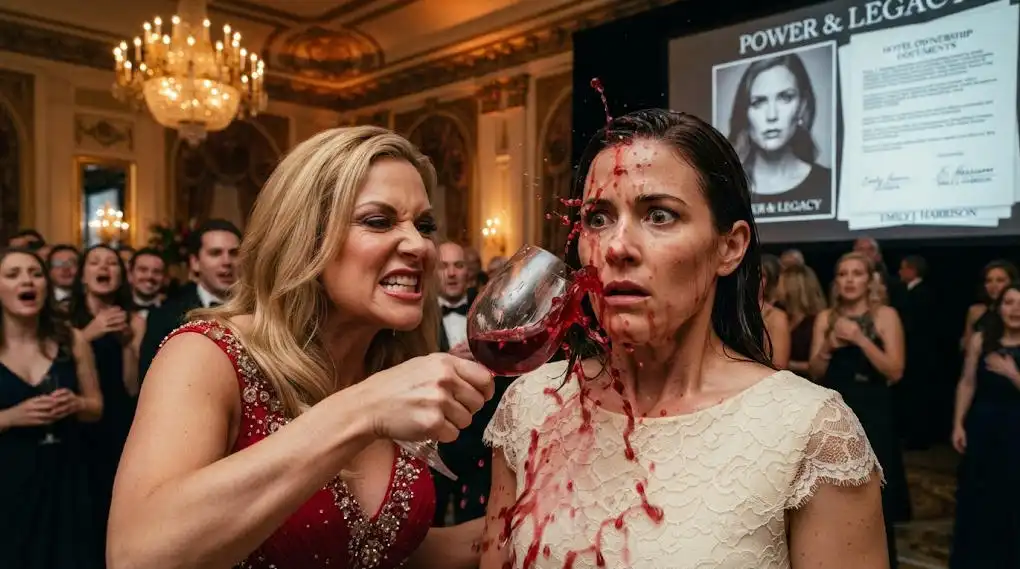
Jessica still held the wineglass, and red wine was spreading across my cream dress.
Nearly two hundred classmates turned toward the stage.
The hotel’s general manager, Martin Hale, placed a sealed silver folder beside the laptop.
“Jessica,” he said calmly, “before anyone removes Clara from this room, we need to verify something.”
Jessica rolled her eyes.
“Martin, please. I have a room full of important people waiting. We don't have time for this.”
Martin didn't answer.
He pressed a button on the laptop.
The first image appeared.
It was a photograph of me at seventeen, standing awkwardly in a blue dress at our high school prom. I was heavier then, with nervous eyes and a smile that looked as though I was apologizing for taking up space.
A few people in the ballroom recognized the photograph immediately.
Jessica laughed.
“Oh, my goodness. They found that picture?”
She turned toward the crowd.
“Everyone, remember Clara? She was the girl who owned that little bakery and thought bringing cupcakes to school would make people like her.”
A few people lowered their eyes.
Others stared at the screen.
I remembered every word Jessica had said to me at that prom.
I remembered the laughter.
And I remembered the red wine running down the front of my dress while she stood beside her friends, holding an empty glass and smiling as if humiliating me were the highlight of her evening.
Ten years had passed.
Apparently, Jessica had learned nothing.
But I had.
The second photograph appeared.
It showed me years later, standing outside a bakery production facility in a fitted white suit, my hair neatly styled and my expression confident. My weight had changed significantly over the years, and the difference was striking.
The room grew quieter.
Then came photographs of my bakery.
One location became three. Three became twelve. My signature pastries, once sold across a handful of neighborhood counters, had eventually reached grocery stores throughout the country.
I had built a national business from recipes, long nights, rejected orders, difficult loans, and years when one bad month could have ended everything.
I had learned to manage employees, negotiate contracts, protect my intellectual property, and recognize the difference between people who respected my work and people who only respected its price.
Eventually, a major food company acquired a controlling interest in my bakery brand.
The transaction, combined with my retained ownership and investments, made me a billionaire.
I never forgot where I started.
I simply stopped believing that my beginnings had to determine my ending.
The screen changed again.
This time, it displayed official corporate records, an acquisition announcement, and the property ownership documents for the luxury hotel where we were standing.
At the center of the screen appeared a name.
CLARA BENNETT.
Below it was the ownership record for the holding company that had acquired the hotel eighteen months earlier.
I was its sole managing member.
The ballroom fell completely silent.
Jessica stared at the screen.
Then she looked at Martin.
Then at me.
“No,” she whispered.
Martin opened the folder.
“The ownership documents have been verified,” he said. “Clara Bennett is the owner of this property through Northstar Hospitality Holdings.”
Someone near the back gasped.
A classmate dropped his fork.
Another woman covered her mouth with both hands.
Jessica's face had gone almost white.
She looked at me as though I had somehow changed into a different person in front of her.
“You own this hotel?”
I gently dabbed the wine from my dress.
“Yes, Jessica. I do.”
For several seconds, she couldn't speak.
Then she forced out a nervous laugh.
“Why didn't you tell anyone?”
I looked at her.
“You never asked.”
“That isn't fair.”
I almost smiled at the irony.
“Fair?”
I repeated the word quietly.
“Is that what you want to talk about now?”
Jessica glanced around the ballroom. The same classmates who had laughed at my humiliation were now watching her with expressions ranging from shock to embarrassment.
She tried to regain control.
“Look, Clara, this was a misunderstanding. We were joking around. You know how reunions are.”
“No,” I said. “I know how cruelty works. It usually sounds like a joke to the person doing it.”
The words landed harder than I had intended.
Jessica's eyes filled with tears.
But I could see that she wasn't thinking about the girl she had humiliated ten years earlier.
She was thinking about her position, her reputation, and the possibility that she had just destroyed her own future.
She stepped toward me.
“Clara, please. We went to school together. We were practically friends.”
I looked directly at her.
“Were we?”
She stopped.
At that moment, Martin addressed the room.
“For clarity, Jessica is the hotel's director of events. Her position does not authorize her to threaten guests, pour alcohol on them, or use hotel security to settle personal disputes. We have witnesses and security footage of what happened tonight.”
Jessica shook her head rapidly.
“Martin, you can't be serious.”
“I'm afraid I am.”
He turned toward the security supervisor.
“Please secure the footage and document the witness statements. Jessica is relieved of her duties pending a formal employment review. She is also to leave the ballroom immediately.”
Jessica stared at him in disbelief.
Then she turned back to me.
“Clara, please!”
Her voice broke.
She dropped to her knees.
The movement was so sudden that several guests stepped back.
“Please don't do this to me,” she begged. “I'll apologize. I'll do anything. You can't let them fire me.”
For the first time that evening, I saw Jessica without the carefully polished confidence she had worn for years.
She looked frightened.
Small.
Desperate.
But I did not feel the triumph I had once imagined feeling if I ever stood above her.
I remembered being seventeen, standing in a stained dress while people laughed.
I remembered wondering whether there was something fundamentally wrong with me.
I remembered believing that if I could somehow become prettier, thinner, richer, or more impressive, perhaps people like Jessica would finally treat me as a human being.
I had spent years trying to prove that I deserved respect.
Now I understood how foolish that bargain had been.
I had deserved respect before the bakery.
Before the money.
Before the hotel.
Before I lost a single pound.
“Get up, Jessica,” I said.
She looked up at me through her tears.
“Are you going to forgive me?”
“That's not what I asked you.”
She slowly stood.
I took a breath.
“You don't need to kneel to me. You need to understand why you thought you could pour wine on another human being and then order her out of the room.”
Jessica's lips trembled.
“I was wrong.”
“Say it to the people who watched you do it.”
She turned toward the ballroom.
For a moment, I thought she would refuse.
Then she faced the crowd.
“I humiliated Clara because I thought I was better than her. I used my position to threaten her, and I poured wine on her dress. It was cruel, and it was wrong.”
Her voice cracked.
“I'm sorry, Clara.”
Nobody applauded.
Nobody laughed.
The silence was more powerful than either.
I nodded once.
“Thank you for saying it.”
Martin gestured toward the exit. Two security officers accompanied Jessica from the ballroom without touching her.
She had entered the reunion believing she controlled the room.
She left it under the watch of the people she had tried to command.
And this time, nobody laughed.
I wish I could say that was the end of everything.
It wasn't.
The following morning, the hotel completed its initial review of the incident. Multiple guest videos supported the security footage, and witness statements confirmed that Jessica had used her professional authority to threaten and humiliate a guest.
The employment review found that her conduct violated the hotel's standards for guest treatment and professional behavior.
She was terminated.
The video circulated among former classmates and eventually reached people in Chicago's private-event industry. Jessica had cultivated a reputation as a luxury event expert, and her personal event-planning business depended heavily on referrals and future bookings.
Several clients withdrew their business.
Her financial problems had begun long before our reunion. She had accumulated substantial debts while financing an expensive lifestyle and relying on future event income to keep up appearances.
Without her position and her expected bookings, those debts became impossible to manage.
Months later, her business closed, and she filed for bankruptcy.
I did not freeze her accounts.
I did not contact her creditors.
I did not order anyone to ruin her.
The consequences followed the records, the policies, and the choices she had made.
That distinction mattered to me.
Justice wasn't the same thing as revenge.
And I had no intention of becoming the sort of person who believed money gave her permission to hurt others.
A few days after the reunion, Jessica sent me a handwritten apology.
It was shorter than I expected.
There were no excuses about the wine, no complaints about the screen, and no mention of her former position.
She admitted that she had spent years measuring people by their appearance, their jobs, and their social standing. She wrote that seeing my success had not made her regret what she did nearly as much as realizing that she would probably have treated me the same way if I had never become successful.
That was the first apology I believed she understood.
I didn't immediately become her friend.
Forgiveness is not a contract that requires you to invite someone back into your life.
But I accepted that she had finally acknowledged what she had done.
And I decided there was one more thing I wanted to do.
The reunion banquet had left trays of untouched food behind. There were roasted vegetables, chicken, fresh bread, salads, and enough desserts to feed dozens of families.
I asked Martin to contact a local food-rescue organization and arrange for the remaining buffet to be delivered to a Chicago family shelter.
Then I asked him to prepare the donation acknowledgment in Jessica's name.
I didn't want to use the donation to humiliate her. I wanted to give her an opportunity to attach her name to something that helped people instead of hurting them.
When Jessica learned about it, she agreed to sign the acknowledgment.
The food was delivered the next morning.
Families who had never met either of us ate the meal that had been prepared for a room full of people who already had more than enough.
That was the part of the story I wanted to remember.
Not the wine.
Not the silence.
Not even the look on Jessica's face when the ownership documents appeared.
I wanted to remember that a painful evening had ended with someone receiving a warm meal.
A few weeks later, I returned to the bakery that had started everything.
The original storefront was smaller than I remembered. The bell above the door still rang when someone entered, and the smell of cinnamon and fresh bread still filled the air.
I stood behind the counter for a while, watching the employees arrange pastries in the display case.
One young woman looked up and smiled.
“Are you Clara? The owner?”
I smiled back.
“I used to be. Now I just come by to make sure the cinnamon rolls haven't changed.”
She laughed.
I bought a box, sat beside the window, and watched people hurry along the sidewalk.
For years, I had imagined that success would feel like finally winning an argument with everyone who had ever doubted me.
Instead, it felt like being able to sit in a bakery without wondering whether someone was laughing at me.
It felt like knowing that I could walk into a ballroom, a boardroom, or an ordinary neighborhood shop without needing to prove I belonged.
Jessica had once poured wine on my dress because she believed my appearance made me an acceptable target.
At our reunion, she learned that I owned the hotel.
But that wasn't the most important lesson.
The most important lesson was that I had never needed to own a hotel to deserve the same dignity as everyone else in that room.
Money had changed my circumstances.
It had not created my worth.
And the next time someone is mocked, excluded, or humiliated in public, I hope the people standing nearby remember what my classmates learned that night.
Silence can make cruelty feel acceptable.
Speaking up can make it stop.
Choose a side: CLARA DESERVED RESPECT BEFORE SHE BECAME WEALTHY, or JESSICA DESERVED A CONSEQUENCE-FREE PASS.
Comment your choice and share this story with someone who believes that dignity should never depend on a person's appearance, job, or bank balance.
Disclaimer: Mention of any brand or trademark is for identification only and does not imply partnership or endorsement

A RURAL TEXAS DOCTOR Poured Ice Water on a Plus-Size Dispatcher in Front of State Inspectors. He Had NO IDEA What She’d Been Recording for Years 😱

She Cut the Plus-Size Assistant’s Hair and Dumped Coffee on Her in Front of Manhattan’s Executives. She Had NO IDEA Who Maya Really Was... 😱

A Chicago Finance Director Poured HOT COFFEE on His Plus-Size Analyst in Front of the Entire Team. He Had NO IDEA What Her Data Could Prove... 😱