
The Gardener with Number 017 Preston Voss hooked his pruning shears beneath the young gardener's soaked pant leg and cut.
The fabric ripped from her calf to her ankle.
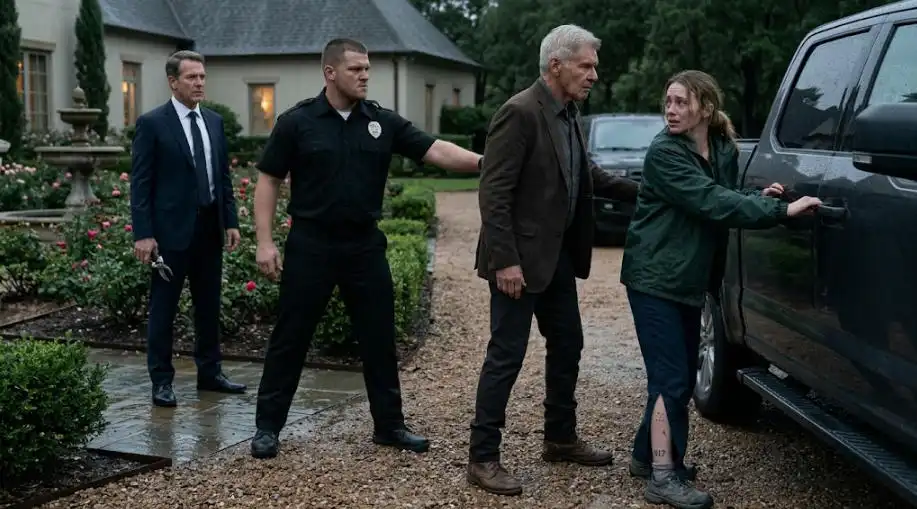
A thin, terrified sound escaped her throat as she stumbled backward, exposing a faded black tattoo above her left ankle.
Three small dots.
A crooked line.
And the number 017.
“Maybe you'll remember how to do your job now,” Voss said, smiling at the guests gathered along the garden walkway.
The young woman dropped to her knees and desperately tried to cover the tattoo with the torn fabric.
But one man had already seen it.
Sixty-three-year-old Wade Calloway, a retired Texas sheriff, stood motionless beside the stone fountain.
Fourteen years earlier, he had found that exact symbol in a photograph recovered during a missing-person investigation.
He had spent the next decade searching for the girl who wore it.
And now, at a wealthy district attorney's private estate, she was kneeling less than twenty feet away.
Then Preston Voss turned toward his security chief.
“Get her in the SUV.”
The young woman looked up.
For the first time, Calloway saw recognition in her eyes.
Not recognition of him.
Recognition of what was about to happen to her.
And it terrified her more than anything he had ever witnessed.
Fourteen Years Earlier Lena Whitlock was twelve years old when she disappeared from a neighborhood charity carnival in Amarillo, Texas.
Her father, Everett Whitlock, was the city's mayor.
Her mother, Caroline, was a public school librarian who still kept Lena's childhood drawings in a box beneath her bed.
On the afternoon Lena vanished, she had been helping distribute bottled water at a children's fundraising event.
A volunteer reported seeing her walking toward a white utility van.
Then she was gone.
The investigation became one of the largest missing-child searches in that part of Texas.
Wade Calloway, then sheriff of the county where the van had last been reported, led the regional investigation with state authorities.
Hundreds of tips came in.
Most led nowhere.
A year later, investigators recovered a box of photographs from an abandoned storage unit belonging to a suspected kidnapping broker.
One photograph showed a frightened young girl's bare ankle.
Above it was a strange tattoo: three dots, a crooked line, and the number 017.
The girl's face wasn't visible.
The photograph was filed as evidence.
The broker disappeared before authorities could question him.
No one could identify the girl.
Calloway kept a copy of the photograph in his case notes, hoping another piece of evidence would someday give the marking meaning.
That day never came.
The Whitlock family eventually stopped holding public birthday vigils.
Everett left political office.
Caroline kept setting a place for Lena at Christmas dinner, even after relatives gently suggested she should stop.
And Calloway retired carrying a case he considered his greatest failure.
The Basement Beneath the Greenhouse Lena had not died.
The white van had carried her across the Oklahoma state line to a secluded holding property.
The man who arranged her abduction was a rising Texas prosecutor named Preston Voss.
Using an intermediary, Voss had paid the kidnapping broker to deliver her to his private custody.
He was building a criminal network that traded in vulnerable captives, falsified identities, and protection bought through political favors.
Lena had been assigned a number.
017.
The tattoo had been forced onto her ankle shortly after her abduction.
For fourteen years, Voss concealed her existence in a secured underground section of his estate.
By the time he became district attorney, he had cultivated a public reputation as a generous supporter of missing-child charities.
His annual fundraising dinners attracted judges, business leaders, and prominent donors.
Almost no one knew what lay beneath the greenhouse behind his mansion.
Lena knew.
She knew the buzzing sound of the basement's steel door.
She knew the four digits Voss entered when he came downstairs.
She knew the footsteps of the guards who delivered food.
And she knew never to make a sound when an unfamiliar man approached.
At twenty-six, Lena had grown into a slender young woman with pale skin, dark-blond hair, and a habit of folding her arms across her chest whenever anyone looked directly at her.
She barely spoke above a whisper.
Even after years of captivity, the sound of a man's voice could make her freeze.
Faint chain marks circled both ankles.
Her fingernails were thick and uneven. The pads of her fingers had developed hard ridges from years of digging and scraping soil.
Those marks came from the only work she had sometimes been allowed to do.
After dark, under supervision, Lena tended plants in the enclosed service courtyard connected to the underground greenhouse.
The guards called her “Seventeen.”
They never used her real name.
At night, when the mansion grew quiet, she knelt beside the drainage channel beneath her room.
With a broken metal bracket concealed behind a loose tile, she worked at the packed soil surrounding an old maintenance access cover.
A spoonful at a time.
A handful at a time.
For eleven months.
Whenever footsteps approached, she pushed the dirt back into place and hid the bracket.
She didn't know whether the passage led to freedom.
She only knew she could not survive another fourteen years belowground.
Then, on a September night, a violent storm swept across the Texas Panhandle.
Rainwater surged through the greenhouse drainage system.
A corroded latch shifted beneath the pressure.
Lena pushed against the loosened cover with her shoulder.
It opened.
For the first time since childhood, she crawled into an outdoor garden without a guard standing beside her.
She was still inside the estate's heavily guarded perimeter.
Beyond the greenhouse were surveillance cameras, motion sensors, and a twelve-foot security fence.
The service road was flooded.
She couldn't reach the outer gate.
At dawn, she heard a truck engine.
An outside landscaping crew had arrived to repair storm damage before that evening's charity dinner.
Lena hid among stacked bags of potting soil, found a discarded dark-green work jacket, and slipped into the group as workers moved equipment between the greenhouse and the formal gardens.
The crew's exhausted supervisor, Marta Ruiz, assumed she was an emergency replacement sent by the subcontractor.
No one stopped to ask for a name.
Lena pulled the jacket low over her soaked navy work pants.
She avoided every male worker.
She worked with her head down, hoping to leave with the landscaping crew when its supply truck departed.
But the damaged irrigation system delayed their work.
By late afternoon, the supply truck had been moved outside the inner security gate.
Lena remained trapped inside.
And Preston Voss was coming to inspect the gardens.
The Guest Who Remembered Wade Calloway had not planned to attend Voss's charity dinner.
Since retiring from law enforcement, he had become chief security consultant to billionaire investor Graham Sterling.
Sterling was considering a major donation to Voss's children's foundation and wanted Calloway to accompany him.
Three weeks earlier, Calloway had reviewed the foundation's public filings.
The missing-child programs looked impressive.
But several of the reported partner organizations had no active operations at their listed addresses.
Calloway had quietly sent those irregularities to Texas Ranger Mara Keene, who was already reviewing old trafficking cases linked to the missing broker.
Keene had told him the financial trail was worth examining, but they had nothing yet connecting Voss personally to the kidnappings.
Calloway wasn't attending the dinner to make an arrest.
He was there to protect Sterling and observe.
Shortly before sunset, he stepped outside while his client spoke with donors inside the mansion.
He noticed a gardener working alone beside a row of damaged rosebushes.
She wore a dark-green jacket and navy work pants.
Unlike the other workers, she kept checking the security cameras and the gatehouse.
When a male guard walked past, her hands began trembling.
Calloway also noticed her fingers.
The thick, uneven calluses didn't look like those of someone who had spent a few seasons pruning roses.
They looked like the hands of someone who had spent years scraping at packed earth.
Then Preston Voss came down the garden path.
Two guests followed him.
The district attorney stopped beside the young woman.
“You're the one who ruined the east hedge?”
Lena lowered her head.
She knew that voice.
Voss leaned closer.
“Look at me.”
She couldn't.
His eyes moved to her wet clothes, then to the left leg of her pants.
A flicker of recognition crossed his face.
He had been told the basement prisoner was missing after the storm. He hadn't expected to find her wearing a contractor's jacket.
“That's not how we trim these branches,” he said loudly.
He took the pruning shears from the worktable.
Before Lena could retreat, Voss caught the loose fabric near her ankle.
“See? This is what happens when people don't pay attention.”
He snapped the blades through the cloth.
The tear ran upward.
Lena collapsed to her knees, desperately grabbing the ripped pant leg.
The tattoo was visible.
Voss looked down.
His smile vanished.
Across the walkway, Wade Calloway felt his stomach tighten.
Three dots.
A crooked line.
017.
It was impossible to mistake.
“Get Her in the SUV.” Voss straightened.
“Blake.”
His security chief, Blake Price, moved forward.
“Take this employee to the service building. She needs to be questioned.”
Lena shook her head violently.
“No. Please.”
Price grabbed her upper arm.
She recoiled so sharply that the pruning shears fell from the worktable.
Voss looked at his guests.
“She's been stealing from the property. We'll handle it privately.”
Calloway stepped between Price and the garden path.
“Then call the sheriff's office.”
Voss's expression hardened.
“Mr. Calloway, this is private property.”
“An employee dispute doesn't give you the right to drag someone into a vehicle.”
“She's trespassing.”
“Then let her speak to the authorities.”
Price tightened his grip.
Lena began crying, but almost no sound came out.
Calloway addressed her gently.
“Ma'am, do you want to go with him?”
She shook her head.
“Can you tell me your name?”
Her lips moved.
Nothing came out.
Price started pulling her toward a black SUV waiting beside the service driveway.
Calloway moved to block him.
“Take your hand off her.”
Voss stepped closer.
“You're making a serious mistake.”
Calloway looked directly at the tattoo.
“I've seen that mark before.”
For one terrible second, Voss didn't answer.
Then he smiled again.
“Of course you have. Plenty of people have tattoos.”
He motioned to Price.
“Get her in the car.”
Lena twisted free.
She ran across the gravel driveway toward Calloway's charcoal pickup truck, parked near the guest entrance.
She caught the passenger-side door handle with both hands.
Price seized her jacket.
The fabric stretched as he pulled.
Lena held on.
“Please,” she sobbed. “Don't let him take me.”
Calloway planted himself between them.
“Let her go.”
Price hesitated.
Voss shouted, “Do your job!”
Calloway had no badge anymore.
He had no authority to arrest the district attorney.
But he knew that a terrified woman was being forced into a vehicle against her will.
And he wasn't going to stand aside.
He pulled out his phone and called 911, identifying himself as a retired sheriff and reporting an attempted abduction at the estate.
Then he spoke to Lena.
“I won't let him put you in that SUV. But I need you to tell me something.”
He pointed toward her ankle.
“Where did you get that mark?”
She stared at him.
He lowered his voice.
“Did someone give you that number when you were a little girl?”
Her fingers loosened from the truck door.
She nodded.
Calloway's throat tightened.
“Were you taken from Amarillo?”
She covered her mouth.
And whispered one word.
“Lena.”
Calloway had heard that name thousands of times.
He had spoken it into microphones.
He had read it on missing-child posters.
He had listened to her mother say it while holding a photograph of a smiling twelve-year-old girl.
“Lena Whitlock?”
Her knees buckled.
Calloway caught her by the elbows, then immediately loosened his grip when she flinched.
“I'm sorry,” he said. “You're safe to stand on your own. I won't hold you.”
Lena grabbed his sleeve instead.
“Please don't send me back.”
The Four Numbers Voss heard the name.
His composure shattered.
“You don't know what you're talking about,” he snapped. “That girl disappeared fourteen years ago.”
Calloway kept the emergency dispatcher on the line.
“Then you shouldn't be afraid of her talking to the police.”
Voss glanced toward the mansion.
His security chief shifted uneasily.
The guests had stopped talking.
From where Lena stood, she could see the greenhouse roof rising above the garden wall.
Below it were locked rooms.
Other voices.
The soft tapping she sometimes heard through the basement walls.
She had spent years believing that if she ever escaped, she would run until she could no longer see the property.
Now she realized running alone might leave others behind.
“There's more,” she whispered.
Calloway leaned slightly toward her without touching her.
“What do you mean?”
Lena's eyes filled again.
“Other people.”
Voss reached beneath his jacket.
Calloway saw the movement.
“Preston, don't.”
The district attorney pulled a handgun.
A guest screamed.
Price backed away.
Calloway pushed Lena toward the stone gatehouse column, placing himself between her and Voss.
“Put it down,” Calloway said.
Voss pointed the weapon toward them.
“You have no idea what you're interfering with.”
Lena could barely breathe.
Fourteen years of fear pressed against her chest.
Then she saw the red emergency alarm switch mounted on the gatehouse column.
She remembered the guards testing it whenever a delivery truck malfunctioned near the security barrier.
The monitored system sounded an alarm inside the estate and alerted the security monitoring company, which could notify county dispatch.
Calloway's call was already connected to 911.
Lena understood something Voss had never expected.
He had spent years teaching her to stay silent.
But the one thing he could no longer control was her voice.
She lunged toward the column.
And slammed her palm against the alarm.
A siren erupted across the estate.
Gate lights flashed.
The driveway barrier locked into its emergency position.
Voss turned toward the noise.
Lena screamed with everything she had left.
“The basement is under the greenhouse! The code is 4619! There are others down there!”
Voss swung the gun toward her.
Calloway struck his wrist with both hands and drove him against the stone wall.
The gun fell onto the gravel.
Price froze as Calloway ordered him away from it.
Calloway kept Voss pinned against the wall while the emergency dispatcher heard the struggle through the open phone.
Lena sank onto the ground beside the alarm.
Her entire body shook.
But she had not gone quiet.
She looked straight at the guests standing on the garden path.
“He keeps people under there,” she said.
“Please. Don't let him lock the door again.”
What Was Beneath the Estate County deputies arrived eighteen minutes later.
Because the district attorney himself was the subject of the accusations, the county sheriff requested immediate assistance from the Texas Rangers.
Mara Keene, already familiar with the financial irregularities Calloway had reported, took over coordination of the investigation with state and federal authorities.
Voss was taken into custody after deputies documented the weapon threat and interviewed witnesses.
Lena was escorted to an ambulance.
Before leaving, she insisted on telling Keene exactly where the basement entrance was located.
“Behind the greenhouse storage shelves,” she whispered. “There's a steel door. Four, six, one, nine.”
“Are there people inside?”
Lena nodded.
“I heard them through the wall.”
The immediate report of living captives in danger gave responding officers grounds to enter the underground area without waiting for an ordinary search-warrant process.
The keypad accepted 4619.
Inside, investigators found three women confined in separate secured rooms.
All three were alive.
Each had been reported missing in a different year.
Medical personnel brought them out through the greenhouse service entrance.
That night, authorities secured the underground rooms, documented the locks and restraints, and preserved the estate's surveillance system before evidence could be erased.
With search warrants obtained as the investigation expanded, forensic teams recovered financial records, communications with the kidnapping broker, and documents that traced payments for the transport and detention of multiple victims.
Several transactions were connected to associates who had benefited from Voss's political protection.
Blake Price's security logs showed repeated night deliveries to the greenhouse under false maintenance descriptions.
A forensic accountant later connected funds diverted from Voss's charitable foundation to companies used by the network.
And the old photograph from Calloway's investigation finally acquired its missing context.
The number 017 wasn't a gang symbol.
It wasn't a worker's identification mark.
It was the number assigned to Lena within the trafficking operation.
Investigators identified matching patterns in other recovered records.
Voss's own payment ledger established that he had financed Lena's original abduction and paid the broker to deliver her into his custody.
The man publicly raising money for missing children had helped make them disappear.
The Fingerprints That Ended Fourteen Years of Doubt Calloway did not rely on Lena's whispered name alone.
At the hospital, after she had been examined and given time to rest, Keene explained that investigators needed to establish her identity.
Lena consented to fingerprint collection.
Fourteen years earlier, her mother had provided the original investigative team with a childhood identification card containing Lena's fingerprints, made during a school safety program.
That card had been preserved with the missing-person case evidence.
Keene retrieved the original file through the cold-case unit under documented evidence procedures.
A state forensic examiner compared the new prints with the archived card.
The examiner identified matching ridge characteristics and concluded that the impressions came from the same person.
The tattoo provided separate corroboration.
The three dots, crooked line, and number 017 matched the old photograph recovered from the broker's storage unit.
Calloway watched the examiner's confirmation arrive.
For fourteen years, he had feared that photograph might be the last trace of the girl he had failed to find.
Now the girl was alive, resting in a hospital room down the hallway.
Mara Keene handed him the report.
“It's her, Wade.”
Calloway looked at the page.
For a long time, he couldn't speak.
The Family That Never Stopped Waiting Caroline Whitlock was sixty-eight when her phone rang.
She was standing in her kitchen in Amarillo, washing a coffee mug.
The caller identified herself as a Texas Ranger.
Caroline gripped the counter.
“Did you find something belonging to Lena?”
There was a pause.
Then Keene said, “Mrs. Whitlock, we've found your daughter alive.”
The mug slipped from Caroline's hand.
Her husband rushed into the room.
Caroline couldn't repeat the words at first.
She only held out the phone.
When Everett heard what Keene was saying, he lowered himself into a chair.
For the next several minutes, neither parent could do anything but cry.
The following afternoon, they arrived at the hospital.
Lena was sitting near the window, wearing borrowed gray sweatpants and a soft blue sweater.
She had washed her hair.
Without the mud and the oversized gardening jacket, she looked smaller than Calloway remembered from the estate.
Caroline stopped in the doorway.
“Lena?”
Lena turned.
She stared at the older woman.
Then her eyes moved to the silver necklace Caroline wore.
A tiny sunflower pendant hung from the chain.
Lena remembered that necklace.
Her mother had worn it to the carnival on the day she disappeared.
“Mom?”
Caroline pressed her hand over her mouth.
“Yes, sweetheart. It's me.”
She took one cautious step forward.
“Can I hug you?”
Lena nodded.
Caroline crossed the room slowly and wrapped her arms around her daughter.
Lena stood stiffly at first.
Then she buried her face against her mother's shoulder.
Everett remained by the door.
He had once been a confident public speaker, a man who could address hundreds of people without notes.
Now he could barely form a sentence.
“Hi, peanut,” he managed.
The childhood nickname made Lena look up.
Her father wiped his eyes.
“You don't have to hug me. You don't have to do anything you're not ready for.”
Lena watched him for several seconds.
Then she reached out her hand.
Everett took it.
They stayed that way for a long time.
The Trial The investigation lasted more than a year.
The Texas Rangers worked with federal prosecutors because the evidence established an interstate kidnapping network and repeated acts of confinement and coercion.
Additional search warrants uncovered communications between Voss, the original broker, and several corrupt associates.
Bank records and witness testimony demonstrated how the network had paid for transportation, concealed victims, and manipulated investigations.
A former estate employee testified that Voss had personally ordered the underground rooms kept off maintenance plans.
The recovered security footage showed Voss recognizing Lena in the garden and directing Price to force her into the SUV.
Guests testified about the gun and the alarm.
Calloway explained the history of the tattoo and the missing-person investigation.
And Lena, after months of therapy and preparation with victim-support specialists, chose to testify.
She was allowed breaks when she needed them.
She described the cellar, the locked rooms, and the years she had spent working at the soil beneath the drainage cover.
She described the day she escaped.
Most importantly, she described the others she had heard through the walls.
Voss's attorneys challenged her memories and tried to undermine the identification.
But the case did not depend on memory alone.
It rested on fingerprints, contemporaneous case evidence, recovered business records, the estate's security footage, financial transactions, and testimony from multiple survivors.
The jury convicted Voss on federal kidnapping and conspiracy charges.
He received a life sentence.
The kidnapping broker, eventually located through the financial investigation, also received life imprisonment.
Two senior organizers received life sentences for their roles in the network.
Price and several other participants received substantial prison sentences, while additional officials implicated by the investigation faced separate prosecutions.
The charitable foundation was dissolved under court supervision, and recovered assets were directed toward restitution and victim assistance.
Lena did not attend every sentencing.
She didn't need to.
The people who had once controlled every door in her world would no longer decide where she went.
The Garden Without a Gate Recovery was not simple.
Lena still startled when doors shut too loudly.
Crowded rooms exhausted her.
She sometimes woke believing she was back underground.
Her therapist helped her develop ways to manage panic, make choices without asking permission, and rebuild trust at her own pace.
Her parents learned to knock before entering her room.
Everett stopped reaching for her shoulder unexpectedly.
Caroline learned that silence did not always mean fear.
Sometimes Lena simply wanted quiet.
Calloway visited occasionally.
He always called first.
He never asked her to retell the investigation.
Sometimes they talked about his old pickup truck.
Sometimes they talked about the weather.
One afternoon, he brought her a small packet of sunflower seeds.
“Your mom told me you used to plant these,” he said.
Lena studied the packet.
“I remember.”
She smiled faintly.
“Mine never got very tall.”
Calloway returned the smile.
“Maybe these will.”
Six months after the trial, Lena moved into a small cottage near her parents' home.
It had wide windows, a sunny kitchen, and a garden that opened onto a quiet meadow.
There was no security gate.
No guards.
No locked greenhouse.
On a Saturday morning in April, Caroline helped her carry a bag of potting soil outside.
Everett set a watering can beside the flowerbed, then went back inside to give her space.
Lena knelt in the sunlight.
For a moment, she studied her hands.
The rough skin had softened.
But faint marks still crossed her fingers.
She pressed them gently into the earth.
This time, she wasn't searching for a way out.
She dug a shallow hole, lowered a young sunflower into it, and carefully covered its roots.
A breeze moved through the grass.
Her mother watched from the porch.
Lena stood, brushed the soil from her palms, and looked toward the open meadow.
Then she picked up the watering can.
In a garden full of sunlight, with no one ordering her to move and no locked door waiting behind her, Lena Whitlock quietly watered her sunflower.
For the first time in fourteen years, she could stay outside as long as she wanted.
Disclaimer: Mention of any brand or trademark is for identification only and does not imply partnership or endorsement

A RURAL TEXAS DOCTOR Poured Ice Water on a Plus-Size Dispatcher in Front of State Inspectors. He Had NO IDEA What She’d Been Recording for Years 😱

She Cut the Plus-Size Assistant’s Hair and Dumped Coffee on Her in Front of Manhattan’s Executives. She Had NO IDEA Who Maya Really Was... 😱

A Chicago Finance Director Poured HOT COFFEE on His Plus-Size Analyst in Front of the Entire Team. He Had NO IDEA What Her Data Could Prove... 😱