

The boot hit Evan Cole before he could turn.
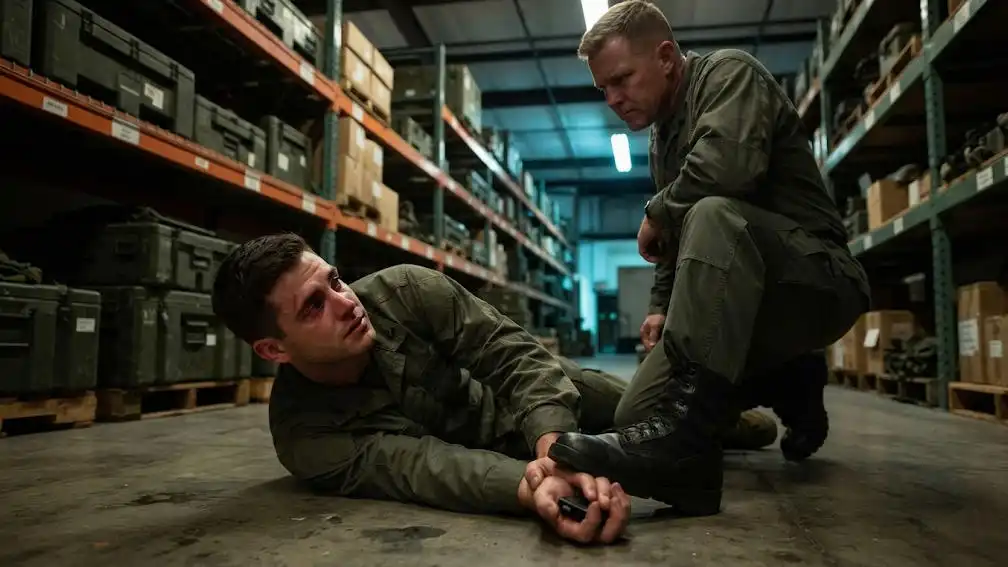
One hard kick sent the young corporal sprawling across the concrete aisle. His right hand struck the floor first, his fist still closed around the tiny black drive hidden inside it.
Lieutenant Colonel Wade Harlan stepped over him.
Then the colonel brought his boot down on Evan's hand.
Pain flashed up Evan's arm. He tried to pull away, but Harlan shifted his weight, grinding the heavy sole against Evan's palm.
“Look at you. A useless little corporal.”
Evan's breath caught. His eyes watered, and his fingers trembled beneath the pressure. He knew something in his hand had given way. But he kept his fist closed.
“Get your boot off my hand.”
Harlan looked almost amused.
For a moment, Evan thought the colonel might press harder simply because he had been challenged. Then Harlan lifted his boot, leaving Evan curled on the warehouse floor, his injured hand against his chest.
“Take him to confinement.”
Two military police officers hurried forward.
Evan tried to rise, but his right arm would not support him. As Harlan turned to shout at the men, Evan used his left hand to slide the microdrive into a concealed pocket inside his uniform cuff.
He kept his face lowered until the drive was secure.
Then the MPs hauled him upright and dragged him toward the steel door.
Harlan watched them go, satisfied.
He had spent years making people at Camp Pendleton afraid to contradict him. He believed fear was the most reliable form of discipline, especially when the people beneath him had nowhere else to go.
He had made one mistake.
He had mistaken Evan's silence for helplessness.
For six weeks, Evan had been living under an assumed identity as a twenty-eight-year-old supply corporal. His official-looking cover records placed him among the junior Marines responsible for counting equipment, checking deliveries, and reconciling warehouse inventories.
The assignment had come from a small, tightly controlled team connected to the Pentagon's Inspector General. Someone suspected serious corruption in the base's logistics operation, but suspicion was not enough to dismantle a command structure. They needed records that could withstand independent examination.
Evan's orders were simple: remain inconspicuous, obtain verifiable evidence, and do not expose his true identity before the evidence was secure.
He had nearly finished the assignment.
The first warning had come from the numbers.
A shipment of military radios was recorded as obsolete and approved for disposal. Yet the serial numbers on the disposal list matched equipment that had recently been inspected and marked serviceable.
A second discrepancy involved medical supplies. The official ledger showed a full inventory, while delivery records showed repeated transfers to a private surplus broker.
The numbers did not agree. Neither did the signatures.
Evan began comparing the records quietly. He checked delivery dates against vehicle logs, disposal approvals against warehouse counts, and serial numbers against the original inventory sheets.
Each comparison revealed another inconsistency.
The private broker was buying valuable equipment at suspiciously low prices. Financial records in the disposal files showed payments routed through offshore accounts. The account transfers corresponded to the same dates as the questionable sales.
This was not a clerical mistake.
Someone had created a system in which equipment could disappear on paper, reappear in private hands, and generate money that never reached the military.
Two Marines had tried to raise concerns before Evan arrived.
Sergeant Peter Lawson had questioned the unexplained disappearance of radios. Lance Corporal Ryan Bell had reported missing medical supplies. Both men were unexpectedly separated from service shortly afterward.
Their departure paperwork moved with remarkable speed. The complaints they had filed went nowhere, and the remaining Marines learned to keep their heads down.
Evan understood the lesson they had been taught.
He stopped asking questions where anyone could hear him.
Instead, he used his assigned inventory duties to establish the discrepancies. He preserved the original records, checked the shipping documentation, and waited until he had access to the disposal ledger containing the resale lists and financial transfers.
He did not need a dramatic confrontation.
He needed one complete, verifiable copy.
On the night Harlan caught him, Evan had finally obtained it.
The microdrive inside his sleeve contained the resale lists and offshore account transfer records, together with the associated inventory and approval records. The evidence had been copied in full. An encrypted transfer to a Department of Defense server was already running in parallel.
Evan had been leaving the records cage when Harlan spotted him.
The colonel did not ask what he had found.
He saw a junior corporal near a restricted records area and immediately assumed he had caught someone who could be frightened into silence.
Now, as the MPs dragged Evan down the corridor, Harlan followed with his hands clasped behind his back.
“Confiscate his identification,” he ordered. “Put him in confinement. I want a disciplinary report for theft and disobedience ready before morning.”
One of the MPs, Corporal Brett Nolan, glanced at Evan's swollen hand.
“Sir, he needs medical attention.”
Harlan stopped walking.
“Are you questioning my orders?”
“No, sir.”
“Then do your job.”
The MPs took Evan's cover identification and ordinary radio. They did not conduct a proper medical intake or formally process him through the normal disciplinary channels. Harlan wanted the matter handled quietly, before anyone outside his immediate circle could ask questions.
That decision would later become part of the investigation.
For now, Evan was pushed into a small confinement room and left alone.
The steel door slammed shut.
He sat against the wall and carefully examined his right hand. The palm was swelling rapidly. Even the smallest movement sent pain through his fingers and into his wrist.
He closed his eyes.
For a few seconds, the pain threatened to overwhelm everything else.
He thought of Lawson and Bell, two men who had tried to report what they saw and lost their careers for it. He thought of the records now hidden in his sleeve. If Harlan found the drive before the transfer finished, he might still destroy the physical copy and manufacture a story about a dishonest corporal.
Evan had to make sure the evidence could not be buried.
He shifted carefully, keeping his back toward the narrow window in the door. Beneath the inner seam of his uniform belt was a concealed secure relay with a small tactile keypad. It had been installed for precisely the kind of emergency in which he could no longer use an ordinary communication channel.
With his left hand, he retrieved the microdrive from his cuff and connected it to the relay's recessed port.
He could not safely use his injured hand. He did not need to.
Working by touch, he found the raised keys and entered the emergency sequence from memory. His fingers moved slowly at first, then more confidently as the familiar sequence returned to him.
The relay began sending the encrypted evidence package again, including the final file index and verification data. It also transmitted the prearranged emergency signal to the team monitoring his assignment.
Evan kept his eyes closed and continued typing.
One key.
Then the next.
The device vibrated once.
The transfer had been accepted.
He disconnected the drive, returned it to its concealed pocket, and pressed his injured hand against his chest.
For the first time since Harlan's boot came down, he allowed himself a full breath.
Then he heard footsteps outside.
The door opened.
Sergeant Kyle Dwyer entered first, followed by Nolan. Dwyer was a stocky military policeman with close-cropped brown hair and an expression that suggested he had already decided how the encounter would end.
He shut the door behind him.
“The colonel wants a confession,” Dwyer said.
Evan looked at him without answering.
Dwyer pulled a baton from his belt.
“Tell us where the drive is. Make this easy on yourself.”
Evan remained seated, his right hand pressed against his uniform.
Nolan glanced at the swollen fingers.
“Maybe we should get a medic.”
Dwyer turned on him.
“You heard the colonel.”
“This isn't a proper interrogation.”
“Then you can explain that to Harlan when he asks why we let his evidence disappear.”
Nolan hesitated.
That hesitation told Evan something important. Harlan had not merely lost his temper in the warehouse. He was afraid of what the drive contained.
Dwyer stepped closer.
“Last chance, Corporal.”
Evan slowly pushed himself to his feet. His right hand hung uselessly against his chest. His breathing was shallow, but he held Dwyer's gaze.
He had no intention of confessing to a crime he had not committed.
Dwyer raised the baton.
Evan watched the movement rather than the man's face.
When the baton came down, Evan lifted his left hand and caught it just above the grip, redirecting the strike away from his head. The impact jolted through his arm. He stumbled, but he did not release the baton.
Dwyer stared at him in disbelief.
Evan drove his shoulder forward, forcing Dwyer back a step and creating enough space to keep the weapon away from his injured hand.
He was not trying to win a fight.
He was trying to stay on his feet long enough for the evidence to matter.
Then the room began to tremble.
A deep, rhythmic roar grew louder outside. Dust shook loose from the upper window frame, and the metal door rattled in its hinges.
Nolan turned toward the window.
“What the hell is that?”
The helicopter's rotors beat against the night air.
Dwyer released the baton and moved toward the door, suddenly uncertain. Before he could open it, heavy footsteps sounded in the corridor.
The door swung inward.
Special Agent Laura Pierce entered with a joint team of Defense Department Inspector General investigators and Naval Criminal Investigative Service agents. Behind them came additional personnel carrying official orders and evidence-preservation equipment.
Pierce took in the scene in a single glance: the baton, Dwyer's position, Nolan's rigid posture, and Evan standing against the wall with his injured hand pressed to his chest.
“Step away from him,” she ordered.
Dwyer dropped the baton.
Nolan immediately moved away from Evan.
Pierce approached the corporal.
“Can you identify yourself?”
Evan reached into the concealed inner pocket of his uniform belt with his left hand. He drew out a military identification card and held it toward her.
Pierce looked at the card.
Her expression changed.
“Major Mercer?”
Evan nodded.
His real name was Daniel Mercer, a twenty-eight-year-old commissioned officer assigned to the Pentagon's Inspector General investigation. The corporal standing before her had never been an ordinary enlisted Marine. His identity, rank, and assignment had been concealed under a tightly controlled operation authorized to investigate the supply corruption without alerting the people responsible.
Harlan had spent six weeks believing he could intimidate a junior soldier into silence.
He had just ordered two military policemen to threaten a field-grade officer carrying a legitimate investigative assignment.
Pierce took the identification card and checked it against the team's secure records.
The confirmation came back immediately.
Major Daniel Mercer.
Inspector General assignment.
Active emergency authorization.
The identity was genuine.
Mercer drew the microdrive from his sleeve and handed it to her.
“The complete resale and transfer records are on there,” he said. “The encrypted package should already be on the Department of Defense server. The final transmission was accepted from this room.”
Pierce passed the drive to the team's forensic specialist, who connected it to a dedicated evidence reader rather than an ordinary networked computer.
The specialist checked the file manifest against the copy already held on the Department of Defense server.
The records matched.
The resale lists identified the equipment and the private buyers. The inventory records showed which items were supposed to remain in military possession. The financial documents traced payments through offshore accounts, and the associated approval records connected those transactions to Harlan's logistics operation.
The serial numbers, dates, and transaction references agreed across the separate records.
The evidence did not rest on Evan's accusation or his word against the colonel's.
It rested on records that could be independently examined.
Pierce looked toward the corridor.
“Where is Lieutenant Colonel Harlan?”
As if summoned by the question, Harlan appeared in the doorway.
He had heard the helicopter and hurried toward the confinement area, expecting to discover an emergency he could control. Instead, he found federal investigators, his two MPs standing apart from the prisoner, and Evan holding himself upright despite his injured hand.
“What is this?” Harlan demanded. “This is my installation. You cannot walk into my command and interfere with a disciplinary matter.”
Pierce presented her credentials.
“We are conducting a joint investigation into the diversion of military supplies and related financial transactions. Your command authority is being suspended pending independent review.”
Harlan's expression hardened.
“That corporal is a thief. He was caught inside a restricted records area.”
Mercer stepped forward.
Harlan looked at him again, this time with confusion replacing contempt.
Mercer held out his real identification card.
“Major Daniel Mercer, Department of Defense Inspector General.”
Harlan stared at the card.
For several seconds, he said nothing.
Then he looked at Evan's face, searching for some sign that the young corporal he had kicked to the floor was still the powerless man he remembered.
“You were a corporal,” Harlan said.
“That was my cover identity.”
“You can't possibly—”
“The records are already secured,” Mercer interrupted. “Your transfer approvals match the resale lists. Your offshore account transactions match the payment records. The server copy has been verified against the drive.”
Harlan's face lost its color.
For the first time, the man who had controlled the warehouse through intimidation seemed unable to find a command that would restore his position.
He tried one anyway.
“Military police! Arrest this man!”
Neither Dwyer nor Nolan moved.
Pierce turned toward the two MPs.
“You will remain here and provide statements about the orders you received. Your actions in this room are part of the investigation.”
Dwyer lowered his eyes. Nolan looked at the baton on the floor.
The colonel had expected his subordinates to protect him.
Instead, they had become witnesses.
Mercer then produced the sealed emergency command authorization that had accompanied his assignment. It had been signed through the appropriate higher-command channel and designated him to assume temporary command if the installation's logistics chain was found compromised.
That condition had now been met.
The order did not depend on Harlan's consent. It did not depend on the colonel believing the evidence. It had been prepared for the precise possibility that an investigation would uncover corruption inside the command structure itself.
Mercer was a commissioned officer, and the sealed authorization gave him the authority to apprehend implicated personnel while the command was secured.
He looked directly at Harlan.
“Lieutenant Colonel Wade Harlan, you are being placed under apprehension pending formal proceedings. You are relieved of your command duties, effective immediately.”
Two agents moved to Harlan's sides.
He pulled his arms away.
“This is a mistake. I have served this Corps for twenty-four years.”
“Then you will have an opportunity to answer the evidence,” Mercer replied.
Harlan tried to turn toward the door, but the agents restrained him. One removed the silver rank insignia from his collar and placed it in an evidence envelope. Another secured his wrists and fitted heavy transport leg restraints around his ankles.
The metallic lock snapped shut.
The sound carried through the room.
Harlan looked down at the restraints, then back at Mercer. The contempt that had filled his face in the warehouse had disappeared, replaced by the dawning realization that no subordinate would come to his rescue.
The colonel was escorted away.
The investigation continued under the emergency command order. The warehouse and financial records were secured, the compromised supply approvals were frozen, and Dwyer and Nolan were removed from their duties pending investigation. The personnel files of Lawson, Bell, and other Marines who had raised concerns were flagged for independent review.
No one promised that the affected Marines would automatically regain their positions. Their complaints would have to be examined on their merits. But for the first time, the records would be reviewed by people outside Harlan's chain of command.
That mattered.
A medical team examined Mercer shortly afterward. X-rays confirmed fractures in his right hand. The physician immobilized it in a plaster cast, and Mercer was ordered to keep it protected while the injuries healed.
He accepted the treatment without argument.
The pain was real. So was the damage.
But the evidence had survived, the investigation was no longer under Harlan's control, and the colonel could not erase what had been transmitted to the Department of Defense.
Under the sealed contingency order, Mercer temporarily assumed command of the base pending the arrival of the designated relief commander. His first orders were to preserve the records, protect personnel involved in the investigation, and prevent any further interference with the evidence.
There would be formal proceedings, financial examination, and a full accounting of the missing supplies. The arrest was not a substitute for those steps. It was the beginning of a process that Harlan had spent years believing he could prevent.
At the edge of the floodlit landing area, Mercer stood with his freshly plastered right arm held stiffly against his body.
The night wind swept across the concrete.
Ahead of him, Harlan was being led toward the waiting aircraft in heavy leg restraints, his rank insignia sealed away and his command authority gone.
Mercer watched him without smiling.
He did not salute.
He did not shout after him or offer one final insult.
He simply stood there, his injured arm in plaster, his jaw set and his eyes cold, watching the man who had called him useless being escorted away under guard.
Disclaimer: Mention of any brand or trademark is for identification only and does not imply partnership or endorsement
A RURAL TEXAS DOCTOR Poured Ice Water on a Plus-Size Dispatcher in Front of State Inspectors. He Had NO IDEA What She’d Been Recording for Years 😱
She Cut the Plus-Size Assistant’s Hair and Dumped Coffee on Her in Front of Manhattan’s Executives. She Had NO IDEA Who Maya Really Was... 😱
A Chicago Finance Director Poured HOT COFFEE on His Plus-Size Analyst in Front of the Entire Team. He Had NO IDEA What Her Data Could Prove... 😱