
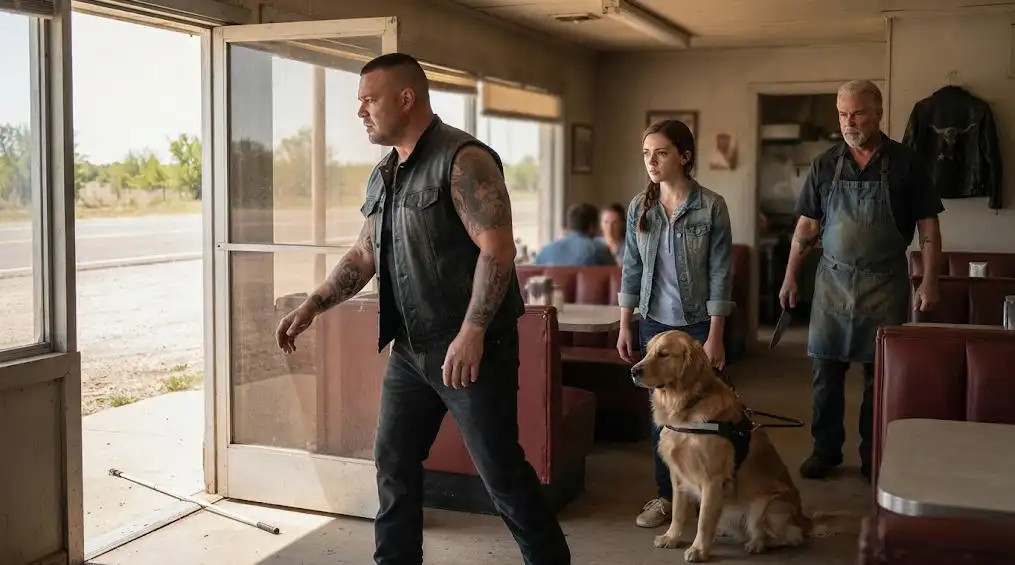
The white cane struck the concrete outside the diner with a sharp crack.
Ellie Mercer heard it bounce once, then scrape across the dusty ground toward the highway.
For a moment, she couldn't quite believe what had happened.
One second, she had been sitting in her usual booth at The Last Stop Grill, her golden retriever resting quietly beside her. The next, a stranger had ripped the cane from her hand and thrown it out the door as though it were a piece of trash.
Her right hand remained suspended in the air.
Then she heard the man's boots shift closer.
“Move that mutt, or I'll put him down.”
Ellie was twenty years old. She was blind, but she had spent years learning how to move through the world on her own terms. Scout, her trained guide dog, helped her navigate sidewalks, doorways, and crowded rooms. Her white cane was another tool, useful when she needed to check unfamiliar spaces or locate obstacles.
Neither was a toy.
Neither was something a stranger had the right to take.
Ellie tightened her left hand around Scout's harness.
“Don't touch him! He's my partner.”
Wade Kessler laughed down at her.
He was a thick-necked biker with a shaved head, tattoos covering both arms, and a black leather vest that creaked whenever he moved. He had entered the diner ten minutes earlier, already irritated by the heat, the wait for his food, and apparently the existence of a dog beneath Ellie's table.
Scout had been lying neatly beside her knees, completely out of the aisle.
Wade had complained anyway.
Ellie had explained that Scout was a working guide dog. She had even shifted her chair to make the passage wider. Wade had ignored her explanation, reached for her cane, and thrown it outside.
Now he leaned over her, blocking the route to the door.
“You heard me,” he said. “Get that animal away from me.”
Ellie's cheeks burned.
She could feel the eyes of the other diners without seeing them. A spoon stopped halfway to someone's mouth. A chair creaked, then went still. Near the counter, a truck driver lowered his coffee.
Nobody intervened.
That silence hurt almost as much as Wade's words.
Ellie was used to people offering unwanted help. She was used to strangers grabbing her elbow without asking, speaking to Scout instead of her, or assuming blindness meant helplessness.
But she had never learned to accept being treated as though she didn't deserve basic respect.
“You threw my cane outside,” she said, forcing her voice to remain steady. “Pick it up and give it back.”
Wade bent closer.
“Make me.”
Scout shifted against her leg. Ellie felt the dog's shoulder press into her hand, warm and solid.
Fear rose in her throat. Not fear for herself, exactly. She was afraid Wade would hurt Scout, and the thought made her stomach twist.
Scout wasn't simply a pet she loved. He was her partner, the animal who helped her cross busy streets, find entrances, and travel independently through places that could otherwise become exhausting and unpredictable.
Losing him would change almost every part of her daily life.
Ellie drew him closer and planted her feet firmly beneath the table.
“Don't you dare touch him.”
Wade's expression hardened.
Then the kitchen door swung open.
Ray Maddox stepped into the dining room.
Most people who ate at The Last Stop knew Ray as a quiet, silver-haired man who remembered regular customers' orders and never rushed anyone who needed a little extra time. He was broad-shouldered, with a close-trimmed beard and a faded denim apron tied around his waist.
At that moment, he was carrying the butcher's knife he had been using to trim a cut of beef.
He stopped several feet from Wade.
“Step away from the dog.”
He didn't shout. He didn't raise the knife.
Yet something about the way he stood made Wade turn around.
Ray lowered his hand slightly, keeping the blade pointed toward the floor.
Wade looked at the older man's face, then at the tattoo on his left forearm.
His expression changed.
The tattoo showed a longhorn skull above three stars. Behind Ray, hanging on the diner wall, was an old black leather motorcycle jacket bearing the same faded emblem.
Wade stared at the jacket.
Then he looked at Ray again.
The man who had been laughing moments earlier seemed to have forgotten how.
He knew that emblem.
The Iron Saints Motorcycle Club had once been the largest and one of the most feared motorcycle clubs in Texas. Ray Maddox had been its founding president. He had walked away from that life years ago, but his name had never disappeared from the stories told among Texas riders.
Wade had spent years using his own intimidating appearance to make people back down.
He had never expected to find himself standing across from Ray Maddox.
Ray set the knife on the nearest counter.
Then he gave one sharp whistle.
It was a piercing, familiar signal.
Outside, a man beside the gas pumps stopped what he was doing. Two broad-shouldered riders rose from a shaded picnic table. Three more emerged from the neighboring repair shop. Inside the diner, several men who had looked like ordinary customers stood up and moved quietly toward the front.
Within seconds, a dozen bikers had gathered around the building.
They didn't charge Wade.
They didn't swing at him.
They simply stood where he could see them, filling the windows, the doorway, and the edges of the parking lot.
The room had changed.
For the first time since he had entered the diner, Wade was surrounded by people who weren't afraid to look him in the eye.
Ray glanced toward the open door.
“Pick up what you threw.”
Wade swallowed.
His eyes moved from Ray to the men outside. His mouth opened, but no words came out. Then his knees began to tremble.
A dark patch spread across the front of his jeans.
He had wet himself.
Nobody laughed.
That somehow made the moment worse.
Ray's expression remained stern.
“You took something that wasn't yours. You threatened a woman and her dog. Nobody here is going to touch you, but you're going to pick up that cane and return it.”
Wade stared at him.
“Now,” Ray added.
The biker turned toward the door. His legs seemed barely capable of supporting him. He dropped onto his hands and knees, crawled across the threshold, and reached for the white cane lying in the dust.
He picked it up with shaking fingers.
Then he crawled back to the entrance and slid it across the floor toward Ellie.
The cane tapped against the toe of her shoe.
Ellie bent down and found the handle.
She ran her fingers along the shaft, checking for damage. It was still intact.
Her hand trembled, but she held it firmly.
Wade struggled to his feet outside.
Ray stepped aside, leaving the doorway clear.
“Leave,” he said. “And don't come back.”
Wade didn't argue. He stumbled toward his motorcycle while the gathered riders watched him go.
Ray raised one hand slightly.
The bikers stayed where they were. Nobody followed Wade, and nobody laid a finger on him.
That mattered.
Ray had not called them to start a fight. He had called them because he knew the threat of a dozen men standing together could stop a bully who had ignored every ordinary request for decency.
And he had made a promise long ago that he would never let this particular young woman face danger alone if he could prevent it.
Behind the counter, Nora Bell, the waitress, finally let out the breath she had been holding. She had quietly called the county sheriff's office when Wade threatened Scout.
Two deputies arrived shortly afterward.
Ray cooperated with them, explaining what he had witnessed and why the riders had gathered. Nora gave her statement. So did the truck driver, the elderly couple, and several other diners who had heard Wade's threat and seen him throw the cane.
Ellie answered the deputies' questions herself.
She described exactly what Wade had done, what he had said, and where her cane had landed. She did not need Ray to speak for her.
The deputies documented the incident, issued Wade a citation for his conduct, and recorded the witnesses' statements. Ray also formally barred Wade from returning to the restaurant.
The matter would not disappear simply because Wade had frightened himself.
When the deputies finished, the room gradually began to breathe again. Chairs scraped. Someone asked for a fresh cup of coffee. A man near the window shook his head and returned to his breakfast.
Ellie remained seated, one hand resting on Scout's back.
Her anger had not vanished.
Neither had the embarrassment.
“I didn't need someone to make him afraid,” she said quietly.
Ray stood a respectful distance from her booth.
“No?”
“I needed him to leave my dog alone. I needed my cane. I needed people to remember I was sitting right here.”
Ray looked down for a moment.
“You're right.”
The simple admission caught her off guard.
He didn't tell her to calm down. He didn't explain that the biker had been dangerous or insist that she should be grateful for the rescue.
He listened.
“I should have stopped him sooner,” Ray said. “I'm sorry you had to sit here wondering whether anyone would help.”
Ellie touched Scout's harness.
“Why did you care so much?”
Ray's eyes shifted toward the old leather jacket hanging on the wall.
For years, he had deliberately kept his distance from Ellie. He knew how fiercely she valued her independence. He had never wanted her to feel that the town was watching her because it considered her weak.
He had wanted her to feel free to come and go as she pleased.
But the time had come to tell her the truth.
“Your mother saved my life,” he said.
Ellie's fingers stopped moving.
“My mother?”
“Claire Mercer. Twelve years ago, I wrecked my motorcycle on a rain-slick county road. A truck clipped me, and I went down hard. I was bleeding badly, and I was losing consciousness.”
Ray pulled out the chair across from her but waited for her permission before sitting.
“Your mother was driving home. She stopped, called for an ambulance, and used her own scarf to put pressure on the wound in my leg. She stayed with me, talking to me, until the paramedics arrived.”
Ellie knew her mother had helped people. Claire had been the sort of woman who stopped for stranded motorists and brought meals to neighbors who were sick.
But she had never told Ellie this story.
“When I recovered, I went looking for her to thank her,” Ray continued. “I learned about you. She told me you were blind, that you were growing up learning to do things for yourself, and that she wanted the world to give you the same chance anyone else had.”
He paused.
“She didn't ask me to buy you anything. She didn't ask me to solve your problems. She told me that if I ever found you in trouble, I should stand beside you without taking your choices away.”
Ray looked directly toward Ellie.
“I promised her I would.”
For a long moment, Ellie said nothing.
The diner sounds seemed to drift farther away. She remembered her mother's hands guiding hers across a kitchen counter when she was little. She remembered Claire teaching her how to ask for directions, how to refuse unwanted assistance, and how to keep going after a difficult day.
Her mother had been gone for eighteen months.
There were still ordinary moments when Ellie reached for her phone to call Claire before remembering that she couldn't.
Now she was learning that her mother had left something behind that she had never known about.
“You've been watching out for me all this time?” Ellie asked.
“Quietly. I asked a few people along your regular route to make sure they knew how to offer help properly. No grabbing your arm. No moving Scout without your permission. No treating you like you couldn't make your own decisions.”
Ray glanced at the old jacket.
“The Iron Saints were once a very different organization. That jacket reminds me of the man I used to be. After I left the club, some of the old riders stayed in touch. They know about my promise, and they respect it.”
He leaned back slightly.
“But I never wanted you to feel like you owed me anything. You came here to eat lunch, not to carry somebody else's debt.”
Ellie let out a small, unsteady laugh.
“Mom would've liked that answer.”
Then she tilted her head.
“She also would've told you that keeping a secret for twelve years was a little ridiculous.”
For the first time since the confrontation, Ray smiled.
“Sounds like Claire.”
He returned to the kitchen, and a few minutes later he came back carrying a plate with a thick cut of premium sirloin, cooked plainly and sliced into small, manageable pieces.
He placed it on the floor beside Scout.
“Something for the man who kept his head when everyone else lost theirs.”
Scout looked up at Ellie, waiting for her signal.
She smiled and gave a small nod.
“Go ahead, boy.”
Scout lowered his head and began eating, calm and content.
Ray watched him for a moment before turning back to Ellie.
“Your lunch is on the house.”
“You don't have to do that.”
“I know.”
That answer made her smile again.
She finished her meal at her own pace. Nobody rushed to take her dishes or grabbed her elbow when she stood. Nora asked whether she wanted help finding the door, and Ellie thanked her but said she was fine.
Her cane was back in her hand. Scout's harness was secure. The path to the exit was clear.
For the first time that afternoon, Ellie felt the tightness in her chest begin to ease.
At the front door, Ray stopped beside her.
“Would you like me to walk out with you?”
Ellie considered the question.
She could leave on her own. She knew how to do that, and she intended to keep doing it.
But accepting someone's company was not the same as surrendering her independence.
“Yes,” she said. “Walk beside me.”
Ray offered his arm without taking hold of hers. Ellie chose to rest her hand lightly against his elbow, while Scout stepped forward in his harness and guided her toward the open doorway.
Outside, the Texas sunlight warmed the pavement. The gathered bikers had begun to disperse, their motorcycles parked quietly along the roadside. Beyond them, the highway stretched into the bright afternoon.
Ray walked beside Ellie, matching her pace rather than pulling her forward.
And with Scout leading the way, her cane secure in her hand, and the man who had kept her mother's promise at her side, Ellie smiled as they stepped out of the diner into the Texas sunlight.
Disclaimer: Mention of any brand or trademark is for identification only and does not imply partnership or endorsement
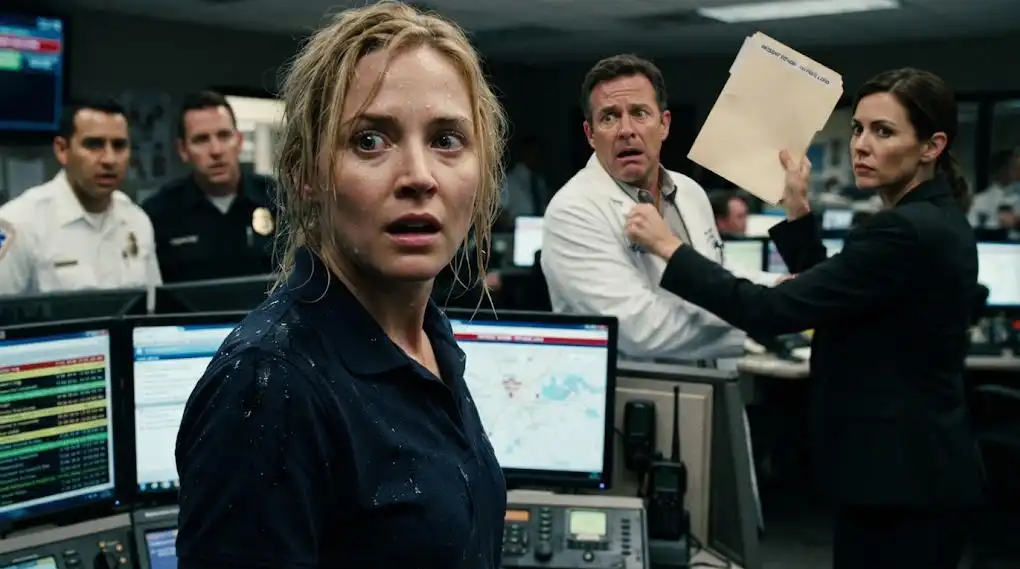
A RURAL TEXAS DOCTOR Poured Ice Water on a Plus-Size Dispatcher in Front of State Inspectors. He Had NO IDEA What She’d Been Recording for Years 😱
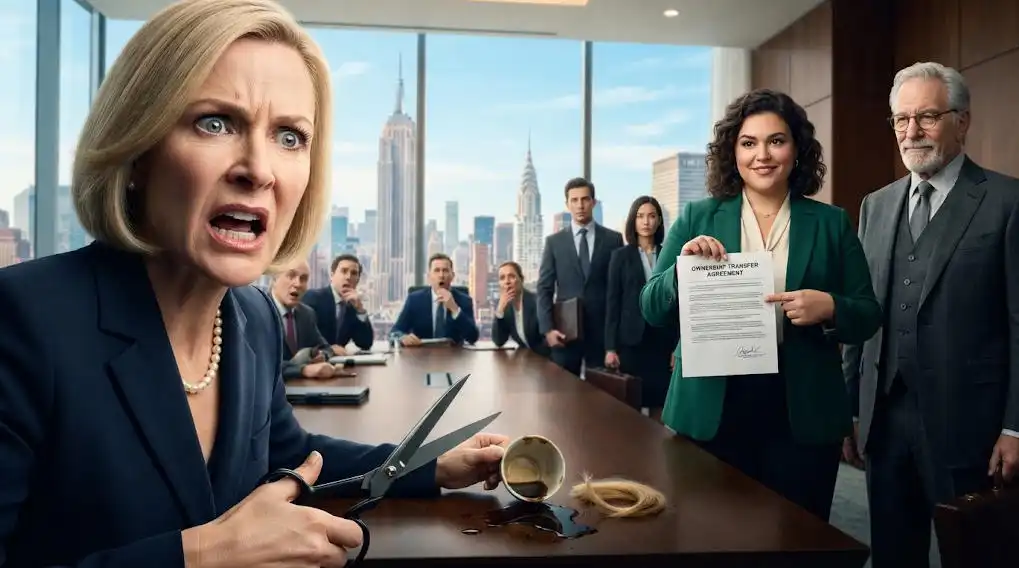
She Cut the Plus-Size Assistant’s Hair and Dumped Coffee on Her in Front of Manhattan’s Executives. She Had NO IDEA Who Maya Really Was... 😱

A Chicago Finance Director Poured HOT COFFEE on His Plus-Size Analyst in Front of the Entire Team. He Had NO IDEA What Her Data Could Prove... 😱