



Richard Cole placed the acquisition proposal on my desk and smiled as though he had never humiliated me in his life.
“You've built something impressive, Evelyn,” he said. “But running a fashion brand is different from designing clothes. Let me handle the business side.”
I looked at the contract.
The man who had once thrown my dress onto a boutique floor was now asking to control the company I had built from almost nothing.
He expected me to be grateful.
He expected me to forget.
What he didn't understand was that I had finally learned the difference between an opportunity and a trap.
Eight months earlier, I had stood on that same man's polished showroom floor, trying not to cry while strangers watched me gather my own designs.
My name is Evelyn Brooks. I'm thirty-two years old, and I design clothing for women who have spent far too much of their lives being told that elegance belongs to somebody else.
I grew up in Florida, where my grandmother taught me to sew at an old machine in her spare bedroom.
She wasn't a professional designer, but she understood fabric.
She could look at a dress and tell whether the seams would pull after a few hours, whether the lining would trap heat, or whether a waistband would become uncomfortable when someone sat down.
She believed that clothes should help people feel at home in their own bodies.
“Never make a woman suffer just to look beautiful,” she used to tell me.
I carried that lesson into adulthood.
After studying fashion design and working several entry-level jobs, I began developing my own clothing line.
I wanted to create sophisticated dresses, tailored jackets, elegant trousers, and occasionwear for women who struggled to find garments that combined attractive design with comfortable construction.
I wasn't interested in making shapeless clothes and calling them practical.
I wanted beautiful clothes.
Structured shoulders.
Carefully placed seams.
Waistlines that followed the body's natural shape without digging into it.
Fabrics that moved instead of fighting the wearer.
Dresses that looked elegant at a formal dinner and remained comfortable after three hours of sitting.
My early prototypes were imperfect.
Some fabrics stretched too much.
Some seams pulled when testers moved their arms.
Certain waistbands looked excellent while standing but became uncomfortable when sitting.
I kept revising them.
I worked with patternmakers and conducted repeated fit tests.
I asked women to try the garments while walking, sitting, reaching, and moving through ordinary daily activities.
I collected detailed feedback from more than a thousand plus-size women.
Their responses revealed patterns I had suspected but wanted to verify.
Many had been told to buy larger sizes even when the proportions were wrong.
Some had learned to accept gaping necklines, tight upper arms, uncomfortable waistbands, and dresses that fit one part of the body while hanging awkwardly everywhere else.
Others had stopped shopping in certain stores because the staff treated their bodies as problems to be managed.
One woman wrote that she had bought a dress for her daughter's wedding and spent the entire reception adjusting it because the seams pulled whenever she sat down.
Another said she could find comfortable clothing, but rarely anything that made her feel elegant.
A third told me she had stopped asking sales assistants for help because she was tired of being directed toward the same few racks.
Their stories stayed with me.
I began developing a proprietary construction method involving carefully engineered pattern proportions, flexible panel placement, and tested seam positioning.
The aim was not to hide anyone's body.
It was to create garments that worked with the wearer.
After repeated testing and professional advice, I secured intellectual property protection for the eligible technical elements of my garment construction.
I also retained dated design files, prototype records, testing notes, and production specifications.
I believed that once people saw the finished collection, they would understand why it mattered.
I was wrong about how difficult it would be to get them to look.
My first collection contained thirty-two designs.
I used savings from several years of work to pay for fabric, sample production, photography, packaging, and an initial manufacturing run.
I rented a small warehouse outside Miami to store the finished garments.
The clothes were beautiful.
Some were evening dresses with clean architectural lines.
Others were tailored separates in rich jewel tones.
I created elegant jackets, flowing trousers, and structured dresses designed to work across a broad range of sizes.
The collection had a clear identity.
It was sophisticated without being restrictive.
It was modern without demanding that women abandon comfort.
I believed it could sell.
The problem was that established retailers were reluctant to carry it.
I contacted buyers.
I sent professional lookbooks.
I arranged appointments.
I followed up with store managers who had initially sounded interested.
Some never replied.
Others rejected the collection after seeing the size range.
One buyer suggested that I remove several larger sizes to simplify inventory.
Another said his customers preferred slimmer silhouettes.
A third told me that women who needed larger sizes were more interested in hiding their bodies than making fashion statements.
I asked whether he had spoken to those women.
He changed the subject.
The rejection that hurt most came from a luxury boutique in Miami's fashionable Design District.
The store was called Maison Vale.
Its windows displayed designer dresses beneath precise lighting.
The floors were polished stone, and every garment seemed to have been arranged according to a secret set of rules.
I had studied the store's merchandise carefully.
It carried elegant eveningwear, tailored separates, and high-end occasion clothing.
My collection fit the aesthetic.
I believed the manager, Richard Cole, might be willing to consider it.
I arrived carrying three samples and a tablet containing the full lookbook.
Richard met me near the entrance.
He was in his early forties, impeccably dressed, with a watch that caught the light whenever he moved his hand.
He glanced at my portfolio.
“You're the independent designer?”
“Yes. Evelyn Brooks.”
He gestured toward a small consultation area.
“Let's see what you've brought.”
I laid out the first dress.
It was a deep emerald evening gown with carefully shaped panels, a clean neckline, and a flowing skirt.
The fabric was substantial enough to hold its structure but flexible enough to move comfortably.
Richard touched the sleeve.
“What's the retail price?”
I explained the proposed pricing, production costs, and wholesale terms.
He frowned.
“And the size range?”
I gave him the details.
His expression changed.
“That's quite a range.”
“Yes. We've tested the construction across the intended sizes.”
He barely glanced at the accompanying fit notes.
“Who is the target customer?”
“Women who want elegant, well-constructed clothing that fits comfortably. The research includes more than a thousand women, and we've tested the designs repeatedly.”
He looked at me.
“You're making this more complicated than it needs to be.”
I opened the lookbook.
“The collection was designed to solve specific fit problems without sacrificing style.”
Richard flipped through a few pages.
Then he closed the tablet cover.
“Let me be frank. This store sells luxury fashion. Our customers expect a certain aesthetic.”
“I understand. That's why I brought the collection.”
He looked at my body, then back at the dress.
“I don't think you're the right person to tell our customers what looks elegant.”
I felt my stomach tighten.
“Could you explain what you mean?”
He gave a short laugh.
“Women like you don't understand fashion from the customer's perspective.”
“I'm a trained designer. I developed these garments through fit testing and customer research.”
“That's not the same as having taste.”
He pushed the sample toward me.
I caught it before it slid off the table.
“Would you at least consider reviewing the full collection?”
“No.”
The answer came so quickly that I wondered whether he had heard anything I said.
He stood.
“This conversation is over.”
I began gathering my materials.
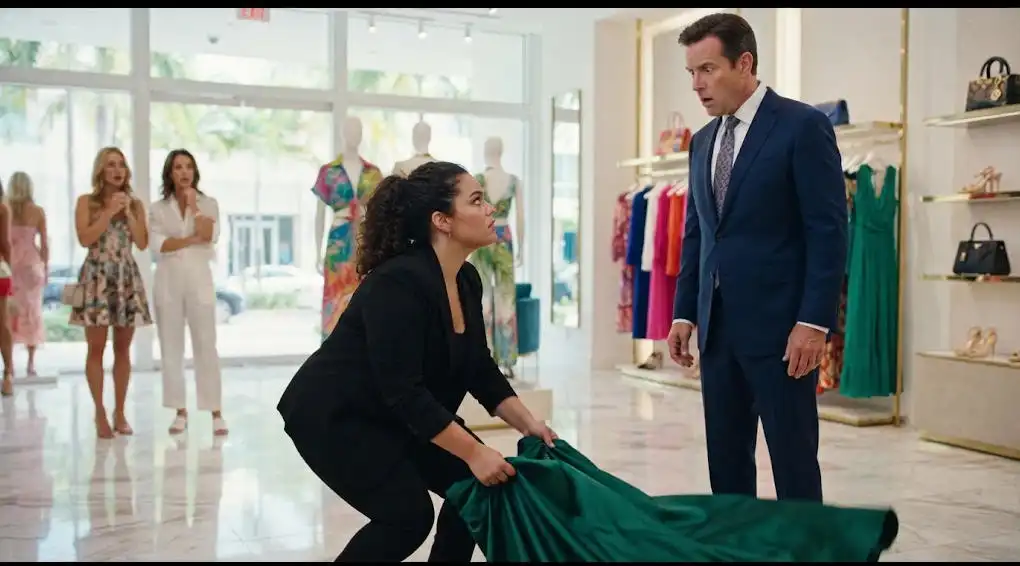
Then he picked up the emerald dress.
For a moment, I thought he intended to examine the construction.
Instead, he held it out at arm's length.
“This is exactly the problem,” he said. “You think adding fabric and calling it elegant will make people want it.”
“Please give me the sample.”
He let the dress fall.
It landed in a heap on the floor.
I bent to retrieve it.
Richard grabbed the remaining sample from my arm and threw it down beside the first.
“Get out of my store.”
Several customers turned toward us.
I tried to keep my voice steady.
“There's no reason to do this.”
He stepped closer.
“Don't tell me how to run my business.”
Then he shoved me.
I stumbled sideways and fell against the edge of a display case.
Pain shot through my hip.
A woman near the entrance gasped.
Another customer raised her phone.
Richard pointed toward the door.
“Get out!”
For several seconds, I could not move.
I was looking at my dresses on the floor.
I had spent months refining those designs.
I had invested my savings in the fabric.
I had tested the seams, revised the patterns, and carefully packed every garment before bringing it to the store.
Richard had not merely rejected them.
He had treated my work as worthless because he had already decided that my body made me unworthy of designing fashion.
I gathered the dresses.
My hands were shaking.
I wanted to scream at him.
I wanted to tell the customers what I had built and how much work had gone into every seam.
Instead, I stood up, checked that the garments were intact, and walked out.
I cried in my car.
Not because I believed Richard was right.
I cried because I was frightened.
The warehouse rent was due.
The manufacturing invoices were waiting.
My savings were shrinking.
I had already invested so much that I could not simply abandon the collection without serious financial consequences.
For the first time, I wondered whether my dream had become too expensive to survive.
I sat in the parking lot for nearly an hour.
Then I looked at the dresses beside me.
They were still beautiful.
The fabric had not become less comfortable.
The construction had not become less thoughtful.
The customer research had not become less valid.
Only one man had decided that I didn't belong.
I started the car and drove home.
That evening, I examined the footage a customer had sent me after finding my business account online.
The video showed Richard throwing the dress and pushing me.
I watched it once.
Then I watched it again.
I considered keeping the incident private.
I worried that speaking publicly would make me look unprofessional.
I worried that potential investors might think I was using controversy to attract attention.
I worried that people would judge my body instead of my work, just as Richard had.
But I also remembered the women whose stories had shaped the collection.
They had told me about fitting rooms where they were ignored, salespeople who refused to help, and stores that treated their size as an inconvenience.
If I stayed silent, Richard's behavior would remain an isolated incident in a world where too many people were already accustomed to being dismissed.
I decided to tell the truth.
I posted a short account of the encounter, including the video, the collection, and the research behind my designs.
I did not publish Richard's private information.
I did not encourage anyone to threaten him or harass his staff.
I explained what had happened and asked women to share their experiences finding elegant, comfortable clothing.
Then I went to bed.
When I woke up, my phone was overflowing with notifications.
Women were sharing the post.
Some described similar experiences at luxury stores.
Others posted photographs of clothing they had altered themselves because the original fit had been uncomfortable.
Several professional designers commented on the construction details in my lookbook.
A patternmaker wrote that the panel placement was technically interesting.
A fashion journalist asked whether I would be willing to discuss the gap between size-inclusive marketing and actual garment design.
The response continued growing.
Within days, the video had reached far beyond my own followers.
My inbox filled with messages from women who wanted to know when the collection would become available.
A few asked whether I could make particular designs in their sizes.
Others said they had never seen clothing that looked both sophisticated and comfortable in the sizes they needed.
For the first time, I had direct evidence that the audience I had been trying to reach was looking for exactly what I had created.
But attention was not the same as a functioning business.
The warehouse still cost money.
The inventory still had to be stored, insured, and shipped.
The manufacturers still expected payment.
I had to turn interest into orders without promising more than I could deliver.
I created a simple landing page where customers could register their interest.
I posted detailed photographs of the garments and explained the sizing and construction.
I asked people what they wanted to see in the first release.
I also began documenting the questions customers asked most frequently.
Many wanted to know whether the garments would remain comfortable when sitting.
Others wanted clear information about measurements and fabric stretch.
Some wanted to know whether a dress could be worn with a standard bra.
These were practical questions, and they helped me refine the launch plan.
I began building a business around the customers rather than guessing what they wanted.
Then an angel investor contacted me.
Her name was Margaret Ellis.
She had invested in consumer brands and manufacturing businesses, and she had followed the discussion surrounding my collection.
She did not begin by telling me how inspiring my story was.
She asked for my financial statements.
She wanted to review the production costs, inventory, customer research, pricing, and sales projections.
She asked whether I had reliable suppliers and whether the intellectual property records matched the construction methods I was claiming to protect.
I prepared everything.
We met in a conference room overlooking Biscayne Bay.
Margaret studied the numbers for nearly an hour.
Finally, she looked up.
“You have a real product,” she said. “But you also have a real cash-flow problem.”
“I know.”
“You've invested too much of your available capital in inventory before establishing a reliable sales channel.”
“I thought the boutiques would help.”
“Some might eventually. But you can't build the business around the approval of buyers who don't understand your customer.”
She turned to the customer research.
“This is useful. You've done more than ask women whether they like the clothes. You've investigated why existing garments fail them.”
She asked about my production capacity.
We discussed manufacturing timelines, return policies, quality control, and how to scale without losing the fit standards that made the collection distinctive.
She did not promise instant success.
She made it clear that the company would need disciplined financial management and that I would have to accept accountability for every major decision.
That was exactly what I wanted.
We negotiated an investment agreement with defined funding milestones, governance terms, and a clear plan for the first commercial launch.
I had the agreement reviewed before signing.
The investment gave the company enough working capital to pay outstanding production costs, improve inventory management, and launch an online storefront.
It did not eliminate the risk.
I still had to sell the clothes.
I still had to deliver what I promised.
And I still had to prove that a brand built around inclusive design could compete in a demanding market.
I named the company TrueForm Atelier.
The name reflected the principle behind the collection: clothing should respect the body wearing it.
We began with a carefully selected range of dresses, jackets, trousers, and coordinated separates.
Rather than launching every design at once, we chose the strongest pieces and produced them in controlled quantities.
We improved the size guides.
We photographed the garments on models across the intended size range.
We included detailed measurements and clear descriptions of fabric behavior.
We also made customer service a priority.
When a customer had a question, she received a useful answer rather than a sales script.
When a garment did not fit as expected, we investigated the reason.
If a pattern needed adjustment, we documented it.
The first weeks were nerve-racking.
Orders arrived, but not in a perfectly predictable stream.
Some designs sold quickly.
Others moved more slowly.
We had to manage shipping costs, customer returns, production schedules, and the constant temptation to expand too quickly.
Margaret helped me build a realistic cash-flow forecast.
We set aside money for essential expenses and resisted the urge to treat every positive sales day as proof that we could safely double production.
I learned that building a company required a different kind of discipline from designing a garment.
A beautiful product was only the beginning.
Then the customer photographs began arriving.
A woman wore one of our dresses to her daughter's graduation.
Another wore a tailored jacket to a job interview.
A customer sent a photograph of herself at an anniversary dinner, smiling in a dark blue evening gown.
Her message read, “I didn't spend the whole night adjusting my clothes. I just enjoyed the evening.”
I printed that message and placed it above my desk.
We were not simply selling fabric and seams.
We were creating clothes that allowed women to participate in their lives without constantly worrying about whether their clothing was working against them.
The business began to grow.
Independent retailers contacted us.
Fashion editors requested samples.
A stylist asked whether we would consider presenting the collection at an upcoming industry event.
Then came the invitation that changed our reach.
TrueForm Atelier was invited to present its collection during New York Fashion Week.
I read the email several times before calling Margaret.
She laughed when I told her.
“Congratulations,” she said. “Now let's make sure you can afford to do it properly.”
We developed a presentation budget, reviewed the production schedule, and selected the pieces that best represented the collection.
I worked with the team to make sure the garments were ready.
Every seam was checked.
Every fitting was documented.
Every model received clothing selected and adjusted for the intended fit.
We wanted the show to demonstrate that a wide size range did not require abandoning sophisticated design.
The night before the presentation, I barely slept.
I thought about my grandmother's sewing machine.
I thought about the warehouse full of dresses I had feared I would never sell.
I thought about Richard's voice.
Women like you don't understand fashion.
The next afternoon, I stood backstage as the first model prepared to walk.
She wore an emerald dress with a sculpted bodice and a fluid skirt.
The construction followed the body's shape without restricting movement.
The lights dimmed.
The music began.
She stepped onto the runway.
Then the next model appeared.
And the next.
The collection moved through rich colors, clean tailoring, structured silhouettes, and flowing eveningwear.
The audience watched closely.
Fashion editors photographed the garments.
Buyers took notes.
Several attendees approached our team afterward to ask about production and retail availability.
The response was not universal, and I did not expect it to be.
Some critics preferred more experimental designs.
Some buyers were cautious about committing to a new brand.
But the collection received significant attention, and the commercial interest was real.
Orders followed.
Retailers that had ignored my earlier emails requested meetings.
Customers traveled to try on the garments.
Our online store continued growing.
We expanded carefully, adding designs in response to actual demand rather than rushing to create an enormous collection.
The company became financially stronger.
We paid our suppliers on time.
We built a reserve for unexpected costs.
We hired additional staff as the workload justified it.
For the first time, I could plan the next season without wondering whether I would have to close the warehouse.
Meanwhile, Maison Vale was facing problems of its own.
The video of Richard's behavior had attracted public criticism.
Some customers said they no longer felt comfortable shopping there.
Others questioned the boutique's approach to customer service.
The controversy was not the only reason the store struggled.
It had also been dealing with high operating costs, weak sales, and inventory decisions that left expensive merchandise sitting on the racks.
Negative publicity made an already difficult situation worse.
The store tried to move forward, but it failed to recover its footing.
Eventually, Maison Vale closed.
I did not celebrate the loss of every employee's job.
I knew that the staff members who had watched Richard humiliate me were not all responsible for his actions.
Some had looked uncomfortable.
One had quietly sent me the video.
I hoped they would find work elsewhere.
But I also understood that a business could not expect customers to ignore its conduct forever.
Several months later, my property broker contacted me.
The commercial space previously occupied by Maison Vale was available for lease.
The location was excellent.
It had large windows, a spacious interior, and enough room to create a different kind of shopping experience.
I visited the property.
The display cases were gone.
The walls needed repair.
The lighting had to be replaced.
But I could see what the space might become.
I imagined a central fitting area with comfortable seating.
I imagined clear size displays and staff trained to help customers without making assumptions about their bodies.
I imagined mirrors positioned to give people room to see the garments properly.
I imagined a store where customers could compare different cuts, fabrics, and silhouettes without being pushed toward a narrow definition of beauty.
I wanted the space to feel like a place where people could explore.
Not a place where they had to prove they deserved to enter.
I negotiated the lease through the company and reviewed the financial commitments with Margaret.
We built a renovation budget.
We examined the projected operating costs and estimated how much inventory the flagship could reasonably carry.
The numbers were demanding but manageable.
We signed the lease.
TrueForm Atelier would open its first immersive flagship store in the former Maison Vale location.
I never imagined that Richard would return to my life.
But he did.
He arrived at our office on a rainy Tuesday, carrying a folder and wearing the same confident expression I remembered from the boutique.
His business had deteriorated after the closure.
He had been consulting for smaller retailers and looking for a way back into the luxury fashion market.
He had heard about our expansion and wanted to negotiate an acquisition.
His proposal offered to buy a controlling interest in TrueForm Atelier and secure exclusive rights to distribute the collection through a retail group he hoped to establish.
The valuation was lower than our recent financing discussions supported.
The agreement also gave his proposed operation significant control over merchandising and distribution.
He presented it as a generous opportunity.
“You have the designs and the public attention,” he told me. “But I know retail. I can help you scale this properly.”
I studied the document.
“You want control over the company.”
“I want to help it grow.”
“You want the right to determine how the collection is sold and presented.”
“That's how business works.”
“Not every business.”
He leaned back.
“Evelyn, let's be realistic. You can't do everything yourself. You need people who understand this industry.”
I looked at him.
“I agree. That's why I hired people with the skills we need.”
He smiled impatiently.
“Don't make this personal.”
I remembered the showroom.
The emerald dress on the floor.
The sharp pain when I struck the display case.
The customers watching while he told me to get out.
But I did not need to tell him how much those memories mattered.
I turned to the final page of the agreement.
The proposed sale would give him control over decisions that had been central to the brand from the beginning.
Our design standards.
Our customer experience.
Our commitment to offering a consistent range of sizes.
The things that made TrueForm Atelier different were the very things his proposal would allow him to change.
I closed the folder.
“I'm declining the offer.”
His smile disappeared.
“You haven't even negotiated.”
“I have reviewed it. I don't want to sell control of the company under these terms.”
He shook his head.
“You're letting an old disagreement cloud your judgment.”
“No. I'm making a business decision.”
“You could make a lot of money.”
“I know.”
“Then why refuse?”
“Because your offer requires me to give up control over the business I've built, and I don't believe the terms serve our company or our customers.”
He stared at me.
I continued.
“I will consider commercial partnerships that respect our standards and make financial sense. I will not sell the company simply because someone tells me I need an established name to succeed.”
Richard gathered the papers.
“You're making a mistake.”
“Perhaps. But it will be my decision to make.”
He stood.
For a moment, I thought he might insult me again.
Instead, he said, “You won't get another offer like this.”
I nodded.
“Then I suppose this is where we say goodbye.”
He left.
I sat quietly for a moment after the door closed.
I had not won a battle against Richard.
I had made a decision about my own future.
That distinction mattered.
Our flagship opened several months later.
The renovation transformed the former boutique into a bright, welcoming space.
The old display arrangement had been replaced with open walkways, carefully organized collections, and comfortable fitting rooms.
We carried sizes across the range our designs were built to serve, with clear measurements and staff trained to explain fit without making customers feel judged.
The clothing was arranged by style and occasion rather than implying that certain bodies belonged in separate corners.
There were elegant dresses for formal events.
Tailored jackets for work.
Comfortable trousers.
Eveningwear in rich colors.
Coordinated pieces that could be dressed up or down.
Every garment had been selected because it met our standards for construction, comfort, and design.
On opening morning, I stood near the entrance and watched the first customers arrive.
A woman in her fifties walked slowly through the dress section.
She stopped in front of a deep blue gown.
One of our associates offered to help her find the right size.
The woman hesitated.
“I'm not sure something like this will work for me.”
The associate smiled.
“Let's find out together.”
They brought the dress to the fitting room.
A few minutes later, the woman stepped out.
She looked at herself in the mirror.
Then she turned sideways and checked the fit.
She sat in the nearby chair, stood up, and moved her arms.
Finally, she looked at me.
“This is the first time in years I've tried on a formal dress without immediately looking for everything that's wrong with my body.”
I felt my eyes sting.
“Does it feel comfortable?”
She nodded.
“And I love the color.”
“Then I think we have a winner.”
She laughed.
She bought the dress.
More customers arrived throughout the day.
Some came because they had followed our online journey.
Others had heard about the store from friends.
A few were curious about the new approach to inclusive fashion.
Our staff helped them explore the collection without pressure.
We did not promise that every garment would fit every person perfectly.
Bodies differ, and good design does not eliminate the need for individual fit.
What we promised was thoughtful construction, honest information, and respect.
By the end of the first week, we had received encouraging sales and useful feedback.
We tracked which designs customers preferred, which sizes required more inventory, and which details needed improvement.
The flagship became a place where we could test new ideas directly with the people who wore our clothes.
It was more than a retail store.
It was a living extension of the research that had inspired the company.
I still worked hard.
There were supplier delays, unexpected expenses, difficult decisions, and days when the business seemed to demand every hour I had.
The investment had not removed the pressure.
Success had not made me immune to criticism.
But I was no longer trying to persuade an industry gatekeeper that I deserved to exist.
I was building something useful.
Something beautiful.
Something that could keep improving because customers were willing to tell us what worked and what did not.
One evening, after the store had closed, I walked through the showroom alone.
The lights illuminated rows of carefully arranged garments.
I stopped beside the display where our emerald evening gown was hanging.
It was not the exact sample Richard had thrown onto the floor.
That original dress was safely stored in our design archive.
But the new gown had the same deep color and the same principle behind its construction.
It had been designed to let a woman move, sit, breathe, and enjoy the occasion for which she had dressed.
I touched the fabric.
For a long time, I had thought that success would mean returning to the people who had rejected me and proving them wrong.
I had imagined the satisfaction of seeing their expressions change when they discovered what I had accomplished.
Some of that satisfaction was real.
But it was not the most important part.
The most important part was that the women who entered our store did not have to earn the right to be treated respectfully.
They did not need a viral video to deserve help.
They did not need an investor to validate their taste.
They did not need to lose weight before wearing an elegant dress.
And they did not need to become someone else before being welcomed.
My grandmother had taught me that clothing should help a person feel at home in her own body.
It had taken me years to understand that the same principle applied to the rest of life.
You could not build something meaningful by allowing other people to define your worth.
You could listen to criticism without accepting contempt.
You could negotiate without surrendering your values.
And you could succeed without becoming the kind of person who had once tried to make you feel small.
I switched off the showroom lights and stepped outside.
The Miami evening was warm.
Behind me, the windows displayed the collection in a wide range of sizes, each garment carefully lit.
A woman passing with her daughter stopped to look at a dress in the window.
The girl pointed toward it.
Her mother smiled.
I watched them for a moment, then continued toward my car.
The next morning, I would review production schedules, meet with the design team, and prepare for our next collection.
There would be new problems to solve.
There would be more decisions to make.
But I would make them as the owner of a business built around the principles I believed in.
Not because Richard had approved of me.
Not because the fashion industry had finally granted me permission.
Because I had done the work, listened to the customers, protected the value of my designs, and built a company that could stand on its own.
I was Evelyn Brooks.
I was a designer.
I was a business owner.
And I no longer needed to ask anyone whether I belonged in the room.
CHOOSE YOUR SIDE: EVELYN WAS RIGHT TO REJECT RICHARD'S BUYOUT AND PROTECT HER BRAND, or SHE SHOULD HAVE ACCEPTED HIS OFFER AND PUT PROFIT BEFORE PRINCIPLES.
Comment your choice and share this story with someone who believes that fashion should celebrate people, not humiliate them. ❤️
Disclaimer: Mention of any brand or trademark is for identification only and does not imply partnership or endorsement

A RURAL TEXAS DOCTOR Poured Ice Water on a Plus-Size Dispatcher in Front of State Inspectors. He Had NO IDEA What She’d Been Recording for Years 😱

She Cut the Plus-Size Assistant’s Hair and Dumped Coffee on Her in Front of Manhattan’s Executives. She Had NO IDEA Who Maya Really Was... 😱

A Chicago Finance Director Poured HOT COFFEE on His Plus-Size Analyst in Front of the Entire Team. He Had NO IDEA What Her Data Could Prove... 😱