

The committee chair leaned toward Grant Whitmore.
“Before you answer, can you explain why the verified record of this algorithm appears months before the version you submitted?”
Grant's smile disappeared.
His advisor stopped turning the pages in front of him.
Across the hearing room, I sat with my hands folded over a thick folder of technical records.
For two years, I had been told that my research wasn't ready, my dissertation wasn't strong enough, and my accusations were the product of jealousy.
Now, for the first time, everyone in the room was looking at the evidence.
My name is Claire Bennett. I was twenty-seven years old, a computer science PhD candidate at an elite Ivy League university near Boston, and I had nearly lost my future because someone with better connections had stolen my work.
But the story began long before that hearing.
It began in a laboratory where people discussed intellectual brilliance as though it were the only quality that mattered, while quietly deciding whose brilliance deserved to be recognized.
I had entered the doctoral program with a clear goal.
I wanted to develop better ways for large computing systems to identify inefficient processing patterns and allocate resources more intelligently.
The problem was technically demanding.
Modern computing environments can involve thousands of interacting processes. A small inefficiency repeated across a large system can waste enormous amounts of processing capacity.
Existing methods often struggled when patterns changed quickly or when the system had incomplete information.
My research focused on a new algorithmic architecture that could identify those patterns more efficiently.
I spent months studying previous approaches, testing hypotheses, and writing experimental code.
My work was not glamorous.
I rarely attended social events.
I often worked late into the evening, comparing outputs, reviewing logs, and trying to understand why a promising result had failed.
Years of academic pressure and irregular sleep had affected my health. I had gained considerable weight, and I was often exhausted.
Some people in the department treated that as a reason to dismiss me.
They made comments about what I ate during long lab sessions.
They joked about how slowly I climbed the stairs.
They discussed fitness routines in front of me as though my body were a public research problem.
I learned to keep my attention on the work.
My research mattered more than their opinions.
At least, that was what I told myself.
Grant Whitmore occupied a very different position in the department.
He was the student council president, a confident speaker, and a favorite of Professor Daniel Mercer, one of the university's most respected computer science faculty members.
Grant knew how to present himself.
He spoke fluently at seminars.
He remembered the names of visiting researchers.
He volunteered to organize academic events and appeared in photographs with donors and senior faculty.
Whenever he presented a research idea, Professor Mercer praised his ambition.
“He has an instinct for the big picture,” the professor often said.
Grant also had a talent for making other people's work sound like his own.
At first, I did not recognize the pattern.
During one group meeting, I explained a technique I had been developing for identifying recurring processing bottlenecks.
Grant interrupted.
“Exactly,” he said. “That's the direction I've been thinking about.”
He then described an extension of the method that I had not discussed.
After the meeting, I approached him.
“That extension is close to the model I've been testing.”
He smiled.
“Great minds think alike.”
I wanted to believe him.
Academic research often involved overlapping ideas. Two researchers could arrive at similar conclusions independently.
I had no reason to assume that every resemblance was evidence of misconduct.
Then he began asking for more information.
He wanted to see my early architecture diagrams.
He asked how I handled particular edge cases.
He requested access to a draft explaining the mathematical assumptions behind the algorithm.
Professor Mercer encouraged us to collaborate.
“Research moves faster when people share ideas,” he told me. “Don't become territorial about your work.”
I agreed with the principle.
I believed in open-source research and the exchange of knowledge.
My algorithm was being developed with an open-source philosophy, and I intended to make the implementation available to other researchers under appropriate licensing terms.
But sharing code did not mean surrendering authorship.
I maintained a public repository containing the versions I was ready to release. I used cryptographically signed commits and preserved independent timestamped snapshots of important milestones. My private research archive also contained original technical notes, experiment logs, and correspondence.
I had learned to keep those records because reproducibility mattered.
At the time, I never imagined that they would become the most important evidence of my career.
I shared a limited technical draft with the research group.
Grant requested a copy.
I sent it through the university's approved collaboration system.
He thanked me.
Two weeks later, he presented a new algorithm at a departmental seminar.
The architecture looked familiar.
Not vaguely familiar.
It contained the same unusual decomposition I had developed to handle a particular class of processing bottlenecks.
It used the same distinctive intermediate representation.
Even the way the presentation described one difficult edge case followed the structure of my notes.
I sat near the back of the room, listening as Grant explained the method.
Professor Mercer looked delighted.
“This is excellent work,” he said when the presentation ended. “The department should be proud of this contribution.”
Several students applauded.
I waited until the room had begun to empty.
Then I approached Grant.
“Where did the architecture come from?”
He gave me a puzzled look.
“My research.”
“It matches the architecture I've been developing.”
He shrugged.
“It's an obvious solution once you understand the problem.”
“Then you should have no difficulty explaining the implementation decisions.”
His expression hardened.
“Are you accusing me of stealing your work?”
“I'm asking you to explain the similarities.”
He laughed.
“Maybe you should focus on finishing your dissertation instead of trying to take credit for my results.”
I went to Professor Mercer.
I brought the relevant technical notes and showed him the similarities.
He glanced through the pages.
“Claire, researchers often work on related problems.”
“These aren't just related results. The structure is nearly identical.”
“Have you considered that your approach may not be sufficiently original?”
I stared at him.
“You praised Grant for presenting it as his own.”
“I praised the quality of the work. I did not make a determination about authorship.”
“Then will you arrange an independent review?”
He closed the folder.
“Let's not turn this into a personal dispute.”
I left his office feeling as though the ground had shifted beneath me.
I had expected my advisor to examine the technical evidence.
Instead, he had treated my concern as a personality problem.
I began comparing the code more carefully.
I documented the similarities between my original implementation and Grant's submission.
I identified sections where the same unusual variable relationships appeared.
I compared the order of operations and the handling of edge cases.
I also documented differences, because a credible technical comparison needed to distinguish genuine similarities from ordinary implementation choices.
The results were troubling.
Grant's version contained the same core architecture I had developed, along with modifications that appeared to have been made after he received my draft.
I prepared a written report.
Before I could submit it, Professor Mercer called me into his office.
“Grant has raised concerns about your conduct,” he said.
I sat down.
“What concerns?”
“He believes you're interfering with his research and making accusations you cannot substantiate.”
“I have documented the similarities.”
“You need to understand how serious these claims are.”
“I do.”
He folded his hands.
“Your dissertation is already behind schedule. I would hate to see you damage your prospects over a misunderstanding.”
I felt a chill move through me.
“Are you saying my dissertation review could be delayed if I continue?”
“I'm saying that you should focus on producing excellent work.”
He did not answer my question.
Over the following weeks, my dissertation review stalled.
Requests for feedback went unanswered.
Meetings were postponed.
Professor Mercer began describing my research as incomplete, even though the technical results I had submitted were consistent with the standards we had previously discussed.
My funding renewal became uncertain.
Meanwhile, Grant's reputation continued to grow.
He was invited to speak at a research event.
He received public praise from faculty members.
His name appeared on a departmental announcement describing the algorithm as a promising new contribution.
I began to feel as though I were watching someone build a career on the foundation of my work while I stood outside the door.
The pressure affected everything.
I struggled to sleep.
I reread emails late at night, searching for some sentence that might explain how the situation had gone so wrong.
I wondered whether I had made a mistake by entering academia.
I wondered whether my health, my appearance, or my lack of social connections had made me an easy target.
Most painfully, I began to doubt the quality of my own research.
That was the part I had not anticipated.
Grant had not merely taken credit for an algorithm.
He had made me question whether I deserved to be there at all.
Then came the incident in the laboratory.
It was late on a Thursday afternoon.
I was working at my usual station, testing a new version of the algorithm against a difficult benchmark.
Several researchers were still in the room.
Grant entered with two students from the department.
He noticed the code on my screen.
“Still working on that?” he asked.
I kept typing.
“Yes.”
He stepped closer.
“Professor Mercer says your dissertation is going nowhere.”
I continued looking at the monitor.
“Then Professor Mercer can discuss the feedback with me directly.”
Grant laughed.
“You really think you're entitled to challenge him?”
“I'm entitled to understand the basis for my dissertation evaluation.”
His expression changed.
“You think you're better than everyone because you write a few lines of code?”
“No. I think my research should be evaluated on its merits.”
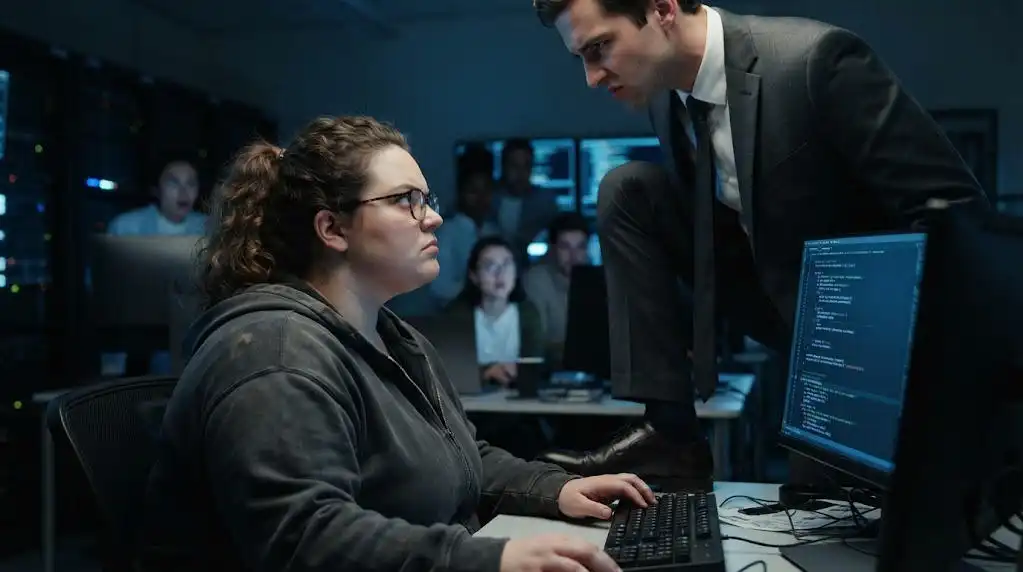
He leaned over the desk.
“You should be grateful anyone takes you seriously.”
I turned toward him.
“Move away from my workstation.”
He looked at my hand resting beside the keyboard.
Then he deliberately placed his polished shoe on it.
Pain shot through my fingers.
I jerked backward, trying to pull my hand free.
Grant pressed down briefly before stepping away.
“Maybe if you spent less time eating and more time thinking, you'd have something worth stealing.”
The room went silent.
My hand throbbed.
One student stared at the floor.
Another took a step toward us but stopped when Grant turned.
I looked at him.
“Get away from me.”
He smiled.
“What are you going to do? Report me?”
I withdrew my hand and stood.
My fingers were trembling.
I could feel tears gathering in my eyes, and I hated that he could see them.
He had taken my work.
He had threatened my career.
Now he had physically hurt me in front of witnesses and seemed certain that nothing would happen.
I left the laboratory and sought medical attention for my injured hand.
The injury was not permanently disabling, but the incident left me shaken.
I documented what happened, including the time, the location, and the names of the people present.
I saved the relevant communications.
I did not exaggerate the injury or make claims I could not support.
I wanted a record that could withstand scrutiny.
That evening, I sat in my apartment with an ice pack beside my laptop.
I opened the encrypted archive where I had preserved my research history.
For the first time in weeks, I stopped thinking about what Grant had said.
I started thinking about what I could prove.
The first record was an independently timestamped snapshot of my original algorithm architecture.
It predated Grant's presentation by months.
The second was a sequence of cryptographically signed commits showing how the implementation had developed over time.
Each commit contained changes that could be compared with the corresponding research notes and experiment logs.
The third was a collection of emails.
Grant had asked me for early technical drafts on specific dates.
In later correspondence, he had referred to details that appeared in those drafts.
The fourth was my original experimental record.
It showed the tests I had run, the failures I had encountered, and the revisions I had made before Grant presented the algorithm.
The fifth was the code itself.
I prepared a side-by-side technical comparison that highlighted the shared architecture, the unusual implementation choices, and the sections in which Grant's version followed the structure of my earlier work.
No single screenshot could prove the entire case.
But the records supported one another.
The signed commits established the sequence of development.
The independent snapshots provided corroboration.
The emails documented access to the early drafts.
The experiment logs connected the technical decisions to my original work.
Together, they formed a verifiable chronology.
I made several copies of the records and preserved the originals.
I also consulted the university's published academic integrity procedures.
The policy provided a formal process for investigating disputes over research attribution.
I could file a complaint, submit evidence, and request an independent review.
There would be no guarantee of a favorable outcome.
The process could take months.
My dissertation might remain delayed.
My funding could still be affected.
I might face further isolation from the people who controlled my academic future.
But remaining silent carried its own cost.
I submitted the complaint.
I included a clear timeline, a technical explanation, and references to the original records.
I also reported the laboratory incident through the appropriate university channel.
I requested that the academic integrity committee preserve the relevant research records and examine the competing claims independently.
Then I waited.
The university acknowledged the complaint and initiated a preliminary review.
Grant responded through the department.
He claimed that the algorithm was the product of independent research and that I was attempting to appropriate his achievement.
Professor Mercer supported his account.
He argued that the similarities reflected common methods within the field.
I knew the committee would need more than accusations.
So I prepared for the technical review.
I rebuilt the algorithm's architecture from my original records.
I explained why I had chosen each major component.
I showed how the first implementation had failed, what I changed, and how those changes improved the results.
I also prepared to explain the limitations.
I refused to present the algorithm as more powerful than the evidence supported.
If I wanted the committee to trust my account, I needed to be precise about what the code demonstrated and what it did not.
The preliminary investigation took several weeks.
During that period, the social atmosphere in the laboratory became colder.
Conversations stopped when I entered the room.
One student who had previously worked with me began avoiding eye contact.
Another quietly told me that he believed my account but was afraid of becoming involved.
I understood his fear.
Grant had influence.
Professor Mercer had authority.
I had a dissertation that still needed approval.
There were days when I wanted to withdraw the complaint simply to make the pressure stop.
Then I would remember my hand beneath Grant's shoe.
I would remember his confidence that I would never dare report him.
And I would return to the records.
Eventually, the university scheduled a formal academic integrity hearing.
Grant arrived wearing a dark suit.
Professor Mercer sat beside him as an advisor to the department's position, although he was not a neutral investigator and was required to answer questions about his own handling of the dispute.
The committee included faculty members from outside our immediate research group and an academic integrity officer responsible for the proceedings.
I sat across from Grant with my laptop and a printed evidence index.
He looked relaxed.
When the chair asked whether he understood the allegations, he said he did.
He denied intentionally taking credit for my work.
He described the algorithm as an independent development.
His representative argued that similarities between research implementations did not automatically establish misconduct.
That was true.
Similarity alone was not enough.
I waited until the chair invited me to present my evidence.
Then I connected my laptop to the display.
I began with the timeline.
I showed the original architecture and the date of the earliest independently preserved version.
I explained the repository structure and how the signed commits could be verified.
I opened the relevant code history and traced the algorithm's development through successive versions.
I showed the original experiment logs.
Then I displayed Grant's submitted version.
The committee examined the shared architecture.
I pointed out the distinctive choices that appeared in both versions and explained why they were not simply generic features of the field.
I showed where Grant's implementation followed the same structure as my earlier draft.
Finally, I presented the emails documenting his requests for the draft and the subsequent correspondence.
The chair asked whether I could establish that the original records had been altered after the dispute began.
I explained the independent timestamps, signed commits, and preserved copies.
The committee's technical reviewers examined the materials and verified the relevant records.
Then the chair turned toward Grant.
“Before you answer, can you explain why the verified record of this algorithm appears months before the version you submitted?”
Grant shifted in his chair.
He said the earlier records showed only a preliminary idea.
I opened the next file.
It contained the technical development that connected the early architecture to the completed implementation.
The commit history showed the progression.
The experiment logs showed the revisions.
The emails established that Grant had requested access to the draft containing the relevant design decisions.
The chair asked him to explain several of the unusual similarities.
Grant offered general answers about common techniques.
The technical reviewers asked more specific questions.
He could not explain the sequence of development in a way that reconciled his account with the records.
Then Professor Mercer was asked about the delayed dissertation review.
He said that he had concerns about the completeness of my work.
The committee asked when those concerns had first been documented and whether they were related to the authorship dispute.
His answers were inconsistent with parts of the written correspondence.
The committee requested additional records.
It also examined whether he had followed the university's procedures for handling a conflict of this nature.
I watched him review the documents.
For months, he had told me to stop treating the matter as a personal dispute.
Now the university was examining the decisions he had made and the records he had left behind.
I felt no triumph.
I felt exhausted.
I had spent so long trying to convince people that my research deserved a fair evaluation that I could barely believe the evaluation was finally happening.
At the end of the hearing, the chair thanked everyone and explained that the committee would issue its findings after completing the review.
Grant walked past me without speaking.
Professor Mercer followed him.
I gathered my laptop and returned to the laboratory.
The waiting period was difficult.
I still had work to complete.
My dissertation remained unfinished, and I could not assume that the committee's eventual decision would automatically solve every academic problem.
I continued running experiments and documenting the results.
I also began applying for research positions outside the university.
For the first time, I allowed myself to consider a future beyond the department that had made me feel trapped.
One company invited me to interview for an algorithm research position.
Its technical team asked detailed questions about my approach to resource allocation and the limitations of my experimental results.
They were interested in the work itself.
They did not ask whether I was popular in the department.
They did not ask what Professor Mercer thought of me.
They asked how I solved problems.
I completed the interviews and waited.
Then the university's decision arrived.
The committee found that the evidence supported a serious breach of academic integrity in the attribution of the algorithm.
The verified chronology, correspondence, and technical comparison contradicted Grant's claim that his submission was an independent development.
The university withdrew his eligibility for the degree candidacy associated with the disputed research and removed him from his student leadership position under the applicable procedures.
Further disciplinary action followed.
Grant left the academic program and did not continue his research career at the university.
The review also found that Professor Mercer's handling of the dispute had fallen short of the university's requirements.
He was removed from my supervisory role while the department addressed the procedural failures and reviewed his conduct.
The committee did not award me a degree simply because Grant had been found responsible.
My dissertation still had to meet the academic requirements.
But the university could no longer treat the authorship dispute as a reason to dismiss my work without proper review.
An independent faculty committee evaluated my dissertation on its technical merits.
They requested revisions, asked difficult questions, and required me to clarify several experimental limitations.
I completed the revisions.
I defended the algorithm's design choices.
I explained the results I could reproduce and acknowledged the cases where the method still needed improvement.
The questions were demanding.
For the first time in months, they were also fair.
I passed my dissertation defense.
When the committee announced its decision, I sat motionless for a moment.
I had imagined that I would cry.
Instead, I felt the tension leave my shoulders.
I had earned the degree through the research I had completed, not through anyone's favor.
A few days later, the technology company that had interviewed me extended an offer.
The position was for a core algorithm research specialist, with responsibility for developing and evaluating methods for improving large-scale computing systems.
The offer included a salary, research resources, and a clear description of my responsibilities.
I read it carefully.
Then I accepted.
My departure from the university was not a victory parade.
Some people avoided me.
Others told me quietly that they were glad the evidence had been examined.
A few insisted that I should have handled the dispute privately.
I did not argue with them.
I knew how easily a formal complaint could be described as an act of aggression when the person making it lacked influence.
But I also knew what would have happened if I had agreed to settle the matter quietly.
The university would have had no reason to examine the evidence fully.
My authorship would have remained disputed.
And the next student who challenged a favored researcher might have faced the same pressure.
I had not filed the complaint because I wanted Grant's life destroyed.
I had filed it because research depends on the honest attribution of ideas and the ability to verify claims.
If an academic institution cannot distinguish documented work from a false claim of ownership, its reputation means very little.
My first week at the new company felt strange.
The office had floor-to-ceiling windows overlooking the city.
The workstations were bright and spacious.
The research team had established procedures for reviewing code, documenting contributions, and resolving technical disagreements.
People still disagreed.
They challenged assumptions and criticized implementations.
But the arguments focused on evidence.
During my first design review, a senior engineer questioned one of my optimization choices.
I explained the reasoning.
He asked whether I had tested an alternative.
I had not, so I added it to the experimental plan.
Nobody treated the question as an attack on my intelligence.
Nobody used my appearance as a substitute for evaluating my work.
After the meeting, I returned to my desk and opened a fresh development branch.
I began testing the next version of the algorithm.
The problems were difficult.
The work required patience.
There were bugs I could not immediately explain and results that refused to match my expectations.
But I no longer confused technical difficulty with personal inadequacy.
When something failed, I investigated.
When someone challenged my reasoning, I examined the evidence.
When I needed help, I asked.
My health also became easier to manage once I established a more consistent routine.
I worked with healthcare professionals to address the symptoms that had affected me during graduate school.
I improved my sleep schedule, made time for movement, and developed more regular eating habits.
My weight changed gradually, but it was not the measure of whether I deserved respect.
I had deserved it when I was exhausted in the laboratory.
I had deserved it when my dissertation was delayed.
I had deserved it when Grant stepped on my hand.
Nothing about my body had made that treatment acceptable.
One evening, several months after joining the company, I stayed late to finish an experiment.
The office was quiet.
The city lights glowed beyond the windows.
I opened the repository containing the next iteration of my research and reviewed the latest results.
A new test had passed.
I smiled.
It was a small achievement, one of hundreds that would eventually become part of a larger project.
But I remembered the old laboratory.
I remembered sitting alone at my workstation, wondering whether I had the right to call myself a researcher.
I remembered the fear that reporting the truth would cost me everything.
I had lost time.
I had endured isolation.
I had spent months defending something that should never have required me to prove my worth as a person.
But I had also learned to preserve my work, trust verifiable evidence, and insist that professional decisions be made according to fair procedures.
I closed the experiment log and began typing a note about the next test.
My hand rested comfortably beside the keyboard.
No one was standing over it.
No one was telling me that my body determined the value of my mind.
I was simply doing the work I had trained for years to do.
Outside, the city moved beneath the evening sky.
Inside, the monitors illuminated my face as I worked on the next problem.
For the first time in a long while, I felt no need to imagine what Grant might think if he saw me.
My future was no longer a debate about whether I belonged.
It was a body of work I could continue building, one verified result at a time.
CHOOSE YOUR SIDE: CLAIRE WAS RIGHT TO EXPOSE THE THEFT AND DEMAND A FORMAL INVESTIGATION, or SHE SHOULD HAVE SETTLED PRIVATELY TO PROTECT HER ACADEMIC FUTURE.
Comment your choice and share this story with someone who believes that talent deserves recognition, regardless of appearance, popularity, or connections. ❤️
Disclaimer: Mention of any brand or trademark is for identification only and does not imply partnership or endorsement
A RURAL TEXAS DOCTOR Poured Ice Water on a Plus-Size Dispatcher in Front of State Inspectors. He Had NO IDEA What She’d Been Recording for Years 😱

She Cut the Plus-Size Assistant’s Hair and Dumped Coffee on Her in Front of Manhattan’s Executives. She Had NO IDEA Who Maya Really Was... 😱
A Chicago Finance Director Poured HOT COFFEE on His Plus-Size Analyst in Front of the Entire Team. He Had NO IDEA What Her Data Could Prove... 😱