



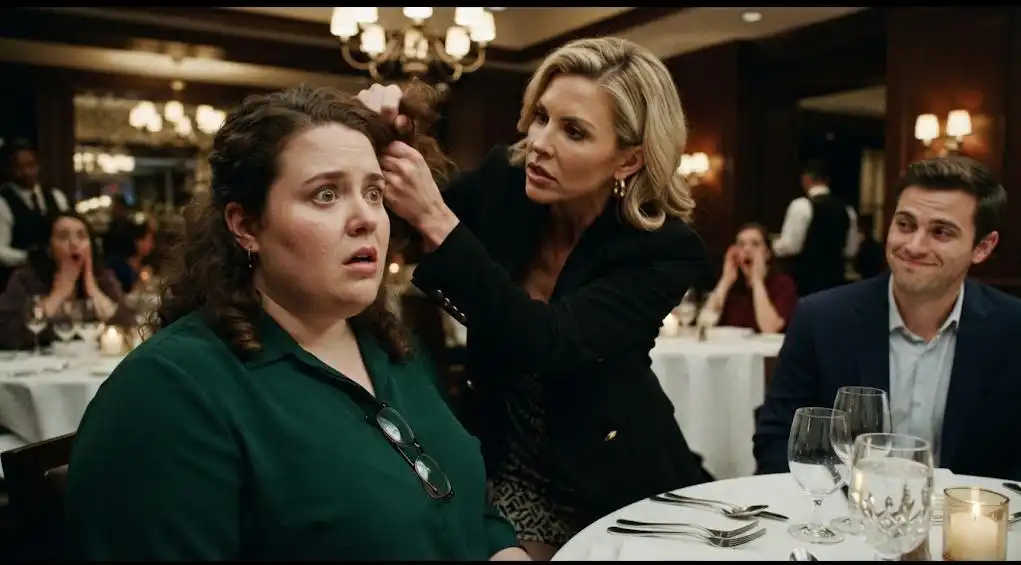
Madison's hand was still tangled in my hair when I realized that nobody at the table was going to stop her.
Ethan Cole sat back in his chair, watching with an amused expression.
A woman at the next table gasped.
Someone whispered, “What is wrong with these people?”
I felt Madison's fingers tighten against my scalp.
Then she released me with a sharp shove.
“Maybe now you'll learn some manners,” she said.
I caught the edge of my chair to steady myself.
Ethan laughed.
“Honestly, Grace, you really know how to make a simple dinner embarrassing.”
I looked at him, then at Madison.
For years, I had been afraid of precisely this moment: a room full of strangers watching me become the punchline.
I had imagined myself apologizing, smoothing my clothes, and pretending that nothing serious had happened.
Instead, I reached for my phone.
“My name is Grace Holloway,” I told the emergency dispatcher. “I'm at a restaurant in Atlanta. A woman has just grabbed my hair and physically assaulted me. I need an officer here.”
Ethan's smile vanished.
“You're calling the police over that?”
I looked at him.
“Yes.”
He shook his head as though I had confirmed something he had suspected about me all along.
“Unbelievable.”
I was twenty-nine years old, worked as a librarian, and had spent most of my adult life trying to become the sort of woman other people would approve of.
I had changed my clothes, my hair, my eating habits, and even the way I spoke around people I wanted to impress.
I had accepted dates I didn't want.
I had laughed at jokes that hurt.
I had mistaken being chosen for being valued.
But I had never imagined that a dinner reservation would end with someone pulling my hair while the man who had invited me watched.
That evening changed the way I understood my own life.
Not because I suddenly became fearless.
Because I finally stopped believing that keeping other people comfortable was more important than protecting myself.
My story began years earlier, in a small house outside Atlanta.
I grew up loving books.
When other children spent their afternoons arguing over television programs, I would sit on the living room rug with a stack of library books and lose myself in stories about distant places.
My mother used to say I had always preferred imaginary worlds to real people.
She meant it as a criticism.
I never saw it that way.
Books gave me a place to think without worrying about whether someone approved of my face, my clothes, or the way I occupied a room.
I eventually became a librarian.
I loved helping people find books they didn't know they needed.
I loved watching a reluctant reader discover a story that made them laugh.
I loved the quiet satisfaction of organizing a collection so that someone could find exactly what they were looking for.
My work wasn't glamorous.
I didn't earn a large salary.
I didn't attend expensive events or travel to fashionable destinations.
But I had built a life around something I genuinely cared about.
Unfortunately, my family measured success differently.
My mother, Diane, believed that a woman's life became more complete when she found a husband.
She rarely said it in exactly those words.
Instead, she asked questions.
“Have you met anyone interesting lately?”
“Are you still using that dating app?”
“Have you thought about letting me introduce you to someone?”
At first, I answered politely.
Then the questions became more pointed.
“You're nearly thirty, Grace. You shouldn't be so particular.”
“Men have preferences. You have to understand that.”
“You can't expect someone to overlook everything just because you have a good personality.”
I knew what she meant by everything.
My weight.
I had struggled with my body image since adolescence.
My weight had fluctuated over the years, influenced by stress, sleep, and my own complicated relationship with food.
I had tried diets that promised dramatic changes.
I had followed exercise plans that left me exhausted.
I had bought clothes that were too small because I believed they might motivate me to change.
Whenever my weight changed, I treated it as evidence of whether I was succeeding or failing as a person.
If I lost a few pounds, I felt hopeful.
If I gained them back, I felt ashamed.
I spent far too much time comparing myself with women who seemed to move through the world without questioning whether they deserved to be seen.
My mother reinforced those fears, sometimes without realizing it.
When I bought a new dress, she asked whether it was slimming.
When I mentioned a social event, she suggested I choose a darker color.
When a date stopped returning my messages, she wondered whether I had made enough effort with my appearance.
I knew she wanted me to be happy.
But somewhere along the way, her idea of helping had become another reason for me to doubt myself.
My friends were not much better.
Some offered genuine encouragement.
Others made jokes about my dating life, then told me not to be so sensitive when I looked hurt.
One friend insisted that I needed to lower my expectations.
“You want someone kind, stable, attractive, and emotionally mature,” she said. “At some point, you have to be realistic.”
I asked her why wanting kindness should be considered unrealistic.
She laughed.
“You know what I mean.”
I did.
And I hated that I had started believing her.
By the time I turned twenty-nine, I had developed a habit of negotiating against myself before anyone else had the chance.
If a man seemed impatient, I tried to become easier to please.
If he made a cutting remark, I told myself he was nervous.
If he ignored a boundary, I wondered whether I had expressed it clearly enough.
I was so frightened of being rejected that I often rejected my own feelings first.
Then my mother introduced me to Ethan Cole.
She had met his mother through a family acquaintance.
According to the stories, Ethan was successful, well-connected, and serious about finding a partner.
He worked in business consulting and had an impressive professional network.
He dressed well and knew how to make people feel that they were being given his full attention.
My mother was delighted.
“He sounds wonderful,” she said. “And his family is very respectable.”
I looked at the photograph she showed me.
Ethan had dark blond hair, a polished smile, and an expensive-looking suit.
He appeared confident without seeming aggressive.
I agreed to meet him.
I told myself that I should give people a chance.
When Ethan called, he spoke gently.
He asked about my work at the library and listened while I explained the community reading programs I helped organize.
He even said that it was admirable to spend so much time helping children.
“You must be a very patient person,” he said.
I smiled.
“I try to be.”
He suggested a high-end restaurant in Atlanta for our first date.
I had never been there.
The restaurant occupied a corner of an upscale building and featured tall windows, polished stone, soft lighting, and carefully arranged tables.
The menu was expensive enough that I checked the prices before leaving home.
I chose a simple, elegant dress from my closet.
It wasn't new, but it fit comfortably and made me feel presentable.
Before I left, I stood in front of the mirror.
I adjusted the neckline.
I turned sideways.
I changed my earrings.
Then I changed them back.
I took a deep breath.
“You look fine,” I told myself.
I was still staring at my reflection when my phone rang.
It was my mother.
“Remember to smile,” she said. “And don't talk too much about work. Ask him questions about himself.”
“I know how to have a conversation, Mom.”
“I'm only trying to help.”
I ended the call and slipped my phone into my bag.
Inside was a small notebook I had begun carrying after starting counseling.
The notebook was not a diary of dramatic revelations.
It was a practical tool.
My counselor had encouraged me to record moments when I noticed myself abandoning my own needs to gain approval.
I wrote down the situation, what I felt, what I feared would happen if I spoke honestly, and what I might say instead.
One page contained a sentence I had copied from a session:
Someone else's disappointment is not proof that I have done something wrong.
I read it before leaving.
Then I closed the notebook and went to the restaurant.
Ethan was already there.
He stood when I approached and pulled out my chair.
“You look nice,” he said.
I felt an immediate rush of relief.
“Thank you.”
He asked about my drive and whether I had found the restaurant easily.
For the first few minutes, the conversation was pleasant.
He talked about his work.
I asked about his interests.
He asked about my job, and I explained that I helped coordinate children's reading programs and community literacy events.
“That sounds rewarding,” he said.
“It is.”
Then he checked his watch.
“Madison should be here soon.”
I looked at him.
“Madison?”
“My friend. She's joining us for dinner.”
I had assumed the date would be between the two of us.
I felt uncomfortable, but I didn't want to seem difficult.
“That's fine,” I said.
It wasn't.
But I said it anyway.
Madison arrived about ten minutes later.
She was a fashionable woman in her early thirties, dressed in a fitted black outfit and carrying a designer handbag.
She greeted Ethan warmly, then looked at me from head to toe.
“So this is Grace.”
I smiled politely.
“Nice to meet you.”
She sat down without returning the greeting.
Ethan explained that Madison was one of his closest friends and had helped him choose the restaurant.
“I told her I was meeting someone interesting,” he said.
Madison gave a small laugh.
“Interesting is one word for it.”
I felt heat rise into my cheeks.
Ethan glanced at her but said nothing.
I tried to redirect the conversation.
“Have you both known each other long?”
“Years,” Madison answered. “I know Ethan better than almost anyone.”
She looked at me again.
“So, Grace, what do you do?”
I explained that I worked as a librarian.
She tilted her head.
“That's sweet. I suppose it's a quiet job.”
“It can be. But the community programs are busy, especially when school is out.”
Ethan interrupted.
“Grace is very passionate about books.”
He said it with a smile that seemed complimentary.
Then he added, “Though I imagine it doesn't leave much time for anything else.”
I wasn't sure how to answer.
“I have other interests.”
“Such as?”
I mentioned walking trails, cooking, and visiting museums.
Madison looked at Ethan.
“See? You don't have to spend much money to have hobbies.”
They both laughed.
I smiled weakly because I didn't know what else to do.
The waiter arrived, and we ordered.
I chose a meal I wanted rather than the salad I had initially considered ordering simply because I thought it might look better.
Even so, when the food arrived, Ethan glanced at my plate.
“That's a substantial meal.”
I put down my fork.
“I'm hungry.”
“Of course,” he said. “Nothing wrong with that.”
His tone suggested otherwise.
Madison leaned toward him.
“Did you tell her about your fitness routine?”
He laughed.
“No, I don't think we need to get into that.”
She turned to me.
“Ethan is very disciplined. He believes people should take responsibility for themselves.”
I looked at him.
“I agree that personal responsibility matters.”
“Then you'll understand his standards,” she said.
“What standards?”
Ethan sighed.
“Madison, don't.”
But he didn't sound as though he wanted her to stop.
She continued.
“He wants someone who takes care of herself. Someone who fits into his lifestyle.”
I stared at her.
“I do take care of myself.”
“Really?”
Her eyes moved over my body.
I felt the familiar urge to explain my medical history, my exercise habits, and every reason my weight had changed.
I wanted to prove that I was trying.
Then I remembered my counselor's advice.
I did not owe strangers an account of my body.
I took a slow breath.
“My health and appearance are not up for discussion at dinner.”
Madison looked surprised.
Ethan's smile disappeared.
“There's no need to be defensive.”
“You asked me to dinner,” I said. “I came here to get to know you, not to have my body evaluated.”
He leaned back.
“Honestly, Grace, you should be grateful someone like me agreed to meet you.”
The words struck harder than I expected.
He said them calmly, almost conversationally, as though he were explaining an obvious social rule.
I looked at him.
“What exactly do you mean by someone like you?”
He shrugged.
“I have a good career. I take care of myself. I have options.”
Madison smiled.
“Ethan is being honest. A lot of women would love to be in your position.”
I felt the restaurant around me.
The quiet clink of silverware.
The low murmur of conversations.
The warm glow of the lights.
I had spent the entire evening trying to make myself acceptable to two people who had decided that my presence was a privilege they were granting me.
I began to gather my bag.
“I don't think this is a good match. I'm going to leave.”
Ethan rolled his eyes.
“Of course. You can't handle an honest conversation.”
“I can handle honesty. I won't stay for insults.”
Madison suddenly leaned across the table.
“You think you're too good for him?”
“No.”
“Then stop acting like a victim.”
“I am asking you both to stop discussing my body.”
She stood so abruptly that her chair scraped across the floor.
“Maybe you need to learn some manners.”
Before I could move away, she grabbed my hair and pulled.
Pain shot across my scalp.
I stumbled against my chair and caught myself against the table.
A woman nearby gasped.
A waiter froze with a tray in his hands.
Ethan laughed.
“Madison, that's enough.”
He said it with the tone of someone mildly inconvenienced by a joke that had gone on too long.
He did not stand to help me.
He did not ask whether I was hurt.
He looked at the other diners and said, “She's making a scene.”
I stared at him.
Something inside me became very still.
I had spent years worrying about being perceived as difficult.
I had swallowed hurtful comments because I wanted to be liked.
I had apologized when other people crossed lines.
Now a woman had physically assaulted me in a public restaurant, and the man who had invited me was trying to make me feel responsible for the embarrassment.
I reached for my phone.
“I am calling the police.”
Madison laughed.
“Go ahead.”
Ethan leaned forward.
“Grace, think about what you're doing. You're going to ruin the evening over nothing.”
I dialed emergency services.
I gave the dispatcher the restaurant's address and explained what had happened.
I asked the manager to preserve the security footage.
I also asked whether the restaurant could provide the names of staff members who had witnessed the incident.
The manager, a middle-aged man named Robert, approached cautiously.
“Ma'am, are you injured?”
“My scalp hurts, and I was pulled backward. I need the footage preserved.”
“Of course.”
He turned toward Ethan and Madison.
“I'm going to ask you both to remain here until the officers arrive.”
Ethan became angry.
“You can't hold us here.”
“I'm asking you to cooperate while we document what happened.”
Madison folded her arms.
“This is ridiculous. She practically invited it by being rude.”
I looked at her.
“I told you to stop discussing my body. You grabbed my hair.”
She opened her mouth.
Then she glanced toward the security camera mounted above the nearby display.
For the first time that evening, she looked uncertain.
The police arrived shortly afterward.
I gave my statement.
Robert explained that the restaurant had cameras covering the dining area and entrance.
Two customers offered their contact information as witnesses.
The officers separated us and asked each person what had happened.
Ethan repeatedly insisted that the incident had been exaggerated.
Madison said she had only been trying to get my attention.
The officers documented the accounts and reviewed the available information.
Madison was detained and later charged in connection with the physical assault, subject to the subsequent legal proceedings.
Ethan's behavior during the incident and his conduct toward the responding officers were also documented for review. The authorities addressed his conduct according to the applicable procedures.
I was asked whether I wanted to pursue the matter.
“Yes,” I said.
My voice was quiet, but I did not hesitate.
I was given information about obtaining the restaurant's preserved footage through the appropriate process and about the next steps in the case.
When I finally left the restaurant, I sat in my car for several minutes before driving home.
My hands were shaking.
I felt embarrassed, furious, and strangely relieved.
I had not made everyone comfortable.
I had not smoothed over the situation.
I had not apologized for being hurt.
And I was still alive, still worthy, and still myself.
That night, I opened the notebook in my bag.
I turned to a blank page.
At first, I couldn't write anything.
Then I wrote:
Tonight, I said no. Someone ignored it. I asked for help anyway.
I stared at the sentence.
For years, I had thought confidence meant entering a room without feeling insecure.
Now I understood that confidence could also mean feeling terrified and protecting yourself anyway.
The following days were difficult.
My mother called when she heard about the incident.
I had expected concern.
Instead, she sounded horrified that the evening had ended so badly.
“Grace, why did you have to escalate things?”
I sat on my sofa, holding the phone away from my ear.
“Madison grabbed my hair.”
“But what did you say to her?”
“I asked her to stop discussing my body.”
“Could you not have just left quietly?”
“I was trying to leave. She grabbed me.”
My mother sighed.
“I just don't want this to damage your reputation. People talk.”
I closed my eyes.
There it was again.
The assumption that my first responsibility was to make the situation look better for everyone else.
“Mom, I was assaulted. I'm not going to pretend it was a misunderstanding just because the truth is uncomfortable.”
She went silent.
Then she said, “I only want you to find someone.”
I felt an old ache rise in my chest.
“I want that too. But I won't accept being treated badly just to avoid being alone.”
She accused me of becoming too sensitive.
I ended the call before the conversation turned into another argument.
For the first time, I did not spend the rest of the evening composing a message to make her feel better.
I opened my notebook instead.
I wrote down what I had felt, what I had feared, and what I wanted to remember.
Then I scheduled another counseling session.
My counselor listened while I described the incident and my mother's reaction.
“You did something important,” she said. “You recognized that a boundary had been crossed and acted to protect yourself.”
“I still feel guilty.”
“Guilt is a feeling. It isn't proof that you've done something wrong.”
I looked down at my hands.
“I keep thinking that if I had been thinner or more confident, maybe none of this would have happened.”
My counselor paused.
“Would a different body have made Madison's actions acceptable?”
“No.”
“Would perfect confidence have made Ethan's behavior respectful?”
“No.”
“Then let's separate what happened from the story you're telling yourself about why it happened.”
I began to cry.
Not because I was ashamed of my body.
Because I was finally beginning to see how much responsibility I had been carrying for other people's choices.
We worked on identifying the beliefs that kept me trapped in the same patterns.
That I needed to be chosen to be valuable.
That saying no made me difficult.
That being alone was worse than being disrespected.
That my body was an apology I owed the world.
None of those beliefs had appeared overnight.
They had accumulated through years of comments, comparisons, disappointing dates, and well-intentioned advice that had taught me to distrust myself.
Changing them would take time.
I did not emerge from counseling with a magical new personality.
I still felt nervous before social events.
I still had moments when I compared myself with other women.
I still worried about what people thought of me.
But I began practicing different responses.
When someone made an unkind comment, I stopped automatically laughing.
When I didn't want to attend an event, I said no without inventing an elaborate excuse.
When my mother brought up marriage, I reminded her that my life was not a deadline.
And when I felt the urge to apologize for taking up space, I paused and asked myself what I had actually done wrong.
Often, the answer was nothing.
At the same time, I began rebuilding my relationship with my body.
I did not set out to become a smaller person so that Ethan or Madison would regret what they had done.
I wanted to feel stronger and healthier.
I spoke with healthcare professionals about my health goals and began following a manageable routine.
I started walking regularly.
I incorporated strength training gradually, with attention to my ability and recovery.
I learned to prepare balanced meals without treating food as a reward or punishment.
I worked on sleeping consistently and managing stress.
Some weeks went well.
Others were difficult.
There were days when work was exhausting and exercise was the last thing I wanted to do.
Instead of declaring the week a failure, I resumed my routine when I could.
Over time, I noticed changes.
My stamina improved.
My posture became more comfortable.
I felt stronger when walking long distances.
My weight changed gradually, but I stopped treating the number as a verdict on my worth.
I bought clothes that fit my body as it was.
I stopped keeping painful reminders of the size I thought I should be.
I learned that taking care of myself did not have to begin with disliking myself.
Meanwhile, the legal case continued.
The restaurant preserved the relevant security footage.
The video showed Madison reaching across the table, grabbing my hair, and pulling me backward.
It also showed that I had been trying to leave before the physical contact occurred.
The footage supported the witness accounts and contradicted Madison's claim that she had merely tried to get my attention.
Ethan's behavior was visible too.
He did not physically attack me, but the recording showed him laughing, dismissing my distress, and attempting to characterize me as the person causing the disturbance.
The evidence was important because it reduced the dispute to what had actually happened, rather than what either side later wanted people to believe.
I provided my statement and cooperated with the investigation.
I did not post the footage online.
I did not want my humiliation to become entertainment for strangers.
I wanted the authorities to handle the matter through the proper process.
A few weeks later, Ethan contacted me through an attorney.
He wanted to discuss a private financial settlement.
The proposal included money in exchange for resolving the dispute and agreeing not to pursue certain claims.
I reviewed it with independent legal counsel.
The amount was substantial enough to make me pause.
I could have used it to pay off debts, move to a better apartment, or take time away from work.
For several days, I considered accepting it.
I was tired of the case.
I was tired of thinking about the restaurant.
I was tired of remembering Madison's hand in my hair.
Part of me wanted to accept the money, sign the papers, and never hear either name again.
But another part of me understood that I needed to know exactly what I was agreeing to.
My attorney explained the terms and the options available to me.
There was no requirement that I accept a private settlement simply because one had been offered.
I thought about the way Ethan had looked at me when I said I was leaving.
I thought about how quickly he had decided that my dignity was negotiable.
And I thought about how easily I had spent years negotiating away my own comfort.
I declined the proposal as written.
I did not demand an outrageous payment.
I did not threaten to ruin anyone's life.
I simply refused to sign an agreement that I believed asked me to give up too much in exchange for making the matter disappear.
Ethan's attorney responded with another offer.
I declined again.
The legal process continued according to the applicable procedures.
Madison ultimately faced consequences for the assault, including court-ordered penalties and requirements arising from the case.
Ethan was separately held accountable for the conduct established through the proceedings, and the matter was resolved through the appropriate legal channels.
I did not receive a miraculous fortune.
I did not become famous.
The court did not transform my life overnight.
What changed was that I stopped allowing the people who had humiliated me to decide when I was permitted to stand up for myself.
The experience also changed the way I approached my work.
Before the incident, I had already been involved in community literacy programs.
I helped organize children's reading sessions, assisted families in finding age-appropriate books, and worked with local volunteers to make reading more accessible.
I loved the work, but I had often treated it as something I did after everything else in my life had been handled.
Now I began making it a priority.
I volunteered for additional community reading events when my schedule allowed.
I helped organize a book collection for children whose families had limited access to new books.
I worked with other librarians and volunteers to create welcoming reading sessions for children who struggled with confidence.
Some were reluctant readers.
Some were shy.
Some worried that they were not as good at reading as their classmates.
I recognized the expression on their faces.
It was the same expression I had worn at the restaurant.
The fear that someone might notice a weakness and decide it defined everything about them.
I never told the children that confidence meant ignoring their fears.
Instead, I told them that learning was a process.
“You don't have to be good at something before you're allowed to begin,” I would say.
“If a page is difficult, we read it together.”
I watched children who once refused to read aloud begin volunteering for their favorite passages.
I saw them help one another sound out difficult words.
I watched a little girl who had barely spoken during her first session stand up and recommend a book to the entire group.
Those moments mattered to me.
They reminded me that encouragement did not need to be grand.
Sometimes it was simply the decision to make room for someone who had been afraid to participate.
My work began attracting attention from local community organizations.
A neighborhood nonprofit asked me to help coordinate a children's book distribution program.
We arranged donations, selected age-appropriate titles, and organized volunteers to distribute books through community centers and libraries.
I helped develop a simple system for tracking which neighborhoods needed more books and which families were asking for particular reading materials.
The program grew steadily.
We did not solve every problem.
We did not reach every child.
But we made a practical difference in the places we could reach.
My supervisor noticed the work and encouraged me to take on a larger role in community programming.
I began helping coordinate literacy partnerships across several neighborhood sites.
It was not a glamorous promotion.
It was meaningful work that matched my strengths.
I had found a place where patience, organization, and care were valued rather than dismissed as ordinary obligations.
Months passed.
My life became fuller.
I had work I cared about, friends who respected my boundaries, and routines that supported my health.
I began attending social events again.
Sometimes I went alone.
Sometimes I met friends for dinner.
I no longer treated every gathering as an audition for a future relationship.
If I met someone interesting, I allowed the conversation to unfold naturally.
If someone made a disrespectful comment, I did not assume it was my job to educate him.
And if a person seemed incompatible with my values, I gave myself permission to walk away.
My mother struggled with the change.
She was pleased that I seemed happier, but she still worried about my relationship status.
One afternoon, she called to tell me about another man she wanted me to meet.
“He has a good job,” she said. “And his mother says he's ready to settle down.”
I smiled to myself.
“Mom, I'm not interested.”
“You haven't even met him.”
“I know. But I'm not looking for a relationship just because someone else thinks I should be.”
She sighed.
“You can't spend your whole life alone.”
“I'm not planning to spend my life alone. I'm planning to choose carefully.”
“What if you miss your chance?”
I looked around my apartment.
There were books stacked beside the sofa, a grocery list on the counter, and a half-finished reading program proposal on my desk.
My life was not empty.
It was full of things that mattered to me.
“If I meet someone kind and compatible, I'll be open to it,” I said. “But I won't accept disrespect just to say I'm dating someone.”
My mother was quiet.
Then she said, “I suppose I don't understand your generation.”
I laughed softly.
“Maybe you don't have to understand everything. I just need you to respect my decisions.”
We ended the call without an argument.
It was a small moment.
But it was the first time I had stated that boundary without spending the next hour worrying about whether I had hurt her feelings.
The following spring, our community library organized a special reading event.
We had received a donation of new books from several local supporters, and volunteers spent weeks sorting and preparing them.
The children's section was filled with bright displays.
We arranged small tables, reading cushions, and baskets of books organized by age and interest.
I helped coordinate the event.
I greeted families at the entrance, introduced children to volunteers, and made sure that every child who wanted a book had the chance to choose one.
A little boy in a blue shirt approached me holding two books.
“Can I take both?”
I smiled.
“Which one do you want to read first?”
He studied the covers.
“This one.”
“Then let's start there.”
He tucked the other book beneath his arm.
His mother thanked me.
I told her I was glad they had come.
For a moment, I watched the room.
Children were reading on cushions.
Parents were talking with volunteers.
A little girl was laughing at a picture book while her older brother tried to explain the ending.
The room felt warm and alive.
I thought about the years I had spent believing that I needed to become more attractive, more agreeable, or more impressive before I could deserve a place in the world.
Then I looked at the children.
None of them needed to earn the right to hold a book.
They simply needed someone to put the book within reach.
That was what I wanted to keep doing.
Not because it would make me look good.
Not because it would help me find a husband.
Because it mattered.
After the event, I stayed behind to help pack the remaining books.
My colleague Sarah found me arranging a box of new titles.
“You know,” she said, “you seem different lately.”
I looked up.
“Different how?”
“More comfortable. Like you're not constantly waiting for someone to criticize you.”
I considered that.
“I think I'm learning that I don't have to answer every criticism.”
She smiled.
“That's a useful skill.”
I laughed.
“I'm still practicing.”
That evening, I walked home beneath the trees along a quiet Atlanta street.
The weather was warm, and the sky was turning pink near the horizon.
I felt physically stronger than I had a year earlier.
My walking pace was easier.
My shoulders were relaxed.
My clothes fit comfortably.
But the biggest change had nothing to do with my measurements.
I no longer spent every day trying to earn permission to like myself.
I could still have difficult days.
I could still feel insecure when I saw an unflattering photograph.
I could still worry about what someone thought when I entered a room.
The difference was that those feelings no longer controlled every decision.
I had learned that confidence was not the absence of insecurity.
It was the willingness to act according to my values even when insecurity was present.
I had learned that kindness did not require silence.
I had learned that forgiveness, if I chose it, did not require pretending that harmful behavior was acceptable.
And I had learned that being single was not a punishment.
It was simply my current relationship status.
It did not determine my value.
Several months later, I returned to the restaurant where the incident had happened.
Not for another date.
The library was hosting a small fundraising dinner, and the restaurant had agreed to provide space for the event.
I had considered asking the organizers to choose another location.
Then I realized that I did not want my world to shrink around the memory of what had happened.
The restaurant had preserved the evidence.
The case had been handled.
I had done what I believed was right.
I was not required to avoid every place that reminded me of a difficult experience.
When I arrived, the manager recognized me.
“It's good to see you again, Ms. Holloway,” he said.
“Thank you, Robert.”
He showed me to the event area.
The room was elegant, but this time I was not there to impress a man or survive a social test.
I was there to talk about children's literacy.
I spoke with volunteers about the reading program.
I explained how donations would be used.
I introduced myself to supporters who wanted to help.
Nobody asked me to justify my appearance.
Nobody treated my work as a consolation prize.
And nobody had the power to decide whether I deserved to be there.
Before leaving, I paused beside the table where the original incident had occurred.
I remembered Madison's hand in my hair.
I remembered Ethan laughing.
I remembered the heat in my face and the fear that I would somehow be blamed for what had happened.
Then I remembered the moment I reached for my phone.
I had not become a different person that night.
I had simply made a different choice.
I chose to protect myself.
I chose to preserve the evidence.
I chose not to buy peace by surrendering my dignity.
Those choices had not made my life perfect.
They had made it mine.
When I stepped outside, the evening air was cool.
I adjusted my bag on my shoulder and walked toward my car.
Inside the bag was my little counseling notebook.
It had grown thicker over the months, filled with reminders, difficult questions, and small victories.
I opened it before driving away and wrote one final sentence.
I do not need to be everyone's choice to make my own life a good one.
Then I closed the notebook.
The next morning, I would return to the library.
There would be children waiting for new books, volunteers asking questions, and another reading program to organize.
There would be ordinary problems to solve and ordinary moments worth enjoying.
I would continue caring for my health.
I would continue learning how to protect my boundaries.
And if love entered my life, I would welcome it as a partnership, not as proof that I had finally become worthy.
I was Grace Holloway.
I was a librarian, a friend, a daughter, and a woman still learning how to trust herself.
I did not need to be smaller to deserve respect.
I did not need to be chosen to be valuable.
And I would never again confuse someone's willingness to date me with their right to mistreat me.
CHOOSE YOUR SIDE: GRACE WAS RIGHT TO REFUSE THE PRIVATE SETTLEMENT AND STAND UP FOR HERSELF, or SHE SHOULD HAVE ACCEPTED THE MONEY AND MOVED ON.
Comment your choice and share this story with someone who needs the reminder that self-respect is not something you have to earn. ❤️
Disclaimer: Mention of any brand or trademark is for identification only and does not imply partnership or endorsement

A RURAL TEXAS DOCTOR Poured Ice Water on a Plus-Size Dispatcher in Front of State Inspectors. He Had NO IDEA What She’d Been Recording for Years 😱

She Cut the Plus-Size Assistant’s Hair and Dumped Coffee on Her in Front of Manhattan’s Executives. She Had NO IDEA Who Maya Really Was... 😱

A Chicago Finance Director Poured HOT COFFEE on His Plus-Size Analyst in Front of the Entire Team. He Had NO IDEA What Her Data Could Prove... 😱