
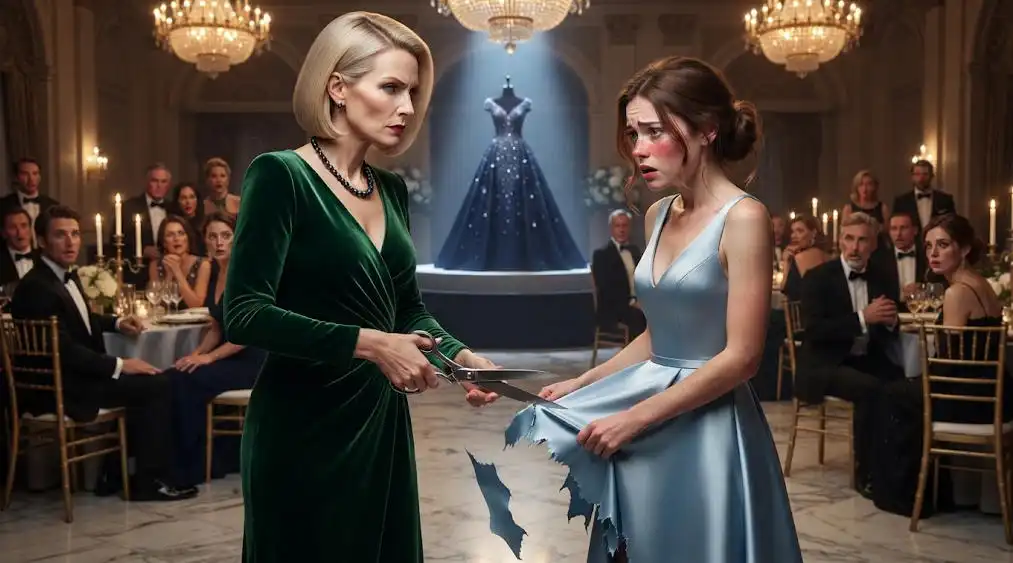
The first cut sounded like someone snapping a thick piece of cardboard.
The second sent a strip of pale-blue fabric sliding down Ella Morrow's leg.
By the third, her homemade evening dress was hanging in jagged pieces.
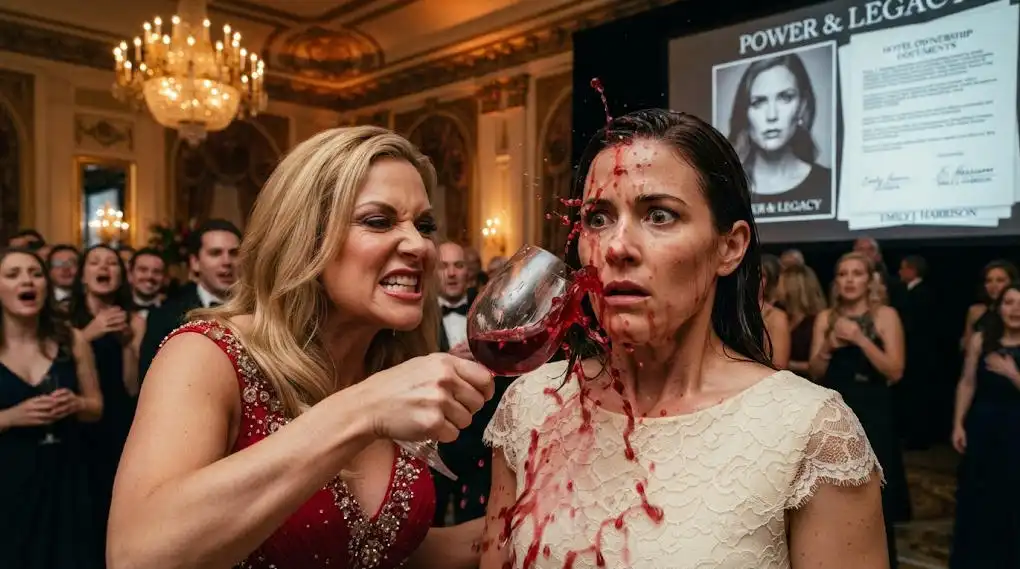
Twenty-five-year-old Ella stood frozen in the center of a magnificent Chicago ballroom, staring at the silver tailor's shears in the hand of the woman who had just destroyed her clothes.
Vivian Kessler, the celebrated design director of Valence Atelier, was breathing hard. Her emerald-green velvet gown shimmered under the chandeliers. A black pearl necklace rested against her throat.
"Thief! You don't belong here!"
The accusation rang across the charity gala.
A violinist stopped playing.
Conversations died at the nearest dinner tables.
Ella staggered backward and seized the torn front of her dress with both hands.
She had made it herself from seventeen dollars' worth of discount fabric. She'd stayed awake until two in the morning finishing the hem because she couldn't afford anything else to wear.
Now three ugly cuts ran through the front-left skirt panel, leaving strips of blue material hanging near her knees.
Her face burned.
She could feel the eyes of wealthy donors, fashion editors, and industry executives following every movement of her shaking hands.
For a moment, she wanted nothing more than to run.
Then she looked up at Vivian.
"You stole my design."
A few guests exchanged amused glances.
Someone near the front whispered, "Isn't that the intern she fired?"
Vivian's mouth curled.
"Get her out."
Two security officers moved forward.
One reached toward Ella's elbow.
She jerked away.
"Don't touch me. I'm not finished."
Vivian laughed.
"You're finished when I say you're finished."
Ella felt tears threatening to spill over. She pressed her lips together so tightly they hurt.
Beyond the guards, on a raised exhibition platform surrounded by velvet ropes, stood a magnificent midnight-blue evening gown.
Hundreds of tiny diamonds glittered across its bodice. Silver embroidery flowed down the skirt in long, curving lines resembling moonlight on dark water.
The gown was called Night Harbor.
Its insurance valuation exceeded ten million dollars.
And the woman claiming to have designed it was standing in front of Ella with a pair of scissors.
Ella stared past Vivian toward the exhibition.
"Check the inside hem."
Vivian's expression changed.
It was only a flicker, quickly hidden beneath another contemptuous smile.
But Ella saw it.
And for the first time that evening, she knew she had frightened the right person.
Six months earlier, Ella had believed Valence Atelier would change her life.
She'd grown up in a modest apartment on Chicago's Northwest Side. Her mother, Ruth, had spent decades altering wedding gowns, replacing damaged linings, and repairing expensive coats for people who rarely remembered her name.
Ruth taught her daughter how to hold a needle before Ella was old enough to ride a bicycle without training wheels.
"People notice the beautiful outside," Ruth used to tell her. "But the inside is what makes a garment last."
When Ella was seventeen, Ruth gradually lost most of her eyesight.
The sewing machine that had supported their family became difficult for her to use. Ella began taking alteration jobs after school, eventually learning to draft patterns and construct garments almost entirely by hand.
Ruth learned Braille and used raised labels to identify her belongings.
Ella began incorporating tiny Braille signatures into her own work.
At first, they were a private gesture.
She wanted her mother to be able to recognize her daughter's designs by touch.
Later, when Ella started creating original couture garments, those signatures became something more deliberate.
Every important sketch had a narrow fabric sample attached to it. Every pattern set included a stitched muslin reference strip. Every prototype carried a tiny arrangement of raised knots forming the Braille initials E.M.
She used a specialty heat-reactive filament that remained nearly colorless at ordinary room temperature but darkened when gently warmed.
The knots could be felt with fingertips.
Under the right warmth, their pattern could also be seen.
It was an unusual habit, developed through years of working with her mother.
Ella never imagined it might save her career.
Fourteen months before the gala, she'd started designing Night Harbor.
The inspiration came one evening when she and Ruth stood beside Lake Michigan.
Ruth could no longer see the skyline clearly, so Ella described the reflections in the water.
"The buildings look broken," Ella told her. "But the pieces make something beautiful."
Ruth smiled.
"Then make me something I can understand with my hands."
Ella spent months experimenting with pleats that moved like rippling water.
She used deep-blue silk, concealed support seams, and an asymmetrical skirt that appeared to float when its wearer walked.
Before applying for an internship at Valence Atelier, she'd already submitted an early version of the design to a college-sponsored exhibition.
Her instructor, Nora Baird, photographed the prototypes and filed the drawings in the school's digital portfolio archive.
That archive would later become important.
But Ella didn't know that then.
She was simply a young designer desperate for an opportunity.
When Valence offered her an internship, she thought she'd finally found one.
Vivian Kessler was everything Ella hoped to become.
Her designs appeared on magazine covers. She had influential clients across the country, a luxurious studio, and enough industry connections to launch an unknown designer's career with a single introduction.
For the first several weeks, Vivian seemed supportive.
She complimented Ella's sketches and asked to see her experimental gown.
Ella brought the drawings, pattern pieces, and original muslin prototype into the studio.
Vivian examined them closely.
"This is extraordinary," she said.
Ella remembered how her heart had leaped.
Then Vivian asked whether Ella could construct the foundation of the gown using the atelier's finest silk.
Ella worked late for several nights, cutting and sewing the original underskirt herself.
She placed the same raised Braille signature along its inner hem, this time spelling her full name instead of merely her initials.
It was invisible beneath the outer layers.
She didn't mention it to Vivian.
To Ella, it was simply how she finished something that belonged to her.
When the silk foundation was complete, Vivian inspected it and praised its movement.
Two weeks later, Ella discovered that Valence had registered Night Harbor as a company design credited exclusively to Vivian Kessler.
Ella requested a meeting.
She brought her original drawings and politely asked why her name was missing.
Vivian didn't even offer her a chair.
"You're an intern, Ella. You're here to learn."
"But I designed that gown before I worked here."
Vivian folded her hands.
"Be very careful about what you're accusing me of."
Three days later, Ella received a termination letter.
It alleged that she'd improperly copied confidential Valence design materials.
Her building access was revoked.
Her internship ended immediately.
And a warning circulated through professional contacts suggesting that Ella couldn't be trusted with proprietary designs.
Two weeks after Vivian had praised her work, Ella found herself unemployed, humiliated, and effectively shut out of the industry.
She applied to twelve other design positions.
Nine never answered.
Three rejected her.
One employer privately admitted that someone at Valence had warned them against hiring her.
Ella wanted to hire an attorney, but her savings were nearly gone.
A nonprofit legal clinic advised her to preserve every document she had and avoid making accusations she couldn't substantiate.
So she gathered her evidence.
She recovered copies of her original sketches from the school's portfolio archive.
She downloaded old emails sent to Nora months before joining Valence.
She found photographs of the muslin prototype laid across her mother's kitchen table.
And she collected the dated construction notes documenting how she'd solved the gown's unusual pleating problem.
The information showed that she'd developed the design independently.
But Vivian's company possessed the finished garment.
It also controlled the studio's internal records.
When Ella approached the organization administering the upcoming design award, she received a polite acknowledgment. The preliminary review office declined to decide the dispute without further verification.
Vivian, meanwhile, continued preparing for the gala.
The final exhibition gown incorporated Ella's original silk foundation, now covered with elaborate embroidery and diamonds loaned by private collectors.
The gemstones accounted for most of its extraordinary insurance valuation.
Night Harbor had become the centerpiece of the annual Mercer Foundation charity gala.
And Vivian was the favorite to win the evening's prestigious design award.
Three days before the event, Ella received a message from Olivia Grant, a senior seamstress at Valence.
Olivia had worked beside her on the original foundation.
They kept your silk underskirt, the message read. I recognized the construction when we were doing the final fitting.
Ella sat staring at the words.
That meant the hidden signature might still be inside the gown.
She replied immediately.
Would you tell the judges?
Olivia didn't answer until the next morning.
I have two kids and a mortgage. Vivian could fire me.
Ella couldn't blame her.
But she also couldn't abandon the design.
The night of the gala, Ella put on the inexpensive blue dress she'd sewn at her kitchen table.
Ruth ran her fingertips along its hem.
"Your stitching is straight," she said proudly.
Ella tried to smile.
"At least something in my life is."
Her mother reached for her hand.
"Whatever happens tonight, don't let anyone convince you that you didn't do the work."
Ella carried her sketchbook, copies of her portfolio records, and a handful of stitched samples in a borrowed evening bag.
She knew she wasn't welcome at the gala.
Her former employer had made that perfectly clear.
Still, she entered the building through a service corridor while staff were moving equipment between the ballroom and an adjoining gallery.
She had no invitation and no intention of pretending otherwise if challenged.
She only wanted the judging committee to look at the evidence before Vivian was honored.
The ballroom was even more intimidating than she'd imagined.
Crystal chandeliers illuminated tables filled with wealthy donors.
An enormous flower arrangement stood beside the stage.
Fashion executives laughed over expensive wine.
And there, beneath a carefully positioned spotlight, stood her gown.
Ella knew it immediately.
The outer embroidery was more elaborate than her original design, and the diamonds transformed its appearance.
But the asymmetrical fall of the skirt was unmistakable.
So was the way the inner silk supported its movement.
It was her work.
Her months of sleepless nights.
Her mother's idea.
Ella had taken only a few steps toward the exhibition when Vivian recognized her.
"What are you doing here?"
Ella turned.
Vivian was standing beside a live couture demonstration table, where a set of professional sewing tools had been arranged for guests to examine.
"I need to speak with the judges," Ella said.
Vivian glanced toward the nearest guests.
"You've already caused enough trouble."
"That's my design on the stage."
Vivian's face tightened.
She seized the heavy tailor's shears from the demonstration table and stormed toward her.
Ella instinctively stepped back.
"Vivian, put those down."
But Vivian grabbed the front-left panel of Ella's blue dress.
The scissors closed.
Once.
Twice.
Then a third time.
The fabric split apart.
A strip fell to the floor.
Vivian called her a thief in front of the entire ballroom.
And now Ella stood in the middle of the wreckage, struggling to keep her damaged dress together while security approached.
"Check the inside hem," she repeated, louder this time.
Vivian's eyes narrowed.
"There's nothing to check."
"Then you shouldn't mind letting them look."
"That gown is worth more than you'll earn in your entire life."
Ella looked at the blue strips hanging from her own dress.
"Apparently mine was worth destroying."
A few people looked away.
Someone at a nearby table muttered that Vivian had gone too far.
But Vivian had no intention of surrendering control.
"Security, I want her removed. Call the police if she refuses."
The older security officer hesitated.
Before he could respond, a silver-haired woman rose from the judges' table.
"One moment."
It was Marianne Ford, the independent chair of the award committee.
She'd spent more than thirty years evaluating couture construction and textile innovation.
Vivian immediately softened her voice.
"Marianne, I'm terribly sorry about this disruption. She's a disgruntled former employee."
Marianne looked at Ella's shredded dress.
"I can see that something has happened here."
"She's trying to steal my work."
"That," Marianne replied, "is what I intend to establish."
Ella felt her knees weaken.
For months, important people had dismissed her without examining a single piece of evidence.
Now someone was actually listening.
Marianne approached her.
"What's your name?"
"Ella Morrow."
"And you claim to have designed Night Harbor?"
"Yes."
"Can you establish that?"
Ella opened her bag.
Her hands shook so badly that she nearly dropped the sketchbook.
She placed it on the nearest cleared table.
Inside were drawings showing the gown's original silhouette, the construction of its unusual pleats, and detailed pattern measurements.
Beside several drawings were narrow muslin strips containing tiny raised stitches.
Marianne examined them.
"What are these?"
"My signatures."
Vivian made a dismissive noise.
"Any intern can sew initials onto scraps."
Ella didn't look at her.
"I've done it for years. My mother is blind. She taught me that a design should be recognizable by touch, too."
Marianne ran a fingertip gently over one sample.
"These are Braille cells."
Ella nodded.
"The letters E and M. Every original pattern and prototype has them."
Vivian folded her arms.
"Lovely story. It doesn't prove anything."
"No," Ella said. "Not by itself."
She took out the printed portfolio archive.
"This design was submitted to my school's exhibition months before I joined Valence. The archive has the original drawings and dated photographs. You can verify them directly with the school."
Marianne turned to another judge, who began checking the exhibition record on his phone.
Vivian's expression hardened.
"Those are preliminary sketches. My company created the finished gown."
Ella felt her anger rise again.
"You kept my original underskirt."
"Your work was done under my supervision."
"I made it before you registered the design."
Vivian glanced toward the stage.
"There's no proof that anything in that exhibition belongs to you."
Ella picked up a muslin reference strip.
"Then let me show you."
She walked toward the exhibition platform.
Marianne followed.
One security officer moved beside them, watching her hands.
The magnificent gown towered above Ella on its mannequin.
Up close, she could see every detail of the embroidery.
Hundreds of tiny stones caught the light.
She also saw something that made her throat tighten.
The original inner pleat fell slightly differently from the surrounding folds.
It had always done that.
She remembered spending an entire afternoon adjusting the seam so the skirt would move correctly without collapsing.
The flaw wasn't visible from the front.
But she knew exactly where it was.
And she knew what lay beneath it.
"May we lift the inner hem?" Marianne asked the display technician.
Vivian stepped forward.
"Absolutely not."
Marianne turned.
"Why?"
"Because the gown is insured for over ten million dollars. The diamonds are on loan. No one is authorized to interfere with it."
"The request is to inspect a seam," Marianne said.
Vivian raised her voice.
"If she damages that dress, she will be personally responsible. I'll make certain of it."
Ella looked down at her shredded blue skirt.
She had less than four hundred dollars in her bank account.
Her rent was overdue.
A claim involving a multimillion-dollar exhibition piece could destroy her financially, even if she ultimately fought it successfully.
She understood the danger.
But she also knew what would happen if she walked away.
Vivian would accept the award.
Her accusation would become harder to challenge.
And the only physical proof that Ella had completed the original gown might disappear into a private collection or a locked corporate archive.
Marianne studied the underside of the skirt.
"Miss Morrow, what exactly are you looking for?"
"A stitched name."
"Where?"
"Inside the lower-left hem. Just above the foundation seam."
Vivian laughed sharply.
"Anyone can put a name inside a garment. That doesn't make them the designer."
"You're right," Ella answered. "That's why I brought the original drawings."
She held up the sketchbook.
"And that's why the construction matters."
Marianne leaned toward the fabric.
"I can see some raised stitching, but it's nearly the same color as the silk."
Ella's pulse raced.
That was it.
The signature.
It was still there.
She could feel herself approaching a moment she'd imagined for six months.
Then Vivian moved between the judge and the display.
"No one is touching this gown again."
She gestured toward security.
"Remove her. Right now."
The older officer stepped closer.
Marianne protested, but Vivian spoke over her.
"I will hold this girl liable for every dollar of damage. And I want the police here."
Ella saw the display technician backing away from the disagreement.
In his hand was a portable heat lamp used to examine how different materials appeared under warm illumination.
She recognized the type.
Its focused warmth was exactly what she needed.
Her mother's workroom had once contained a similar lamp.
Ella had used controlled heat many times to reveal the special filament in her samples.
But those samples had been inexpensive scraps.
This was a diamond-covered exhibition gown.
If she scorched the silk, damaged the embroidery, or dislodged a gemstone, Vivian would have every reason to pursue a devastating claim.
Ella knew there was a safer option.
She could leave.
Ask a lawyer to arrange an inspection.
Wait months.
Hope the garment remained unchanged.
But Vivian was already ordering the gown removed from public access.
And the judges were about to conclude the competition.
Ella made her choice.
She stepped forward and snatched the portable heat lamp from the technician's hand.
"Miss Morrow!" Marianne cried.
Vivian lunged toward her.
"Stop her!"
Ella dropped to one knee beside the mannequin.
She caught the lower-left edge of the gown's inner skirt with her free hand.
The technician shouted a warning about the hot lamp housing.
Ella kept her fingers clear and angled the light toward the inside hem, holding it close enough to warm the fabric without touching it.
For one terrible second, nothing happened.
She could hear Vivian screaming.
Security rushed toward the platform.
The fabric remained pale.
Ella's stomach dropped.
Had the special thread been removed?
Had the embellishment process destroyed it?
Then a tiny dot turned dark.
Another followed.
Then another.
A line of raised stitches slowly emerged against the midnight-blue silk.
The color spread across the hidden pattern as the filament warmed.
Small, orderly groups of dots became visible.
Marianne leaned closer.
"What is that?"
Ella could barely speak.
"Braille."
The warmth revealed a complete sequence of raised cells arranged into two words.
ELLA MORROW.
Her full name.
Hidden inside the original underskirt.
The same raised stitching technique appeared on the muslin samples in her sketchbook.
The same stitch spacing.
The same heat-reactive thread.
The same careful construction.
For several seconds, nobody moved.
Then Vivian said, too quickly, "She must have planted that there when she was an intern."
Ella looked up at her.
"Before you fired me. Before you entered the design under your own name."
"That doesn't prove ownership."
"No," Ella replied. "But it proves I worked on the actual foundation. And the dated drawings show who designed it."
Marianne lifted her hand.
"Everyone, stop."
The security officers halted.
She asked the technician to switch off the lamp and inspect the warmed area.
He examined the silk carefully.
"The filament reacted," he reported. "I don't see any scorching or damage."
Ella released a breath she hadn't realized she was holding.
Marianne asked the other judges to approach.
One compared the exposed Braille cells with a reference chart while another inspected Ella's original portfolio.
They confirmed that the raised letters spelled her name.
Then they opened the school's publicly accessible exhibition archive.
The original Night Harbor drawings appeared on the screen.
Dated before Ella's employment at Valence.
The photographs showed the same unusual pleating geometry and the same fabric reference strips.
Marianne turned the screen toward Vivian.
"These records predate your company's submission."
Vivian's confidence began to crumble.
"That doesn't mean she didn't borrow ideas from somewhere."
Marianne held up the earliest drawing.
"Then explain how an independent student exhibition contained your supposedly original design before she joined your staff."
Vivian opened her mouth.
Nothing came out.
A quiet voice interrupted from beside the platform.
"I can explain the foundation."
It was Olivia Grant.
The senior seamstress had been standing near the exhibition equipment, helping the technicians manage the garment.
Ella stared at her.
Olivia looked terrified.
Her eyes moved from Vivian to Ella.
Then she took a breath.
"I worked with Ella when she made that underskirt."
Vivian whipped around.
"Olivia, don't you dare."
Olivia flinched.
For an instant, Ella thought she would retreat.
Instead, the older woman straightened her shoulders.
"I watched her draft the final pleats. She cut the silk herself. When Vivian decided to use the gown for the gala, our team kept Ella's original foundation and built the embellishments over it."
Vivian's face went pale.
"You're fired."
Olivia's eyes filled.
"Maybe I am."
She looked at Ella.
"But I'm tired of pretending I don't know who made it."
The silence in the ballroom changed.
Before, people had been waiting for the disturbance to end.
Now they were watching a respected fashion executive struggle to explain why someone else's name had been sewn into the core of her celebrated design.
Marianne asked Olivia several questions about the construction dates and the internal workroom records.
Olivia identified the pattern pieces she'd handled and explained why the distinctive foundation had been reused.
Her account matched the independent documents Ella had brought.
One of the judges pulled up the official competition submission.
Vivian had signed an authorship declaration stating that she was the originating designer of Night Harbor.
No other creator was credited.
Marianne read the declaration twice.
Then she faced Vivian.
"Mrs. Kessler, this committee was asked to judge your original design. We have substantial contemporaneous evidence that the underlying design originated with Miss Morrow before her employment at Valence."
Vivian tried to interrupt.
Marianne continued.
"You may have contractual claims you wish to raise. Those belong in a separate process. But this committee cannot honor you as the original creator while this evidence stands."
Another judge nodded.
The panel conferred at the side of the platform.
They examined the dated portfolio again, confirmed the rules governing author attribution, and recorded their decision.
Then Marianne returned to the microphone.
"On behalf of the independent judging committee, I am announcing that Vivian Kessler is disqualified from tonight's design award."
A stunned murmur swept through the ballroom.
Vivian gripped the back of a chair.
Marianne continued.
"The award submission contained a materially inaccurate declaration of original authorship. The committee will refer the documentation for a full attribution review and request preservation of all relevant studio records."
Vivian stared at her.
"You can't do this to me."
"The rules apply to every entrant," Marianne said.
Vivian turned toward the crowd as though expecting someone influential to intervene.
No one did.
A fashion editor who had been photographing the exhibition lowered her phone.
Two donors began talking quietly to the organizers.
A member of the foundation's legal team approached Marianne to arrange preservation of the supporting documents.
Vivian looked back at Ella.
"You have no idea what you've just cost me."
Ella glanced down at her ruined blue dress.
Then at the gown she had spent so long creating.
"You knew what this work meant to me," she said. "You took it anyway."
Vivian had no answer.
The gala's security manager approached and quietly informed her that the venue had preserved footage of the scissor incident.
Ella would have the opportunity to report the destruction of her clothing, and Vivian's threats of a disorderly-conduct arrest did not establish that Ella had committed a crime.
Vivian was asked to leave the exhibition area while the organizers completed their review.
She protested.
She demanded to speak with the foundation's leadership.
But her authority had disappeared.
The people who had once hurried to obey her were now watching the event staff escort her away.
Ella stood beside the mannequin, exhausted.
Her hands were still shaking.
She had proven that the original design was hers.
The judges had verified it.
Vivian had lost her place in the competition.
But Ella was still unemployed.
Her career had been damaged for months.
A single public decision couldn't pay her rent or erase every professional accusation.
She looked toward Olivia, who was wiping her eyes.
"I'm sorry," Ella said quietly.
Olivia shook her head.
"Don't apologize. I should have spoken up sooner."
Ella took her hand.
For the first time that night, she felt some of the weight begin to lift.
Then a man in a simple charcoal-gray suit approached the platform.
Ella recognized him vaguely.
He'd been standing near the side of the ballroom during the argument, listening without interrupting.
He wasn't wearing a flashy watch or an elaborate evening jacket.
He looked like someone who preferred not to attract attention.
"Miss Morrow?"
"Yes?"
"I'm Daniel Mercer."
Ella blinked.
The name was familiar.
The gala.
The foundation.
The enormous charitable program supporting emerging designers.
Then she understood.
Daniel Mercer was the chief executive of the Mercer Foundation, the organization hosting the entire event.
He offered his hand.
"I wanted to speak with you before the ceremony began," he said. "Apparently tonight had other plans."
Ella gave an uncertain laugh.
"I'm sorry about the disruption."
He glanced at her torn dress.
"I think the person with the scissors owes that apology."
She looked down, embarrassed.
Daniel gestured toward her sketchbook.
"May I?"
She handed it to him.
He turned several pages.
"These drawings are beautiful. But what interests me most is the engineering. You designed a foundation that can carry significant weight without losing its movement."
Ella was surprised.
Most of the people praising the gown had talked about the diamonds.
Hardly anyone had mentioned the construction.
Daniel continued.
"Our foundation supports a program called the Chicago Makers Studio. It provides paid design positions, apprenticeships, and technical training for people who otherwise can't afford access to professional ateliers."
Ella nodded.
She knew the program.
She had submitted her independent portfolio to it the previous spring.
"We received your application," Daniel said.
Her breath caught.
"The selection committee liked your work very much. Then questions were raised about the ownership of the portfolio. Our legal team asked us to delay the decision until the claims could be reviewed."
Ella swallowed.
Vivian's accusation had reached even that opportunity.
Daniel looked toward Marianne, who had just delivered the committee's written findings to the organizers.
"Tonight provided evidence that those questions deserved a very different answer."
He reached inside his jacket.
Ella expected a business card.
Instead, he withdrew a cream-colored envelope bearing the foundation's official seal.
"I had our employment team prepare this after we verified your archived portfolio earlier this evening. The final offer was waiting for the attribution question to be resolved."
He handed it to her.
Inside was a signed employment offer for a salaried lead designer position at the foundation's new design workshop, with benefits and responsibility for developing its emerging-talent collection.
Her name appeared at the top.
Ella Morrow.
Not Valence Atelier.
Not Vivian Kessler.
Hers.
Ella read the first paragraph.
Then she read it again.
"I don't understand," she whispered.
Daniel smiled.
"We're building a studio where young designers receive proper credit for their work. You understand construction, you know what it means to start with very little, and you've demonstrated that you're willing to defend the truth about your own designs."
Ella looked at the letter.
"You're offering me a job?"
"A real one. With a salary."
Her eyes filled.
For months, every rejection had made her wonder whether she had already lost her only chance.
She had counted grocery money.
Avoided opening bills.
Slept beside a sewing machine that she couldn't bear to sell.
Now the chief executive of one of Chicago's most influential charitable organizations was standing in front of her, offering her an opportunity to build something of her own.
She pressed a hand over her mouth.
"I don't know what to say."
"You don't have to decide tonight," Daniel said. "Read the terms. Talk to someone you trust. But I wanted you to have the offer personally."
Ella looked at the signature.
It was real.
For the first time since she had been fired, she could imagine telling her mother that things might finally be okay.
Daniel nodded toward the damaged blue dress.
"There's something else."
Ella glanced down.
"Oh. I know. I look terrible."
"No," he said. "You look like someone who had a very difficult evening."
She gave a shaky laugh.
He continued.
"The committee would like to make a public correction before tonight's program ends. They want to acknowledge you as the original designer of Night Harbor."
Ella looked toward the stage.
The gown still stood under the lights.
Marianne was speaking with the event coordinator, who was updating the introduction and arranging for the original design attribution to be announced.
Daniel added, "The formal rights and compensation questions will still need to be addressed. We've asked independent counsel to help you understand your options, and the foundation will preserve the evidence from tonight."
Ella nodded.
She understood.
There would still be difficult conversations.
Possibly attorneys.
Possibly a long struggle to recover what Vivian had taken.
But she wasn't facing those questions with nothing anymore.
The work itself had been recognized.
Her name had been confirmed.
And a powerful woman could no longer call her a thief without being challenged by the evidence.
An event assistant hurried over.
"Miss Morrow, we can find you another dress before you go onstage."
Ella looked at the tattered blue fabric hanging around her legs.
She thought about her mother feeling along the hem that afternoon.
Your stitching is straight.
She remembered the small kitchen table where she'd cut the fabric, carefully trying to make something presentable out of materials she could barely afford.
Then she looked toward the magnificent exhibition gown.
The garment Vivian had stolen.
The garment that carried Ella's name hidden inside it.
Ella shook her head.
"Thank you. But I'll keep this one."
The assistant hesitated.
"Are you sure?"
Ella smiled through her tears.
"I made it."
Across the ballroom, Marianne stepped onto the stage.
The music faded.
Guests returned their attention to the podium.
"Ladies and gentlemen," Marianne began, "before we continue tonight's program, the judging committee has an important correction to make."
She explained that the original design and construction of Night Harbor had been traced to a young independent designer whose contribution had been omitted from the award submission.
She thanked the people who had provided records and testimony.
Then she spoke the name.
"Ella Morrow."
The room went quiet for an instant.
Ella felt her heart hammering.
Marianne continued.
"Would you please join us onstage?"
Daniel stepped aside.
Olivia squeezed Ella's hand.
Ella slowly walked toward the steps.
Her inexpensive blue dress brushed against her legs. The ripped panels moved unevenly as she climbed, and the long strip Vivian had cut loose was still missing from the front.
She didn't try to hide it.
She had arrived expecting to be thrown out.
She had been called a thief.
Humiliated.
Threatened.
And forced to risk everything to prove that something beautiful had begun with her own hands.
Now the judges were waiting for her.
Daniel Mercer stood beside the podium.
The magnificent midnight-blue gown gleamed behind them.
Marianne offered Ella the microphone.
Ella took it, looked across the ballroom, and tried to speak.
For a moment, no words came.
Then she said quietly, "My mother taught me that the part nobody sees is sometimes the most important part."
She paused.
"I just wanted my name back."
A woman near the front stood.
Then another guest rose.
Olivia stood beside the platform, clapping with tears on her cheeks.
The applause spread through the ballroom until it filled the space beneath the chandeliers.
And there, beneath the brilliant stage lights, 25-year-old Ella Morrow stood at the center of the stage in her shredded blue dress, her eyes shining with tears as hundreds of people applauded her.
Disclaimer: Mention of any brand or trademark is for identification only and does not imply partnership or endorsement
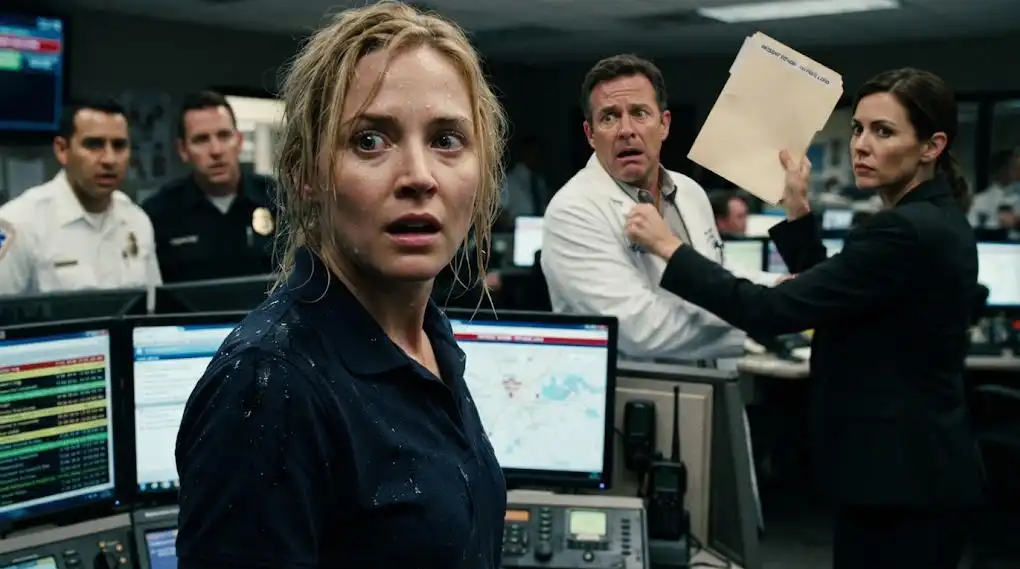
A RURAL TEXAS DOCTOR Poured Ice Water on a Plus-Size Dispatcher in Front of State Inspectors. He Had NO IDEA What She’d Been Recording for Years 😱
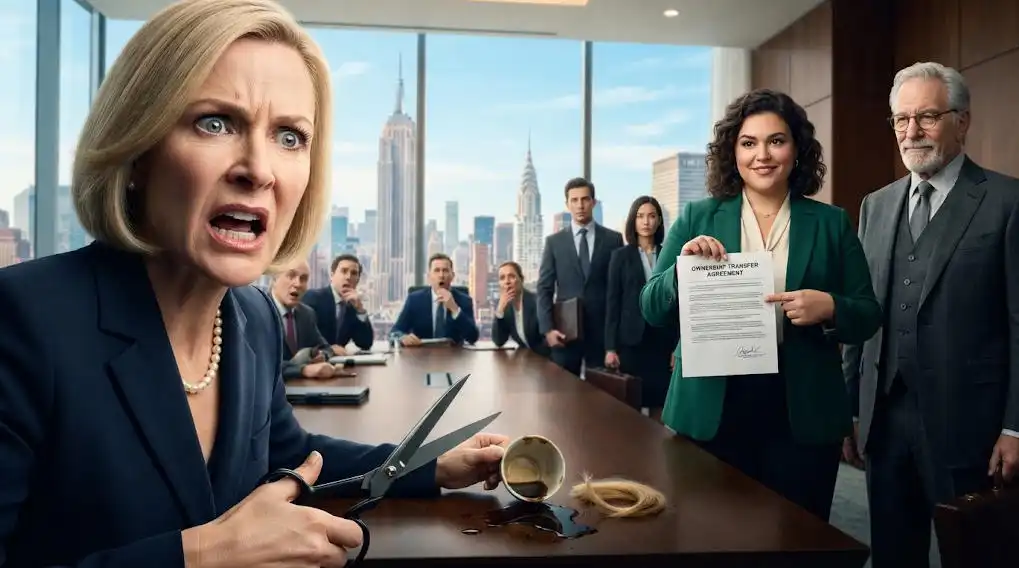
She Cut the Plus-Size Assistant’s Hair and Dumped Coffee on Her in Front of Manhattan’s Executives. She Had NO IDEA Who Maya Really Was... 😱
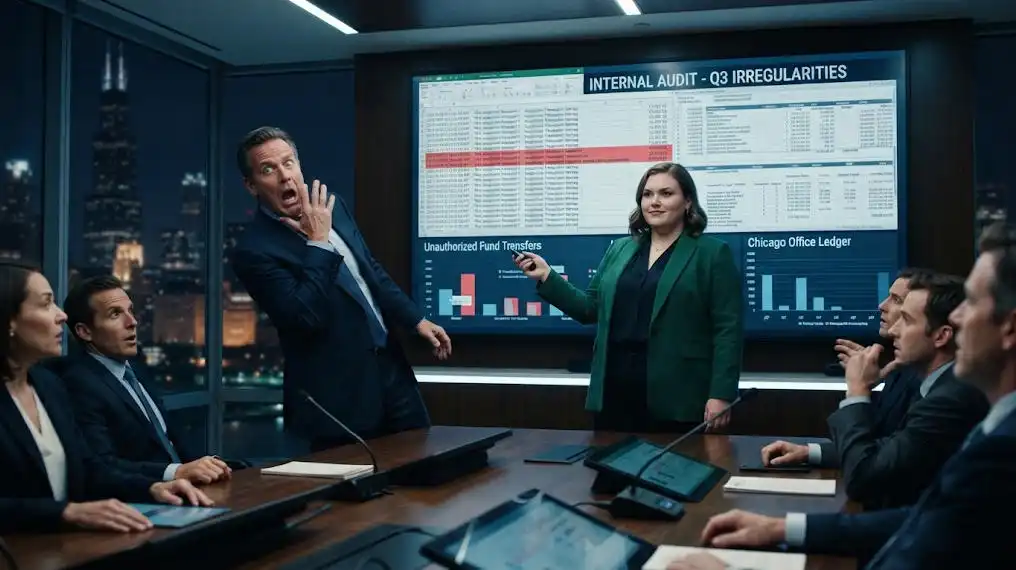
A Chicago Finance Director Poured HOT COFFEE on His Plus-Size Analyst in Front of the Entire Team. He Had NO IDEA What Her Data Could Prove... 😱