
The officer didn’t speak at first.
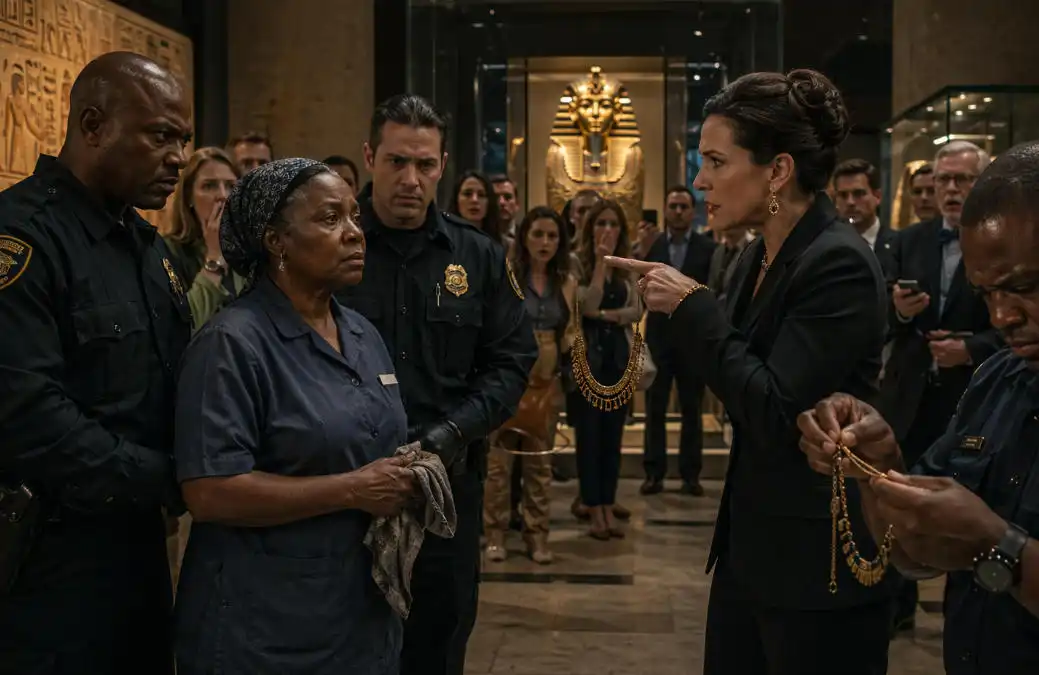
He just held the necklace under the exhibit light, turned the clasp over, and narrowed his eyes.
Then he read the number again.
Out loud.
And my knees almost gave out.
Because I had not heard that number spoken in public in fifty years.
The curator laughed too fast.
“That proves nothing,” she snapped. “She’s trying to stall because she got caught.”
I was the one in a faded cleaning uniform.
She was the one in heels, silk, and museum authority.
We were standing in the Ancient Egypt hall, under gold lights and armed cameras, with donors, guards, tourists, and staff all staring at us like I was garbage that had finally been dragged into the open.
She wanted me humiliated where everybody could see it.
That was the point.
She didn’t just want her necklace back.
She wanted my dignity broken.
“Search her apron,” she told security again. “These women always hide things in layers.”
A few people gasped.
A few more stayed quiet.
That’s how it always goes when somebody in power decides a poor woman is safe to destroy.
I kept my hands at my sides.
I kept my mouth shut.
Because I had learned a long time ago that loud truth loses to polished lies—until the rules step in.
The officer looked at me.
“How do you know this number?”
I swallowed hard.
“Because my mother made me memorize it when I was nine years old.”
Now the room was truly silent.
I pointed at the underside of the clasp.
“There should also be a tiny dent near the hinge. My father dropped it while fixing the chain. And inside the back curve, there’s a hand-cut mark shaped like a crescent. It was our family sign.”
The officer checked.
Dent.
Crescent mark.
Exact match.
The curator’s face lost all color.
She tried to recover fast. “That only means she saw it somewhere before. This is a museum object. She could be making up a story.”
I looked straight at her.
“No,” I said. “It became a museum object after it was stolen.”
That hit the room like broken glass.
One donor actually took a step back.
A guard lowered his hand from my apron.
The lead officer asked me to continue, so I did.
My name is Loretta Mae Johnson.
For the people in that room, I was the older Black cleaning lady who wiped cases, emptied bins, and stayed invisible.
But fifty years earlier, before this museum ever put that necklace behind glass, it belonged to my mother’s family in Charleston.
It wasn’t just jewelry.
It was the last piece my grandmother hid during a violent home robbery that ended with my grandfather dead and half our family records gone.
My mother spent the rest of her life chasing that necklace.
She had one faded insurance form.
Two old photographs.
And the original registry number from a private appraisal done in 1949.
Before she died, she made me promise something.
“If you ever see it,” she told me, “don’t grab. Don’t scream. Make them prove where it came from.”
So that’s what I did.
Not because I was weak.
Because I was ready.
For six months, I had been cleaning that hall.
Six months of watching that curator lock cases herself.
Six months of seeing pieces moved in and out without proper internal logging.
Six months of noticing small things that poor workers notice because rich people think we don’t matter.
Wrong barcode stickers.
Fake loan tags.
Shipping crates arriving after hours.
Exhibit cards changed at the last minute.
And one more thing.
The necklace’s description on the digital catalog had been edited three times in one month.
I knew because I cleaned her office too.
And when people think you are invisible, they stop hiding their screens.
So while she thought I was “just the cleaner,” I quietly wrote dates down.
Truck license numbers too.
Times.
Storage room access logs.
Names on courier slips.
I never touched a single artifact.
I touched evidence.
That day, when she accused me, I knew she had panicked.
She had seen me look at the necklace one second too long.
She thought public shame would bury me before I could speak.
She almost got away with it.
Almost.
The second officer asked the curator where the necklace had been acquired.
She answered too smoothly.
“Private estate transfer. Fully documented.”
“Show us.”
She paused.
That pause was everything.
Then she started ordering staff around instead of answering.
“Call legal.”
“Clear the hall.”
“Remove her.”
Not one officer moved.
The lead officer asked for provenance documents.
She handed over a polished folder.
He read it once.
Then again.
Then asked why the export seal referenced a ministry office that had not existed in that country for twelve years.
Her mouth opened.
Closed.
Opened again.
No answer.
That’s when the museum’s board liaison, who had been standing near the back, stepped forward and said he had never seen that acquisition file before in any board review.
Now even the donors were whispering.
Phones were fully out.
The curator saw the room turning and got meaner.
She pointed at me like I was still the easiest target.
“She planted this. She’s been lurking around the collections area. She’s obsessed.”
I finally let some anger show.
“Obsessed?” I said. “You held my family’s bloodline in your hand and called it inventory.”
She sneered.
“Prove it.”
So I did.
I asked the officer to call the downtown records unit and pull the archived insurance statement under my mother’s maiden name.
Then I asked him to request the scan of a 1953 family photograph already filed in a cold-case theft supplement after the robbery.
He did both.
We waited.
That wait was brutal.
No one moved much.
No one talked loud anymore.
The same people who had watched me get publicly accused were now watching her sweat through perfect makeup.
One guard stopped looking at me like a suspect and started looking at her office keys.
Another quietly sealed the side access door.
The curator tried to leave.
They stopped her.
Then the records came in.
First, the insurance file.
Same necklace.
Same clasp description.
Same serial number.
Then the photograph.
Black-and-white.
My mother as a little girl.
My grandmother standing behind her.
And around my grandmother’s neck—
that necklace.
The exact one.
Same crescent mark.
Same broken link near the side loop.
The hall erupted. 😱
One woman covered her mouth.
A donor said, “My God.”
The curator snapped, “Photos can be forged.”
Bad move.
Because the officers were already deeper than the necklace by then.
They had started checking the catalog records for three other pieces displayed in the same hall.
Two showed chain-of-custody gaps.
One had a loan file tied to a shell company.
And the shell company led straight back to a private logistics firm that had the curator’s brother listed as director.
That was the crack.
Everything poured out after that. 🤯
Police opened her office.
Then the private storage room.
Then an off-site vault.
Inside were dozens of undocumented objects, swapped labels, fake provenance certificates, and shipping records connecting pieces across three countries.
Not random theft.
Organized theft.
Professional theft.
A pipeline.
And she wasn’t a small player.
She was the head of it.
The same cold woman who had just tried to strip-search me in public was standing in the middle of the Ancient Egypt hall as officers read her rights for trafficking stolen cultural property, fraud, records falsification, and conspiracy.
She screamed.
Not with dignity.
Not with power.
With panic.
She called for lawyers.
For board members.
For donors.
For anybody.
Nobody stepped in.
That’s the thing about public humiliation.
It feels very different when it turns around and lands on the person who built it.
They cuffed her right there in front of the same crowd she had used against me.
Cameras caught every second.
The guards who were told to search me escorted her out instead.
That part healed something in me I can’t fully explain.
Not because I enjoyed watching a woman fall.
Because for once, the rules worked before my dignity was buried.
The museum shut the hall for investigation.
Board members contacted me two days later.
Then again the next week.
Then they came to my apartment in person.
They apologized.
Not with pretty museum language.
With plain words.
They said I had helped expose one of the largest artifact theft operations connected to a private museum network in the region.
They asked what I wanted.
I said, “My family necklace back.”
That part was easy.
The courts confirmed our claim after the archived records, appraisal trail, and recovered evidence aligned.
The necklace was returned to me in a quiet room with no cameras.
I held it in both hands and cried like a child.
Not because it was gold.
Because my mother had died thinking the world would never admit what was taken from us.
Now it had.
A month later, the museum offered me a public role.
Honorary Curator for Community History and Restitution Outreach.
Some people were shocked.
They still thought titles belonged only to the polished.
But the new board chair said something I will never forget:
“She saw what experts ignored because she respected history more than the people getting paid to protect it.”
I accepted.
But I added one condition.
The necklace would not stay mine alone.
I donated it to the museum under a permanent family acknowledgment agreement.
In exchange, the museum created a citywide education fund for poor children—especially Black kids and kids from families who had never once believed those polished marble buildings were meant for them.
Books.
Field trips.
Scholarships.
After-school arts programs.
History access.
Real doors opened.
That necklace had sat in darkness for fifty years.
Now it paid for light.
The first year, hundreds of children came through.
The second year, even more.
Some of them saw me leading tours.
An older Black woman with sensible shoes, a calm voice, and a badge where nobody expected one.
A few would stare like they were trying to figure me out.
I always smiled and told them the truth.
“Never let a title tell you who matters here.”
The curator lost everything.
Her job.
Her reputation.
Her network.
Her freedom.
Several partners turned on one another in court.
International investigators picked apart the ring piece by piece.
The museum published corrected records and started a restitution review across its collections.
That mattered too.
Because justice is not just punishing one liar.
It is fixing the room that let the lie breathe.
As for me, I still keep an old cleaning rag in my desk drawer.
Not as shame.
As proof.
Proof that the woman they wanted to search in public ended up teaching the whole city what value really looks like. 💔
Team dignity over status. Always.
Share this story for every person who was treated like they were small, and stand with the children who now get a future from what was once stolen.
Disclaimer: Mention of any brand or trademark is for identification only and does not imply partnership or endorsement

A Cruise Security Chief Cut a Cleaner's Skirt in Front of Terrified Passengers, Then Accused Her of Helping Hijackers, Until a Classified Device on Her Thigh Caught a Security Tycoon's Eye. 🚢

A Millionaire's Wife Shoved Her Ex-Con Sister Into a Cruise Ship Pool, Hoping a Theft Charge Would Silence Her, Until the Ship's Feared Owner Saw the Tattoo Showing Through Her Uniform. ⚖️

The Headmistress Shoved a Mom Into the School Pool for Bringing Her Daughter a Muffin, Then Threatened to Fire Her, Until a Silver Lock Made the Board Chair Freeze. 😳