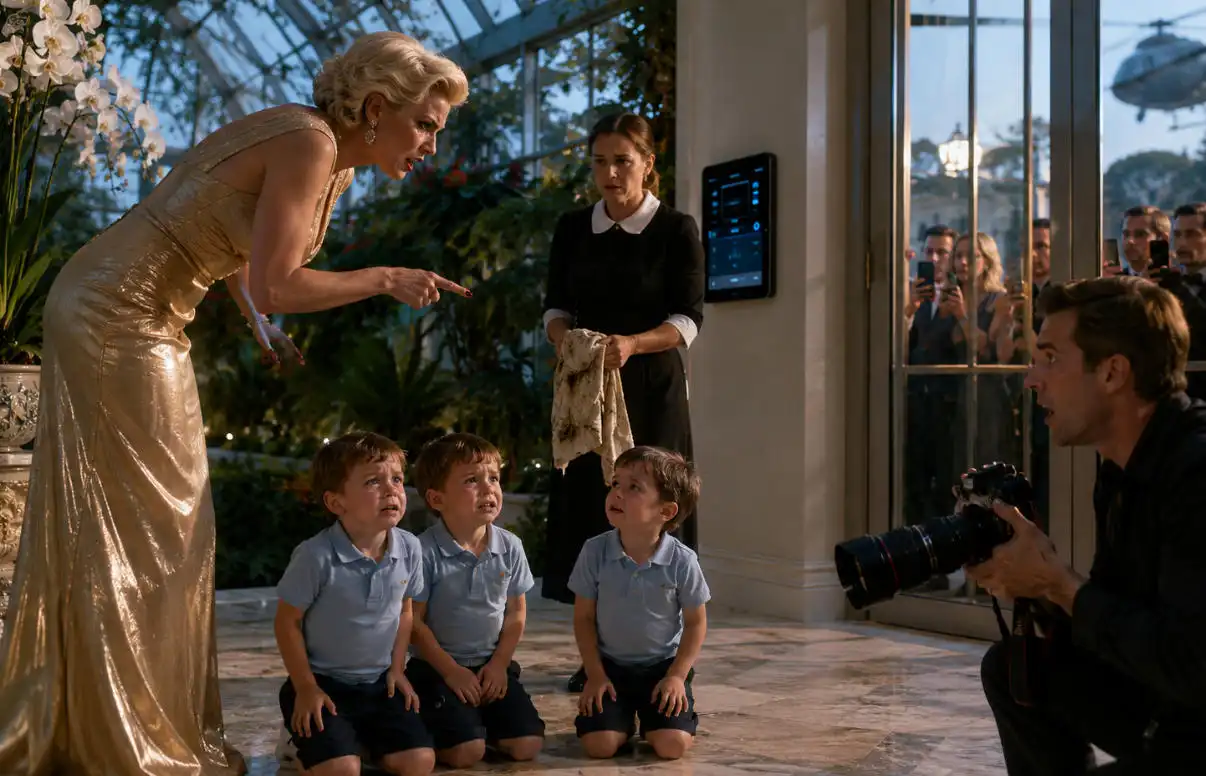
The helicopter blades shook the glass roof.
My wife stared through the greenhouse ceiling like judgment itself had just landed in our backyard.
The triplets were still on their knees.
The cameras were still live.
And the mansion AI had just said the one sentence my wife never expected to hear:
“Child distress detected. Global protocol activated.”
For six seconds, nobody moved.
Not the guests.
Not the photographer.
Not the maid holding the dirty towel.
Not Cassandra, my second wife, standing in her cream-colored designer dress with fake tears still shining under her eyes.
She had spent the entire afternoon pretending to be a saint.
She called it a charity campaign.
She called it “raising awareness.”
But what she really wanted was footage.
Footage of my 4-year-old triplets looking helpless.
Footage of her looking compassionate.
Footage she could use to repair her public image after months of whispers about her spending, her temper, and her sudden control over my family foundation.
My daughter Lily knelt between her brothers, Noah and Caleb.
Her tiny hands were wrapped around theirs.
Their clothes were smeared with dirt.
Their cheeks were wet.
Their faces were confused in that heartbreaking way only small children can look confused.
Like they were still trying to believe the adult in front of them was not actually cruel.
Cassandra turned toward the wall panel.
“Turn that thing off,” she hissed.
The AI answered calmly.
“Command denied.”
A low murmur moved through the guests outside the greenhouse.
Phones lifted higher.
The photographer, Brent, swallowed hard.
“Cassandra,” he whispered. “The stream is still running.”
Her eyes widened.
Then she spun toward him.
“Then cut it!”
Brent fumbled with his camera.
Before he could touch the control screen, the greenhouse speakers spoke again.
“External recording preserved. Live stream mirrored. Evidence package distributed.”
The maid gasped.
Cassandra’s face changed.
The perfect smile vanished.
The soft charity voice disappeared.
What remained was the woman my children had been living with when I was overseas.
Cold.
Panicked.
Furious.
“You little brats,” she snapped at the triplets. “Look what you did.”
Lily flinched.
That was when I opened the greenhouse door.
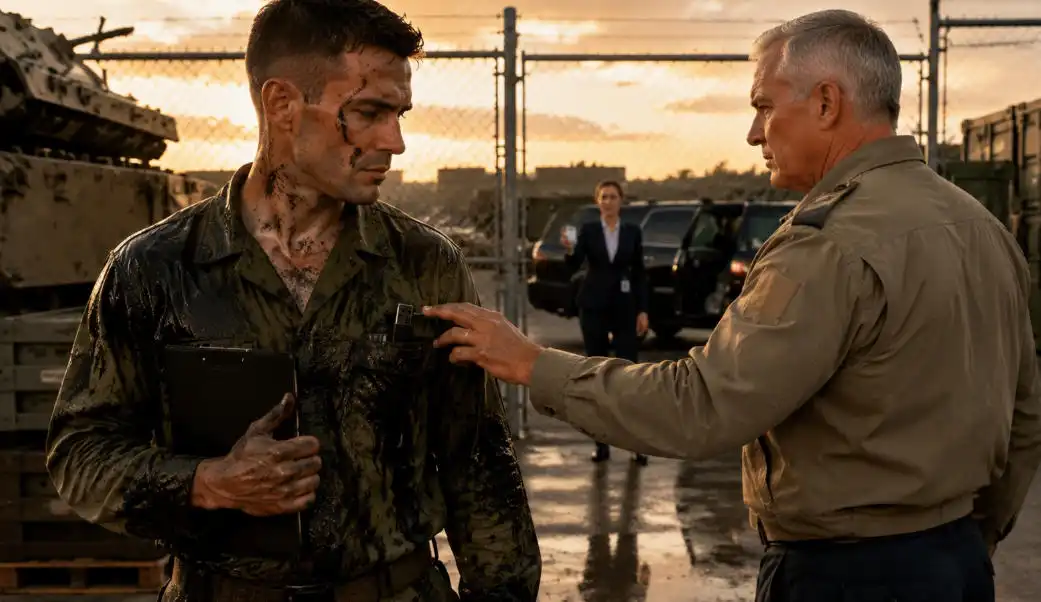
Two private security officers walked in first.
Behind them came an international child protection liaison.
Then a federal marshal.
Then me.
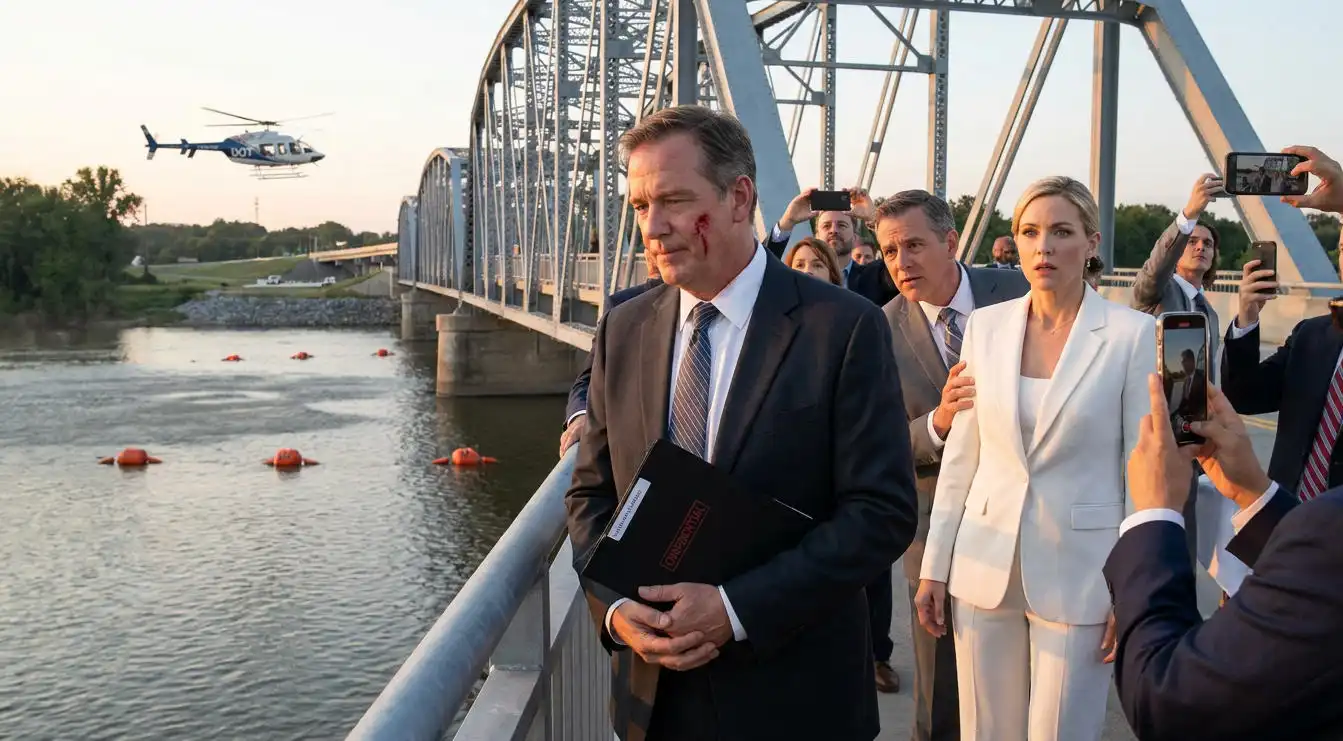
I stepped inside wearing the same dark suit I had worn at the summit in Geneva.
In my left hand was a sealed black folder.
In my right hand was a small stuffed rabbit Lily had left in my office months earlier.
The moment she saw it, she broke.
“Daddy!”
She tried to stand, but her knees buckled.
I crossed the greenhouse fast and dropped to the floor in front of them.
I didn’t look at Cassandra.
Not yet.
I looked at Lily.
Then Noah.
Then Caleb.
“You are not bad,” I said. “You were never bad.”
Noah’s lip trembled.
“She said we had to help her video.”
Caleb whispered, “She said rich kids need to learn shame.”
I pulled all three of them into my arms.
For a moment, the entire greenhouse went silent except for their crying.
Not dramatic crying.
Not the kind Cassandra wanted for her fake charity video.
Real crying.
The kind that comes after children finally realize the safe person has arrived.
Cassandra stepped forward.
“Daniel, this is being misunderstood.”
I finally looked at her.
She had used that tone before.
At board dinners.
At charity luncheons.
At interviews.
Soft enough to sound wounded.
Sharp enough to threaten anyone who knew better.
“This was a staged awareness piece,” she said. “You know how media works. The children were acting.”
Lily buried her face against my jacket.
“She told us if we smiled, we wouldn’t eat dinner.”
The guests outside reacted at once.
Someone said, “Oh my God.”
Someone else whispered, “She said that on camera?”
The AI answered.
“Confirmed. Timestamp: 2:14 p.m.”
Cassandra’s head snapped toward the wall panel.
“You had no right to record me in my own home.”
I stood slowly.
“It is not your home.”
Her mouth opened.
Closed.
Then opened again.
“What?”
I handed the stuffed rabbit to Lily and turned fully toward my wife.
“This estate is held in trust for my children. You were granted residence by marital agreement. Not ownership.”
The guests went silent again.
Cassandra glanced toward the livestream camera.
For the first time all afternoon, she seemed to remember millions of people were watching.
She lifted her chin.
“Daniel, don’t embarrass yourself. You’re emotional.”
That almost made me smile.
For two years, Cassandra had depended on one thing:
My silence.
I was a private man.
An invisible man, according to the press.
An energy investor who never gave interviews.
An oil magnate whose name appeared only in closed court filings, trust documents, and international arbitration records.
She married me believing privacy meant weakness.
She mistook my absence for ignorance.
She mistook my patience for permission.
And worst of all, she mistook my children for props.
I opened the black folder.
The marshal stepped beside me.
Cassandra stared at the seal on the first page.
Her face drained of color.
“This is a temporary protective order,” I said. “This is the emergency custody order. This is the asset freeze authorization tied to the family foundation investigation.”
Her voice cracked.
“Investigation?”
The maid began to cry behind her.
Brent, the photographer, lowered his camera completely.
I looked at them both.
“Yes,” I said. “Investigation.”
Then I turned back to Cassandra.
“For the last eight weeks, my legal team has been reviewing irregular transfers from the Davenport Children’s Wellness Foundation.”
Cassandra whispered, “That foundation is mine.”
“No,” I said. “It was created after my first wife died. For children in trauma recovery.”
Her fake tears were gone now.
Only sweat gathered at her hairline.
“You moved donor money into shell vendors,” I continued. “One of them paid Brent for staged charity shoots. Another paid your cousin’s media agency. Another paid the maid bonuses every time my children appeared distressed enough to improve engagement.”
The maid sobbed.
“I didn’t know it was illegal,” she whispered.
Cassandra whipped around.
“Shut up.”
The AI spoke again.
“Audio confirmation preserved.”
The crowd outside erupted.
Phones pressed against the glass.
Comments from the live stream began flooding across a monitor near the camera table.
Those babies were used.
Arrest her.
The maid helped.
Where is the father?
That woman is evil.
Cassandra lunged toward the monitor.
“Turn it off!”
The marshal stepped between her and the equipment.
“Ma’am, step back.”
Her voice rose.
“You people cannot do this to me. Do you know who I am?”
That was the most Cassandra sentence she could have said.
Do you know who I am?
She had said it to restaurant managers.
To flight attendants.
To the gardener.
To Lily when my daughter accidentally spilled juice on one of her silk scarves.
Now she said it in front of millions.
The marshal replied, “Yes, Mrs. Davenport. That is why we are here.”
He took the sealed document from the folder and read the first lines aloud.
The warrant had been issued through an international tribunal connected to cross-border child exploitation, foundation fraud, and unlawful media monetization involving minors.
Cassandra stepped back.
“No. No, Daniel, you cannot let them do this.”
I said nothing.
Because the truth was simple.
I had not “let” them do anything.
The law had arrived.
The evidence had arrived.
The world had arrived.
Cassandra pointed at Brent.
“He filmed it! He edited everything! He told me emotional content performs better!”
Brent’s face twisted.
“You paid me double if they cried.”
The maid covered her mouth.
Cassandra spun toward her.
“And you ruined their clothes!”
The maid shook her head, crying harder.
“You told me to. You said if they looked too clean, nobody would donate.”
The greenhouse filled with the sound of people turning against each other.
That is what happens when cruelty loses its costume.
It does not become noble.
It becomes paperwork.
Records.
Invoices.
Messages.
Receipts.
Timestamps.
The AI panel lit again.
“Additional evidence available: wardrobe staging instruction, donor manipulation script, minor distress audio, coercive feeding threat, unauthorized foundation vendor payments.”
Cassandra screamed, “Stop!”
Lily flinched again.
I turned to the child protection liaison.
“Take them inside. The east wing is cleared.”
Lily clung to me.
“Daddy, are you coming?”
I knelt.
“Yes. Right behind you.”
Noah looked at Cassandra.
“Do we still have to be in the video?”
That question broke something in the room.
Even one of the security officers looked away.
I touched his shoulder.
“No. Never again.”
The liaison wrapped the children in soft blankets and guided them out through the side entrance, away from the cameras, away from the guests, away from the woman who had taught them that tears could be useful to adults.
Only after they were gone did I face Cassandra fully.
“You wanted the world to see you as a mother,” I said.
Her mascara had started to run.
“I am their mother.”
“No,” I said. “You were my wife. That ended today.”
The marshal moved closer.
“Cassandra Davenport, you are being detained under emergency warrant authority pending extradition review and formal charges.”
He began listing the charges.
Financial exploitation.
Coercion involving minors.
Fraudulent charitable solicitation.
Evidence tampering.
Conspiracy.
Cassandra’s knees weakened.
The same greenhouse floor where she had forced three toddlers to kneel now caught her expensive dress as she stumbled.
Nobody helped her.
Not the guests.
Not the photographer.
Not the maid.
Not me.
She looked toward the livestream camera one last time.
Millions were watching.
Her lips trembled.
“Daniel, please. Don’t let them ruin me.”
I stepped closer, lowering my voice so only she and the nearest microphone could hear.
“You ruined yourself when you told my children they were useful.”
The marshal cuffed her.
The sound was small.
Metal on bone.
But it landed louder than any speech.
Outside, the helicopter waited.
Police vehicles rolled through the back drive.
News vans had already begun gathering beyond the gates.
By midnight, Cassandra’s charity empire was finished.
By morning, the family company’s stock had lost more than ten billion dollars in value after emergency disclosures revealed how deeply her media fraud had touched public donor campaigns.
Sponsors fled.
Board members resigned.
Her luxury friends deleted photos with her.
Brent’s photography license was suspended pending investigation, and every staged charity shoot he had ever produced was subpoenaed.
The maid accepted a cooperation agreement after admitting she had followed Cassandra’s instructions, but she was banned from childcare work and faced charges for her role.
As for Cassandra, the trial took months.
She entered the courtroom in pearls the first day.
By the final hearing, she wore no makeup.
No cameras were allowed near my children.
That was one of the first things I demanded.
Their pain would not become content again.
The evidence was overwhelming.
The AI logs.
The livestream.
The foundation transfers.
The vendor invoices.
The messages where Cassandra wrote:
“Make them look abandoned. Donors love rescue stories.”
That line ended her defense.
The court found her guilty on the major counts.
Because the case involved international donor fraud, child exploitation, and cross-border financial crimes, she faced the harshest sentencing category available.
When the judge said the words “life imprisonment eligibility,” Cassandra grabbed the table like the room had tilted.
For once, she had no audience to charm.
Only consequences.
The triplets did not attend.
They were at a trauma recovery center in Colorado, the best child psychologists, play therapists, and family counselors I could find working around them gently, patiently, day by day.
Lily started drawing houses with open doors.
Noah stopped asking permission before eating.
Caleb began sleeping through the night with the stuffed rabbit tucked under his arm.
Healing did not look like a movie ending.
It looked like small breakfasts.
Safe bedtime routines.
Tiny shoes by the back door.
A therapist teaching them that adults are not allowed to use fear as love.
Three months later, we returned to the mansion greenhouse.
I almost had it torn down.
But Lily asked me not to.
“Can we make it for flowers?” she said.
So we did.
We removed the cameras.
Removed the lighting rigs.
Removed the polished platform Cassandra had used for her fake charity sermons.
In their place, we planted sunflowers, lavender, and three small lemon trees.
One for each child.
On the first warm morning of spring, the triplets ran barefoot across the greenhouse path.
Lily laughed first.
Then Noah.
Then Caleb.
That sound did more to heal me than any court ruling ever could.
I stood near the glass doors and watched them water their trees.
My assistant asked if I wanted to release a statement.
I said yes.
One sentence.
“Children are not props.”
That was all.
The post was shared around the world.
Not because I was powerful.
Not because Cassandra fell.
But because every decent person understands one thing:
A child’s tears should never be used to make an adult look good.
So choose a side.
If you believe the stepmother got exactly what she deserved, share this.
If you believe the maid and photographer should never work around children again, say it loud. 👇
Disclaimer: Mention of any brand or trademark is for identification only and does not imply partnership or endorsement