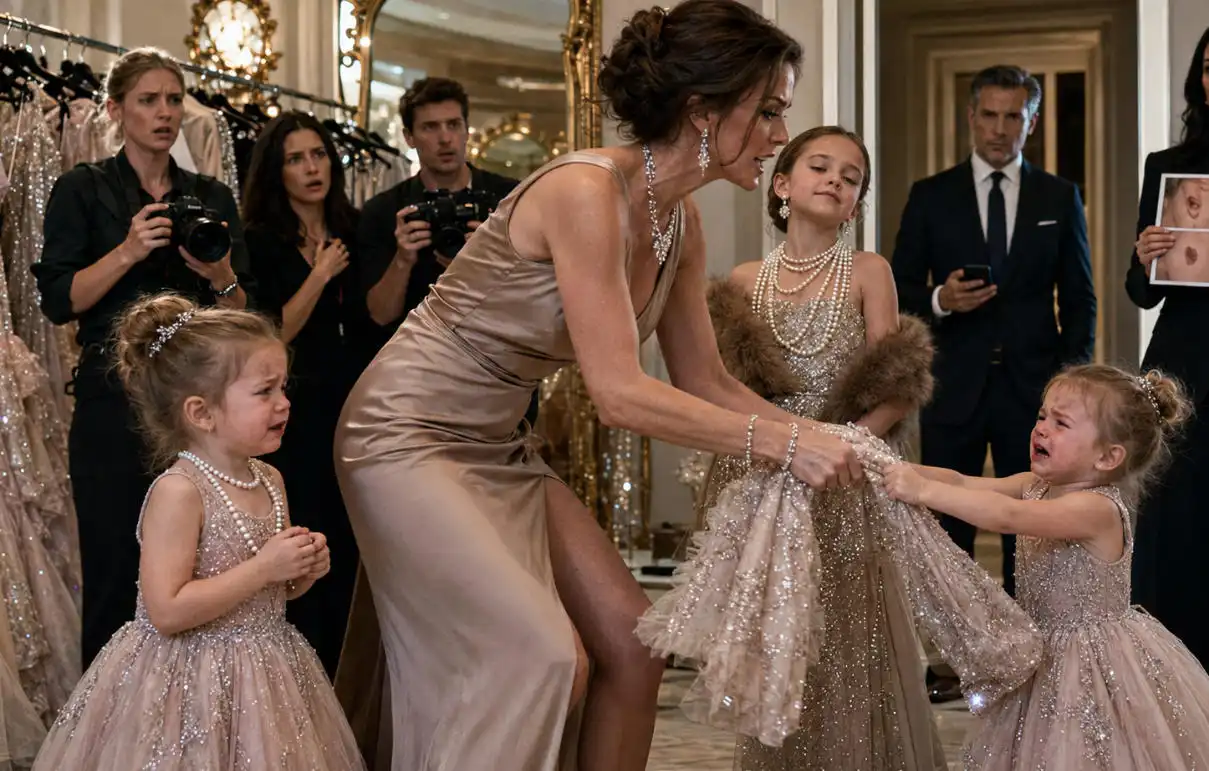
The editor pointed at Rose’s collarbone.
Not loudly.
Not dramatically.
Just one quiet finger.
And somehow, it made Vanessa look smaller than any scream ever could.
“There are supposed to be two very specific little girls in this shoot,” the editor said. “And neither of them is wearing that gown right now.”
Vanessa blinked.
Then she laughed.
That brittle little laugh people use when they know the room has turned but they still think money can buy it back.
“Oh, come on,” she said. “They’re toddlers. Nobody can tell the difference once the styling is right.”
My daughter Lily squeezed Rose’s hand so hard her knuckles turned white.
Rose kept one little palm over the star-shaped birthmark near her collarbone.
The same mark her sister had in reverse near her wrist.
A matched pair.
One tiny blue-gray star on Rose.
One tiny blue-gray star on Lily.
That was the entire concept of the magazine feature.
“The Star Twins of American Fashion.”
That title had been chosen months earlier.
Not by Vanessa.
Not by some stylist chasing gossip.
By the global editor herself.
Because my daughters were not just rich little girls playing dress-up.
They were the private muses behind a children’s couture foundation I had funded quietly for three years.
Every dress in that room had been created around them.
Every pattern.
Every fitting.
Every embroidered stitch.
And Vanessa knew it.
That was what made it ugly.
She did not misunderstand.
She planned it.
The shoot was supposed to happen in our mansion’s dressing room because the magazine wanted intimacy.
A home feature.
Soft light.
Family heritage.
Little girls surrounded by custom gowns made by artisans from Paris, Milan, New York, and London.
But when the crew arrived that morning, Vanessa got there first.
She told security she was coordinating family logistics.
She told the stylists I was “running late.”
She told the assistant editor that my daughters were “shy and difficult.”
Then she introduced her own daughter, Brielle, as “the stronger face of the family.”
By the time I walked upstairs, my twins had been pushed to the corner beside a rack of backup clothes.
Backup clothes.
For my children.
In my house.
At their own shoot.
Brielle stood on the center carpet wearing Lily’s pearl headband and Rose’s satin slippers.
She was only six.
I did not blame the child.
She kept looking at her mother, waiting for permission to smile.
Vanessa gave plenty.
“Chin up, sweetheart,” she said. “You were born for cameras.”
Then she turned to my twins.
“Watch and learn.”
One photographer shifted uncomfortably.
A young stylist whispered, “Should we pause?”
Vanessa shot him a look sharp enough to cut silk.
“Do you want to work in this industry or not?”
That was the sentence that told me everything.
She thought power was volume.
She thought access was ownership.
She thought because she had married into money, she could steal dignity from two little girls too young to defend themselves.
I wanted to walk across the room and take those gowns back.
I wanted to shout.
I wanted to throw every camera out of my house.
But I didn’t.
I looked at Lily.
I looked at Rose.
Then I looked at the mirror wall behind Vanessa.
Every angle was being recorded by the security system I had installed after a previous charity theft in Palm Beach.
Audio too.
Vanessa didn’t know that.
The magazine crew didn’t know that.
But I did.
So I stayed calm.
I crouched down beside my daughters.
“Are you hurt?” I asked.
Lily shook her head, but her lower lip trembled.
Rose whispered, “Auntie said we’re not princesses.”
I kissed the top of her head.
“You’re not princesses,” I said softly. “You’re my daughters. That’s better.”
Then I stood.
Vanessa rolled her eyes.
“Oh, please. Don’t turn this into a fatherhood speech.”
The editor-in-chief, Celeste Monroe, had just arrived from New York.
She was not loud either.
That was why the room feared her.
She had ended careers with a pause.
She opened the original creative brief and held it up.
Two toddler silhouettes.
Two custom birthmark references.
Two sets of initials.
L.M. and R.M.
Lily Mercer.
Rose Mercer.
My daughters.
Not Brielle.
Not Vanessa.
Not some social-climbing fantasy dressed in borrowed satin.
Celeste looked at Brielle and softened her voice.
“Sweetheart, come down from the carpet.”
Brielle looked at Vanessa.
Vanessa grabbed her shoulder.
“No,” she snapped. “My daughter is already dressed. You can shoot her first and fix the copy later.”
A few people gasped.
Celeste’s eyes lifted.
“Fix the copy?”
Vanessa realized too late what she had admitted.
I lifted my phone and made the call.
Not to security.
Not to the police.
Not yet.
To Julian Cross.
The chairman of the International Couture Council.
My oldest friend.
The man magazines called only when they wanted access to the real rooms behind fashion.
He answered on speaker.
“Elliot,” he said. “Is Celeste there?”
The room went dead silent.
Vanessa stared at my phone.
Elliot Mercer was my name.
But most people in fashion knew me by another one.
Not because I liked it.
Because other people kept saying it.
The godfather of modern couture.
I had built three heritage houses back from bankruptcy.
I had chaired the private client ethics board.
I held veto rights over a global consortium of designers, advertisers, stylists, and luxury retailers after a scandal years earlier nearly destroyed young models and unpaid artisans.
I rarely used that power.
I hated using it.
But I had one rule.
Nobody exploited children under my roof.
“Julian,” I said, “we may have a breach of identity representation, wardrobe misappropriation, and unauthorized substitution of minors for a contracted editorial feature.”
Vanessa’s face drained.
Celeste closed her brief.
“Confirmed,” she said.
Julian’s voice changed.
“Is the magazine crew present?”
“Yes,” I said.
“Is the substitute child represented as one of the contracted minors?”
Celeste answered before I could.
“Yes.”
“And are the original couture pieces currently on the substitute child?”
A stylist looked like he might faint.
“Yes,” Celeste said.
Vanessa stepped forward.
“This is insane. It’s a family misunderstanding.”
I looked at the mirror wall.
“No,” I said. “It’s recorded.”
That was the first hammer.
The second came when our house counsel entered through the side door with my security director.
They had been watching from downstairs since the first alert.
The system flagged Vanessa the moment she moved my daughters’ garments without authorization.
Every couture piece had embedded inventory tags for insurance.
Every garment belonged to the Mercer Children’s Couture Foundation until the shoot ended.
No one had the right to transfer them.
No one had the right to put them on a different child.
No one had the right to represent that child as Lily or Rose.
Vanessa backed away.
“You can’t do this to me,” she said.
I almost laughed.
That was her problem.
She thought consequences were something people did to her.
Not something she earned.
Celeste turned to the magazine’s creative director.
“Stop the shoot.”
The creative director nodded instantly.
Celeste continued, “Remove every image taken after wardrobe transfer. Quarantine all files. No publishing, no leaks, no behind-the-scenes clips.”
Vanessa’s eyes widened.
“You’re ruining my daughter’s chance!”
Celeste’s voice went cold.
“Your daughter never had a chance that belonged to her.”
Brielle began to cry.
That was when I stepped in.
I walked to the little girl and knelt.
“Brielle,” I said gently, “you did nothing wrong by wearing what your mother gave you.”
She looked at me through wet lashes.
“Mom said I had to be better than them.”
Vanessa hissed, “Brielle.”
Too late.
The whole room heard it.
So did the cameras.
So did the security system.
So did Celeste.
I asked one of the stylists to help Brielle change privately and respectfully.
No cameras.
No shame for the child.
Only the adult who had used her.
Vanessa tried to follow.
Security blocked her.
That was when she snapped.
“You think those girls deserve all this just because they have your name?” she shouted. “My daughter is prettier. She’s older. She can pose. She can sell. Your twins don’t even know what they’re wearing.”
My daughters heard every word.
Lily buried her face in my leg.
Rose stared at Vanessa like she was trying to understand how an adult could sound so cruel.
I picked Rose up.
Then Lily.
One in each arm.
“They don’t need to understand couture,” I said. “They understand being humiliated.”
Vanessa laughed again, but this time nobody joined her.
“You’re all acting like I committed a crime.”
House counsel stepped forward.
“Possibly several civil violations,” she said. “And depending on what you submitted to the magazine in writing, potentially fraud.”
Vanessa’s mouth opened.
No sound came out.
Then Celeste handed me the intake folder.
Inside were printed emails.
Vanessa had sent them from a private account pretending to be my family coordinator.
She had changed the call sheet.
She had removed the nanny from the room.
She had requested that “the more camera-ready cousin” be dressed first.
She had even written:
“Mr. Mercer approves the flexible use of child talent for visual consistency.”
My signature was pasted below.
Badly.
The kind of copy-paste forgery someone makes when they believe charm will handle the details.
I looked at her.
“You used my name.”
She whispered, “It was just for access.”
“No,” I said. “It was to erase my daughters.”
That was the third hammer.
Julian asked for copies of everything.
Celeste sent them while standing in the middle of the dressing room.
Within twenty minutes, the magazine’s legal department called.
Within thirty, their publisher called.
Within forty, the entire shoot contract was terminated for cause.
Not against my daughters.
Against the magazine’s internal team for allowing an unauthorized substitution to proceed.
Celeste did not argue.
She accepted responsibility.
That mattered.
So I did not destroy her career.
But the magazine itself had a choice to make.
Protect the children.
Or protect the optics.
They hesitated.
For eleven seconds.
That was enough.
I invoked the veto.
The International Couture Council suspended the magazine’s access to all Mercer Foundation couture archives, private client features, and donor-backed children’s fashion initiatives pending investigation.
Their September luxury supplement lost four houses before lunch.
Three advertisers paused campaigns by dinner.
By midnight, the magazine issued a public correction without naming my children.
Celeste personally called me and said, “We failed them.”
I said, “Then help me fix it.”
She did.
The next morning, Vanessa tried to go shopping.
That was when her fantasy world collapsed.
Her private client account at Maison Ardent was suspended.
Her appointment at Bellucci Kids was canceled.
Her preferred stylist dropped her.
The luxury resale platform flagged the custom pearl headband she tried to list online because it was foundation property.
Then came the party invitations.
Gone.
The charity gala table.
Withdrawn.
The children’s fashion week passes.
Revoked.
The influencer brunches she used to parade through with Brielle in borrowed couture.
Closed doors.
No one announced a blacklist.
That would have been crude.
They simply stopped opening doors she had never earned.
Vanessa called my wife first.
My wife did not answer.
She called me next.
I answered.
Because I wanted her to say it.
“You went too far,” she snapped.
“No,” I said. “You did.”
“You humiliated my family.”
“You humiliated two toddlers in front of strangers.”
“They won’t even remember!”
I looked across the nursery where Lily and Rose were sitting together, drawing stars on paper crowns.
“They remembered enough to ask why Aunt Vanessa didn’t like them.”
Silence.
Then she tried the last weapon people like her always try.
Pity.
“Brielle is suffering.”
That softened me for exactly the right reason.
“Brielle is welcome in our home when she is with a safe adult,” I said. “She is not responsible for your ambition.”
Vanessa went quiet.
I continued.
“But you are not welcome here until you apologize to my daughters in a room with no cameras, no audience, and no benefit to yourself.”
She hung up.
She never apologized.
So the legal process continued.
The forged approval email became the center of the case.
The unauthorized garment transfer became an insurance claim.
The attempt to misrepresent Brielle as one of my daughters became a professional ethics investigation.
Vanessa’s husband, my brother-in-law, claimed he knew nothing.
Then the texts came out.
He had written:
“Just get Brielle in the shoot. Elliot won’t make a scene in front of Vogue people.”
He was wrong.
I did not make a scene.
I made a record.
Three months later, the corrected feature came out.
Not in the same magazine.
They had lost that privilege.
Celeste resigned and launched an independent editorial house built around ethical children’s fashion.
Her first cover featured Lily and Rose.
My girls stood barefoot in our dressing room, wearing simple ivory dresses with tiny embroidered stars at the cuffs.
No heavy makeup.
No forced poses.
No stolen identity.
Just two little girls holding hands.
The headline read:
“The Twins Who Changed the Rules.”
The cover went global.
VOGUE Global requested licensing.
This time, I said yes only after every protection was in writing.
Child advocates reviewed the set.
A psychologist stayed on-site.
No one touched my daughters’ clothes without consent from their mother, their nanny, and the wardrobe director.
And my girls?
They laughed through the whole shoot.
Rose kept asking if the camera liked her star.
Lily told everyone her sister’s star was “the moon’s baby.”
That line ended up in the article.
It became the most shared quote of the campaign.
As for Vanessa, she became famous too.
Not the way she wanted.
The security clip never showed my daughters’ faces.
I made sure of that.
But it showed enough.
A grown woman taking a gown from a toddler.
A grown woman telling stylists to replace two little girls with her own child.
A grown woman saying, “In fashion, identity is styling.”
The internet did not forgive that.
Luxury circles called it “the dressing room scandal.”
Parents called it what it was.
Cruel.
Her family moved from front-row seats to whispered side-eyes.
Brielle eventually came to our house with her grandmother.
She brought Lily and Rose two handmade bracelets.
“I’m sorry my mom made me wear your dresses,” she said.
Lily hugged her.
Rose gave her a paper crown.
Children can be kinder than the adults who fail them.
That was the part that healed me.
Not the contracts.
Not the cover.
Not Vanessa losing access to every room she worshiped.
It was watching my daughters learn that being stolen from does not make you less valuable.
Being copied does not make you replaceable.
And being quiet does not mean you are powerless.
The last time I saw Vanessa, she was outside a fashion benefit arguing with a door attendant who would not find her name on the list.
People were filming.
She saw me.
For one second, I thought she might finally apologize.
Instead, she looked away.
That was fine.
My daughters were inside, standing beneath a giant framed copy of their global cover.
Lily pointed at it and said, “Daddy, that’s us.”
I picked them both up.
“Yes,” I said. “And nobody gets to pretend otherwise again.”
Vanessa wanted her daughter to become a fake princess.
Instead, she taught the world why real dignity cannot be stolen.
Pick a side and share this: was I too harsh for using every rule in the industry against her, or did she earn every consequence the moment she tried to erase my children?
Disclaimer: Mention of any brand or trademark is for identification only and does not imply partnership or endorsement