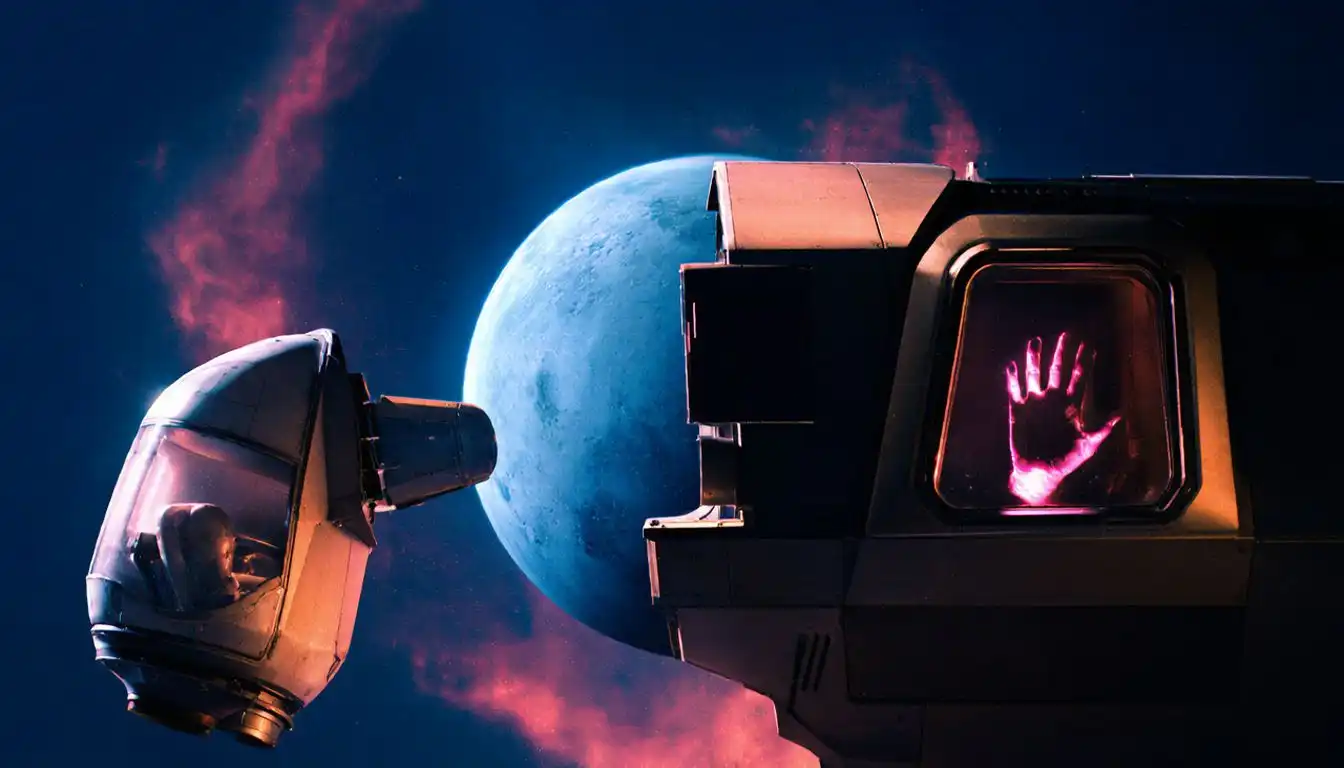
The Seed Vessel would launch in seventy-two hours. Lin Shen stood beneath Launch Complex 3 at the Kennedy Space Center, gazing up at the silver-white rocket. At its tip sat Lightyear One—humanity's first interstellar colony ship. Designed passenger capacity: zero human adults. Instead, one hundred thousand frozen human embryos. He was the only living passenger. Or rather, the only living human being on board. "Lin Gong, airlock check complete." The voice came through his earpiece from Mission Control. "Su Xia's cell sample has been transferred to Cryo Bay 3. Priority... highest." Lin Shen was silent for three seconds. "Acknowledged." He didn't say thank you. Mission Control understood. Some things are too heavy to say aloud.
Su Xia was his fiancée. Or rather, his former fiancée. One year ago, when the Lightyear Project was announced, Su Xia was already in the late stages of ALS. She knew she wouldn't live to see the colony ship completed. So she made a decision. She gave Lin Shen her cell samples. "Take it with you," she said from her hospital bed, her voice thin as paper. "When you reach the new planet, plant these cells for me." "It's not you," Lin Shen said, holding her hand. "Of course it is." She smiled—that same warm smile she had before the illness. "Your DNA carries traces of me. These cells do too. They'll grow into a tree, or a flower, or... who knows? Better than this broken body of mine anyway." Lin Shen couldn't argue. He couldn't change her mind any more than he could change the fact that he had to board this ship. Three days later, Su Xia passed away. Her cell samples were already in Bay 3 of the Lightyear One, frozen in an independent thermal unit. The unit's priority was set to "highest"—higher than hull shielding, higher than life support, higher than Lin Shen's own life. That was Su Xia's idea. "You're not planning to come back anyway," she told him on her last day. "So set my cells as highest priority. That way if anything goes wrong... the bay will protect them first." "Su Xia..." "I love you." She cut him off. "But I love the version of me on the new planet more. Help me get there, okay?" He didn't answer. But he wrote that priority setting into the code, with seven layers of encryption no one could override.
Launch was at three in the morning. Everyone within thirty kilometers of Kennedy Space Center had been evacuated. Not because of danger—the NASA officials simply didn't want too many people to witness humanity's first escape. Lin Shen sat in the cockpit, watching the flames bloom outside his window. The Lightyear One's engines fired, a brilliant blue-white glow. The rocket shuddered, then began to rise. T-minus 10 seconds. T-minus 0. Acceleration pressed Lin Shen into his seat. He felt his eye sockets distort under the G-forces. Then: darkness. Not the darkness of night, but the darkness of space—pure, absolute, with no reference points at all. The Lightyear One entered its planned orbit. Solar panels unfolded like two silver wings. Earth shrank to a blue marble in the distance. "Lin Shen, please confirm receipt." That was the last transmission from the ground, crackling through his earpiece. "Confirmed." "...Safe travels." Then static. Earth's signal had gone out of range. From this moment until he reached Proxima Centauri b, he would be the most isolated human being in the universe.
The Lightyear One's journey was scheduled for sixty years. At this velocity, it couldn't approach the speed of light—that would require the energy output of an entire solar system. Instead, Lightyear One traveled at 15% of light speed. Sixty years to reach Proxima Centauri b. Sixty years of cyclic hibernation. Lin Shen would wake every twenty years for system maintenance. The rest of the time, his body would be fixed in the hibernation pod, vital signs suspended at minimal function. But this time, he couldn't sleep. He sat in the cockpit, watching the stars drift past the viewport. The stars weren't moving—it was Lightyear One hurtling through the void at forty-five thousand kilometers per second. He opened Su Xia's cell sample bay. Through the observation window, he could see the small thermal unit containing the last physical trace of Su Xia. Her skin cells, reprogrammed into totipotent stem cells, capable of differentiating into any tissue. "Can you see the stars out there?" he said to the unit. The unit didn't answer. "Let me show you." Using the ship's robotic arm, he carefully extracted the unit and positioned it against the viewport. That way, no matter which direction Lightyear One turned, Su Xia's cells would always have a view of the cosmos. "You always said you wanted to go to space." He spoke softly. "Now you're on your way."
Year thirty-two. When Lin Shen woke from his first hibernation cycle, he found something wrong with the ship. The main engine's cooling system had developed a crack—not catastrophic, but it meant the ship would steadily bleed fuel over the next twenty-eight years. According to the original plan, that fuel was supposed to be enough for him to decelerate into orbit around Proxima Centauri b and conduct preliminary planetary surface operations. Now it wasn't. Lin Shen spent three days recalculating every variable. The conclusion: if he didn't repair the cooling system, Lightyear One would be unable to decelerate. It would shoot past Proxima Centauri b at thirty kilometers per second and continue hurtling into infinite void—until the heat death of the universe. But repairing the cooling system required an EVA—extravehicular activity. And EVA consumed life support resources. If anything went wrong during his spacewalk, Lightyear One would become a true ghost ship, drifting forever through the cosmos. Lin Shen stared at the numbers for a long time. Then he made his decision. He modified the life support parameters. He reduced the oxygen and food reserves allocated for himself by thirty percent, diverting them to the cooling system's backup module. That way, even if something happened to him during the spacewalk, the backup module could sustain basic operations long enough to deliver Su Xia's cells safely to their destination. The EVA took eleven hours. When he dragged his exhausted body back inside, the engine's cooling system was restored to full function. But his life support reserves had been reduced by thirty percent. This meant: if anything went wrong after his second hibernation cycle, he wouldn't have enough resources to survive until arrival. He logged this information in the ship's journal but didn't report it to Mission Control. Earth could no longer hear him anyway.
Year fifty-nine. When Lin Shen woke from his second hibernation, he could feel something was wrong with his body. Not a mechanical failure—time itself. Sixty years of cosmic radiation had been slowly corroding his cells. His immune system was degrading. Tiny fractures had appeared in his retinas. His lungs were exchanging oxygen at seventy percent of normal efficiency. He calculated: at this rate, he had roughly three years left. Three years until Lightyear One reached Proxima Centauri b. But he wouldn't live to see it. Lin Shen spent two days writing his final words. Not to Earth—Earth was beyond hearing. To the future. He used the ship's AI system, Athena, to record a video. "Hello, future friends." He spoke clearly. "My name is Lin Shen. Captain of the Lightyear One, and its only crew member." "What you're seeing now is a ship carrying one hundred thousand human embryos and one special cell sample. Those embryos are humanity's last hope—if Proxima Centauri b isn't suitable for life, they'll remain preserved here, waiting for the next rescue ship." "And that cell sample... belongs to my wife." He paused. "Her name was Su Xia. One year ago—no, sixty years ago—she passed away. But her cells are still alive. They're in Bay 3 of this ship, priority set to highest." "I've reprogrammed the embryo bay. When Lightyear One enters orbit around Proxima Centauri b, the bay will separate automatically, decelerate, and land. At that point, the AI system will wake a portion of the embryos and let them begin a new civilization." "As for Su Xia's cells... I hope you'll let them grow. Plant, animal, whatever form—anything is fine." "Because that's what I promised her." He smiled at the camera. "My star shattered. But her light will be reborn in the new world."
Year sixty. Lin Shen didn't die of disease. He died waiting. When Lightyear One's deceleration engines fired, he was sitting in the cockpit, watching Proxima Centauri b slowly enlarge in the viewport. The planet matched NASA's observations—barren, cold, with a thin atmosphere. But at the poles, ice sheets gleamed. And beneath that ice, traces of liquid water. Water meant possibility. The deceleration burn roared for three hours. Then came orbital insertion. Lightyear One entered low orbit around Proxima Centauri b. Lin Shen stared at that desolate planet and felt, for the first time, a strange calm. "Athena," he said, "initiate embryo bay separation." "Confirm execution?" "Confirmed." Separation sequence initiated. The embryo bay and the crew compartment disconnected at the junction with Bay 3—Bay 3, where Su Xia's cells waited. "Lin Shen," Athena said suddenly, "your vital signs are failing. You need to enter the medical bay within the next ten minutes, or—" "I know." He walked to Bay 3 and placed his hand against the thermal unit's surface. Through the observation window, he could see the pale pink cells suspended peacefully in their nutrient solution, like a sleeping star. "We made it," he whispered. He didn't say anything else. He opened the thermal unit and transferred Su Xia's cell sample into a small lander capsule. This capsule was designed to fly independently, landing on the planetary surface ahead of the embryo bay to establish an initial life signature. That way, when the children from the embryo bay descended to this new world, they would know—they were not alone. The lander was ejected, carrying Su Xia's cells toward Proxima Centauri b's frozen south pole. Lin Shen stood at the viewport, watching the small light disappear beyond the horizon. Then he shut down all non-essential systems. He sat alone in the cockpit, waiting for the end.
Later generations didn't know who Lin Shen was. They only knew that they had landed on an alien world with a hundred thousand companions, and a ship full of supplies. In the ship's computer, they found a video file and a journal entry. The video showed a man in his mid-fifties, gray-haired but with bright eyes. He spoke calmly about his sixty-year journey, and why the embryos were here. The journal contained something more personal—daily system logs, observations of the stars, and his longing for Su Xia. They later found the small lander on Proxima Centauri b's southern ice sheet. It was damaged—the impact of landing had been too harsh. But inside, the cell sample was intact. They used those cells to cultivate a plant—a white-flowered vine that spread across the ice like a gentle galaxy. No one knew what to call this plant. So they gave it a name.
Disclaimer: Mention of any brand or trademark is for identification only and does not imply partnership or endorsement