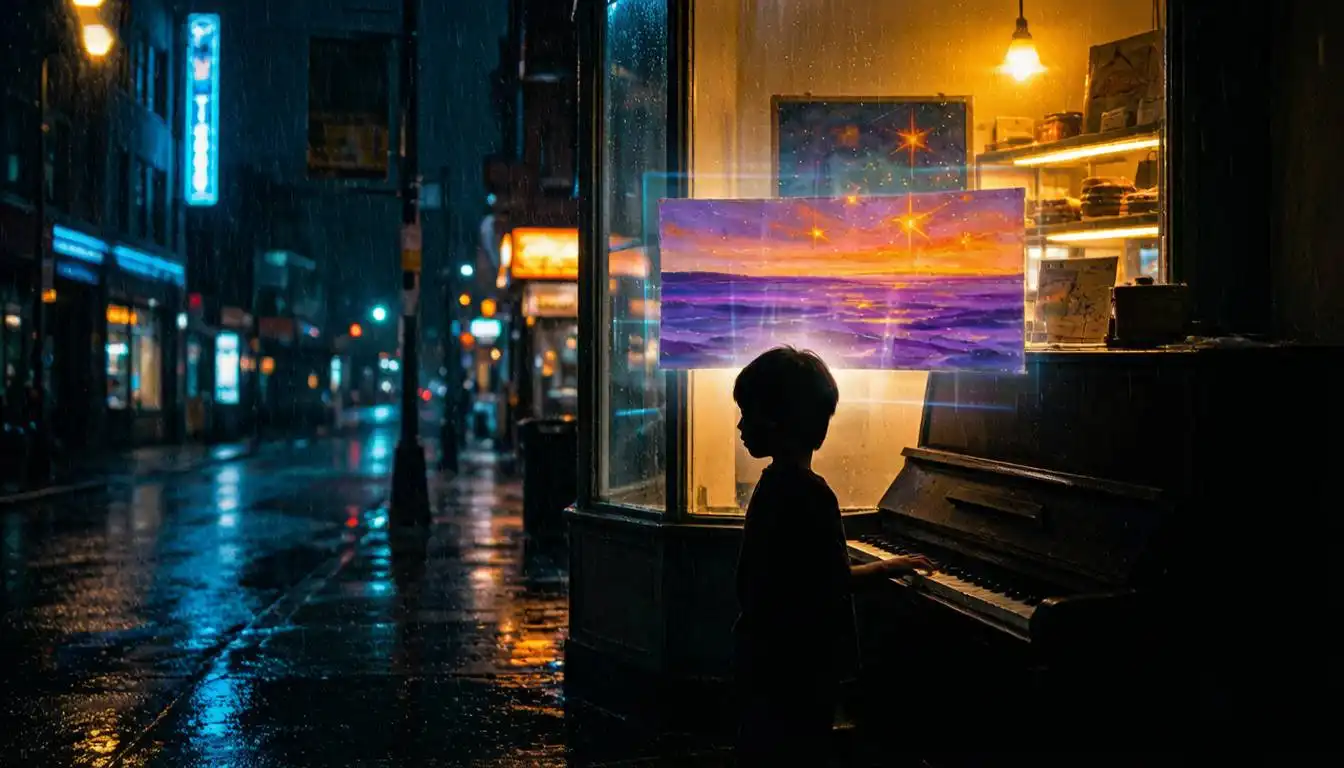
Shen Nian woke at four in the morning. Not because something woke her — her body simply decided it was done sleeping. She lay in the dark, listening to the East River's tide through the window and the occasional hydraulic groan of a garbage truck passing by. Her phone glowed on the nightstand. She picked it up. An email from Milan. Sender: Politecnico di Milano, Department of Architecture. Subject: Notification of the passing of Professor Alessandro Bianchi. She stared at the screen for a long time. Long enough for the screen to dim, then brighten again at her touch. Long enough for the sky outside to shift from deep blue to pale gray. Long enough for her to realize — her face was dry. There were no tears. She did not cry. Fifteen years ago, she would have expected herself to sob. But fifteen years had passed, and she had apparently used up all her tears in advance. Or perhaps she had been crying all along, imperceptibly, without noticing. Alessandro Bianchi. Professor of Architecture. Sixty-three years old. Lung cancer. The email said the funeral would be held in Milan in three days. Friends and acquaintances were cordially invited. Shen Nian got up, poured herself a glass of cold water, and stood by the window. Manhattan was half-awake. A tugboat moved slowly across the East River, its stern light drawing a golden trail on the water. The streets of the Upper East Side were empty except for a sanitation worker hosing down the sidewalk with a high-pressure jet. She thought: Should I go? Fifteen years. Enough time for a girl to become an architect. Enough time for a one-sided crush to fade into the background noise of a career. Enough time for a person to say, "That's all in the past." But she knew it was not in the past. She had simply learned not to look back. Shen Nian picked up her phone and booked a flight to Milan. Then she opened an old email account and found the only exchange she had ever had with Professor Bianchi — She had written: "Professor, thank you for your guidance this semester. I thoroughly enjoyed your lectures on space and memory." He had replied: "Shen Nian, you are a gifted observer. Keep your eyes." Just two sentences. She had carried them for fifteen years.
Autumn 2011. Shen Nian was twenty-five. After graduating from the Department of Architecture at Tsinghua University, she arrived at the Politecnico di Milano on a full scholarship to pursue a master's degree in architecture. She was the only Chinese student in her cohort. Her Italian was halting — she could say "hello," "thank you," and "how much does this cost." The first class was titled "Architecture and the Theory of Memory." When the bell rang, a tall man entered through the back door of the classroom. He set a stack of books on the lectern, turned to the blackboard, and drew a square. At each of the four corners, he placed a dot. He turned around. In English tinged with a Tuscan accent, he said: "This is everything you will learn this semester. One room. Four walls. One space." Alessandro Bianchi was forty-eight that year. Neither tall nor short, neither thin nor heavy. He wore a dark gray sweater and beige chinos, silver wire-rimmed glasses. His hair was already touched with gray, but his eyes were olive green — in the afternoon light of Milan, they shifted between green and amber. Shen Nian loved his eyes. She also loved his voice. The way he drew on the blackboard with such focused concentration. The casual sincerity with which he greeted the cleaning staff in the hallway, never condescending. She never told anyone about any of this. She sat in the third row by the window. She arrived fifteen minutes early to every class. She thought no one noticed. But Professor Bianchi noticed. One day after class, as she was packing her bag, he called out to her. "Shen Nian." She turned. "Your essay last week — on Adolf Loos and the Raumplan design. It was good." "Thank you." "But." He walked over, holding her paper, covered in pencil annotations. "Your analysis is very precise. But it lacks one thing." "What?" "Temperature." She was taken aback. "Architecture is not just geometry, Shen Nian. It is a three-dimensional container for human emotion. The warmth of the bodies inside a room. The echo of voices. The speed at which light travels across a surface. These are what make a building alive. Your analysis saw the walls, but it did not see the people inside them." She looked at him, feeling something strike her — not criticism, but understanding. Professor Bianchi handed the paper back to her and smiled — a very faint smile, barely a curve, but she remembered it. "Next semester I am running a studio — 'Space and Narrative.' You should join." "Okay." She turned and walked out of the classroom. In the hallway, she looked down at her hands. They were trembling slightly. That was not a good sign. Because she knew exactly what it meant.
The "Space and Narrative" studio was held on the second floor of a fifteenth-century former monastery. The ceiling was high, painted with a fresco of the Annunciation. The Archangel Gabriel's wings were gilded with gold leaf, still gleaming under Milan's gray light. This was Professor Bianchi's favorite studio. He said teaching here felt like teaching inside architectural history itself. Twelve students sat around a long wooden table. Each was working on a project about "memory spaces" — places in architecture or urban design that carry collective or personal memory. Shen Nian's project was about Beijing's hutong neighborhoods. She spent three months photographing, surveying, and conducting interviews. She documented seventeen hutongs — from their disappearance to their rebirth — and created a multimedia installation: a wall with seventeen recesses, each containing a hidden audio device. When you reached your hand into a recess, you could hear the story of someone who had lived there. At the final review, Professor Bianchi stood before the wall and listened to seven stories. Then he turned to Shen Nian. He said nothing. He just kept looking at the wall. Finally he said: "You can feel their warmth." Shen Nian knew he was quoting his own words back to her. It might have been the proudest moment of her life.
After the final review, the studio students went for drinks at a bar along the Navigli canal. Shen Nian had two glasses of Italian white wine and felt lightheaded. Professor Bianchi came too — he sat at the far end of the long table, chatting with a teaching assistant, occasionally laughing. Shen Nian wanted to walk over. To say something. To ask if he wanted to see a building she had discovered — an abandoned factory near Porta Romana. She had climbed over the fence to explore it. Inside, there was a vast atrium where daylight poured through a broken glass roof like a cathedral. She stood up. Took two steps. Stopped. A female teaching assistant had moved to stand beside Professor Bianchi. She placed her hand on his shoulder with natural ease. Shen Nian sat back down. She finished the wine she had left — half a glass. That night, she walked back to her dormitory alone. The November wind of Milan hit her face. Her eyes were hot. She told herself it was the white wine. Alcohol has warmth. Alcohol makes you imagine things. She stood outside her building for a moment. An old man walked his dog — a lumbering golden retriever that sniffed the base of a tree under the streetlight. She went upstairs. Showered. Got into bed. She did not sleep.
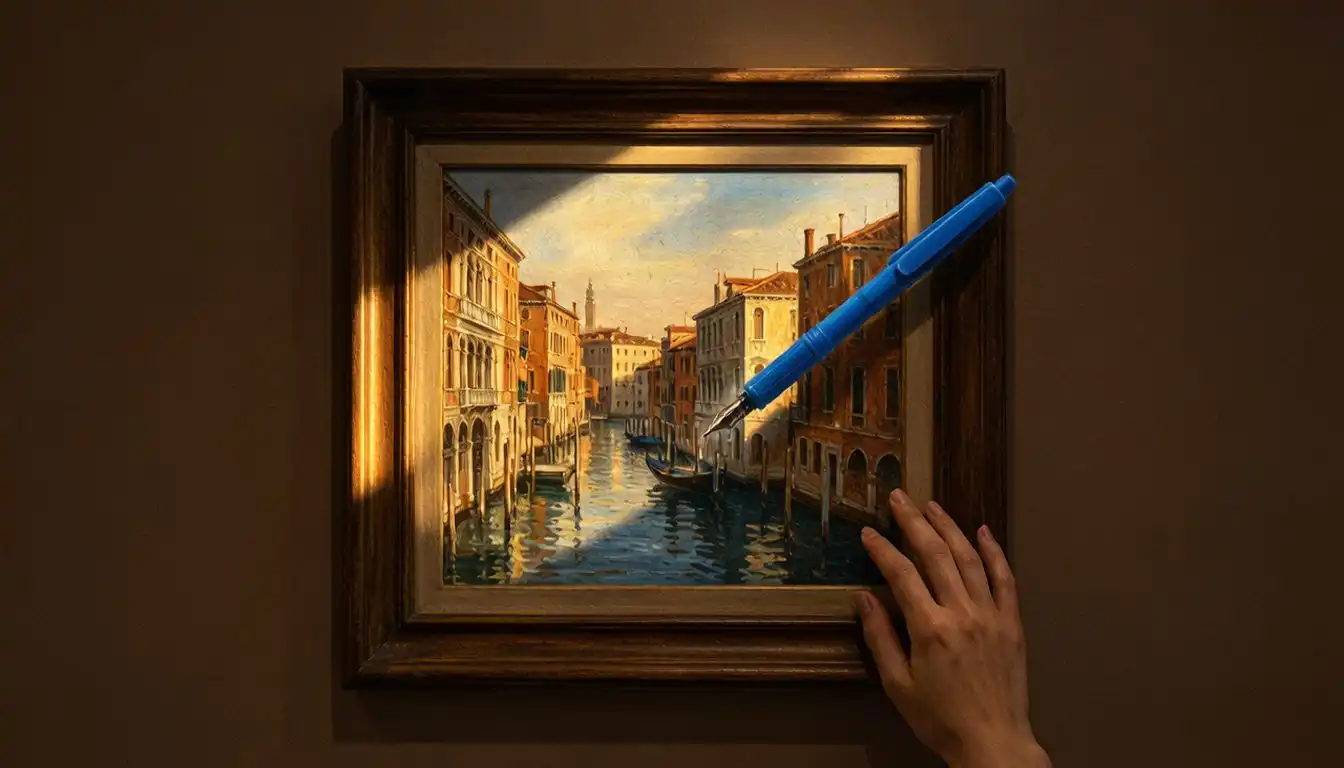
June 2012. Shen Nian completed her master's thesis — on the spatial representation of memory in Beijing's hutongs. The defense passed smoothly. She received her degree. The day before leaving Milan, she went to the Pinacoteca di Brera. The Brera Gallery sits in the heart of the Brera district, a museum converted from a seventeenth-century palace. Shen Nian had visited many times. Each time, she went to see Mantegna's "Lamentation of Christ" — the painting where Christ's body is shown in extreme foreshortening, the soles of his feet facing the viewer. She loved the composition. The directness with which it confronted death. But that day, she stood for a long time in front of a Canaletto. It depicted the Grand Canal in Venice. Sunlight broke across the water into countless points of brilliant light. A gondola sat at the edge of the frame, the gondolier holding his long pole — as if he might at any moment row out of the painting and into the room where you stood. She thought: If only architecture could do this — make the viewer feel they could step inside. She left the gallery and walked slowly along Brera's cobblestone streets. She passed a stationery shop and stopped to look at the window display — a plaster face mask, half a face, eyes closed, expression serene. She went inside and bought a fountain pen. Not a good pen. Just an ordinary blue plastic fountain pen. She did not know why she bought it. Perhaps to remember this moment. Perhaps for no reason at all. Then she walked to the door of Professor Bianchi's office. The office was on the second floor of the university building, its window facing an inner courtyard. A large magnolia tree grew there — it was in full bloom, a cascade of white flowers like small lanterns. She stood at the door, holding a small paper bag. Inside was a card and the pen. She wanted to knock. Her hand rose. Stopped in mid-air. Fifteen seconds. Thirty seconds. She heard Professor Bianchi's voice from inside. He was on the phone, speaking rapid Italian. He was laughing. She placed the paper bag on the chair outside his door. Then she turned and walked away. The card read: "Professor, thank you. I learned to feel the warmth. Shen Nian." She never knew if he received the card. She was not even sure she wanted him to.
After Milan, Shen Nian returned to Beijing and worked at an architecture firm for two years. Then she applied to Columbia University's post-professional architecture program and moved to New York. New York is a good city for forgetting. It is too big, too loud, too busy. Every morning, you are woken by the roar of the subway, surrounded by the smell of hot dog carts, pushed forward by the crowds in Times Square. You have no time to think about anything except where to go next. Shen Nian worked at SOM for eight years, rising from junior designer to senior architect. She worked on two super-tall towers, a museum, and an airport terminal. Her name appeared on the project teams — small font, but it was there. She had two relationships. The first was with an American working in finance. They dated for eight months and broke up when the subject of moving in together came up. The reason, Shen Nian realized, was that she could never feel that "warmth" with him. They were good together, but she was always pretending — pretending to be invested, pretending to care, pretending he was the one. When they broke up, he said: "You never really let me into your life." She could not argue. The second was with a Chinese man who worked as a curator at MoMA — gentle, considerate, understanding of her work rhythm. They were together for a year and a half. They almost got married. Almost. One time, they visited an architecture exhibition in Brooklyn. There was a photograph — the Navigli canal in Milan at night, lights rippling on the water. He looked at the photograph and said, "Do you want to go? I can arrange the vacation." Shen Nian said "Sure" and turned to the next gallery. Her eyes were red. He saw. He did not ask. They broke up later. Not because of that photograph. But Shen Nian knew it was the starting point. Some cities you cannot talk about. Some memories you cannot share — not because you do not want to, but because you do not know how. Between "I once had a crush on my professor" and "I have not stopped thinking about him for fifteen years," there is a distance that language cannot cross.
Milan. March 2026. The funeral was held in a small church. The day was sunny — rare good weather for March in Milan. Sunlight streamed through the stained glass, casting blue shadows on the stone floor. Shen Nian sat in the fourth row, near the aisle. She wore a black coat. Her hair was pinned up. She looked exactly like what she was — a former student who happened to be in Milan, come to pay respects to a respected teacher. About forty people were gathered. Professor Bianchi's family — a sister who had come from Tuscany; several nieces and nephews; colleagues; former students. His wife was not there. Shen Nian later learned that he had been divorced for ten years. After the service, Professor Bianchi's sister — a gray-haired woman with the same olive-green eyes — approached her. "Are you Shen Nian?" "Yes." "Alessandro mentioned you." Shen Nian did not know how to respond. "He asked me to give you this." She took a manila envelope from her bag. Not large — A5 size. Unsealed. Shen Nian accepted it. "Three years ago, when he was organizing his office, he put this in a separate box. The box had your name on it." "Did he say anything else?" "He said, 'If anyone ever asks, give this to her.'" Shen Nian opened the envelope. Inside was a photograph. It showed a wall. On the wall was an installation — seventeen recesses, each with a beam of light inside. Her hutong memory installation. On the back of the photograph, written in pencil, in handwriting she knew well — the same hand that had annotated her thesis fifteen years ago — was one line: "Shen Nian — I touched the warmth."
The envelope contained one more thing. A folded piece of paper. Shen Nian opened it in her hotel room in Milan. Outside the window, the sky was the same color it had been when she left Milan fifteen years ago — that transitional blue between afternoon and dusk. It was a pencil sketch. It showed a young woman, seated in a chair by the window. The window was open — a breeze had caught the curtain, lifting it into a curve. The woman was in profile, her gaze fixed on a book in her hands. Her hair was black. A few loose strands were lifted by the wind. It was her. Fifteen years ago. In the "Space and Narrative" studio classroom. At a moment when she thought no one was watching. This angle — Shen Nian suddenly understood where the drawing had been made. The professor stood at the lectern. From there, he could see the entire classroom. If his gaze traveled over the lectern, over the students in the first and second rows — He had been watching her all along. She had sat in the third row by the window. She arrived earlier than anyone else. She thought no one noticed. But she had been wrong. The belief she had carried for fifteen years — that her feelings were a one-sided affair, a solo theater of the heart — had just been shattered by this drawing. Because if he had drawn her. If he had taken the time to capture — stroke by stroke — her profile, her hair, her fingers turning a page — Then she had not been the only one pretending.
Shen Nian lay on her hotel bed, the photograph and the sketch on the nightstand, and let herself remember. Fifteen years ago, after she submitted the final draft of her thesis, she went to Professor Bianchi's office for a signature. It was a day in late June. Milan was hot. There was no air conditioning in the office — only an old standing fan, humming as it turned. The desk was covered with drawings and models. The walls were covered with photographs of student work. Outside the window, the magnolia tree was in full bloom, white as snow. She stood before his desk, waiting for him to sign the document. He signed it. He closed the file. He looked up at her. His olive-green eyes looked at her. The shadow of the magnolia blossoms fell across his face. "Shen Nian." "Yes?" "You leave tomorrow?" "Yes. Tomorrow afternoon." He nodded. A few seconds of silence. "You will become a very good architect." "Thank you." "One of the best students I have ever taught." She said nothing. She was afraid that if she opened her mouth, her voice would betray her. He said nothing either. His gaze rested on her face for a moment longer than necessary — perhaps — and then he looked down and placed the file in his drawer. "Take care, Shen Nian." "Take care, Professor." She walked out of his office. In the hallway, she stopped. She turned to look at the half-closed door. Through the gap, she saw him standing at the window, his back to the door, looking out at the magnolia tree. She left. She thought that was the end. Now it was fifteen years later. She lay in her Milan hotel room and remembered that image — his back, facing the window, looking at the magnolia tree. A question occurred to her, one she had never thought to ask before: In that moment, was he waiting for her to turn around?
The next day, Shen Nian went to Professor Bianchi's office. His sister had given her the key. The office looked almost exactly as it had fifteen years ago. The same desk. The same bookshelves. The same old fan — but no longer turning, covered in dust. The magnolia tree was still there, but past its bloom. On the bookshelf, she found a box. A wooden box, handmade, the size of a thick book. No ornamentation. She opened it. Inside were her things. Her thesis — neatly bound, with a handwritten note on the title page: "Shen Nian — Thesis. 2012." The card she had given him — "Professor, thank you. I learned to feel the warmth." — flattened and placed inside the first page. And a sheet of paper covered in his handwriting — notes he had taken during her final review. At the bottom was a photograph. She did not remember it being taken. It must have been a group photo from the end of the studio — several years of students together. She was at the very edge. Professor Bianchi stood in the center, maintaining a composed smile. On the back of the photograph was a date: May 2012. And beneath it, a line of text she had not seen the night before — in the lower right corner, written in pencil, barely legible: "Ho ancora caldo." Italian. She took out her phone to look up the translation. "I am still warm." Shen Nian sat in his chair. The office was quiet. Sunlight fell through the window, drawing a bright band across the floor. The branches of the magnolia tree tapped lightly against the glass in the wind. She finally cried. Not because of grief. Because she suddenly understood — that ordinary blue plastic fountain pen from the stationery shop in Brera. The card left on the chair outside his office door. The weight she had carried all alone for fifteen years — He had been carrying the other half the whole time. Neither of them had spoken. Perhaps he had run out of time. Perhaps he thought she knew. Perhaps they were both waiting for the other to speak first. Fifteen years. Shen Nian closed the box, holding it against her chest. Outside, Milan looked the same as it had fifteen years ago. But everything had changed.
Shen Nian did not go to Professor Bianchi's grave. She went to the Pinacoteca di Brera. Second floor, third room. She stood before the Canaletto — the Grand Canal in Venice. Sunlight broke across the water into countless points of brilliant light. She took the blue plastic fountain pen from her bag — identical to the one she had bought at the stationery shop in Brera fifteen years ago. She had kept it all these years. Through three moves. Across continents. Through several different bags and work totes. She had kept it. She had never used it. She held the pen, exactly as she had fifteen years ago. But this time, there was no door to knock on. Milan's evening came slowly. The gallery was about to close. The security guard began clearing the rooms, footsteps echoing on the marble floor. Shen Nian put the pen back in her bag. She stood up and took one last look at the painting. The sunlight was still on the water. The gondola was still there. The gondolier still held his long pole. As if at any moment he might row out of the frame. As if at any moment he might row into your room. She turned. She walked out of the gallery. She carried his warmth with her.
Disclaimer: Mention of any brand or trademark is for identification only and does not imply partnership or endorsement