
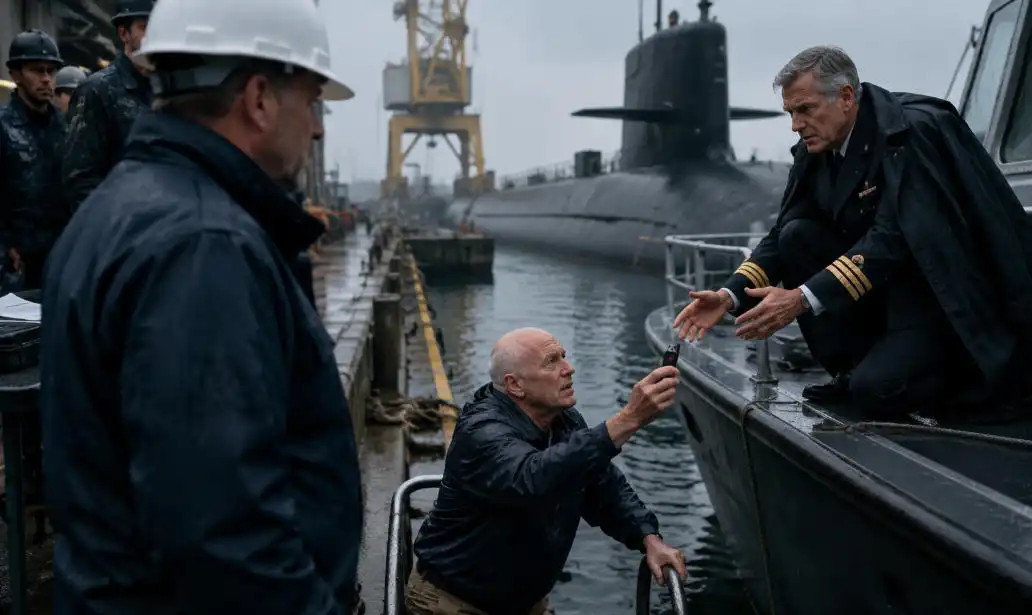
Holloway locked both hands around Thomas’s forearms and pulled him against the patrol boat ladder while a sailor steadied him from behind the rail.
Thomas’s soaked jacket dragged at his shoulders. His lungs burned, but his right fist remained closed around the matte black USB, its red tamper seal still intact above the water.
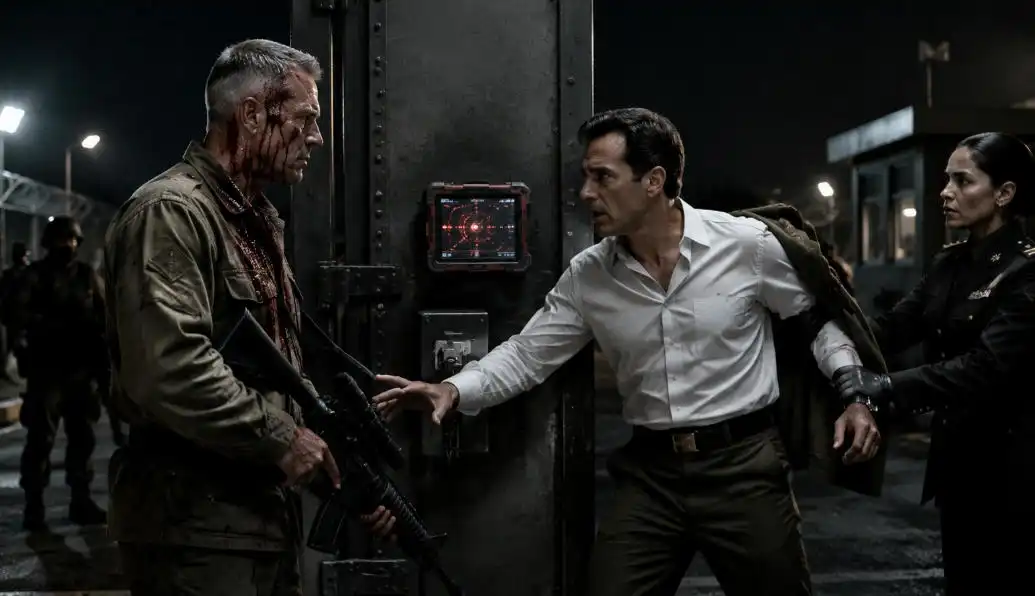
Derek pushed toward the edge of the dock.
“He slipped,” he said. “That drive is unauthorized, Admiral. The steel already passed our internal inspection.”
Holloway did not look at him.
“Get a blanket. Call the medical unit.”
Thomas was hauled over the rail. The moment his boots struck the patrol boat deck, his knees folded.
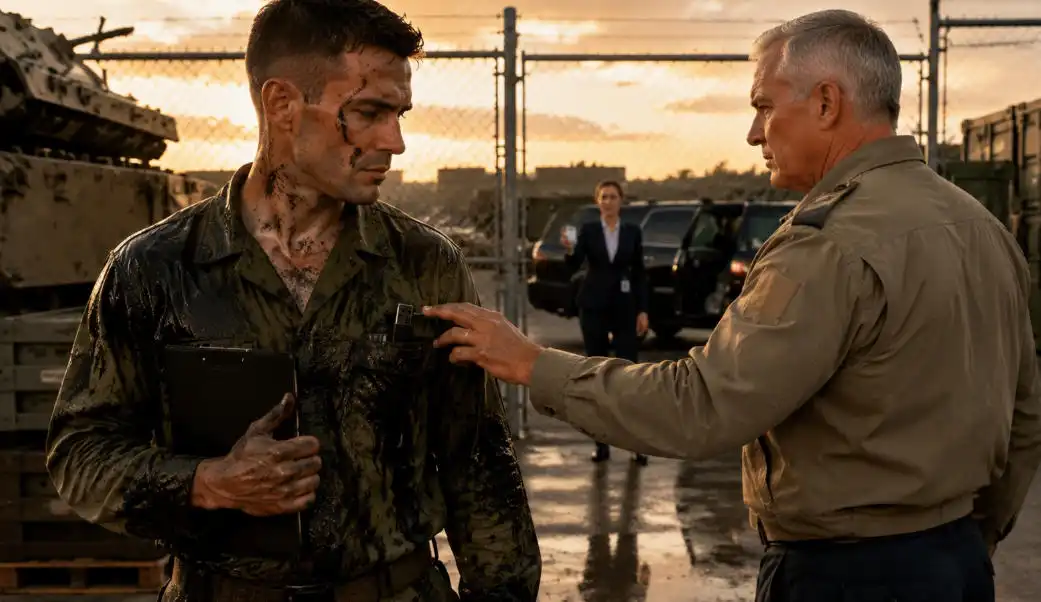
Holloway caught him under one arm and wrapped the dark overcoat around his shaking shoulders.
“Tom,” he said quietly. “What are you doing here?”
Derek heard the name.
More importantly, he heard the way the fleet commander said it.
Not like he was speaking to a troublesome retiree.
Like he was speaking to an equal.
Thomas coughed water onto the deck.
“Stopping the signing.”
Derek laughed too loudly.
“With respect, sir, he’s been harassing my crews for weeks. He wanders onto restricted work areas, makes claims he can’t support, and interferes with the schedule.”
Thomas opened his fist.
The USB lay across his wet palm.
Derek reached for it.
Holloway caught his wrist before his fingers came close.
“Don’t touch evidence.”
The inspection team shifted behind Derek.
Thomas saw uncertainty replace the obedient silence on their faces.
Derek pulled his arm free.
“Evidence of what? A private drive from a man who isn’t assigned to this project?”
Thomas forced himself upright.
“Section Fourteen. Starboard pressure hull. Replacement plates beneath the temporary coating.”
One of the inspectors looked toward the submarine.
Derek stepped between him and Thomas.
“We tested that section.”
“Your company tested it,” Thomas said.
“And it passed.”
Thomas’s teeth chattered beneath the words.
“Then repeat the test.”
Derek glanced at the acceptance documents waiting on the folding table.
“We are not restarting a completed inspection because an old man has a theory.”
Thomas looked at the submarine’s dark hull.
For most of his life, vessels like that one had been more than machines to him. Every weld carried men into a place where one bad decision could become the last sound they ever heard.
Years earlier, younger engineers had teased him because he touched the hull before every deep-pressure certification.
He had never told them it was a promise.
Bring them home.
Holloway crouched beside him.
“You need a hospital.”
“In a minute.”
“That wasn’t a suggestion.”
Thomas looked him in the eye.
“If that boat is signed over today, Derek can replace records before anyone scans the steel.”
Derek’s expression changed for half a second.
Thomas saw it.
So did Holloway.
“Secure the dock,” the admiral ordered. “No material, equipment, or documents leave this area.”
Derek stepped forward.
“You can’t freeze a federal contract over an accusation.”
“I can suspend a launch over a safety concern.”
“You don’t have a safety concern. You have a sick retiree with an encrypted drive.”
The words hung in the cold air.
The acceptance team stared at Thomas’s bare scalp. His gray wig still floated near the ladder below.
Holloway’s jaw tightened.
Thomas placed a hand against the rail and pushed himself up.
“Bring the portable sonar unit.”
The lead inspector hesitated.
Derek turned on him immediately.
“You work under the acceptance schedule approved by my office. Do not touch that hull unless I authorize it.”
The inspector looked from Derek to Holloway.
The admiral spoke without raising his voice.
“You are a Navy acceptance officer. Who authorizes your safety verification?”
The inspector straightened.
“The Navy does, sir.”
“Then verify one thing. Nothing more. Scan the location Mr. Hale identified.”
That was the first crack in Derek’s control.
The portable unit was rolled from a dockside equipment case while Thomas remained wrapped in Holloway’s coat. A medical corpsman arrived with a thermal blanket and oxygen.
“You’re hypothermic,” the corpsman told him. “Your pulse is irregular.”
Thomas accepted the oxygen mask but pushed it aside after one breath.
“After the scan.”
“Mr. Hale—”
“After.”
Holloway knelt close.
“Your doctors called my office last month.”
Thomas looked away.
“I told them not to.”
“They said you stopped treatment.”
“It stopped working.”
Holloway’s face hardened, but his voice softened.
“How long?”
Thomas watched the inspector position the sensor against Section Fourteen.
“Long enough to finish this.”
The sonar unit began sending pulses through the metal.
Derek moved toward the acceptance table.
Thomas saw him reach for the documents.
“Leave them,” Thomas said.
Derek froze.
“You don’t command this dock.”
“No,” Thomas replied. “But I know what you’re trying to hide.”
The scanner produced a clean tone at the first point.
Derek smiled.
“There. Happy?”
Thomas shook his head.
“Six inches lower. Along the weld.”
The inspector moved the sensor.
The tone changed.
A broken, uneven pulse clicked through the speaker.
The inspector ran the pass again.
The same irregular pattern returned.
The smile disappeared from Derek’s face.
“What does that prove?” he demanded. “Surface contamination? Calibration drift?”
The inspector checked the unit’s status light.
“Calibration is stable.”
Thomas closed his eyes for one second.
That sound was not the full truth.
But it was enough to stop the lie that nothing was wrong.
The inspector scanned a third time.
The broken pulse remained.
Holloway looked at Derek.
“Your internal report says uniform density.”
“It was uniform when we tested it.”
“Metal doesn’t become inferior because an old engineer walks onto a dock.”
Derek pointed toward Thomas.
“He has no chain of custody. No authorization. No proof that whatever is on that drive came from this submarine.”
Thomas held out the USB.
“Check the seal.”
A Navy evidence custodian was called from the security office. He photographed the device where it lay in Thomas’s hand, recorded the red tamper seal number, and placed it inside a clear evidence pouch.
He did not open it.
He verified only what could be verified on the dock.
The seal was intact.
The recorded creation date on the encrypted container preceded the day’s inspection.
The serial number matched the device Thomas had listed in the written safety notice he had sent three weeks earlier.
Derek’s face went pale.
“You received his notice?” Holloway asked.
The lead inspector looked uncomfortable.
“Our office received a copy.”
“And?”
“It was forwarded to the contractor for response.”
Every head turned toward Derek.
Derek spread his hands.
“We reviewed it. It contained speculation from someone outside the project.”
Thomas stared at him.
“You knew exactly who I was.”
Derek’s eyes narrowed.
“I knew you used to work for the Navy.”
“You had my engineering designation on the notice.”
“That doesn’t make your private tests official.”
“No,” Thomas said. “That’s why I asked you to repeat them.”
A transport team arrived with a stretcher.
Thomas knew he should lie down.
His hands had begun to lose feeling. His chest felt tight, and the cold had settled deep enough that even Holloway’s coat could not touch it.
But the acceptance papers were still unsigned.
The steel was still in the hull.
And Derek was not finished.
Derek turned toward the inspection team.
“You heard the admiral. One abnormal reading. That does not invalidate the entire repair.”
No one answered.
He lowered his voice.
“You all reviewed the internal certification. You stood beside me during the original inspection. If you suddenly claim the material was never verified, you’re not just accusing me.”
He tapped the unsigned forms.
“You’re admitting you failed too.”
That changed the room.
Thomas watched three inspectors glance at one another.
Derek saw it and pressed harder.
“Sign the acceptance as scheduled. Note that a secondary review was requested after completion. That protects everyone while the Navy checks his claim.”
The lead inspector looked at the signature line.
Derek slid a pen toward him.
“You don’t need to destroy your careers over a dying man’s unauthorized scan.”
Holloway took one step forward.
Thomas raised his hand.
“Let him finish.”
Derek looked at him with open contempt.
“You think they’re going to choose you? They have pensions. Families. Clearances. You’ll be gone before the investigation ends.”
The words struck harder than the water had.
Because they were true.
Thomas might not live to see the repaired submarine leave the dock.
He might not see Derek answer for anything.
For one weak moment, the stretcher looked like relief.
He could let Holloway take over. He could go somewhere warm. He could spend what remained of his life without another hearing, another scan, another night studying numbers through pain medication.
Then Thomas looked at the men standing beside the acceptance table.
They were not cruel.
They were afraid.
And fear, when given a pen, could kill as surely as bad steel.
Thomas pulled the oxygen mask away.
“Don’t sign it.”
The lead inspector swallowed.
Derek snapped, “You don’t get to order them.”
“I’m not ordering anyone.”
Thomas looked directly at the inspection team.
“I’m asking each of you to put your own name beneath a statement that the steel was independently verified.”
No one moved.
“If you believe that statement,” Thomas continued, “sign it.”
Derek pointed at the stretcher.
“You need medical care. Stop performing.”
Thomas’s legs shook as he stepped off the patrol boat and back onto the dock.
Holloway grabbed his elbow.
“What are you doing?”
“Showing them where to scan.”
“You can direct them from here.”
“No. The coating pattern hides the edge.”
The corpsman protested, but Thomas crossed the dock slowly, Holloway supporting one side of him.
Every step cost him.
The cold made his bones ache. The cancer had already taken his strength, his appetite, and most of his time. Now he gave it another piece.
At the submarine, he raised one trembling finger.
“Remove a six-inch strip of temporary coating there.”
Derek moved in front of the hull.
“You are not damaging completed work.”
Thomas looked at the clean navy paint, then at the faint ridge beneath it.
“That isn’t completed work. It’s camouflage.”
Derek shoved his hand away from the hull.
Holloway immediately stepped between them.
“Touch him again,” the admiral said, “and you leave this dock under guard.”
For the first time, Derek backed up.
The coating was carefully stripped under Navy supervision.
Beneath it, the weld line changed color halfway across the plate.
The lead inspector crouched.
“That wasn’t visible in our presentation photographs.”
“No,” Thomas said. “Because your photographs were taken before the final coating. Look at the plate stamp near the lower edge.”
The inspector cleaned the area.
Only part of the manufacturer’s mark remained visible.
It did not match the certified batch number listed on the acceptance sheet.
Derek spoke quickly.
“Plates can be restamped during cutting.”
“Not with a different mill code,” Thomas said.
The USB was taken to a secure engineering room at the edge of the dock, where a Navy systems officer opened the encrypted container using Thomas’s provided access phrase and a second authentication token held in Navy archives.
Thomas was placed on the stretcher just inside the doorway. Holloway remained beside him.
The first file displayed only raw data.
Time-stamped sonar passes.
Material response curves.
Locations marked along Section Fourteen.
The systems officer compared one of Thomas’s readings with the scan just completed outside.
The patterns matched.
One fact was now certain.
Thomas had tested the same defective area before the acceptance inspection, and the abnormal response had existed before Derek shoved him into the water.
Derek leaned over the table.
“Raw signals can be interpreted differently.”
Thomas nodded.
“They can.”
Derek blinked, surprised by the agreement.
“So you admit your conclusion isn’t final.”
“I said the signal can be interpreted. That’s why the drive also contains the approved steel baseline.”
The systems officer opened the comparison file.
Two curves appeared.
One was dense and consistent.
The other broke into shallow irregular bands.
The officer did not call it catastrophic. Not yet.
He said only, “These materials do not respond the same way.”
That was the surface truth.
The steel in the repaired section did not match the approved hull material.
Derek still had one path left.
He took it.
“Our supplier delivered a certified equivalent. The contract allows equivalent materials when approved internally.”
“By whom?” Holloway asked.
“My quality office.”
“Show me the approval.”
Derek looked at the acceptance team.
The lead inspector looked down.
Derek’s voice sharpened.
“You were present when we discussed the substitution.”
“We discussed a delay in the original shipment,” the inspector said. “You told us the installed plates came from the certified reserve batch.”
“And you accepted that.”
“Based on your documentation.”
Derek moved closer.
“Be very careful. If you change that statement now, the contracting office will ask why you didn’t challenge it earlier.”
The inspector’s face tightened.
Thomas understood the threat.
Derek was trying to bind everyone to his lie by reminding them that admitting deception also meant admitting they had been deceived.
Thomas turned to the inspector.
“What did you physically verify?”
The man was silent for several seconds.
Then he looked at the exposed mill code outside.
“We verified the documents. We did not witness the plates being taken from the reserve batch.”
Derek slammed his palm against the table.
“That is not what you told my team.”
“It is what happened.”
The other inspectors slowly nodded.
Derek pointed at them.
“You’re all protecting yourselves.”
The lead inspector met his eyes.
“No. We were protecting ourselves when we stayed quiet.”
That was the moment Derek lost the team.
Not because Thomas humiliated him.
Because the truth became safer than helping him lie.
Holloway ordered the acceptance process formally suspended. The contracting office froze payment. Security sealed the replacement steel, the inspection table, and the contractor’s records.
Thomas was finally taken to the base hospital.
Six hours later, after his temperature stabilized, Holloway entered his room carrying the evidence pouch.
“The independent engineering group begins a full scan tonight,” he said.
Thomas looked at the USB.
“Did they preserve the procurement files?”
“Before Derek could reach them.”
“He’ll say the supplier deceived him.”
“He already has.”
Thomas gave a tired smile.
“Then check the internal inspection timestamps.”
Holloway pulled a chair closer.
“You knew.”
“I suspected.”
“How?”
Thomas stared at his hands.
Three weeks earlier, he had stood outside the dock fence and heard the new plates ring under a worker’s hammer.
Most people would have heard metal.
Thomas heard the wrong metal.
He had spent decades studying how pressure traveled through submarine hulls. Cancer had taken his hair and weakened his body, but it had not taken that knowledge.
He used an old professional authorization, still valid for archived safety consultation, to compare the repair response with the original design baseline.
Then he sent Derek a written warning.
Derek answered by revoking his dock access.
“So you came back anyway,” Holloway said.
“Yes.”
“Why didn’t you call me?”
“Because I needed data, not friendship.”
Holloway looked hurt.
Thomas continued more gently.
“If you stopped the launch because I asked, Derek would call it favoritism. If the steel stopped the launch, he couldn’t.”
Two days later, the independent scan confirmed multiple density failures around the replacement plates.
The deeper investigation took longer.
Procurement records showed that the approved steel had been delayed and would have pushed the launch past a major contract milestone. Derek’s company faced heavy financial penalties if it missed that date.
So inferior commercial-grade steel was purchased through a cheaper secondary order.
The internal certification had been created after installation.
Its inspection time stamps came from hours when the scanning equipment had not even been checked out.
Derek had not merely trusted a bad supplier.
He had protected a substitution because replacing the plates would cost his company the deadline, the payment, and possibly the entire contract.
Thomas’s report explained what the numbers meant.
At shallow depth, the hull might appear stable.
Under extreme pressure, the inferior section would flex differently from the surrounding steel. The welds would bear uneven force. Once one fracture began, the failure could move faster than the crew could respond.
The result would not be a leak sailors could patch.
The pressure hull could tear apart.
And because the submarine carried a nuclear reactor, the disaster would not end with the crew.
When the full findings were presented, Derek was no longer allowed on the dock.
He still tried to control the story.
Through his company, he claimed Thomas had caused panic, that the Navy had overreacted, and that the defective steel could have been replaced through routine warranty procedures.
But the acceptance team gave matching statements about his threats.
The evidence custodian documented the untouched USB seal.
The Navy systems officer confirmed the files’ dates and integrity.
The independent engineers matched Thomas’s data.
The contracting office connected the false certification to the material order.
Each piece proved only part of the truth.
Together, they left Derek nowhere to hide.
NCIS investigators interviewed Thomas at the hospital.
He did not ask them to punish Derek for throwing him into the water.
He described the shove. He answered their questions. Then he returned to the steel.
“The important part,” he said, “is that he knew the inspection was false and kept pushing for acceptance.”
One investigator closed his notebook.
“Both parts matter, Mr. Hale.”
Thomas looked toward the hospital window, where the submarine’s sail was visible beyond the buildings.
“Then make sure the crew matters most.”
Within a week, NCIS took Derek into custody after investigators secured the contractor’s records and completed the first round of witness interviews.
The Navy terminated the repair contract and barred the company from further work while the case proceeded.
Replacement costs, frozen payments, penalties, and civil claims crushed the business Derek had tried to save.
Months later, the company entered bankruptcy.
Derek lost the schedule, the contract, the reputation, and the authority he had protected at everyone else’s expense.
Thomas never celebrated.
By then, he was back at the dock in a wheelchair, wrapped in a blanket, reviewing the corrected engineering plan.
The Navy offered him a formal office.
He refused it.
“Put the desk where I can see the hull.”
Holloway arranged a small heated work area near the repair bay.
Thomas spent his remaining weeks checking scans, questioning weld sequences, and teaching younger engineers why a number should never be trusted simply because it appeared beneath an official logo.
One afternoon, the lead inspector came to see him.
“I should have stopped Derek sooner.”
Thomas kept reading the scan in his lap.
“Yes.”
The man flinched.
Thomas looked up.
“But you stopped signing when it mattered.”
“That doesn’t erase what I missed.”
“No. It makes sure you don’t miss it again.”
The inspector nodded.
“Is that forgiveness?”
“It’s responsibility.”
Near the end, Thomas was too weak to visit the dock.
Holloway brought him a photograph of the repaired section.
Beside it was the final independent certification.
No shortcuts.
No internal substitute.
No unanswered readings.
Thomas ran one finger over the photograph.
“Now she can dive.”
“She can,” Holloway said.
“And come back?”
Holloway placed his hand over Thomas’s.
“And come back.”
Thomas died three nights later.
On a gray morning after his funeral, the submarine remained safely at the dock, waiting for its final sea trial.
Thomas’s recovered yellow hard hat rested on the rail.
Beside it lay Holloway’s dark overcoat, cleaned, folded, and protected from the wind.
The fleet commander stood facing the water.
Across the harbor, sailors stopped beside their ships.
Then the first horn sounded.
A second answered from farther down the channel.
Then another.
One by one, every ship in the harbor joined the salute until the sound rolled across the cold water and shook the windows of the empty repair bay.
The submarine did not move.
It did not need to.
The men aboard it would live because a dying engineer had refused to step aside.
FINAL ENGAGEMENT
Was Thomas right to risk his final months to stop the launch—or should he have protected his remaining time and let the Navy handle it?
Disclaimer: Mention of any brand or trademark is for identification only and does not imply partnership or endorsement