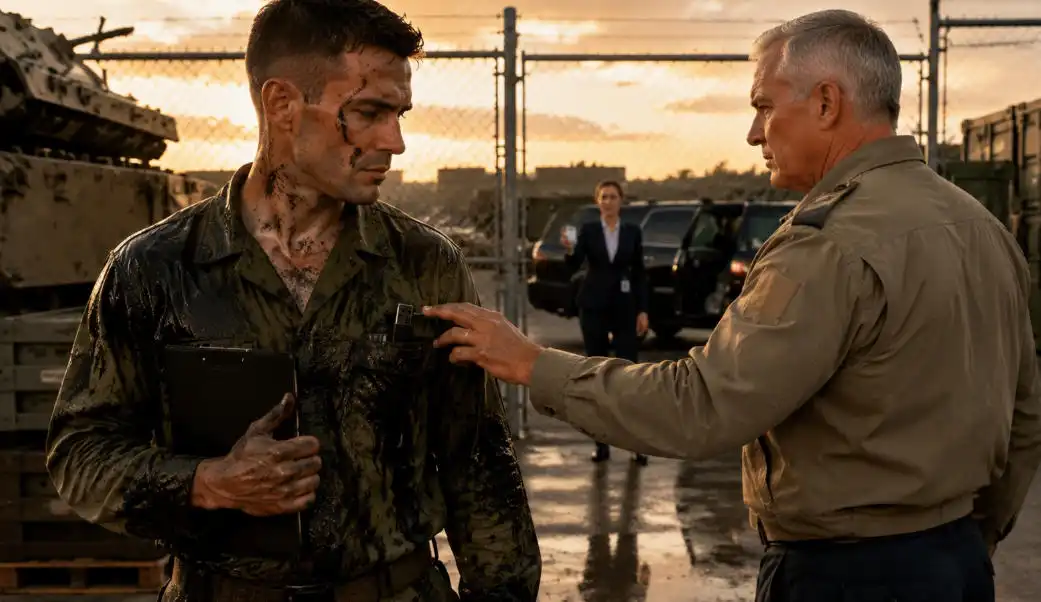

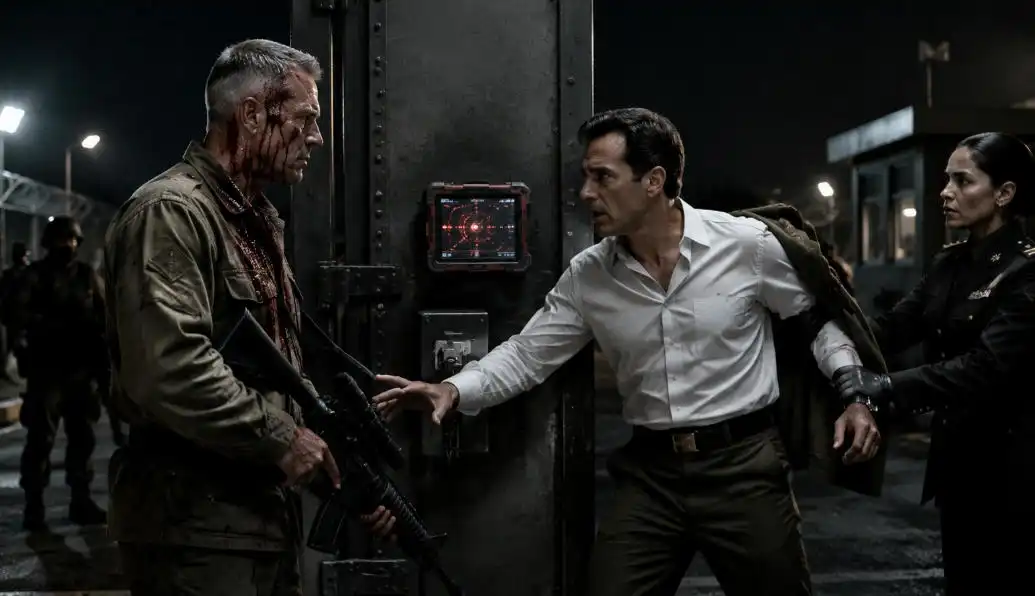
Vance forced Cole’s captured wrist downward, stepped between him and Daniel, and ordered the major to show both hands while Daniel kept his rifle secured.
The red-rimmed security tablet still flashed on the steel gate console beside Daniel’s right shoulder. Wine ran from his jaw to the front of his olive uniform, but his muzzle remained pointed at the concrete.
Cole twisted against Vance’s grip.
“He’s drunk,” he snapped. “Look at him. He attacked me, locked out a superior officer, and contaminated a restricted post.”
Vance did not release him.
“The wine is on his face, Major.”
“Because he grabbed my bottle.”
Daniel said nothing.
Cole looked toward the two sentries beside the guard booth.
“You saw it. Tell her.”
Neither man moved.
That silence hit Cole harder than an answer.
Vance shifted her stance and pushed his hand farther from Daniel’s rifle.
“Secure the major’s bottle. Keep everyone off that console.”
One of the sentries stepped forward, took the half-empty bottle from the pavement with a gloved hand, and placed it in an evidence bag from the guard booth.
Cole’s face tightened.
“You don’t take orders from her over me,” he told the sentries. “I’m the duty officer.”
Vance finally released his wrist, but only after two members of her response team closed in on either side of him.
“Not while I’m controlling an active security incident,” she said. “Hands where I can see them.”
Cole raised them slowly.
Then he pointed at Daniel with one finger.
“That man refused a direct order.”
Daniel felt the old instinct to defend himself rise in his chest. He had spent years learning how quickly a private could lose when an officer framed the question first.
But the gate behind him was still sealed.
That mattered more than his pride.
Vance turned to Daniel.
“Private Rourke, status of the depot?”
“Secondary lockdown active, ma’am. Local access disabled. Infrared perimeter alert preserved at twenty-three eighteen.”
“Any confirmed breach?”
“Not confirmed.”
“Any reason to open this gate?”
“No, ma’am.”
Cole laughed, too loudly and too quickly.
“He saw a rabbit and panicked.”
Daniel looked at the dark fence line.
“Rabbits don’t stop at a junction box.”
For the first time, Vance’s eyes went to the tablet instead of Cole.
“Show me only what triggered your lockdown.”
Daniel moved one hand toward the console, slow enough that every armed person around him could track it. He entered his sentry code and opened the preserved incident marker without opening the full record.
A red line crawled across the screen.
Two heat signatures had approached the outer fence from the maintenance road. They paused at the perimeter junction box. One shape crouched. The second remained behind it.
Then the local sensor feed cut for four seconds.
When it returned, both shapes were moving toward the ammunition compound.
The sentry beside the booth whispered, “That wasn’t there on the routine sweep.”
Vance lifted a hand.
“Security Operations, verify the incident marker from the central archive.”
A voice came through the radio on her shoulder.
“Marker verified. Automatic system timestamp. Twenty-three eighteen and twelve seconds. Data originated from the north perimeter infrared array.”
One fact.
The alert was real.
Cole’s claim that Daniel had invented the danger died on the concrete between them.
Vance looked at Daniel.
“Why did you disable local access?”
“The sensor interruption matched a tamper condition. Procedure says the gate stays sealed until the perimeter is cleared and command identity is verified.”
Cole cut in.
“I am command identity.”
“You arrived without your access card,” Daniel said.
“My card is in my jacket.”
Vance glanced at the uniform jacket hanging over Cole’s shoulder.
“Then produce it.”
Cole reached into one pocket, then another.
His movements slowed.
Nothing came out.
Daniel watched the major’s expression change. Not fear yet.
Calculation.
Cole had taught enough young soldiers to recognize hesitation. Daniel recognized it, too.
Years earlier, during a freezing night exercise, Cole had stood in front of a line of exhausted enlisted men and said, “A sentry is the last man between order and disaster.”
Daniel had believed him.
That was the part that hurt.
Not the wine.
Not the shove.
The fact that the officer who had once spoken about duty like it was sacred now treated duty as an insult when a private applied it to him.
Vance held out her hand.
“Major, your identification.”
“I don’t answer to a private’s checkpoint game.”
“You answer to me during this response.”
Cole’s jaw worked.
Then he changed tactics.
“Fine. Take Rourke’s rifle. Take the tablet. I’ll assume control of the gate, and we can sort this out after the depot is open.”
That was the second move.
Not another accusation.
A grab for the two things keeping the truth alive: Daniel’s lawful post and the preserved record.
Cole turned toward the sentries.
“Erase his incident report. It’s compromised because he was impaired.”
The younger sentry looked at Daniel’s stained uniform, then at Vance.
He did not touch the console.
Vance said, “Nobody erases anything.”
Cole stepped closer to her.
“Lieutenant Colonel, you are allowing a private to obstruct an officer in front of armed personnel. Think carefully about what you’re endorsing.”
“I am.”
“And when this turns out to be nothing?”
“Then the record will show we followed procedure.”
Cole’s eyes narrowed.
“And when the record shows he assaulted me?”
Daniel could feel every person at the gate waiting for him to speak.
He also knew what speaking could cost.
Cole still held rank. Even if Vance controlled the scene tonight, tomorrow could bring an evaluation, an undesirable reassignment, a disciplinary recommendation, or months of quiet retaliation that never appeared in one dramatic order.
Daniel could stay silent and let Vance carry the fight.
That would be safer.
It would also leave Cole’s version standing beside the evidence as if both deserved equal weight.
Vance looked at him.
“Private, do you wish to make a statement now?”
Daniel saw the easy path.
Say no.
Wait.
Hope the system worked without asking him to risk anything else.
Then he looked at the sealed blast door.
Behind it were enough weapons and ammunition to turn one security failure into a base-wide disaster.
Daniel straightened.
“Yes, ma’am.”
Cole smiled without humor.
“Careful, Private.”
Daniel met his eyes.
“Installation security regulation requires the assigned duty officer to remain available at the protected site during restricted hours,” he said. “It also prohibits unverified access during an active perimeter alert and requires relief of anyone attempting entry while impaired.”
The words came out steady.
Cole’s smile vanished.
Daniel continued.
“Major Cole was not at this site when the alert began. He returned without verified credentials, smelling of alcohol. When I denied entry, he threw wine in my face, shoved me, accused me of drinking, and reached for my weapon.”
Cole took one step toward him.
Both tactical soldiers moved with him.
“You’re finished,” Cole said quietly.
Daniel knew he might mean it.
That was the price.
Daniel did not look away.
“Maybe,” he said. “But this gate stays closed.”
For a moment, nobody spoke.
Then Vance touched her radio.
“Security Operations, lock the tablet under incident control. Create a protected copy of the full infrared sequence. No local user may alter or delete the record.”
“Copy. Protected archive initiated.”
She pointed to the guard booth.
“Pull the duty roster and access log.”
The older sentry moved immediately.
Cole’s voice sharpened.
“You are turning a minor misunderstanding into insubordination.”
Vance looked at him.
“No. I’m separating rank from evidence.”
The protected copy completed with a soft tone.
Security Operations began the full playback from the central archive.
The first sequence showed the two heat signatures coming down the maintenance road.
The second showed one person kneeling beside the perimeter junction box.
The third showed the four-second interruption.
Then another camera angle, triggered automatically when the system came back online, showed both figures crossing the outer boundary.
Daniel’s hand tightened once around the rifle sling.
He had seen only pieces in real time. A flash. A gap. Movement where there should have been none.
Now the whole pattern was forming.
At twenty-three nineteen, Daniel’s secondary lockdown activated.
The blast gate sealed.
The interior vehicle barrier rose.
The exterior access controls stopped accepting local overrides.
Thirty-two seconds later, the two figures reached the inner approach and found every route closed.
One struck the side panel.
The other looked toward the floodlight mast.
Then both retreated toward the maintenance road before the counterterror team arrived.
The surface truth was no longer simply that Daniel had followed a rule.
His decision had blocked an active attempt to reach the depot.
Vance watched the final frame twice.
“Can the system identify them?”
“Not from infrared alone,” Security Operations replied. “Perimeter team is searching the route now.”
Cole seized on the uncertainty.
“So we don’t know who they were. We don’t know what they wanted. Rourke overreacted.”
Daniel turned his head toward him.
“They cut the sensor feed.”
“Equipment fails.”
“They stopped at the junction box.”
“You’re guessing.”
Vance spoke before Daniel could answer.
“The search team will determine intent. The gate remains closed.”
Cole’s nostrils flared.
He had lost the argument about the alert, so he reached for the only ground he had left.
“Even if the lockdown was justified, his conduct was not. He challenged me, refused to surrender his weapon, and created confusion during a live response.”
Daniel almost laughed.
Not because it was funny.
Because Cole was trying to turn discipline into misconduct while standing in front of the sealed depot that discipline had protected.
The guard booth door opened.
The older sentry carried out the printed duty roster and the electronic access summary.
He handed both to Vance.
“Major Cole was the assigned duty officer from twenty-two hundred to zero two hundred,” he said. “His credential did not register at this gate after twenty-two fourteen.”
Vance looked at Cole.
“Where were you?”
“Conducting an off-site command engagement.”
“Authorized by whom?”
Cole hesitated.
“It was informal.”
“Location?”
“That is not relevant to the immediate threat.”
It was relevant.
Daniel could see that in the way Vance folded the roster once and tucked it under her arm.
The deeper question had arrived.
Not whether Daniel had protected the gate.
Why the assigned officer had been missing, why he had returned impaired, and why he had tried so hard to make the sentry look guilty.
Vance ordered military police to the depot.
They did not appear out of nowhere. They came because an officer had allegedly assaulted a sentry, attempted to interfere with a secured weapon, and was present during an active incident while apparently impaired.
While they were en route, Vance assigned one response-team member to Daniel’s rifle—not to take it from him, but to document that the safety remained engaged and no round had been chambered.
The check took seconds.
“Weapon safe,” the soldier said.
Another piece of Cole’s story fell away.
The younger sentry gave his statement next.
He had seen Cole arrive unsteady.
He had heard Daniel request credentials.
He had watched Cole throw the wine and shove him.
He had watched Daniel keep the rifle down.
The older sentry confirmed the same sequence.
Cole listened with a hard, fixed expression.
When the military police vehicle stopped outside the barrier, he tried one last time.
“This is a command matter,” he told Vance. “Handle it internally. If you put me in a holding room, you damage the unit over the word of a private.”
Vance’s reply was flat.
“The unit was damaged when its duty officer left the post.”
Cole looked at Daniel.
“You think she can protect you from what comes next?”
Daniel’s face still felt sticky. His collar was cold where the wine had soaked through.
“No, sir,” he said. “I think the record can.”
Military police removed Cole’s access badge, secured his sidearm, and escorted him to the base’s secure holding room pending the commander’s review.
He was not convicted on the spot.
He was not dragged away in a theatrical confession.
He simply lost what he had been trying to use all night: immediate control.
The gate remained closed under Vance’s authority.
Daniel remained the lawful sentry.
And the tablet remained untouched.
By 3:40 that morning, the perimeter search team found fresh tool marks on the junction box and a cut in the protective conduit. They also recovered a discarded insulated cutter along the maintenance road.
The unidentified intruders had escaped beyond the outer search area, but the physical damage matched the interruption recorded by the infrared system.
That corroborated what the tablet had shown.
Someone had not wandered near the fence by accident.
Someone had tried to blind part of the system before approaching the depot.
At dawn, Daniel finally surrendered his rifle to the properly documented relief guard.
Only then did he wipe the dried wine from his face.
Vance stopped him before he left the gate.
“You need medical attention?”
“No, ma’am.”
“You need a clean uniform.”
Daniel looked down at the stained front of his shirt.
“Yes, ma’am.”
“You also need to understand something. Speaking tonight may make the next few weeks uncomfortable.”
“I understood that before I spoke.”
“Why do it?”
Daniel glanced at the blast door.
“Because the regulation only matters when it costs something to follow it.”
Vance studied him for a moment.
Then she nodded.
The formal investigation began that morning.
Security Operations certified the infrared archive and the lockdown timestamps. The duty roster established that Cole was required to remain available at the depot. The access log showed he had not used his credentials there for more than an hour before the alert.
Investigators then requested records connected to Cole’s stated “off-site command engagement.”
His own expense explanation gave them the starting point.
The card issuer returned timestamped transactions from a downtown bar: drinks purchased during the exact period he was supposed to be covering the depot.
The final charge was for the bottle he carried back to the gate.
That record did more than prove where he had been.
It explained everything he had done after returning.
Cole had seen Daniel standing where Daniel was supposed to stand.
He had seen the locked gate, the preserved alert, and two witnesses.
In that instant, Daniel was not merely a private blocking his path.
He was the living timeline of Cole’s absence.
So Cole had tried to reverse the roles.
Make Daniel the drunk.
Make Daniel the aggressor.
Make Daniel’s lawful refusal look like insubordination.
Then seize the rifle and the tablet before anyone qualified could separate accusation from fact.
The plan failed because Daniel did not retaliate, the sentries did not repeat the lie, and the system had recorded what rank could not erase.
Three weeks later, the installation commander completed the initial command review.
Cole was permanently removed from the ammunition-depot command chain and stripped of operational authority pending further disciplinary proceedings. His officer evaluation was flagged, his promotion track stopped, and the allegations concerning abandonment of duty, impaired misconduct, assaultive behavior, false accusation, attempted interference with a secured weapon, and interference with an active security record were forwarded through the formal military process.
Daniel was cleared of every accusation.
The weapon inspection showed safe handling.
The witness statements matched.
The sensor record proved the lockdown was justified.
The wine bottle and Cole’s bar transactions destroyed the claim that Daniel had been drinking.
Daniel did not celebrate when he heard.
He sat alone on a bench outside the administration building, holding the written finding in both hands.
For years, he had believed survival in uniform meant keeping his head down when rank entered the room.
That night had taught him something harder.
Silence could preserve a career.
But sometimes it could endanger everyone else.
A month after the incident, the base held a small formation outside the ammunition depot.
No stage.
No dramatic banners.
Just the soldiers who worked the gate, the security team that had answered the alarm, and the sealed structure Daniel had refused to open.
Daniel stood at the front in a clean olive uniform.
Vance walked toward him carrying a formal commendation.
She read only a few lines: that Private Daniel Rourke had maintained weapons discipline, preserved critical evidence, enforced access procedure under pressure, and prevented a compromised gate from creating an opening during an attempted sabotage.
Then she lowered the paper.
The morning sun had begun to rise behind the chain-link fence. The sodium floodlights faded one by one.
Daniel could still remember the cold wine running down his face.
He could still hear Cole telling him he was finished.
Vance faced him beneath the last burning floodlight and raised a formal salute.
“Rank did not protect this base that night,” she said. “Discipline did.”
Daniel returned the salute.
Behind him, the blast gate remained sealed and secure.
For the first time since the alarm, he allowed himself to breathe like the danger was truly over.
FINAL ENGAGEMENT
Was Daniel right to risk his career by speaking against his superior—or should he have stayed silent and let the investigation handle it?
Disclaimer: Mention of any brand or trademark is for identification only and does not imply partnership or endorsement