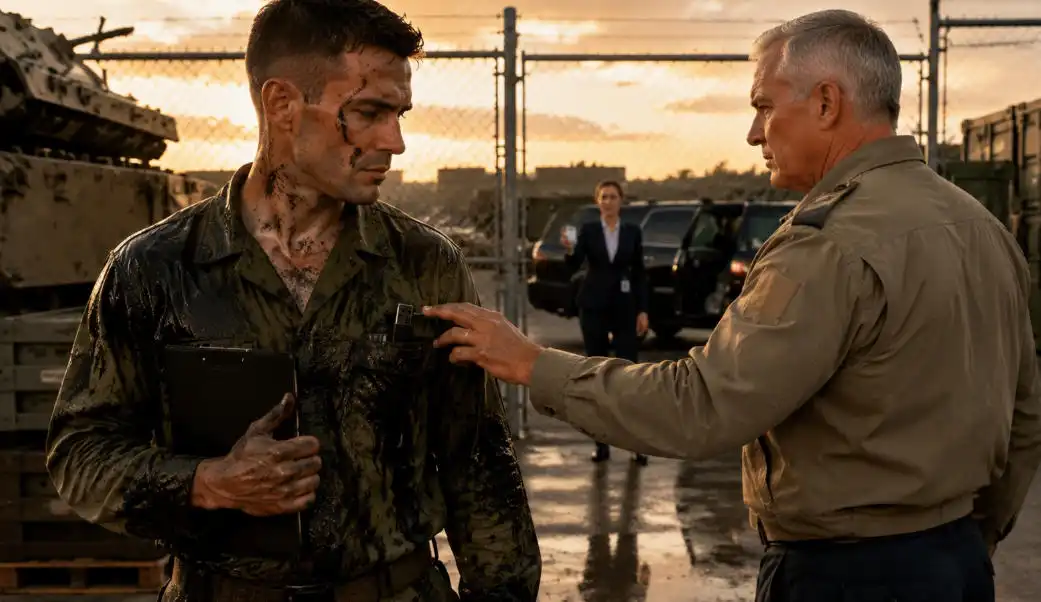

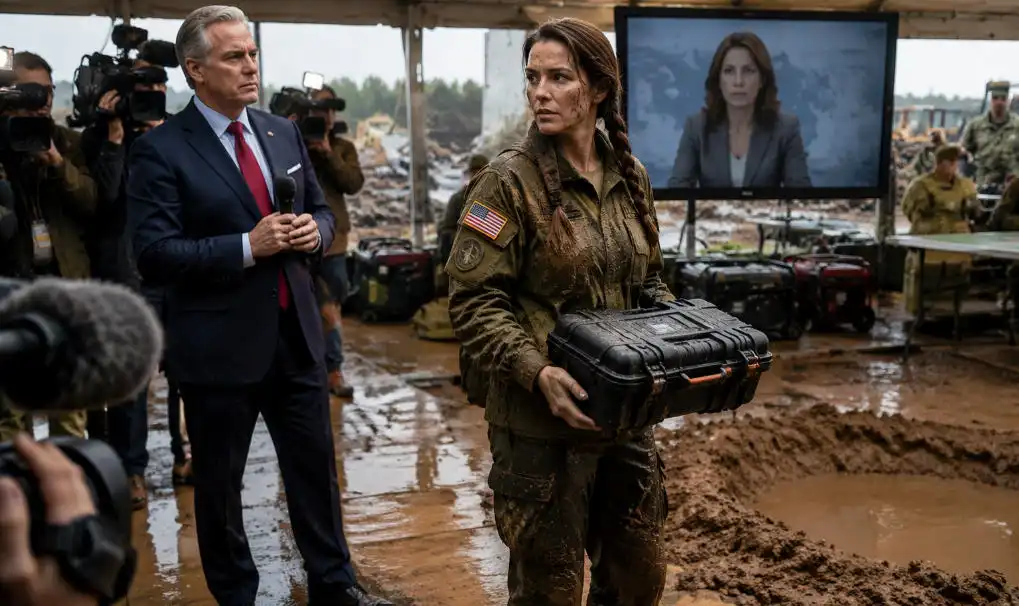
I placed the black drone case on the edge of the platform and flipped the orange latch open with my muddy thumb.
Victor Hale stepped toward it before I could lift the lid.
“This is political theater,” he snapped. “Whatever she’s about to show you is fabricated.”
The station producer glanced from Hale to Governor Greene’s face on the command monitor.
“Representative, the governor ordered us to play it.”
Hale raised the microphone.
“It’s a deepfake. An obvious deepfake created by people who don’t understand how government works.”
The case opened with a hard plastic click.
Inside sat the original recording module, its serial label smeared at one corner but still intact. Beside it were two backup drives and the flight-control tablet my team had used throughout the storm.
I lifted the module carefully.
“No edited clips,” I said. “Load the original files.”
Hale laughed, but the sound came too quickly.
“You expect the public to trust a mud-covered soldier with a grudge?”
I looked at him.
“I expect them to trust timestamps.”
For the first time since I had climbed out of the mud, the reporters stopped reacting to Hale and started watching me.
The young specialist I had held back moved beside the platform, but I shook my head again.
This part had to stay clean.
The station producer inserted the module into the command console. A progress bar appeared on the monitor beneath Governor Greene’s video window.
Hale pointed at the screen.
“Stop. That equipment is under local emergency authority.”
Governor Greene leaned closer to her camera.
“No, Representative Hale. The state emergency command system is under my authority.”
The room went quiet except for the generators outside and the rainwater dripping from the platform roof.
The producer opened the file index.
Rows of recordings appeared, each marked with a date, flight number, GPS route, and automatic weather reading.
He selected the first storm-night flight.
Before the video played, he opened the metadata panel.
“Original creation time is 11:42 p.m.,” he said. “File has not been re-encoded.”
Hale crossed his arms.
“That proves nothing.”
The producer pointed at another field.
“The drone serial number matches the mission log attached to the base emergency system.”
Governor Greene said, “Confirm the route.”
A technician at the operations table pulled up the authorized flight plan.
“Launch point was the east maintenance yard. Route covered the lower dam, the north access road, the command bunker, and the flood barrier.”
The first image filled the monitor.
Rain swept across the camera. Emergency lights flashed against black water. The footage was rough, but it was clear.
Our engineers were visible along the dam, waist-deep in runoff, dragging reinforcement panels into place.
A reporter whispered, “That was during the worst part of the storm.”
“Yes,” I said.
The footage moved over the barrier.
Three Guard trucks were parked nose-to-tail, their headlights aimed at the damaged section. Soldiers carried sandbags while another team secured a temporary brace against the concrete wall.
No campaign staff.
No local officials.
No Victor Hale.
Hale lifted the microphone again.
“You’re watching routine military operations. My office coordinated the entire response.”
I almost laughed.
Instead, I watched the route marker crawl across the lower corner of the screen.
The drone turned inland.
It passed over the emergency command bunker and descended toward the reinforced cellar behind the administration building.
A black SUV sat beside the entrance.
Hale’s SUV.
The thermal image showed several people inside the cellar.
The timestamp read 11:57 p.m.
The camera stayed over that building for eighteen seconds because the drone had paused to relay a radio signal.
Hale appeared at the cellar door, looked toward the rain, and went back inside.
One of the reporters slowly lowered her notebook.
Governor Greene said, “Representative Hale, you told my office you were directing operations from the dam.”
“I was moving between locations.”
The producer advanced the footage.
At 12:31 a.m., the SUV had not moved.
At 1:08 a.m., it was still there.
At 2:17 a.m., while our team fought to keep the lower barrier standing, Hale was visible carrying bottled water deeper into the cellar.
The room changed.
It was not dramatic. No one shouted. No one applauded.
The reporters simply stopped looking at him as if he were in charge.
Hale felt it.
He turned toward me.
“So this is what you wanted? To embarrass an elected official during a disaster?”
My knee throbbed under the mud. I could feel blood drying beneath my cargo pants, though no wound showed through the fabric.
I thought about the thirty-six hours my team had spent working without real sleep.
I thought about Specialist Cole crying behind a generator after finally reaching his wife and learning their apartment had flooded.
I thought about Sergeant Ruiz giving his last dry socks to a nineteen-year-old private whose boots had filled with water.
And I thought about Hale arriving after sunrise, asking where the cameras would be positioned.
“You embarrassed yourself,” I said. “The drone only recorded it.”
His face tightened.
“My office secured the recovery funding that paid for every piece of equipment out there.”
That statement made our engineering captain look up sharply from the operations table.
I saw it.
So did Governor Greene.
“What is it, Captain?” she asked.
Captain Ellis hesitated.
Then he looked at me.
I gave him a small nod.
He turned toward the monitor.
“Governor, some of the equipment we were promised never arrived.”
Hale cut in immediately.
“This briefing is about storm response, not procurement complaints.”
Captain Ellis continued.
“The original barrier contract included twelve modular reinforcement panels, two portable pumps, and four pallets of waterproof sealant. We received five panels, one pump, and less than half the sealant.”
Governor Greene’s expression hardened.
“Were the missing items reported?”
“Yes, ma’am. Three times.”
“To whom?”
Ellis looked directly at Hale.
“The local recovery committee.”
Hale stepped off the center mark on the platform.
“That committee handled dozens of requests. Delays happen during emergencies.”
“Those requests were submitted six weeks before the storm,” Ellis said.
A reporter raised her hand.
“Representative, didn’t you chair that committee?”
Hale ignored her.
He focused on the producer.
“Turn the footage off. Now.”
The producer did not move.
Hale climbed down from the platform and headed toward the broadcast console.
The cameras followed him.
That was when I realized he no longer cared what the public saw. He only cared about stopping what they might see next.
The drone footage had reached the lower flood barrier.
Even through rain distortion, the missing reinforcement sections were obvious. There were gaps where new panels should have been installed.
The older concrete beneath them had cracked.
One reporter pointed at the image.
“Is that where the barrier failed?”
Captain Ellis answered carefully.
“That is the section our team had to brace during the storm.”
Hale reached the console.
“Kill the livestream.”
The producer blocked him with one arm.
“I have direct orders from the governor.”
“I am the elected representative for this district.”
“And I am the governor of this state,” Laura Greene said from the monitor. “Step away from the equipment.”
Hale’s gaze moved to the cable running from the mixer to the transmission unit.
He lunged for it.
I moved before I had time to think.
He got one hand around the cable, but I caught his wrist and pushed it away from the port.
He swung the microphone toward me.
“You touch me again, and I’ll make sure your career is over.”
There it was.
The choice he thought would stop me.
A soldier putting muddy hands on an elected official during a live broadcast could be edited into any story he wanted. He had campaign people, donors, and years of practice turning pictures into narratives.
I had spent my career learning to follow the chain of command.
I also knew what happened when people used that chain to choke the truth.
I looked at the station producer.
“Will disconnecting his microphone interrupt the video feed?”
“No.”
“Will it interrupt the governor?”
“No.”
Hale realized what I was about to do.
“Don’t you dare.”
I reached past him with my mud-covered hand and pulled his microphone plug from the mixer.
The speakers went silent.
The livestream continued.
For a second, Hale stared at the dead microphone as if power itself had been switched off.
Then Governor Greene spoke.
“Captain Ellis, secure the drone module and all related mission logs.”
“Yes, ma’am.”
“Station producer, preserve a complete copy of this broadcast.”
“Yes, Governor.”
“Emergency management director, freeze all local recovery disbursements connected to the flood-barrier project until they can be reviewed.”
A man at the rear operations desk stood.
“I’ll issue the hold immediately.”
Hale dropped the useless microphone onto the console.
“You cannot suspend public funds because of one video.”
“No,” Governor Greene said. “But I can suspend disbursement when physical evidence contradicts certified project reports.”
The producer paused the drone footage on a wide aerial view of the barrier.
The missing sections formed three dark gaps.
Captain Ellis opened the engineering file stored on the command network.
“This is the approved completion map,” he said.
Twelve new reinforcement panels were marked in blue.
Then he opened the inspection photograph submitted by Hale’s recovery committee two weeks earlier.
From a distance, it appeared to show a completed barrier.
Ellis zoomed in.
The same five panels had been photographed from different angles.
Someone had cropped the images to make them look like separate sections.
The reporter nearest Hale stared at him.
“Your committee certified all twelve panels as installed.”
Hale pointed at Ellis.
“I don’t review individual photographs. Contractors handle that.”
That was his new defense.
First, the footage was fake.
Then it proved nothing.
Now someone else was responsible.
Governor Greene asked, “Who signed the completion report?”
The emergency management director searched the state database.
After a few seconds, he answered.
“Victor Hale, as chair of the local recovery committee.”
Hale’s jaw flexed.
“My signature confirms receipt of a committee recommendation. It is not a personal inspection.”
I looked at the image of the barrier.
That photograph explained something that had bothered me from the moment we reached the base.
The concrete had not failed evenly.
The sections with new reinforcement had held.
The empty spaces had cracked first.
The storm had been severe, but the damage pattern had never made sense if the work had truly been completed.
Now it did.
“They knew the panels were missing,” I said.
Hale turned on me.
“You know nothing about municipal procurement.”
“I know structural failure.”
I pointed at the monitor.
“Five reinforced sections held. The unreinforced sections broke. My team spent the night replacing work your committee reported as finished.”
Captain Ellis pulled up our emergency repair log.
Every replacement panel, brace, pump hour, and sandbag deployment had been recorded during the storm.
The quantities matched the missing materials almost exactly.
That was the first corroboration.
The second came from the delivery records.
The emergency management director contacted the state logistics office while the livestream remained active. He did not need to find a surprise witness or an anonymous message.
He requested the records that should already have existed.
The supplier had delivered only five reinforcement panels to the base.
The invoice submitted to the federal recovery program listed twelve.
One pump had been delivered.
Two had been billed.
Less than half the sealant had reached the site.
The full amount had been charged.
Hale began moving toward the edge of the command area.
Two Guard security officers shifted into the walkway—not arresting him, not touching him, simply preventing anyone from leaving with state equipment or records before they were secured.
“You are not detained,” Captain Ellis told him. “But this site is under emergency command. You may not remove anything.”
Hale gave a short, bitter laugh.
“So now the military is taking over civilian government?”
“No,” Governor Greene said. “Civilian government is finally reviewing what you certified.”
The broadcast ran for another twenty-two minutes.
By the end of it, the public knew two things for certain.
Victor Hale had not led the rescue.
And the flood barrier he claimed had been completed was missing more than half of its contracted materials.
The deeper question—where the money had gone—could not be answered responsibly on a livestream.
That required records, subpoenas, accountants, engineers, and time.
Governor Greene said so plainly.
“We will not conduct a criminal investigation through television. We will preserve the evidence and follow the process.”
Then she looked toward me.
“Engineer Bennett, do you require medical attention?”
I almost said no.
That was what I always said.
But my knee was swelling, and refusing treatment would not prove strength. It would only give my soldiers one more bad example to follow.
“Yes, ma’am,” I said. “After the module is logged.”
Captain Ellis took the recording module from me with gloved hands. He read the serial number aloud while the station producer and emergency management director witnessed the transfer.
The module went into an evidence bag.
The backup drives were sealed separately.
The flight-control tablet remained powered on so its mission history could be copied without altering the original device.
Only after every item had been recorded did I let the medic guide me toward the treatment tent.
As I passed Hale, he spoke quietly enough that the cameras could not hear.
“You think this makes you a hero?”
I stopped.
“No.”
I looked back at my team.
“It makes them visible.”
That afternoon, the state emergency management director suspended Hale’s recovery committee from handling any additional disaster funds.
The governor transferred temporary authority to a state-controlled response team and ordered an independent engineering inspection of the barrier.
Hale was not marched away in handcuffs.
Real accountability rarely moved that fast.
He left the command center in the same clean suit he had worn when he arrived, but without the microphone, without the cameras following his instructions, and without control of the recovery money.
Three days later, state investigators returned to the base.
They interviewed Captain Ellis, the procurement staff, the supplier, and every engineer who had documented the missing materials.
I gave my statement last.
An investigator placed photographs of the barrier across the table.
“Why did your unit launch the drone that night?”
“To map water flow and identify failure points.”
“Was Representative Hale the target of surveillance?”
“No.”
“Did anyone instruct the drone team to record him?”
“No. His location happened to fall within an authorized emergency route.”
That mattered.
The footage existed because of a legitimate disaster mission, not because anyone had gone looking for political dirt.
Its timestamps matched weather-service records.
Its GPS path matched the approved flight plan.
Its original file hashes matched the copies preserved during the broadcast.
The deepfake claim collapsed before it reached the end of the week.
The financial investigation took longer.
Federal disaster-program auditors compared the invoices Hale’s committee approved with supplier records, bank transfers, contractor payments, and actual deliveries to the base.
The pattern was not one missing shipment or one clerical mistake.
Money designated for flood protection had been redirected through inflated invoices and payments for work that was never completed.
Hale had signed the reports that released those payments.
His office had also sent repeated messages pressuring local staff to mark the barrier project complete before his campaign’s recovery announcement.
Those messages explained why he had been so desperate to control the cameras.
He had not simply wanted credit for our work.
He needed the public to see a finished recovery project before anyone looked closely at the barrier.
The storm had exposed the structure.
The drone exposed him.
Six weeks later, the state attorney general announced that a grand jury had returned felony indictments connected to the diversion of federal disaster funds, false recovery reporting, obstruction of the evidence presentation, and conduct that endangered public safety.
The federal inspector general opened a parallel case involving the disaster grants.
Hale’s committee positions were removed immediately.
His party withdrew its support.
Major donors requested refunds.
The contractors tied to the false invoices were barred from new recovery work while their own roles were investigated.
Hale appeared outside the courthouse in another polished suit.
This time, no one asked him to describe how he had saved the base.
They asked why he had certified work that had never been completed.
He did not answer.
By then, the flood barrier was being rebuilt under direct state oversight.
Every delivery was photographed, counted, and entered into a public project log.
My team returned to regular duty after the emergency phase ended, but the mud seemed to follow us everywhere.
It was in the seams of our boots.
Under the floor mats of the trucks.
Inside the hinges of equipment cases that had been opened in the rain.
Months later, even after I scrubbed the black drone case clean, a thin brown line remained around the orange latch.
I left it there.
Not because I wanted to remember Hale.
Because I wanted to remember the night my soldiers held the barrier together while someone else prepared to take their credit.
The rebuilt floodwall opened in early fall.
The sky was clear, and the water below it moved quietly through the reinforced channel.
Governor Greene came to the base in person.
There were cameras again, but this time none of them blocked the view of the engineers.
My team stood behind me in clean uniforms.
At my feet rested the black drone case and the pair of boots I had worn during the storm. They had been washed so many times the leather had faded, but the mud stains around the stitching never disappeared.
Governor Greene pinned a state service medal onto my field jacket.
“This recognizes courage under dangerous conditions,” she said, “but also the discipline to protect the truth when protecting it carried a personal cost.”
I looked down the line at Captain Ellis, Specialist Cole, Sergeant Ruiz, and the others.
“This belongs to the team.”
“I know,” she said. “That’s why they’re standing with you.”
The applause that followed felt different from the camera shutters at Hale’s briefing.
No one had been pushed out of the frame.
No one had stolen the microphone.
No one had to pretend clean hands had done the hardest work.
Behind us, sunlight struck the new reinforcement panels and turned the wet concrete silver.
For the first time since the storm, I looked at the floodwall and saw more than damage.
I saw proof that the truth could survive pressure.
Sometimes it just needed someone willing to hold the line.
FINAL ENGAGEMENT
Was Rachel right to unplug Hale’s microphone, or should she have stayed completely hands-off and trusted the officials to stop him?
Disclaimer: Mention of any brand or trademark is for identification only and does not imply partnership or endorsement