The elevator doors opened.
But Evan Whitmore didn’t step inside.
For the first time that night, the rich kid who had slapped me in front of half the lobby looked confused.
The penthouse button was dark.
The screen above the elevator read:
ACCESS REVIEW IN PROGRESS.
Melissa, the property manager, turned pale.
That was when I knew she understood before Evan did.
He laughed anyway.
Because men like Evan always laugh one second too long.
“What is this?” he snapped. “Fix your little elevator, Frank.”
I picked up my cap from the marble floor.
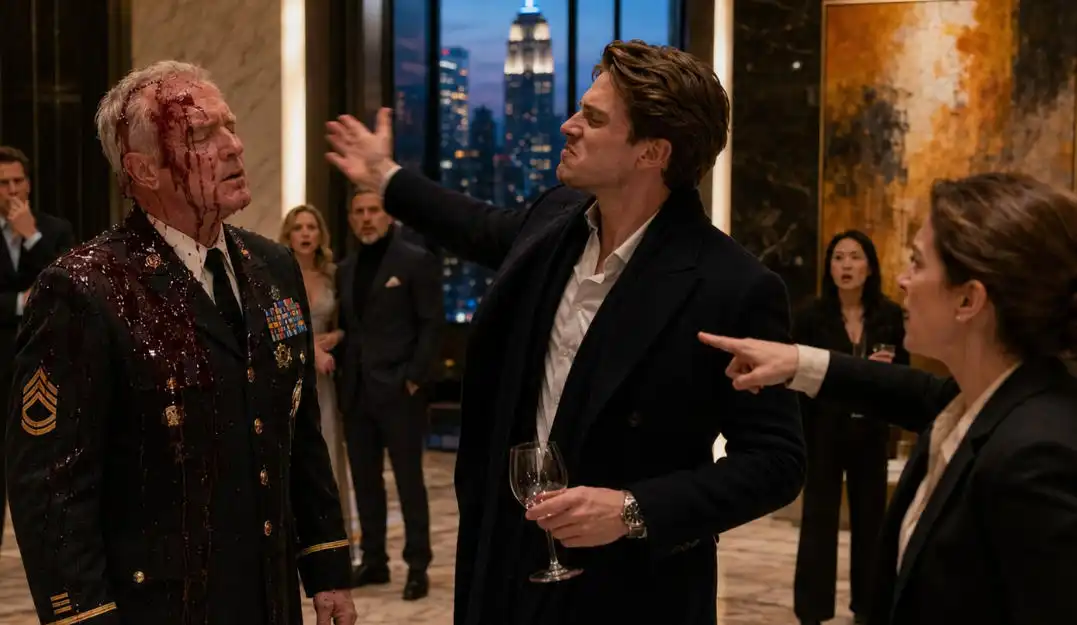
Red wine still dripped from the medals on my chest.
My cheek burned where he had slapped me.
I could feel every pair of eyes in that lobby.
The broker near the front desk.
The older couple by the mailroom.
The delivery driver holding a paper bag.
The two tenants recording with their phones.
And Melissa.
Standing there with a fake report already half-written in her head.
I was the security guard.
She was the property manager.
Evan was the rich tenant in the penthouse.
On paper, I was the easiest man in that room to destroy.
That was what they were counting on.
Evan stepped closer.
“You’re fired,” he said. “I’ll make sure you never work in this city again.”
His friend laughed.
Another one said, “Bro, he looks like he’s about to cry.”
I didn’t answer.
That bothered them more than anger would have.
Melissa lifted her phone and said, loudly enough for everyone to hear:
“I’m calling corporate. Frank assaulted a resident’s guest, then tampered with building access.”
That was the lie.
A clean lie.
A useful lie.
The kind of lie people believe when it comes from someone wearing a blazer instead of a security jacket.
Evan played his part perfectly.
He grabbed his collar like I had shoved him.
“He attacked me when I asked a question,” Evan said. “Everybody saw him get aggressive.”
Nobody spoke.
That hurt more than the slap.
Not because they believed him.
Because they were scared to be the first person to say they didn’t.
So I did what I had done for thirty years.
I stayed still.
I watched.
I remembered.
And I let the room keep talking.
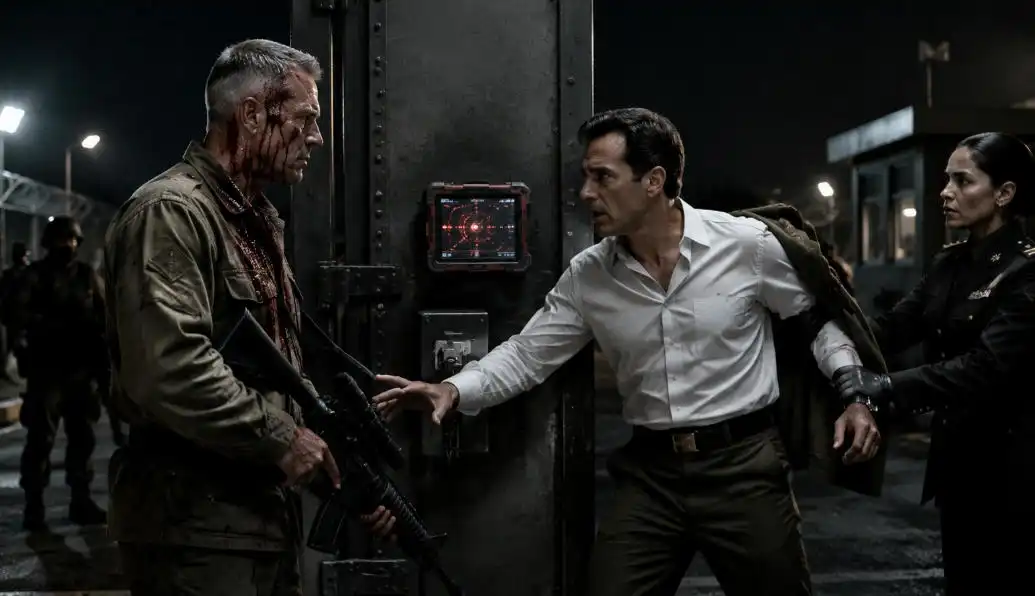
Melissa came behind the desk and reached for the control tablet.
I slid it away with two fingers.
“Don’t touch that.”
She froze.
“Excuse me?”
“That system is under administrative lock.”
Evan laughed again.
“Administrative lock? Listen to yourself. You’re a doorman.”
I looked at him.
“No. Tonight I’m the man who has to document why a temporary resident assaulted staff, attempted to file a false incident report, and violated the building’s guest policy.”
His smile faded.
Only a little.
Melissa recovered quickly.
“You don’t document anything,” she said. “I do.”
I nodded.
“That used to be true.”
Then the lobby screens changed.
One by one.
The security feed from the last ten minutes appeared.
No sound at first.
Just the picture.
Evan entering with two unregistered guests.
Me asking for signatures.
Evan stepping close.
The wine glass lifting.
The red splash across my medals.
The slap.
My hands at my sides the entire time.
The lobby made one sound.
A low, collective inhale.
Evan’s friend stopped recording.
Melissa’s mouth opened, but nothing came out.
Then the sound turned on.
Evan’s own voice filled the lobby.
“Do you know who my father is?”
Then:
“Lobby trash.”
Then:
“You people should be grateful we let you stand near the rich.”
The older woman by the mailroom whispered, “Oh my God.”
Evan lunged toward the desk.
“Turn that off.”
I didn’t move.
The system had already uploaded the footage to three locations.
Local server.
Corporate archive.
Legal hold.
Melissa knew that phrase.
I saw it in her eyes.
Legal hold meant nobody could delete it.
Nobody could “lose” it.
Nobody could edit out the slap and keep only the part where Evan pretended to be a victim.
Evan pointed at me.
“You’re dead. My family knows lawyers.”
I said, “Good. So do mine.”
Melissa took one step backward.
The truth was, I had worked that lobby for four months.
Quietly.
Night shifts.
Morning shifts.
Holiday coverage.
I opened doors.
Signed packages.
Helped residents with groceries.
Let people assume I was just another old man in a uniform.
That was the point.
My company, Mercer Shield, had been hired after a string of unauthorized penthouse parties, stolen packages, and suspicious access overrides.
But there was another layer nobody in the lobby knew.
Mercer Shield didn’t just install the security system.
Through a holding company, my partners and I owned the building’s security infrastructure.
The cameras.
The access controls.
The elevator permissions.
The digital visitor logs.
And after a quiet acquisition two months earlier, our holding company had taken control of the building’s commercial operating entity.
I wasn’t there because I needed a chair at the front desk.
I was there because someone inside the building was selling access.
Someone was falsifying reports.
Someone was protecting a handful of rich temporary renters who treated the place like their personal playground.
And Melissa had been at the center of every complaint that disappeared.
For weeks, I had watched her.
Not guessed.
Watched.
Every elevator override.
Every deleted visitor note.
Every “noise complaint resolved” report filed before anyone ever investigated it.
Every late-night penthouse party marked as “family gathering.”
Every envelope passed from Evan’s assistant to Melissa beside the service hallway.
I had enough to suspect corruption.
But suspicion is not a hammer.
Evidence is.
That night, Evan gave me the final piece.
In public.
On camera.
With witnesses.
Melissa tried one last time.
“This is illegal,” she said. “You can’t lock a resident out.”
I looked at her.
“Emergency exits remain active. No one is trapped. The elevator is restricted because a security assault occurred and the penthouse access credentials are under review. The unit’s smart systems are in maintenance hold due to unauthorized overrides from your admin account.”
Her face went gray.
Because I had not said Evan’s admin account.
I said hers.
Evan turned slowly toward her.
“What is he talking about?”
Melissa whispered, “Don’t say anything.”
That was the first honest thing she had said all night.
The front doors opened.
Two NYPD officers walked in, followed by our corporate counsel and the building’s asset manager.
Evan looked relieved.
That made sense.
He thought authority always arrived for him.
Not because of him.
One officer asked, “Who is Frank Mercer?”
I raised my hand.
“That’s me.”
The officer nodded.
“We received the footage and the incident packet.”
Evan exploded.
“Great. Arrest him. He hit me.”
The officer looked at him.
“Sir, the video shows you struck him.”
The lobby went silent again.
Different silence this time.
The kind that lands like a verdict.
Evan’s mouth opened.
Closed.
Opened again.
“My father—”
The officer cut him off.
“Your father is not in this lobby.”
Someone near the mailroom actually gasped.
I didn’t smile.
I wanted to.
But I didn’t.
Because the moment was bigger than revenge.
The officer asked if I wanted to file a complaint for assault.
I looked at Evan.
His face had gone red.
His friends had stepped away from him like embarrassment was contagious.
Melissa was staring at the floor.
“Yes,” I said. “I do.”
Then our counsel handed Melissa a folder.
“Melissa Grant,” he said, “you are suspended pending investigation for falsifying incident reports, misusing administrative access, and interfering with security records.”
She grabbed the folder with shaking hands.
“You can’t do this.”
The asset manager said, “We already did.”
That was when Evan realized the elevator still would not take him upstairs.
He jabbed the button again.
Nothing.
He tried his phone.
The penthouse smart lock app rejected him.
He cursed and said, “My clothes are up there.”
Counsel answered calmly.
“Your belongings will be inventoried and returned through legal process. Your lease agreement allows immediate access suspension after violence against staff and documented policy violations. Formal eviction proceedings begin tomorrow morning.”
Evan looked at me like I had betrayed him.
That still amazes me.
Men like him can pour wine on your medals, slap you in public, lie about you, and somehow feel betrayed when consequences arrive.
“My credit is perfect,” he said.
The asset manager held up another document.
“It won’t stay that way if the unpaid penalties, damages, and legal fees go to collections. Your guarantor has already been notified.”
That word hit him harder than anything.
Guarantor.
His father.
For the first time all night, Evan stopped performing for the room.
He looked young.
Not innocent.
Just young.
Like a child who had finally broken something money could not instantly fix.
The police took statements.
The tenants who had stayed quiet began talking all at once.
“I saw the slap.”
“He never touched him.”
“She accused Frank before checking anything.”
“I recorded the wine.”
The older woman from the mailroom came over to me after giving her statement.
She touched my sleeve lightly, avoiding the wine.
“My husband served,” she said. “Those medals matter.”
I swallowed hard.
“They do.”
She nodded.
“I’m sorry nobody spoke sooner.”
That almost broke me.
Not the slap.
Not the wine.
That apology.
Because humiliation is heavy, but silence makes it heavier.
By midnight, Evan was gone.
Not in handcuffs.
Not dramatically.
Just smaller.
Escorted out through the same lobby where he had tried to turn me into a joke.
His friends did not leave with him.
One of them asked the officer if he could “not be included in this.”
That told me plenty.
Melissa left through the service entrance with a cardboard box two days later.
The investigation found she had taken payments to ignore violations, delete complaints, and keep wealthy renters protected from consequences.
She had also drafted three prior complaints about me that were never filed.
All fake.
All waiting for the right moment.
If I had raised my hand that night, even to defend myself, she would have used them.
That was the trap.
So I am grateful I stayed still.
A week later, the building sent residents a formal notice.
New management.
New access rules.
New reporting procedures.
No more “special treatment” for temporary penthouse tenants.
Evan’s family tried to settle quietly.
They paid for the damaged uniform, the cleaning, the legal fees, the security breach costs, and the unpaid penalties.
His rental agreement was terminated through court process.
The eviction filing and collections claim followed him into tenant screening.
He did not move into another skyline penthouse.
Last I heard, he was staying in a weekly hotel across the river, telling people he was “between places.”
Melissa lost her license with the management firm and became a warning story in every staff training session we ran afterward.
As for me?
I kept working the front desk.
Not because I had to.
Because I wanted every employee in that building to understand something.
The uniform is not weakness.
Service is not shame.
Quiet is not permission.
And dignity does not belong only to the people who can afford the top floor.
One month after the incident, the residents held a small ceremony in the lobby.
Nothing fancy.
Coffee.
Store-bought cake.
A new framed policy on the wall:
Respect for staff is a condition of residence.
The older woman from the mailroom pinned a replacement ribbon on my jacket.
My hands shook a little.
I admit that.
Then the elevator opened.
A new tenant stepped out, saw me, and said:
“Good morning, sir.”
Not “guard.”
Not “doorman.”
Sir.
I nodded and opened the door for him.
Because that is what I do.
But this time, everyone in that lobby understood the difference between serving people…
And being beneath them.
So pick a side.
Was I right to stay silent until the system exposed everything…
Or should a man never have to swallow that kind of public insult just to prove the truth?
Share this if you believe respect should never depend on someone’s paycheck. 🛡️
Disclaimer: Mention of any brand or trademark is for identification only and does not imply partnership or endorsement