The library doors opened, and for the first time all morning, Dr. Meredith Vale stopped smiling.
She didn’t know what I had seen.
She didn’t know what the little LEGO pattern meant.
And she had no idea that the three boys she had just mocked in front of a room full of adults had built the one thing she couldn’t talk her way out of.
Proof.
My sons were five.
Triplets.
Small enough to still sleep with stuffed animals.
Smart enough to build a distress message in Morse code because they were too terrified to say the words out loud.
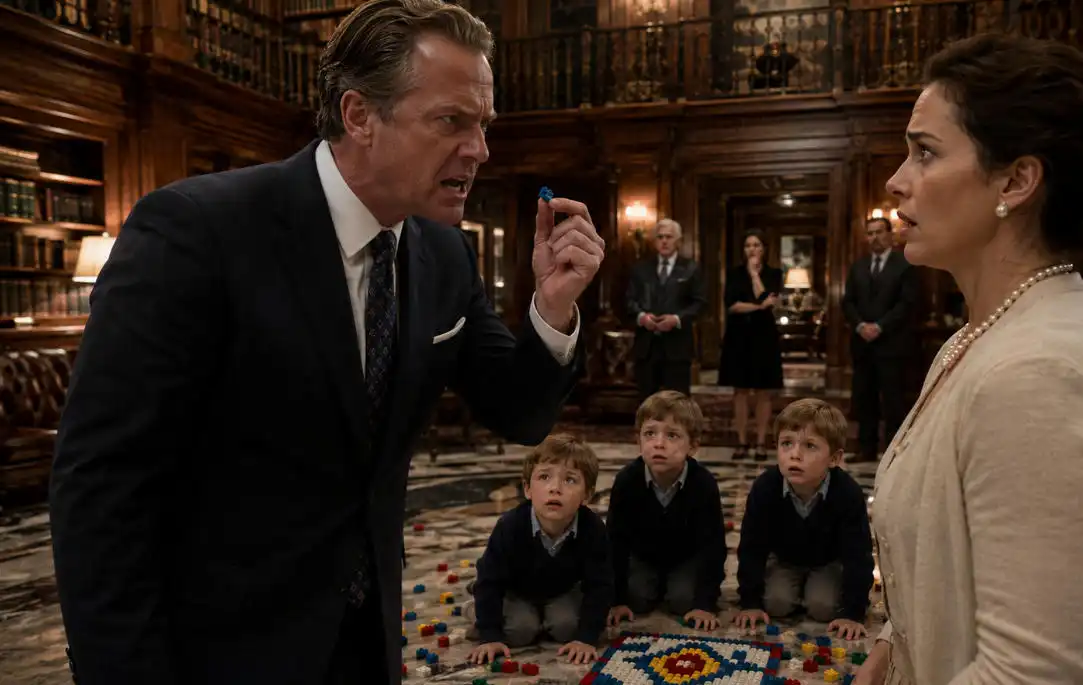
And Dr. Vale, their “elite developmental tutor,” had just made them stand facing the wall in our two-story library like criminals.
In front of my housekeeper.
In front of the nanny.
In front of her teaching assistant.
In front of two donors visiting my private research foundation.
She didn’t whisper her cruelty.
She performed it.
That was the part I could not forget.
She wanted witnesses.
She wanted the room to believe she was the authority and my sons were the problem.
“Some children are simply decorative,” she said.
Then she laughed.
A small, polished laugh.
The kind people use when they think cruelty sounds educated.
My oldest son, Noah, stared at the wall.
My middle son, Caleb, kept rubbing his sleeve over his eyes.
My youngest, Eli, had one hand clenched around a red LEGO brick like it was the only thing keeping him steady.
I stood behind the half-open door, frozen.
Not because I was afraid of her.
Because I was afraid of what I might do if I stepped in too soon.
Dr. Vale walked in front of them slowly, heels clicking against the marble.
“You boys need to understand something,” she said. “Your father may be a very wealthy man, but wealth does not create intelligence.”
Her assistant, Rachel, gave a nervous little laugh.
The nanny, Paula, stood beside the fireplace and said nothing.
That silence cut almost as deeply as the insult.
Because Paula had been with our family for six months.
She had seen my boys read maps for fun.
She had seen them solve pattern puzzles meant for children twice their age.
She had watched them build a working pulley system out of blocks and string just to lift a cookie jar off the kitchen counter.
But that day, she looked away.
Dr. Vale turned toward the adults.
“This is what I meant in my report,” she announced. “Repetitive play. Poor verbal response under pressure. Social withdrawal. Possible severe developmental limitations.”
Then she looked at my sons again.
“And frankly, I suspect very low IQ.”
My hand tightened around the doorframe.
I could hear my late wife’s voice in my head.
Don’t explode.
Protect them first.
Expose her second.
So I stayed quiet.
For ten more seconds.
That was all it took.
Dr. Vale walked to the table where my sons had spent the morning building a LEGO model of the library.
Two floors.
Tiny bookshelves.
A spiral staircase.
A miniature balcony.
It was beautiful.
She placed one manicured hand on it and said, “This is not giftedness. This is obsession.”
Then she swept it onto the floor.
The crash echoed through the whole library.
Hundreds of pieces scattered across the marble.
Eli made a sound I had never heard from him before.
Small.
Broken.
Dr. Vale pointed to the mess.
“Clean it up.”
Noah whispered, “We worked hard.”
She leaned down until her face was close to his.
“Then maybe next time, work smart.”
That was when Caleb moved.
He didn’t argue.
He didn’t cry.
He dropped to his knees and began collecting pieces.
But he didn’t rebuild the library.
He made a line.
Black.
Black.
Black.
A pause.
Yellow.
Yellow.
Yellow.
A pause.
Black.
Black.
Black.
My breath stopped.
Years ago, during a storm, the boys had asked me how ships asked for help before radios had voices.
I taught them S.O.S.
Three dots.
Three dashes.
Three dots.
They loved it.
For weeks, they tapped it on tables.
Blinked it with flashlights.
Built it with cereal.
I thought it was just a game.
That morning, it became a lifeline.
Noah joined Caleb.
Then Eli.
The three of them worked in silence, placing bricks with strange precision.
Dr. Vale stood above them and smirked.
“Do you see?” she said to the assistant. “This is what I mean. Pattern fixation.”
Rachel nodded quickly.
“Yes. I saw the same behavior yesterday.”
Yesterday.
The word landed hard.
I opened my phone and checked the library camera feed.
The cameras were hidden in plain sight, installed years earlier after a rare manuscript was damaged during a fundraiser.
They captured the whole room.
Every angle.
Every word.
Every adult who watched.
I rewound the feed from the last hour.
There she was.
Dr. Vale grabbing Caleb by the upper arm and pulling him away from the table.
Not hard enough to leave obvious marks.
Hard enough to scare him.
There she was, pushing Noah’s workbook to the floor because he solved a logic problem “too fast to have understood it.”
There she was, telling Eli, “Your brothers carry you. Without them, you’re nothing.”
And there was Paula, the nanny, nodding when Dr. Vale asked, “They are difficult every morning, aren’t they?”
Paula said, “Yes, ma’am.”
But the video showed my boys had been quiet.
Focused.
Obedient.
Rachel, the assistant, had been worse.
She corrected records.
She moved papers.
She wrote fake notes into a tablet after each insult, turning ordinary childhood fear into “clinical observations.”
That was the real danger.
Not just a cruel teacher.
A cruel teacher with paperwork.
A cruel teacher building a file that could follow three children for years.
I stepped into the room.
Nobody noticed at first.
The boys were still placing bricks.
Dr. Vale was still talking.
“They need a restrictive learning plan,” she said. “Honestly, Mr. Whitmore is in denial. Brilliant adults often produce disappointing children and cannot accept it.”
One of the donors looked uncomfortable.
The other stared at the floor.
I said, “Dr. Vale.”
The room went silent.
My sons turned around.
All three of them looked at me like they were ashamed.
That nearly destroyed me.
Not afraid.
Ashamed.
As if they had failed by being hurt.
I walked past Dr. Vale and knelt beside them.
“Are you okay?” I asked.
Noah nodded too fast.
Caleb stared at the LEGO pieces.
Eli whispered, “We made the message, Dad.”
“I know,” I said.
His chin trembled.
“We didn’t know if you’d see it.”
I took his hand.
“I saw it.”
Then I stood.
Dr. Vale recovered quickly.
People like her always do.
She put on a sad professional face.
“Mr. Whitmore, I’m glad you came. I was just documenting some concerning behavior. I know this may be emotional for you, but—”
“Stop.”
The word was quiet.
She stopped anyway.
I picked up one black LEGO brick from the floor.
“What does this pattern say?”
She glanced down.
“It doesn’t say anything. It’s repetitive construction.”
I looked at Rachel.
“Do you agree?”
Rachel swallowed.
“Yes. That would be my professional opinion.”
I turned to Paula.
“And you?”
Paula’s eyes filled with tears.
“I… I don’t know.”
Dr. Vale shot her a warning look.
That look told me everything.
I walked to the wall beside the fireplace.
There, proudly framed, was a copy of Dr. Vale’s doctoral diploma.
She had brought it herself on her first day.
She said parents respected visible credentials.
I had let her hang it.
That morning, I removed it from the wall.
Her face tightened.
“Mr. Whitmore, that is private property.”
I opened the frame.
Pulled out the copy.
And tore it down the middle.
The sound was sharp.
Rachel gasped.
Dr. Vale’s mouth opened.
I held the torn pieces in one hand and said, “This paper made everyone in this room afraid to question you.”
Then I pointed to the children.
“But those bricks told the truth faster than your degree ever did.”
Her face went red.
“How dare you?”
“No,” I said. “How dare you.”
I placed my phone on the table and turned the screen toward the room.
The live security archive was open.
Her voice played back from the speaker.
“Some children are simply decorative.”
Then another clip.
“Very low IQ.”
Then another.
“Your father bought books, not brains.”
The donors stared.
Rachel went pale.
Paula covered her mouth and began crying.
Dr. Vale reached for the phone.
I pulled it back.
“Careful,” I said. “That would be evidence.”
Her expression changed.
For the first time, she looked less offended than afraid.
Good.
“Evidence of what?” she asked.
“Child emotional abuse. Physical intimidation. Falsified educational records. Professional misconduct. And, depending on what the police decide after they review the footage, intentional harm.”
She laughed once.
Too loud.
“You’re not a lawyer.”
“No,” I said. “I’m not.”
Then I looked toward the doorway.
“My attorney is.”
A woman in a navy suit stepped inside.
Beside her were two uniformed officers.
Dr. Vale took a step back.
Rachel whispered, “Oh my God.”
My attorney, Elaine Porter, had represented my research foundation for twelve years.
She was calm in the way only dangerous people are calm.
“Dr. Vale,” Elaine said, “we preserved the footage from the last thirty days. We also have copies of your written evaluations, your assistant’s notes, and the household employment records. You should not discuss this further without counsel.”
Dr. Vale snapped, “This is intimidation.”
Elaine nodded toward my sons.
“No. What happened to them was intimidation.”
The officers asked everyone to remain in the library.
One spoke gently to my boys.
Another took statements from the adults.
Rachel broke first.
She admitted Dr. Vale told her to exaggerate the boys’ “deficiencies” so she could recommend an expensive private behavioral program.
A program where Dr. Vale served as a paid consultant.
Paula broke next.
She admitted Dr. Vale had pressured her to support the reports.
“She said if I contradicted her, Mr. Whitmore would fire me for being unqualified,” Paula said through tears. “I was scared.”
I believed she was scared.
I also believed fear did not excuse watching children be humiliated.
Dr. Vale denied everything.
Then Elaine played another clip.
This one was from two weeks earlier.
Dr. Vale in the library.
Talking to Rachel.
“If we establish developmental concerns early, the father will pay anything. Rich widowers always do. Especially ones who think their children are miracles.”
I felt the room shift.
Even the officers looked disgusted.
My sons were not broken.
They were a business plan.
That was the truth.
Ugly.
Simple.
Profitable.
Dr. Vale saw three gifted little boys and decided their gifts threatened her control.
If they looked brilliant, she was just a tutor.
If they looked damaged, she became necessary.
So she manufactured weakness.
She punished confidence.
She trained adults to doubt children.
And she wrapped it all in academic language.
That was the part that made people believe her.
Not cruelty.
Credentialed cruelty.
The legal process took months.
Not days.
Real consequences rarely happen as fast as people want.
But they happened.
The footage went to law enforcement.
The state education board opened an investigation.
The private schools listed on her résumé were contacted.
The university that had granted her doctorate received formal complaints supported by video, records, and witness statements.
I did not need to “ruin” her.
I only had to remove the shadows she was hiding in.
The truth did the rest.
Rachel lost her assistant certification and testified under a cooperation agreement.
Paula was dismissed from our home, but I paid for three months of counseling and job placement because my boys asked me not to “make her homeless.”
That was who they were.
Still kind.
Even after adults failed them.
Dr. Vale was charged with child endangerment-related offenses and professional misconduct tied to intentional emotional harm and falsified reports.
Her license was permanently revoked.
The consulting program cut ties with her.
Every school quietly removed her name from their referral lists.
The academic world she had used like armor closed around her.
Yes, I made calls.
To university presidents.
To foundation boards.
To research partners.
To every institution that had ever put her name beside the word “expert.”
But I never lied.
I sent the footage.
I sent the documents.
I sent the LEGO photos.
And I asked one question:
“Is this the standard you endorse?”
Not one of them said yes.
Months later, a colleague saw Dr. Vale working in the kitchen of a small restaurant outside Boston.
Washing dishes.
I did not celebrate that.
Not exactly.
I thought about the framed diploma tearing in my hands.
I thought about how much power we give people when they sound educated.
Then I thought about my sons.
And I felt peace.
Because they were safe.
That mattered more than revenge.
A year after the library incident, the boys were invited to demonstrate their pattern-recognition project at an international youth science showcase.
They were still only six.
They wore tiny navy blazers.
Eli carried a LEGO brick in his pocket for courage.
Noah explained the math.
Caleb explained the code.
Eli pressed the final button and made a small robot blink:
S.O.S.
Then he smiled and said into the microphone:
“It means help. But it also means somebody listened.”
The room stood up.
Not because they were rich.
Not because of me.
Because three little boys who had been called “decorative” had taught a room full of adults how intelligence can look quiet.
How fear can look like silence.
And how a child asking for help may not always use words.
That night, we went home to the same library.
The LEGO model had been rebuilt.
This time, the boys added something new.
Three tiny figures standing on the balcony.
A father below them.
Looking up.
Eli handed me a little LEGO sign.
It said:
SAFE.
I kept it on my desk.
I still have it.
And every time someone tells me a child is “too quiet,” “too different,” or “not as bright as expected,” I remember three small boys on a marble floor, building the truth one brick at a time. 🧱
Pick a side and share this: Was I too harsh for tearing down a respected teacher’s entire career? Or should every adult who humiliates children in public face consequences just as public?
Disclaimer: Mention of any brand or trademark is for identification only and does not imply partnership or endorsement