The file marked MARBLE ROOM — 3:17 PM didn’t open right away.
For three seconds, all we saw was my father’s hand resting on the tablet.
Nobody breathed.
My cousin Vanessa still had that smug little smile on her face, like she had already won.
Then my father said, very softly, “Let it play from the beginning.”
I was four years old when my cousin tried to turn me and my twin sister into thieves.
Not teenagers.
Not spoiled adults.
Four.
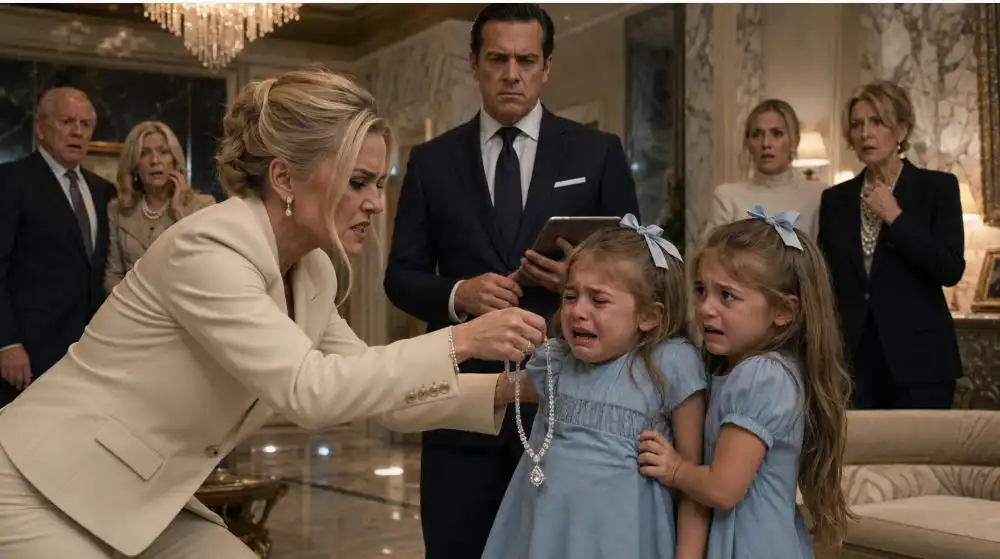
My sister Lily and I were standing barefoot on the cold marble floor of my father’s estate, wearing matching white birthday dresses with tiny blue bows.
It was supposed to be a family celebration.
Instead, it became the day I learned that some people don’t hate you because you did something wrong.
They hate you because you were loved.
My father, Alexander Vale, owned one of the largest media companies in the country.
To the outside world, he was powerful, polished, untouchable.
But to Lily and me, he was just Dad.
The man who let us put stickers on his laptop.
The man who carried us both at the same time even when his back hurt.
The man who checked under the bed every night for “dragons,” because Lily insisted monsters were too boring.
That afternoon, our relatives had filled the central marble room of the estate.
There were cousins, aunties, lawyers, family friends, old-money investors, charity board members, and staff moving quietly along the walls.
The room had white columns, a glass dome ceiling, gold-framed portraits, and a grand staircase that made every entrance feel like a performance.
Vanessa loved that room.
She loved being seen in it.
She was my older cousin, beautiful in a sharp way, with perfect hair, cold eyes, and the kind of smile people use when they want to look kind without actually feeling kindness.
She had grown up close enough to wealth to feel entitled to it, but not close enough to control it.
That made her dangerous.
My father’s trust supported several branches of the family.
Vanessa’s mother, Aunt Marjorie, lived off that support.
Their vacation homes.
Their club memberships.
Their “consulting company” that never seemed to consult anyone.
All of it was tied to my father’s family trust.
But Vanessa wanted more.
She wanted position.
She wanted control.
Most of all, she wanted to be treated like the rightful daughter of the empire.
Then Lily and I were born.
Twin daughters.
My father’s only children.
And suddenly, Vanessa wasn’t the future anymore.
She was just a relative.
That day, Vanessa wore a cream designer suit and a diamond necklace so large that even at four years old, I knew it was meant to be noticed.
She kept touching it while people complimented her.
“Vintage,” she said. “Custom setting. Almost impossible to replace.”
Later, when the music started in the east gallery, Lily and I ran around the edge of the marble room with our little toy ponies.
A nanny had stepped away for less than a minute to answer a question from the kitchen staff.
That was all Vanessa needed.
She bent down and smiled at us.
“Come here, girls,” she said. “I have a surprise.”
Lily trusted everyone back then.
I trusted anyone Lily trusted.
Vanessa held out two tiny velvet pouches.
“For your treasures,” she said.
We thought she meant our toy rings.
She touched our shoulders.
She fixed our bows.
Then she slipped her hands into the pockets of our dresses.
I remember the cold brush of her fingers.
I remember the smell of her perfume.
I remember her whispering, “Don’t tell anyone. It’s a grown-up game.”
Then she stood up and walked away.
A few minutes later, she screamed.
“My necklace!”
Every adult turned.
Vanessa clutched her bare neck like she had been attacked.
“My diamond necklace is gone!”
The room erupted.
Aunt Marjorie hurried to her daughter’s side.
“Who was near you?” she demanded.
Vanessa pointed directly at us.
“The twins.”
Lily froze.
I looked down at my toy pony.
I didn’t understand.
Captain Reed, my father’s head of security, stepped forward immediately.
He was tall, broad, and serious, the kind of man everyone obeyed without thinking.
He had worked for my father for years.
But Vanessa had spent months flattering him.
Bringing him coffee.
Calling him “the only competent person in this house.”
Making him feel important.
So when she cried, he believed her.
“Girls,” he said, “empty your pockets.”
Lily started crying.
I shook my head.
Not because I was hiding anything.
Because I was scared.
Vanessa’s voice sharpened.
“See? They know.”
Aunt Marjorie looked around the room, making sure everyone was listening.
“Alexander has spoiled them rotten,” she said. “Children raised in too much luxury never learn boundaries.”
Then she said the sentence I will never forget.
“Maybe this family needs to stop pretending those girls are little angels.”
Captain Reed reached gently but firmly toward Lily’s pocket.
Out came the diamond necklace.
The room gasped.
Then he checked mine.
Out came the velvet pouch.
People whispered.
Someone said, “Oh my God.”
Another person murmured, “At their age?”
A phone lifted near the staircase.
Someone was recording.
Vanessa looked down at us like we were dirt on her shoe.
“Well,” she said. “What do we call children who take things that aren’t theirs?”
Lily sobbed, “I didn’t.”
Vanessa bent closer.
“Bad girls lie too.”
That was when my father entered.
He had been in a private call in the west office.
One look at his face, and the room shifted.
Not because he looked angry.
Because he looked calm.
Too calm.
Captain Reed straightened.
“Sir,” he said, holding out the necklace, “it was found in the children’s pockets.”
Aunt Marjorie stepped in before my father could answer.
“Alexander, don’t make excuses. This is embarrassing, but it must be handled. If they steal from family at four, imagine what happens at fourteen.”
Vanessa wiped at one dry eye.
“I’m heartbroken,” she said. “I love the girls, but accountability matters.”
Accountability.
That word came out of her mouth like poison wrapped in silk.
My father walked to us.
He knelt.
He did not ask, “Did you do it?”
He did not ask, “Why?”
He simply looked at Lily, then at me, and said, “Are you hurt?”
Lily reached for him.
I did too.
But Captain Reed shifted slightly, as if the “evidence” meant we should not be comforted yet.
My father saw that.
His eyes moved from Captain Reed’s hand to Vanessa’s face.
Then to Aunt Marjorie.
Then to the glass dome above the marble room.
There was a tiny red light near the inner rim.
Almost invisible.
Vanessa never noticed it.
No one did.
My father stood.
“Captain Reed,” he said, “who searched the girls?”
“I did, sir.”
“On whose accusation?”
“Miss Vanessa’s.”
“Did you review the room feed first?”
Captain Reed hesitated.
“No, sir. The item was recovered directly from their pockets.”
Vanessa gave a little laugh.
“Alexander, please. We all saw it.”
My father turned his tablet on.
“No,” he said. “You saw what someone wanted you to see.”
Aunt Marjorie scoffed.
“Don’t turn this into one of your media dramas.”
My father tapped the screen.
The security wall display behind the bar lit up.
Then came the replay.
The first angle came from the ceiling.
Too high to be a normal camera.
Years later, I learned what it was.
My father’s estate had a private security contract connected to a micro-satellite imaging system used for high-value property monitoring, paired with internal reflective sensors around the glass dome.
It wasn’t spying on guests in bathrooms or bedrooms.
It was perimeter and public-room security, disclosed in the estate access agreement that every adult had signed at the gate.
Vanessa had signed it too.
She just never read anything she thought rich people could ignore.
The footage showed the marble room from above in startling detail.
There we were.
Two little girls with toy ponies.
There was Vanessa, smiling as she bent down.
The room watched silently.
The replay zoomed.
Her hand slipped into Lily’s pocket.
Then mine.
Not removing anything.
Planting something.
Aunt Marjorie’s face changed first.
Not shock.
Recognition.
My father noticed.
So did everyone else.
The footage continued.
Vanessa walked away, touched her bare neck, waited until the nanny left, and screamed.
The second angle opened.
Audio.
Her whisper filled the marble room.
“Don’t tell anyone. It’s a grown-up game.”
Lily whimpered.
I remember my father’s hand tightening around the tablet.
Vanessa’s mouth fell open.
“That’s edited,” she said quickly. “That has to be edited.”
My father swiped again.
A third file appeared.
Gate audio.
Aunt Marjorie’s voice played from earlier that afternoon.
“Make it look childish. If Alexander thinks those girls are becoming a liability, the trustees will panic.”
Then Vanessa’s voice.
“And when he questions their nanny?”
Aunt Marjorie replied, “The staff always takes the blame first.”
The room went completely still.
Captain Reed looked like he had aged ten years.
The nanny covered her mouth and started crying.
My father looked at Vanessa.
For the first time, his calm cracked.
“You planted stolen property on my daughters,” he said.
Vanessa backed up.
“They’re children. They won’t even remember.”
That was the moment everyone turned on her.
Not because she denied it.
Because she admitted what she really believed.
That hurting children was acceptable if they were too young to fight back.
My father stepped forward.
Vanessa lifted her chin, still trying to perform dignity.
“You need to think carefully,” she said. “Family scandals hurt everyone.”
My father slapped her once.
Open hand.
Sharp.
Non-bloody.
Final.
The sound cracked across the marble room.
Vanessa fell sideways onto the white rug, more shocked than hurt.
Aunt Marjorie screamed, “Alexander!”
My father did not raise his voice.
He didn’t need to.
“You are no longer family in any legal, financial, or private capacity.”
Then he turned to the trustees standing near the fireplace.
“Execute Article Twelve.”
One of the lawyers opened a folder immediately.
That was the legal hammer.
Article Twelve of the Vale Family Trust stated that any beneficiary who attempted fraud, coercion, reputational sabotage, or harm against a direct heir would be removed permanently.
Not warned.
Not suspended.
Removed.
Aunt Marjorie’s branch lost everything in that room.
Trust distributions.
Estate access.
Company retainers.
Preferred housing.
The consulting contracts.
The private credit guarantees my father had quietly provided for years.
Gone.
Vanessa tried to stand.
“You can’t do that.”
The lawyer adjusted his glasses.
“You signed the trust covenant in 2019.”
Aunt Marjorie snapped, “This is emotional retaliation.”
“No,” my father said. “This is compliance.”
Then he looked at Captain Reed.
“You are suspended pending investigation.”
Captain Reed swallowed hard.
“Yes, sir.”
My father’s voice dropped.
“You were hired to protect my children. Not protect the pride of an adult woman because she flattered you.”
That sentence destroyed him more than shouting ever could.
The police were not dragged in for spectacle.
My father did it properly.
Statements were taken.
The original footage was preserved.
The estate logs were secured.
The family trust board received the evidence before midnight.
By morning, Aunt Marjorie and Vanessa were escorted out of the guest wing with only their personal belongings.
No screaming scene.
No dramatic chase.
Just two black suitcases, a silent lawyer, and a front door that would never open for them again.
Their companies collapsed within weeks.
Without my father’s contracts, Vanessa’s luxury “brand strategy firm” had no clients.
Without the trust income, Aunt Marjorie’s homes went into default.
The bank called in loans my father had once guaranteed.
He did not ruin them with gossip.
He simply stopped protecting them from the consequences of their own signatures.
That was enough.
As for Lily and me, my father did something people still argue about.
He commissioned two custom toys for us.
Tiny carousel horses made of white gold, with little diamond-set saddles.
Not necklaces.
Not grown-up jewelry.
Toys.
Each marked with our initials.
When he gave them to us, he said, “No one in this world gets to make you feel dirty for something they put in your pocket.”
Lily asked, “Are we bad girls?”
My father pulled us both into his arms.
“No,” he said. “You are my daughters. And you told the truth by being brave enough to cry.”
Years passed before I understood the full weight of that day.
At four, I only knew that the room was loud, then silent.
That adults could lie beautifully.
That my father’s hug felt safer than any mansion.
At twenty-four, I finally watched the footage myself.
I saw Vanessa’s face.
I saw my aunt’s calculation.
I saw Captain Reed’s failure.
And I saw my father pause before revealing the truth.
For years, people asked why he let the accusation go on for those extra minutes.
Why not stop it immediately?
His answer never changed.
“Because I needed everyone to see who joined in.”
That was the part people missed.
The replay did not only expose Vanessa.
It exposed every relative who smirked.
Every guest who recorded.
Every adult who watched two crying children get cornered and decided silence was safer than decency.
After that day, my father changed the guest list forever.
The marble room became warmer.
Smaller dinners.
Kinder people.
More laughter.
Less performance.
Lily and I grew up knowing wealth could buy security systems, lawyers, and diamond toys.
But it could not buy character.
That had to be chosen.
Vanessa tried to apologize once, years later, when the debts became too heavy and her social circle disappeared.
She wrote that she had been “under pressure.”
My father mailed the letter back unopened.
Not because he hated her.
Because forgiveness does not require giving dangerous people another doorway to your children.
Today, Lily keeps her diamond carousel horse locked in a glass case.
I keep mine on my desk.
Not because of the diamonds.
Because every time I see it, I remember the lesson.
Some people will plant shame on you and then demand you carry it.
Don’t.
Empty your pockets.
Show the truth.
Let the whole room watch.
And when people say my father was too harsh, I ask them one thing:
If someone framed two 4-year-old children in front of an entire family just to steal their future, should they get mercy — or should they get exactly what the rules promised? Share this if you believe children should NEVER be used as pawns. 💎
Disclaimer: Mention of any brand or trademark is for identification only and does not imply partnership or endorsement