She saw the father first.
Not the billionaire from magazine covers.
Not the calm man sitting across from the President ten minutes earlier.
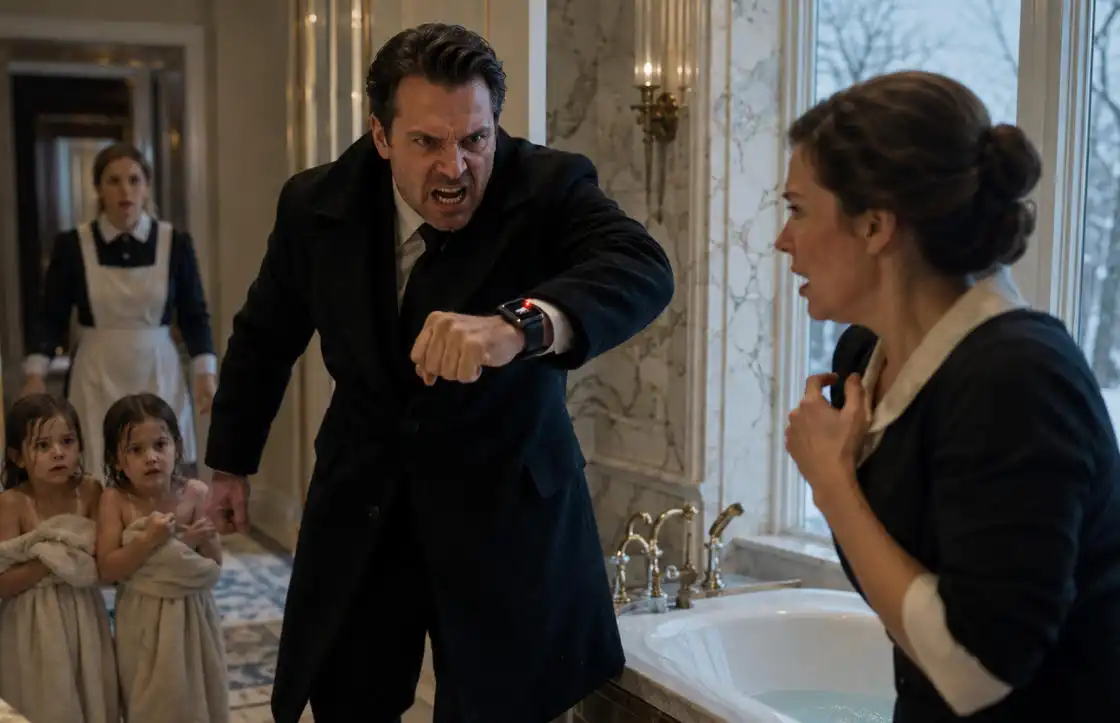
Just a father in a black overcoat, staring at steamless water and two trembling little girls.
Behind him came three pediatric trauma nurses, a security chief, and two federal agents who had not asked permission to enter.
Marla, the nanny, still had one hand on a towel.
Her smile died slowly.
“Mr. Hayes,” she said, forcing sweetness into her voice. “There’s been a misunderstanding.”
Ethan Hayes did not answer her.
He walked past the marble sink.
Past the maid standing frozen in the doorway.
Past the open cabinet where the twins’ warm pajamas had been shoved onto the floor.
He knelt beside the bathtub.
His daughters, Lily and Rose, were three years old.
They had matching wet curls plastered to their cheeks.
Their lips were pale.
Lily reached for him with both arms.
“Daddy,” she whispered. “We were bad.”
That sentence broke something in the room.
One of the nurses covered her mouth.
The security chief turned his head like he needed one second to control himself.
Ethan wrapped both girls in heated medical blankets.
Then he looked at Marla.
Not with rage.
With something colder.
“Who told them they were bad?”
Marla lifted her chin.
“They were hysterical. I was disciplining them.”
“In cold water?”
“They were being spoiled.”
The maid shifted in the doorway.
Ethan’s eyes moved to her.
“And you stood guard?”
The maid opened her mouth.
Nothing came out.
The maintenance man, Dale, appeared at the end of the hall.
He had been running.
He stopped when he saw the federal agents.
That was when everyone understood.
This was not a misunderstanding.
It was a plan.
Ethan stood up slowly.
“You have one chance,” he said. “Tell the truth before the cameras do.”
Marla laughed once.
A small, arrogant sound.
“Cameras? In a bathroom? That’s illegal.”
Ethan nodded.
“You’re right.”
For the first time, Marla looked relieved.
Then Ethan pointed to the hallway ceiling.
“But not outside the door.”
He pointed to the smart thermostat panel.
“Not on the plumbing system.”
He pointed to his watch.
“And not on the medical device that recorded my daughters’ body temperatures dropping second by second.”
The maid began to cry.
Dale whispered, “Marla…”
Ethan turned to the security chief.
“Lock down the house. Nobody leaves.”
Marla’s face hardened.
“You can’t hold me here.”
“No,” Ethan said. “But the police can.”
The first siren sounded outside.
Then the second.
Then the third.
By then, half the household staff had gathered at the end of the hallway.
The chef.
Two drivers.
A gardener.
The assistant house manager.
People who had heard crying and chosen silence.
People who were now watching Marla stand beside a tub of cold water with two children being treated by emergency doctors.
Ethan did not yell.
That made it worse.
He simply said, “Bring up the plumbing log.”
The security chief tapped his tablet.
The screen showed the hot-water valve had been manually shut off at 2:03 p.m.
Dale’s employee badge had opened the utility room at 2:01.
The maid’s phone had sent Marla a message at 2:05:
“Hall clear. He’s still with the President.”
Marla’s face drained.
Ethan looked at her.
“You knew I was gone.”
Marla folded her arms.
“I knew you were never here.”
The hallway went silent.
There it was.
The truth behind the cruelty.
Not discipline.
Not a mistake.
Resentment.
Marla had worked in the Hayes mansion for eight months.
She smiled for family photos.
She packed the twins’ lunchboxes.
She waved at cameras during charity events.
But behind closed doors, she called the girls “little princesses.”
She told other staff they were “born lucky.”
She told Dale that rich families only understood pain when it cost them something.
Dale owed money.
The maid wanted Marla’s job recommendation for another wealthy family.
So Marla made a plan.
Turn off the hot water.
Stand guard.
Punish the girls.
Make it look like a tantrum.
Then blame the twins for “refusing to bathe properly.”
What she did not know was that Lily and Rose had both been premature babies.
Ethan had designed custom medical sensors after one of them had a breathing scare as an infant.
Tiny wearable bands.
Temperature monitoring.
Heart-rate tracking.
Silent emergency alerts.
The kind of technology his company built for hospitals, not headlines.
That day, it saved them.
The police entered the hallway at 2:31 p.m.
Marla tried to walk past them.
One officer stopped her.
“Ma’am, remove the coat.”
She looked offended.
“Excuse me?”
The officer pointed at the label inside the sleeve.
It was not her coat.
It was one of the twins’ heated outdoor coats, altered to fit an adult.
She had stolen it from the children’s winter closet.
Ethan said quietly, “That belongs to my daughter.”
Marla’s mouth opened.
No words came.
The officer took the coat as evidence.
Marla stood in her thin uniform near the open front doors while police photographed the stolen clothing, the plumbing records, the hallway footage, and the medical alert timeline.
Snow blew across the driveway.
The same cold she had forced on two toddlers touched her face.
Nobody laughed.
Nobody had to.
The entire staff watched as she was placed in handcuffs.
Dale was arrested in the utility room.
The maid confessed before sunset.
She admitted Marla had paid her to keep everyone away from the hallway.
She admitted the twins had cried for their father.
She admitted Marla had said, “Let them learn what real life feels like.”
The case became national news within twenty-four hours.
Not because Ethan wanted attention.
Because the President’s office had to explain why one of America’s most powerful tech executives had left a secure meeting in the middle of a national semiconductor briefing.
Ethan released only one statement:
“My daughters are alive because a machine listened when adults refused to.”
That sentence was shared millions of times.
But the legal hammer came quietly.
Not online.
Not through revenge.
Through evidence.
Medical reports showed the twins were minutes away from a dangerous emergency.
The plumbing logs proved intent.
The hallway camera proved the maid blocked the door.
The stolen coat proved Marla had planned for herself to stay warm while the children suffered.
Her text history proved motive.
And Dale’s bank deposits proved payment.
Marla’s lawyer tried to call it “poor judgment.”
The prosecutor called it what it was:
Coordinated child endangerment.
Conspiracy.
Assault.
Attempted harm against vulnerable children in her care.
Betrayal of trust.
The judge watched the hallway footage once.
Only once.
Then he turned it off.
He said, “The court does not need to watch children suffer twice.”
Marla lost every certification.
Her name was entered into every childcare registry in the state.
Her assets from private nanny contracts were frozen pending civil judgment.
Dale took a plea deal and testified.
The maid did the same.
Marla refused.
She still believed the world would see her as a hardworking woman punished by a rich man.
Then the jury heard Lily’s recorded statement from the hospital.
A soft little voice.
“Miss Marla said Daddy wouldn’t come.”
One juror cried.
Another stared at the floor.
The verdict took less than two hours.
Guilty on all major counts.
The judge gave her the maximum sentence the law allowed.
The newspapers called it a “legal death sentence” for her old life:
No freedom.
No career.
No access to children.
No hiding behind wealthy families ever again.
And Ethan?
He did something nobody expected.
He did not sell the mansion.
He did not turn the bathroom into a locked room.
He rebuilt it.
The entire west wing became a warm-water therapy space for Lily and Rose.
He hired pediatric trauma counselors.
He hired nurses.
He installed temperature-controlled pools, soft slides, heated floors, and glass walls that opened to a snowy garden.
Six months later, Lily stood at the edge of the little indoor water park, holding her father’s hand.
She looked at the warm water.
Then at him.
“Is it safe?”
Ethan knelt beside her.
“I’ll always check first.”
Rose dipped one toe in.
Then she giggled.
Lily followed.
For the first time since that day, both girls splashed without fear.
Ethan did not cry in front of the cameras.
There were no cameras.
Just a father sitting on the floor in rolled-up sleeves, letting two little girls pour warm water over his shoes.
Justice did not bring back their innocence.
But it gave them safety.
It gave them truth.
And it taught every adult in that mansion one lesson they would never forget:
Silence protects the cruel.
Evidence protects the innocent. ⚖️
So choose a side:
Was Ethan right to expose every person involved publicly, or should he have kept the family’s pain private?
Share this if you believe children should be believed before adults are protected.
Disclaimer: Mention of any brand or trademark is for identification only and does not imply partnership or endorsement