The Governor did not speak right away.
That was the part that scared Victoria most.
He walked down the center aisle slowly, with two state auditors behind him and a sealed folder tucked under his arm.
Every phone in that auditorium turned toward the stage.
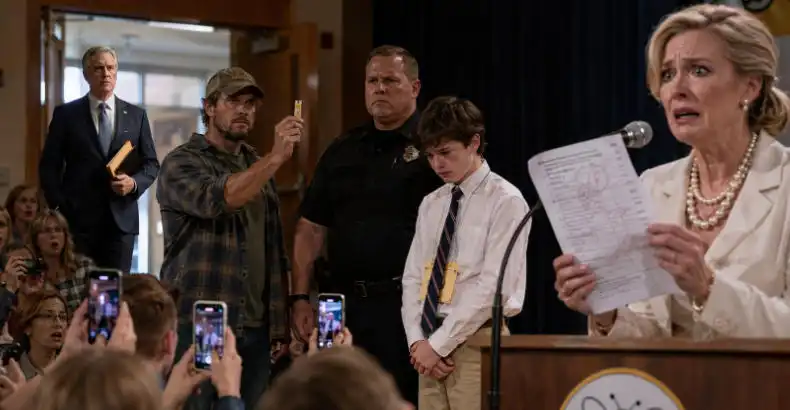
And my son Caleb stood there under the lights, still holding back tears while Victoria Whitmore gripped the microphone like it belonged to her.
I am not a rich man.
I drive trucks.
I know the sound of bad brakes on a mountain road.
I know what a tired man’s hands look like after unloading pallets at 3 a.m.
But that day, at the state spelling bee finals, I learned something worse than exhaustion.
I learned what it looks like when powerful people decide your child is disposable.
Caleb was fifteen.
Smart.
Quiet.
Dyslexic.
He had spent most of his school years being underestimated by people who confused slow reading with slow thinking.
But spelling was different for him.
He studied words like puzzles.
He listened to them.
Broke them apart.
Built them back together.
We practiced in diners, truck stops, parking lots, and sometimes in the sleeper cab of my rig while rain tapped the roof.
He earned his way to that state final.
Nobody handed it to him.
Victoria Whitmore could not stand that.
She was the state education director.
Her son Preston was also in the finals.
Preston was clean-cut, confident, and surrounded by adults who clapped before he even opened his mouth.
Victoria had spent the whole day acting like the trophy was already his.
She shook hands with donors.
Smiled at cameras.
Whispered to judges.
And every time Caleb answered correctly, her smile got thinner.
When Caleb spelled “chiaroscuro” correctly in the semifinal round, the audience clapped hard.
Victoria did not clap.
She leaned toward one of the judges and whispered something.
I saw it.
I always notice people who think working-class folks do not pay attention.
The final round came down to Caleb and Preston.
The word given to Caleb was difficult enough that half the adults in the room murmured.
“Synecdoche.”
Caleb closed his eyes.
I knew what he was doing.
He was hearing it.
Not seeing it.
That was how his mind worked best.
Then he spelled it slowly.
“S-Y-N-E-C-D-O-C-H-E.”
The head judge looked at the card.
Correct.
The room exploded.
Caleb covered his mouth with both hands.
I stood up without even realizing it.
Then the host lifted the trophy.
But before he could say Caleb’s name, Victoria stepped onto the stage.
“Hold on,” she said.
Her voice cut through the applause.
The host blinked. “Director Whitmore?”
She smiled like she was doing everyone a favor.
“There has been an irregularity.”
The room quieted.
Caleb looked at me.
I gave him a small nod.
Victoria reached to the judge’s table and picked up a packet of papers.
“Given the sensitive nature of this competition,” she said, “we cannot reward a student who appears to have submitted inconsistent written verification materials.”
That was nonsense.
Everyone knew it.
But she had a title.
And titles make weak people brave.
Caleb whispered, “Dad?”
I stepped toward the aisle.
A security guard moved in front of me.
“Sir, please stay back.”
I looked at him.
“My son is on that stage.”
He lowered his voice. “I’m sorry. Director’s orders.”
Victoria turned toward the crowd.
Then she did the cruelest thing I have ever seen an adult do to a child.
She held Caleb’s paper in the air and said:
“Perhaps the audience should hear what his actual work looks like.”
Caleb’s face drained.
The host whispered, “Director, I don’t think—”
Victoria snapped, “This is about integrity.”
Then she started reading.
Wrong letters.
Crossed-out words.
Misspellings.
Things that made Caleb sound careless.
Things that made people shift in their seats.
A few teenagers laughed nervously from the back.
One mother covered her mouth.
Caleb stood frozen beside the podium.
He did not cry.
That almost broke me more.
Because I knew he wanted to.
Victoria leaned closer to the microphone.
“Children with challenges deserve compassion,” she said, “but compassion is not the same as qualification.”
That was the line that made the room change.
Even the people who had been silent looked uncomfortable.
Then she turned to her son.
“Preston, please come forward.”
Preston stood from his chair, confused but pleased.
The host looked sick.
“Director Whitmore, the final result has not been—”
Victoria lifted one finger.
“I am the senior state official present.”
Then she looked directly at me.
“Some families need to learn that effort does not entitle them to excellence.”
I felt every eye on my work shirt.
The oil stain near my sleeve.
The cheap boots.
The old cap in my hand.
She wanted me to explode.
She needed me to become the angry truck driver she could remove from the room.
So I did not give her that gift.
I looked at Caleb.
“Stand tall, buddy.”
He swallowed.
His shoulders lifted half an inch.
That was enough.
Because here is what Victoria did not know.
Two weeks earlier, Caleb’s school counselor had called me by mistake.
She thought she was leaving a voicemail for Victoria’s assistant.
Instead, she left it on my phone.
The message said:
“Director Whitmore wants the accommodation sheets pulled before the final review. She also asked whether the handwritten verification page can be replaced if the score stamp is already logged.”
I listened to it six times in my truck.
Then I called a lawyer I once hauled furniture for.
He told me one sentence I never forgot:
“Gary, do not accuse anyone until the records are preserved.”
So I got quiet.
I requested copies of Caleb’s submitted materials.
I photographed the timestamped school portal.
I saved the delivery confirmation from the testing office.
And when a clerk I knew from a district warehouse told me a sealed audit copy had been sent to the Governor’s education compliance team, I drove five hours on my day off to make sure they knew what was happening.
Not to ruin Victoria.
To protect my son.
There is a difference.
Back in that auditorium, Victoria was still smiling.
She lifted the trophy toward Preston.
“Ladies and gentlemen, your rightful state champion—”
That was when the auditorium doors opened.
The Governor entered.
No music.
No announcement.
Just a room full of people turning around at once.
Victoria’s hand froze on the trophy.
The Governor walked to the stage and said, “Director Whitmore, step away from the microphone.”
Her face changed so fast people gasped.
“Governor,” she said, trying to laugh. “This is a student matter.”
He took the microphone from her hand.
“No,” he said. “It is now a state integrity matter.”
One of the auditors placed the sealed folder on the judge’s table.
The Governor looked at Caleb.
“Son, you do not need to say anything right now.”
Then he looked at the audience.
“Before this competition began, our office received evidence suggesting that a contestant’s official materials may have been altered after submission.”
Victoria went pale.
I heard someone whisper, “Oh my God.”
The auditor opened the folder.
Inside were two versions of Caleb’s verification sheet.
One had the official timestamp.
One did not.
One had the original blue score stamp.
One had a copied mark in the wrong corner.
One showed Caleb’s correct written confirmation.
One showed mistakes that had been inserted after the fact.
The Governor held both pages up.
“These are not the same document.”
Victoria tried to interrupt.
“I was protecting the reputation of the competition.”
The Governor did not raise his voice.
That made it worse.
“You were protecting your son’s position.”
Preston looked at his mother.
For the first time all day, he did not look smug.
He looked ashamed.
The head judge stood.
“I was told the replacement page came from the accommodations office.”
An auditor turned to Victoria.
“There is no record of that office issuing a replacement.”
Another judge lowered his head.
The Governor continued.
“We also have a voicemail, a document access log, and a security timestamp showing who opened the student file after certification.”
The room went dead silent.
Victoria’s mouth opened.
Nothing came out.
The same parents who had watched my son be humiliated now had their phones raised higher.
Victoria looked smaller under those lights.
Not poor.
Not helpless.
Just exposed.
The Governor turned to the security guard.
“Please escort Director Whitmore away from the competition area.”
Victoria snapped, “You cannot do this to me in public.”
A woman in the audience said, “You did it to that boy.”
That was the moment the room turned.
Not loud.
Not violent.
Just final.
Victoria was removed from the stage.
The Governor announced that she was suspended immediately pending formal investigation.
The state attorney’s office would review the altered records for fraud and misconduct.
The competition board would be audited.
Any official who knowingly participated would be removed.
Facts.
Not insults.
That is what made it powerful.
Then the Governor turned to Caleb.
“Caleb,” he said gently, “the official record confirms your final spelling was correct.”
Caleb looked at me.
I nodded.
The Governor asked, “Would you like to complete the ceremony?”
Caleb wiped his cheek with the back of his hand.
Then he stepped back to the microphone.
The host, whose hands were shaking, opened the final championship card again.
“For the record,” he said, “Caleb Miller’s final word is synecdoche.”
Caleb stood straight.
He spelled it again.
Clear.
Slow.
Perfect.
“S-Y-N-E-C-D-O-C-H-E.”
The applause hit like thunder.
People stood.
Teachers cried.
Even some of Preston’s friends clapped.
And then something happened I did not expect.
Preston walked to the microphone.
He looked at Caleb and said, “You won. I’m sorry.”
That did not fix what his mother had done.
But it mattered.
Caleb nodded once.
The trophy was placed in his hands.
It looked too big for him.
Then he looked at me from the stage, and for a second, he was six years old again, holding a library card and asking me if words would ever stop moving on the page.
I lost it then.
Not loud.
Just tears.
The scholarship committee met before we left the building.
Because of the official win, Caleb received the full state academic scholarship.
Four years.
Books included.
Victoria lost her position before the week was over.
The investigation found she had pressured two staff members to alter Caleb’s file and disqualify him quietly if Preston did not win outright.
One staff member cooperated.
One resigned.
Victoria was later charged with state records misconduct and fraud-related offenses.
Her name came off every education board she had ever bragged about.
But here is the part I remember most.
Not the trophy.
Not the cameras.
Not Victoria being walked away.
I remember Caleb sitting in the passenger seat of my truck afterward, holding the scholarship letter with both hands.
He said, “Dad, she made everyone hear my mistakes.”
I said, “No, son.”
He looked at me.
“She made everyone hear her character.”
He stared out the window for a long time.
Then he smiled.
Small.
Real.
Healing does not always arrive like fireworks.
Sometimes it arrives in a quiet truck cab, with your kid finally breathing like the world did not beat him.
A year later, Caleb started tutoring younger kids with dyslexia.
He tells them, “Your brain is not broken. Some people just don’t know how to read it yet.”
That is my boy.
Victoria tried to use power to shame a child.
Gary used patience, records, and the law to make sure the truth had witnesses.
So pick a side:
Was Gary right to stay calm until the evidence could destroy the lie in front of everyone — or should any parent step in the second their child is publicly humiliated? ⚖️
Share this if you believe a child’s dignity matters more than an official’s title.
Disclaimer: Mention of any brand or trademark is for identification only and does not imply partnership or endorsement