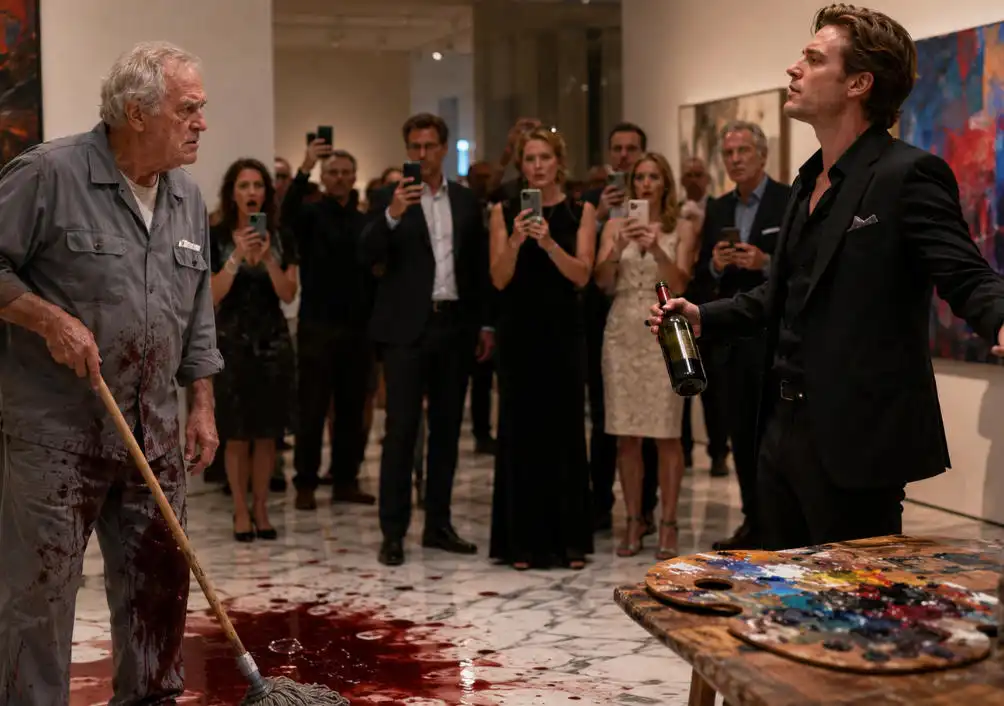
The gallery owner looked at the sealed provenance envelope in my hand.
He saw the initials pressed into the red wax.
For the first time that night, the room stopped treating me like furniture.
Julian Vale still had his phone in his hand, but he was no longer smiling.
And I had not even said my name yet.
The red wine was still dripping from my pants.
The marble floor looked like a crime scene painted by someone with too much money and no shame.
I was standing there with a mop.
He was standing there with a tuxedo, a following, a press badge on his lapel, and three walls full of applause that did not belong to him.
That was the difference between us.
At least, that was what he thought.
Julian Vale had arrived that night as the featured young genius of the Whitcomb Gallery’s Manhattan opening.
He had a publicist.
A camera crew.
A crowd of collectors.
He spoke loudly about “disrupting old traditions” while waiters passed champagne under white lights.
I arrived through the service entrance.
Gray uniform.
Rubber-soled shoes.
A janitor’s badge clipped to my chest.
To Julian, that was all I was.
To most of the room, too.
The gallery was packed with people who liked to say art belonged to everyone while standing behind velvet ropes.
I had spent the first hour quietly cleaning footprints from the marble.
A spilled drink near the sculpture room.
A muddy track by the elevator.
A trail of glitter from a woman’s silver dress.
Nobody thanked me.
That was fine.
I was not there for thanks.
I was there because three covered canvases were being unveiled at nine o’clock.
Three canvases with no artist name beside them.
Just a small card that read:
Private Collection. Anonymous Master.
Julian hated those canvases.
I could see it before he ever spoke to me.
Every time a collector asked about them, his jaw tightened.
Every time the gallery owner mentioned “tonight’s final reveal,” Julian looked like someone had stepped on his throat.
He wanted the room.
All of it.
The praise.
The money.
The cameras.
The kind of attention that makes a weak man feel powerful.
So he found the oldest, quietest, easiest target in the room.
Me.
I was mopping near the main hall when he walked over with his phone already recording.
“Sir,” I said quietly. “The floor is still wet.”
He laughed.
Not a real laugh.
A performance laugh.
The kind people use when they want the room to join them.
“Did you hear that?” he said to his phone. “The mop is giving orders.”
A few guests chuckled.
I kept my eyes down.
That made him bolder.
He stepped closer and bumped my shoulder hard enough that the mop handle hit my ribs.
Not enough to leave a mark.
Enough to make a point.
“You should be grateful,” he said. “Tonight you’re standing next to greatness.”
Then he lifted the bottle of red wine from the cocktail table.
I saw what he was about to do.
So did two women standing near the wall.
One of them whispered, “Don’t.”
He did it anyway.
He turned the bottle over.
The wine hit the white marble first.
Then my shoes.
Then my pants.
The splash was loud in that quiet, expensive room.
Someone gasped.
Someone else laughed.
Then the camera phones came up.
Julian grinned like a boy who had just discovered cruelty and mistaken it for wit.
“Clean it,” he said. “That’s what you people do.”
I said nothing.
He leaned closer.
“You are a parasite on art,” he said. “You feed off beauty because you can’t create any.”
That sentence traveled through the room.
I watched people hear it.
Some looked away.
Some kept filming.
Some smiled because they were afraid not to.
That is the thing about public humiliation.
The crowd becomes part of it.
Even silence has fingerprints.
I could have told him who I was right then.
I could have made the room gasp.
I could have watched his face collapse.
But I had learned long ago that truth works best when it arrives with evidence.
So I bent down.
Slowly.
Not to mop.
To place a small folded cloth over the wine before it reached the base of the covered canvases.
Julian laughed again.
“Look at him,” he said. “Protecting the art like a loyal little servant.”
That was when I noticed his palette on the display table.
It was part of his performance.
He had been showing collectors his “process” all evening.
A smear of bone black.
A broken line of cadmium red.
Too much linseed oil.
And one gray-green mixture no honest painter would use unless he was copying a very specific underpainting technique.
My technique.
I had created it in 1997 after a hand injury made it hard for me to blend shadows the old way.
I had never taught it publicly.
Never published it.
Only one sketchbook contained the formula.
That sketchbook was stolen from my studio twenty-seven years ago.
I looked at the palette.
Then at Julian’s largest painting on the wall.
Then at the three covered canvases behind him.
The shape was different.
The subject was different.
But the skeleton was mine.
Not inspired.
Not influenced.
Stolen.
Julian saw me staring.
“What?” he snapped. “You suddenly understand composition?”
I reached for the palette.
He grabbed my wrist.
“Don’t touch that,” he hissed.
The gallery owner, Martin Whitcomb, stepped forward.
“Julian,” he said carefully, “let him go.”
Julian’s eyes flicked toward him.
“Are you serious? He’s the cleaner.”
Martin did not answer.
That made Julian nervous.
I gently pulled my wrist free and picked up the palette.
Then I took a blank white gallery card from the table.
I dipped the brush into Julian’s gray-green mixture.
One stroke.
Then another.
The room went quiet.
A woman near the front whispered, “Wait…”
I added a third line.
Not a painting.
Not even a sketch.
Just enough.
Three strokes formed the hidden structure beneath Julian’s celebrated piece.
The same broken diagonal.
The same false shadow.
The same impossible curve that had appeared in my stolen sketchbook.
Julian’s face changed.
The blood left it slowly.
Like the wine draining from the bottle.
I looked at him and said, “You made the same mistake the thief made.”
He swallowed.
“I don’t know what you’re talking about.”
“Yes,” I said. “You do.”
The gallery owner opened the sealed envelope in my hand.
Inside was the provenance certificate for the three covered paintings.
There was also a notarized statement.
A copyright registration record.
Photographs of my original sketchbook pages.
And a private condition of the exhibition contract.
Martin turned to the microphone.
His voice shook once, then steadied.
“Ladies and gentlemen,” he said, “before tonight’s final reveal, the Whitcomb Gallery must address a serious matter concerning originality, fraud, and copyright infringement.”
Julian barked out a laugh.
“This is ridiculous. You’re letting a janitor accuse me?”
Martin looked at him.
“No,” he said. “I am letting the owner of the three anonymous works speak.”
The room froze.
I stepped forward.
My shoes squeaked slightly because they were still wet with wine.
That sound, for some reason, felt louder than the applause had been all night.
“My name is Elias Mercer,” I said.
A collector near the front covered her mouth.
Someone else whispered, “No way.”
Julian stared at me like I had become a ghost.
For thirty years, my work had been exhibited under only one mark:
E.M.
No interviews.
No photographs.
No public appearances.
I had disappeared from the art world after my wife died and my studio was robbed.
Over the years, the paintings became famous without me.
Collectors called me “the anonymous master.”
Critics invented stories.
Some said I was dead.
Some said I was a woman in Paris.
Some said I was a group of painters hiding behind one name.
The truth was simpler.
I was tired.
I was grieving.
And I no longer wanted rooms full of rich people arguing over the price of my pain.
So I kept painting privately.
I sold through a trust.
I donated quietly.
And once a year, I visited galleries where my work was shown.
Not as a celebrity.
Not as a guest of honor.
As someone nobody noticed.
A guard.
A cleaner.
A deliveryman.
People reveal themselves when they think status is not watching.
Julian had revealed everything.
He stepped backward.
“This is a stunt,” he said. “This old man is lying.”
Martin opened the second document.
“Mr. Vale,” he said, “your consignment agreement with this gallery includes a warranty of originality. It also includes immediate removal for fraudulent authorship claims and full indemnity for damages.”
Julian’s publicist moved toward him.
He shoved her hand away.
“I painted those works.”
I pointed to the large canvas behind him.
“Then explain the understructure.”
He said nothing.
I turned to the audience.
“Every painter has habits. Mistakes. Little injuries that become signatures. I have nerve damage in two fingers of my right hand. It forces my shadow lines to break before they turn. That break appears in my registered studies from 1997.”
Martin held up the copies.
A camera zoomed in.
I continued.
“Mr. Vale copied not only my composition studies, but also the flaw created by my injury.”
A low sound moved through the room.
Not a gasp.
Something colder.
Recognition.
Julian tried to laugh again, but it fell apart halfway.
“You can’t prove I saw those sketches.”
“That is why I waited,” I said.
Then I nodded to Martin.
He tapped a tablet.
On the screen behind us appeared a scan of a purchase invoice.
A storage locker auction.
Brooklyn.
Eight years earlier.
Among the listed contents:
Assorted artist journals, initials E.M., damaged leather binding.
The buyer name was not Julian Vale.
It was his assistant.
She was standing near the back wall.
Her face was white.
Julian turned toward her.
“Don’t,” she whispered.
But she was already crying.
Martin spoke again.
“We received this documentation last week from Mr. Mercer’s legal team. We chose not to confront Mr. Vale privately because the gallery needed to verify whether the disputed works would be publicly represented as original tonight.”
I looked at Julian.
“You signed the final originality certificate at 7:42 p.m.”
Martin held up the paper.
There it was.
Julian’s signature.
Fresh ink.
The legal hammer had not fallen because he was rude.
It fell because he lied in writing.
That matters.
Cruelty shows character.
Paper proves fraud.
Julian’s lawyer, who had been standing near the champagne table, finally pushed through the crowd.
“Stop talking,” he told him.
But Julian was too proud to stop.
“He was nobody,” Julian snapped, pointing at me. “He vanished. People like him abandon the world, and then people like me make the work matter again.”
That was the sentence that destroyed him.
Not legally.
Morally.
The room heard it.
The cameras caught it.
The collectors understood it.
He was not defending art.
He was defending theft.
I walked to the wall and stood beside his largest painting.
Then I used his own palette to place four small strokes on the lower corner.
Not to damage it.
To demonstrate.
With those four strokes, I completed the hidden line he had failed to understand.
The room saw the copied structure appear like a bone under skin.
A woman who had been smiling earlier whispered, “Oh my God.”
Julian lunged toward me.
A security guard caught his arm before he reached the canvas.
Not dramatic.
Not violent.
Just firm.
The kind of grip that says the room has chosen the rulebook now.
Martin turned to the staff.
“Remove Mr. Vale’s works from the walls.”
Julian shouted.
“You can’t do that!”
Martin did not raise his voice.
“We already have.”
Two handlers came forward with white gloves.
One by one, the paintings that had carried Julian’s name were lifted from the walls.
The silence was brutal.
No applause.
No music.
Just the soft scrape of frames being removed while every phone in the room recorded his career coming apart.
Then Martin nodded toward the three covered canvases.
The cloths were pulled away.
For the first time in decades, my new work stood in public.
Not behind a lie.
Not beside a thief.
In full light.
The room did not cheer immediately.
I was grateful for that.
Some art deserves quiet first.
The first painting showed a woman seated by a kitchen window, her hand resting on an empty chair.
My wife.
The second showed a classroom with no students, sunlight falling across old desks.
The third showed a janitor’s mop leaning against the wall of a museum, casting the shadow of a paintbrush.
That one made several people cry.
Martin came back to the microphone.
“These three works are the only works Mr. Mercer agreed to exhibit tonight,” he said. “Their insured value exceeds one hundred million dollars.”
Julian lowered his head.
Not because he was sorry.
Because he finally understood the cost.
Within twenty-four hours, the gallery terminated his exhibition.
Within a week, two museums suspended planned acquisitions.
Within a month, the foundation that had awarded him a fellowship withdrew its support pending investigation.
Then came the lawsuits.
Copyright infringement.
Fraudulent representation.
Breach of warranty.
Defamation after the video of him calling me a parasite went public.
His collectors demanded refunds.
His dealers disappeared.
His assistant gave a sworn statement that she had delivered the stolen sketchbook to him years earlier.
She admitted he studied it, copied from it, and told her, “Dead men don’t sue.”
That line did not age well.
He was expelled from two major art associations.
The damages were not symbolic.
They were enormous.
The kind with commas.
The kind that follow a person longer than applause ever does.
People asked me later if I enjoyed watching him fall.
The honest answer is no.
Not exactly.
I enjoyed watching the truth stand up.
There is a difference.
I had spent years letting the world think I was gone because grief made fame feel ugly.
But that night reminded me of something my wife used to say:
“Elias, hiding is not the same as healing.”
So I made one more decision.
At the press conference two days later, Martin expected me to announce a private auction.
Collectors expected bidding.
Reporters expected drama.
Instead, I stood beside the painting of the empty classroom and said:
“The Whitcomb Gallery will open its doors permanently to students from low-income schools. Free admission. Free workshops. Free supplies. Every month. For as long as this building stands.”
Martin smiled.
He had already signed the agreement.
The room applauded then.
Not for money.
Not for scandal.
For the children who would walk into that gallery without being made to feel small.
The first group came three weeks later.
Fifth graders from the Bronx.
One little boy stood in front of the mop painting for almost ten minutes.
Then he turned to me and said, “So the janitor was the artist?”
I smiled.
“Sometimes,” I said.
He looked back at the canvas.
Then at the mop in the corner.
Then at his own hands.
And I saw the exact moment a door opened inside him.
That was worth more than every collector in Manhattan.
Julian wanted the world to believe dignity belonged to the loudest person in the room.
He was wrong.
Dignity can wear a gray uniform.
It can hold a mop.
It can stay silent while fools perform.
And when the time comes, it can pick up a brush and let the truth finish the painting. 🎨
Share this if you believe no one should ever be judged by their uniform.
And choose a side:
Was I right to let Julian be exposed in front of everyone — or should mercy have protected him after what he did?
Disclaimer: Mention of any brand or trademark is for identification only and does not imply partnership or endorsement