The attorney didn’t raise his voice.
That made the room even quieter.
He stepped out of the elevator, crossed the marble floor, and stopped beside me while red wine dripped from my jacket sleeve onto a carpet the manager had just claimed I could never afford.
The store manager looked at the folder in his hand.
Then at me.
Then back at the folder.
“Inventory,” I said calmly. “Let’s start there.”
Five minutes earlier, she had been laughing.
Her name was Marissa Vale, general manager of the Fifth Avenue flagship store of Bellmont & Blythe, an old luxury brand famous for handbags, silk scarves, leather trunks, and the kind of jewelry people pretend not to check the price of.
It was their anniversary cocktail party.
Soft piano music.
Crystal glasses.
White roses.
Security at the door.
Women in gowns.
Men pretending they weren’t checking who was richer than whom.
And me?
I was wearing blue jeans.
Comfortable shoes.
A gray wool coat I had owned for twelve years.
I had not planned to attend the party.
I had only been walking down Fifth Avenue after visiting my accountant. My driver was stuck in traffic, the rain had started, and Bellmont & Blythe happened to be on the corner.
I stepped inside for shelter.
That was my first mistake.
Or maybe it was Marissa’s.
A young sales associate near the front gave me a polite nod.
“Good evening, ma’am. Welcome in.”
Before I could answer, Marissa appeared from behind a display of pearl-handled handbags.
Her eyes moved from my wet shoes to my jeans.
Then to my coat.
Then to my face.
The smile disappeared.
“Can I help you?” she asked.
Not kindly.
Not professionally.
Like I had wandered into her dining room and touched the silverware.
“I’m just waiting for my car,” I said. “I’ll stay out of the way.”
She looked past me at the room full of wealthy guests.
“This is a private anniversary event.”
“I understand,” I said. “I won’t be long.”
That was when Mrs. Celeste Whitmore stepped closer.
Everyone in that room knew Celeste.
At least, they knew the version she paid to be seen as.
Widow of a real estate developer.
Charity gala regular.
A woman who wore diamonds at breakfast and called waiters “dear” in the tone people use for dogs.
Celeste was holding champagne in one hand and a tiny crocodile handbag in the other.
She looked me over and gave Marissa a slow smile.
“Oh, Marissa,” she said. “Are we letting walk-ins mingle now?”
A few people chuckled.
Not loudly.
Just enough.
The kind of laugh that says, I’m relieved it isn’t me being targeted.
Marissa’s cheeks colored.
She wanted Celeste’s approval.
Badly.
I could see it in her posture.
The tilted chin.
The tight smile.
The way she leaned toward Celeste like a schoolgirl hoping the popular girl would invite her to lunch.
“I’m handling it,” Marissa said.
Then she turned to me.
“Ma’am, this event is for actual clients.”
Actual clients.
I looked around the room.
At the glass cases.
At the handbags displayed like museum pieces.
At the old Bellmont & Blythe crest carved into the wall.
I had known that crest for forty years.
My mother owned one Bellmont trunk.
Just one.
Brown leather.
Brass corners.
She bought it secondhand after my father died, back when she worked two jobs and still polished her church shoes on Saturday night.
She used to say, “Quality isn’t about showing off. It’s about something lasting after people stop looking.”
After she passed, I bought my first Bellmont piece in her memory.
Then another.
Then another.
Not because I needed them.
Because each one felt like touching a piece of her strength.
Over the years, I became the largest private collector Bellmont & Blythe had ever had.
Not that Marissa knew.
And not that Celeste knew.
That was the point.
Real ownership rarely walks in with a spotlight.
Marissa took one step closer.
“You’ll need to leave.”
I glanced toward the window.
“My car is two minutes away.”
Celeste sighed dramatically.
“This is why standards matter.”
That was when Marissa made her decision.
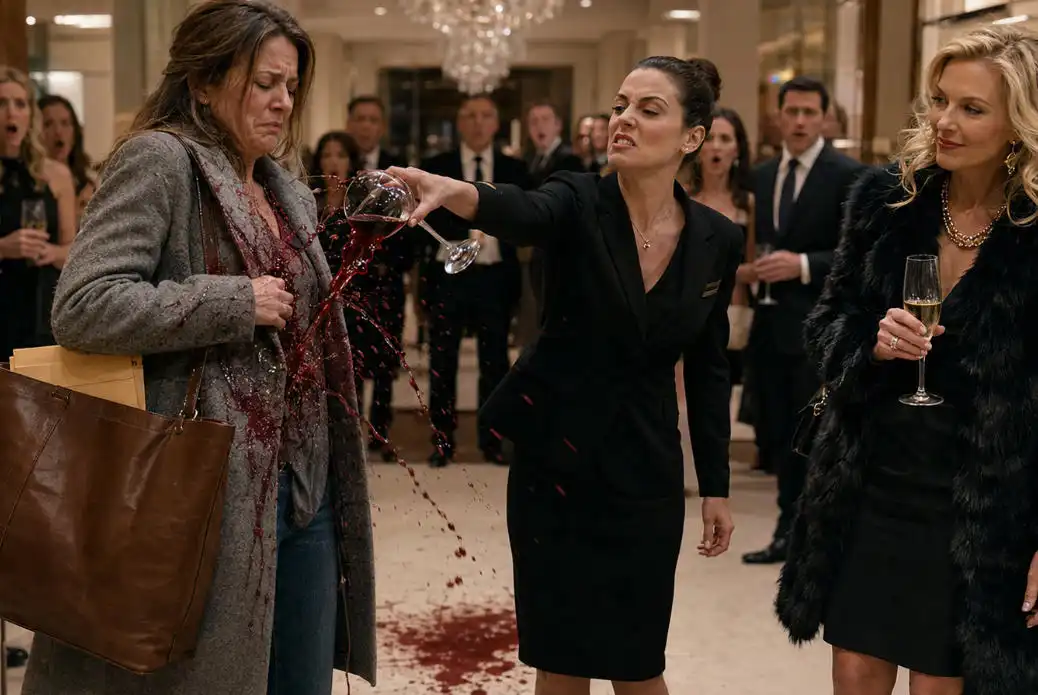
She reached for a passing waiter’s tray.
Picked up a glass of red wine.
Held it too loosely.
Then turned too sharply.
The wine spilled across my sleeve, my coat, and the pale cream carpet below.
Gasps.
One woman covered her mouth.
A man lifted his phone.
The young sales associate froze.
Celeste’s eyes glittered.
“Oh no,” she said, smiling. “Look what she did.”
Marissa stared at the stain as if I had thrown the wine myself.
“Security,” she snapped.
The guard near the door straightened.
I looked down at my coat.
The wine was cold.
It soaked through fast.
My mother’s old silver bracelet, the one I always wore, was stained red too.
That hurt more than the coat.
Marissa pointed at the carpet.
“Do you understand what you just damaged?”
“I didn’t damage it,” I said.
Her face hardened.
“Don’t make this worse.”
Celeste leaned in, voice sweet as poison.
“Some people simply don’t know how to behave around nice things.”
A few more guests laughed.
That little polite laugh again.
The kind that makes cruelty feel like manners.
Marissa stepped close enough that only the front circle could hear her clearly.
But phones were already out.
“Sweetheart,” she said, “not one hair on your body could pay for this carpet.”
There it was.
The sentence.
The one she could never unsay.
I did not argue.
I did not wipe the wine.
I did not raise my voice.
I opened my old leather tote and pulled out the sealed envelope my attorney had prepared that morning.
Marissa saw it.
Her expression flickered.
“What is that?”
“A choice,” I said.
Celeste laughed.
“Oh, she brought paperwork.”
I looked at Marissa.
“Are you sure you want this handled publicly?”
She crossed her arms.
“You’re the one making a scene.”
“No,” I said. “I’m the one giving you a final chance to move this somewhere private.”
She smiled for the crowd.
“Anything you have to say, say it here.”
So I sent one text.
Just one.
The elevator opened thirty seconds later.
My attorney, Daniel Reeves, walked in with the second folder.
That was where the whole room changed.
Not because they knew him.
But because Marissa did.
Her lips parted.
“Mr. Reeves?”
Daniel nodded.
“Ms. Vale.”
Celeste looked annoyed.
“Why is a lawyer here?”
Daniel did not answer her.
He looked at me.
“Ma’am, do you want to start with the inventory… or the lease?”
I said, “Inventory.”
Daniel opened the folder.
Marissa’s hands dropped to her sides.
“Inventory?” she repeated.
I finally removed the wine-soaked coat and handed it to the young sales associate.
“Please put this somewhere safe,” I said gently. “It was my mother’s favorite color.”
The girl nodded quickly.
Her eyes looked wet.
Daniel turned to Marissa.
“My client would like to purchase the entire retail inventory currently on the floor and in the stockroom.”
The room went still.
Someone whispered, “The entire what?”
Marissa laughed once.
Not because it was funny.
Because panic needed a sound.
“That isn’t possible.”
“It is,” Daniel said. “Your own event contract states anniversary inventory may be sold at management discretion, provided payment clears immediately.”
He placed a printed clause on the glass counter.
Marissa stared at it.
Celeste scoffed.
“This is ridiculous. Do you know who she is?”
Daniel looked at me.
“Yes.”
That was all he said.
I removed a black card from my wallet and placed it on the counter.
Not to impress them.
Not for drama.
To finish the transaction under the rules Marissa had chosen to weaponize.
“Every handbag,” I said.
The young sales associate blinked.
“Ma’am?”
“Every handbag. Every trunk. Every scarf. Every pair of gloves. Every wallet. Every piece in the cases. Ring it all.”
Marissa snapped, “Do not touch the register.”
Daniel slid another paper forward.
“Then we will document refusal to sell after public discrimination and intentional property damage.”
There was that word.
Intentional.
Marissa’s eyes jumped toward the phone cameras.
“Turn those off,” she said sharply.
No one did.
People rarely stop filming when power starts bleeding.
The young sales associate stepped behind the counter.
Her hands shook as she began scanning.
One item.
Then another.
Then another.
The total climbed so high that the guests stopped pretending not to stare.
Celeste’s champagne glass lowered.
Marissa whispered, “You can’t do this.”
I looked at her.
“You asked me to prove I belonged.”
She swallowed.
“No, I asked you to leave.”
“You poured wine on me to make that easier.”
The room heard it.
The cameras caught it.
The young associate kept scanning.
A man in a tuxedo muttered, “That was foul.”
Celeste turned on him.
“Oh, please.”
I looked at Celeste.
“You encouraged it.”
She lifted her chin.
“I did no such thing.”
Daniel removed another document.
“Actually,” he said, “your statement was recorded by at least three guests. ‘Now look what she did.’ That was before Ms. Vale accused my client of damaging the carpet.”
Celeste’s face went pale under her makeup.
The transaction cleared.
The receipt printed.
It was absurdly long.
Like a white ribbon of consequences.
Then came the second part.
I turned to the security guard.
“What’s your name?”
He hesitated.
“Malcolm, ma’am.”
“Malcolm, do you know the shelter on 49th Street?”
“Yes, ma’am.”
“Please call them. Tell them Bellmont & Blythe will be delivering coats, gloves, scarves, wallets, leather goods, and travel bags tonight. Anything practical goes first. Anything too delicate to use will be auctioned privately and the proceeds donated.”
Celeste made a sound like she had been slapped.
“You’re giving it away?”
“Yes.”
“To homeless people?”
I looked at her.
“To people who understand the value of warmth better than anyone in this room.”
No one laughed that time.
The young sales associate covered her mouth.
Malcolm nodded once and stepped aside to make the call.
Marissa’s eyes filled with something close to rage.
“You’re doing this to embarrass us.”
“No,” I said. “You embarrassed yourself. I’m just refusing to let your cruelty be wasted.”
Then Daniel opened the third folder.
The lease.
This was the part Marissa truly did not understand.
Bellmont & Blythe did not own that Fifth Avenue space.
The building belonged to a private holding company created by my late husband and me.
Years earlier, when Bellmont was struggling, I had quietly granted the brand a rent waiver on that flagship location.
A long one.
Generous.
Designed to keep the brand alive while they rebuilt.
I had done it because of my mother’s trunk.
Because I believed heritage mattered.
Because I believed stores like that could still stand for craftsmanship instead of arrogance.
But the waiver had conditions.
Customer dignity.
Public conduct.
Brand stewardship.
No discriminatory denial of service.
No intentional humiliation by management.
No acts that damaged the reputation of the property or the brand.
Marissa had violated all of it in less than ten minutes.
Daniel placed the lease addendum on the counter.
Marissa read the first page.
Her mouth opened.
Closed.
Opened again.
“You’re the landlord?”
I said nothing.
Daniel corrected her.
“She controls the rent waiver. Without it, this location owes full market rent retroactively from the date of breach, subject to review.”
Celeste whispered, “Oh my God.”
Marissa grabbed the paper.
“You can’t just—”
“I can,” I said. “Because you insisted we do this publicly.”
The regional director arrived twenty minutes later.
His name was Thomas Greer.
He had been upstairs in a private lounge with board members.
By then, the store looked like a courtroom with handbags.
Guests lined the walls.
Phones were still out.
My coat was drying in the back.
The inventory was being packed for donation.
And Marissa was standing behind the counter like the floor had disappeared beneath her.
Thomas looked at me and went completely still.
“Mrs. Alden.”
There it was.
The first time anyone in that room heard my name said correctly.
Not ma’am.
Not sweetheart.
Not nobody.
Mrs. Evelyn Alden.
Largest private Bellmont & Blythe collector in the world.
Major creditor.
Silent landlord.
Holder of the waiver keeping their flagship alive.
The young sales associate looked at me like she had just watched a movie twist happen in real life.
Thomas turned to Marissa.
“What happened?”
Marissa pointed at me.
“She came in uninvited and caused a disruption.”
Before I could speak, Malcolm did.
“No, sir.”
Everyone turned.
The security guard’s voice was steady.
“She was standing by the door waiting for her car. Ms. Vale told her she didn’t belong. Mrs. Whitmore mocked her. Then Ms. Vale spilled wine on her on purpose.”
Marissa snapped, “You don’t know that.”
The young sales associate spoke next.
“I saw her tilt the glass.”
Her voice trembled.
But she kept going.
“And Ms. Vale told her one hair on her body couldn’t pay for the carpet.”
The silence after that was different.
Heavier.
The kind that comes when people realize they are standing beside the wrong person.
Thomas asked Daniel for the papers.
Daniel handed them over.
Thomas read the lease clause.
Then the purchase receipt.
Then the written statement from Malcolm.
Then he watched three different videos guests had recorded.
By the time he finished, his face had turned gray.
“Ms. Vale,” he said, “you are relieved of your duties effective immediately.”
Marissa grabbed the counter.
“What?”
“You will leave the premises now.”
“You can’t fire me in front of everyone.”
Thomas’s voice sharpened.
“You humiliated a client in front of everyone.”
Marissa looked at Celeste.
As if Celeste might save her.
Celeste looked away.
That was the loyalty of people who only respect status.
It lasts until the bill arrives.
But Celeste was not finished either.
Thomas turned to her.
“Mrs. Whitmore, Bellmont & Blythe will be reviewing your client status.”
She stiffened.
“For what?”
“For encouraging mistreatment of a guest, making false statements, and attempting to shift blame after witnessing misconduct.”
Celeste’s mouth twisted.
“I spend more in this store than most people make in a year.”
I finally smiled.
“Not anymore.”
Daniel handed Thomas the final document.
A recommended client conduct ban.
Bellmont’s board had already authorized one for severe reputational risk.
Celeste Whitmore was blacklisted from Bellmont & Blythe globally before dessert was served.
No private appointments.
No limited releases.
No gala tables.
No auction access.
No special orders.
For a woman like Celeste, that was not just shopping.
That was oxygen.
She left through the side door with her driver holding her coat over her face.
Marissa left five minutes later.
No applause.
No shouting.
Just the sound of her heels crossing the same marble floor she had tried to use as a stage.
A month later, the consequences became public.
Marissa’s termination made it impossible for her to land another luxury management job in New York.
The video had spread quietly among industry circles first.
Then loudly everywhere else.
Two civil claims followed.
One from the brand.
One from the property group.
Between legal fees, a clawback tied to misconduct bonuses, and a failed attempt to open her own boutique, Marissa filed for bankruptcy within the year.
I did not celebrate that.
But I did not rescue her from it either.
Some consequences are not revenge.
They are receipts.
Celeste tried to force her way back through friends on boards, charity committees, and old-money lunch tables.
It did not work.
The blacklist held.
For the first time in her life, doors stayed closed because of her character, not her net worth.
And Bellmont & Blythe?
That changed too.
Six months after the incident, I led a private acquisition of the brand.
People called it shocking.
It wasn’t.
I had loved that company longer than most of its executives had worked there.
I just refused to keep funding a culture that mistook cruelty for exclusivity.
The first policy I changed was simple:
No client ranking visible to floor staff.
No commission incentives tied to judging appearance.
No “private event” exclusion without written invitation lists and accessible guest support.
No manager could remove someone from a store without documented cause and a second employee witness.
Every employee received dignity training.
Not a slideshow.
Real training.
With real consequences.
Then I created something my mother would have loved.
The Lasting Goods Program.
Every year, Bellmont & Blythe now donates repaired coats, gloves, scarves, and luggage to shelters, foster youth aging out of care, and women rebuilding their lives after hardship.
Not leftovers.
Not trash.
Beautiful things restored with respect.
The first delivery went to the shelter on 49th Street.
Malcolm helped unload the boxes.
The young sales associate came too.
Her name was Anna.
I promoted her three months later.
Not because she defended me.
Because she told the truth when lying would have been easier.
That night at the shelter, an older man picked up a dark wool scarf and ran his fingers over it carefully.
“This is too nice,” he said.
I thought of my mother.
Her trunk.
Her Saturday shoes.
Her belief that dignity should never depend on who is watching.
“No,” I told him. “It’s exactly nice enough.”
My wine-stained coat could not be fully saved.
Anna had it cleaned anyway.
A faint shadow remained on the sleeve.
I kept it.
I wear it sometimes when I visit the flagship.
The carpet was replaced.
The store was redesigned.
The old VIP lounge became a public craftsmanship room where anyone can watch artisans repair leather, polish brass, and stitch handles by hand.
No velvet rope.
No sneering.
No “actual clients.”
Because the truth is simple.
Money can buy a handbag.
It cannot buy class.
A title can open a door.
It cannot teach kindness.
And the person you dismiss as nobody may be the one person holding the keys to everything you’re standing on. 🗝️
So pick a side:
Was I too harsh for taking the inventory, ending her career, and changing the whole brand?
Or did Marissa earn every consequence the moment she poured that wine?
Share this with someone who believes respect should never be reserved for the rich.
Disclaimer: Mention of any brand or trademark is for identification only and does not imply partnership or endorsement