
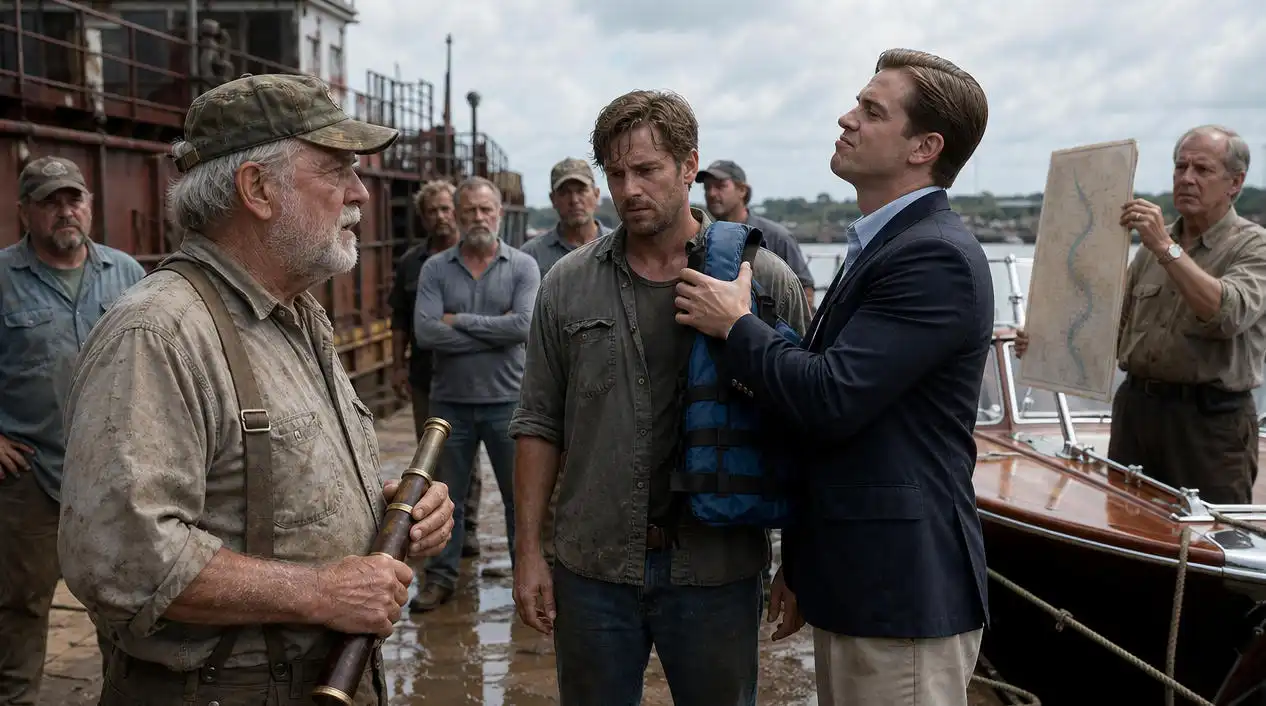
The harbor master unfolded the chart in front of everyone.
Nobody spoke.
Not Mark.
Not my son.
Not even the old sailors who had just thrown down their ropes and shut down half the dock.
Because on that laminated map was the one section of the Mississippi River every real pilot respected.
And Mark had taken my boy straight into it.
The radio cracked again.
“Dad… please…”
That was Tyler.
My son.
The same son who had looked at me less than ten minutes earlier like I was something old, slow, and useless.
The same son who had stepped onto Mark Caldwell’s speedboat because a rich man in clean shoes had promised him a faster life.
I didn’t blame Tyler in that moment.
Not yet.
Fear has a way of stripping anger down to bone.
All I heard was my boy trying not to sound like a little kid.
All I saw was the river.
Brown.
Low.
Fast in the wrong places.
Dead calm in the worst ones.
Mark’s voice burst through the radio next.
“Port authority, this is Caldwell Freight vessel—”
The harbor master snatched the radio off the wall.
“Vessel?” he barked. “You’re in a private speedboat in a restricted freight channel during a low-water advisory. State your position.”
Static.
Then Mark, suddenly not so cocky.
“I don’t know. We hit something. Engine’s dead.”
The old sailors behind me exchanged looks.
Every man on that dock knew what he had hit.
The Devil’s Teeth.
That’s what we called that stretch.
Not on any tourist sign.
Not in any glossy brochure.
Just a jagged line of old limestone and broken pilings hidden under Mississippi mud.
At high water, you could pass over them if you knew exactly how the river rolled.
At low water, they waited.
And if you treated that river like a racetrack…
They tore the bottom out from under you.
The harbor master looked at me.
“James.”
That was all he said.
I was already moving.
I climbed the steel steps to my barge, the old Mary Ellen, while half the dock watched.
Her paint was faded.
Her railings were scarred.
Her engine sounded like an old bear waking up mad.
Mark had called her scrap metal.
Tyler had once asked why I wouldn’t upgrade.
I told him, “Because she knows the river.”
He rolled his eyes then.
He wasn’t rolling them now.
One of the old sailors, Earl, ran beside me.
“Need hands?”
I looked down at him.
“All of you.”
That was when the strike changed shape.
The same men who had refused to move one box for Mark Caldwell came alive for the rescue.
Ropes flew.
Engines turned.
Spotlights swung toward the water.
A woman from the port office started filming.
Two truck drivers climbed on top of their cabs to see.
A crane operator shut his machine down and pointed the boom lights toward the bend.
This wasn’t private anymore.
This was the whole port watching a rich boy’s arrogance get measured against an old man’s patience.
And the river did not care how much money Mark’s father had.
I took the wheel.
My hands knew the worn spots without looking.
The Mary Ellen groaned as I eased her out.
Slow.
Steady.
Ugly to people who don’t understand power.
On the radio, Tyler was breathing hard.
“Dad, water’s coming in.”
“I hear you,” I said.
“I’m sorry.”
“Not now.”
That was all I could give him.
Because apologies don’t keep a boat afloat.
Experience does.
The harbor master came over the radio.
“James, Caldwell’s boat is drifting east of Marker 42. Current’s pushing him toward the broken piling field.”
I looked out at the water.
Most people see brown.
A river pilot sees wrinkles.
A seam in the current.
A slow twist where deep water cuts left.
A silver boil over stone.
A smooth patch that looks safe but means death underneath.
I had spent thirty-six years learning what the Mississippi whispers before it screams.
Mark Caldwell had spent one summer posting boat photos on social media.
And my son had mistaken shine for skill.
The Mary Ellen moved forward.
Slow enough to look foolish.
Precise enough to live.
Behind me, Earl muttered, “He’s going to try the narrow draw.”
“No,” I said.
Earl blinked. “That’s the fastest way.”
“That’s why Mark took it.”
Another sailor cursed under his breath.
I turned the barge wider, away from what looked like open water.
A young deckhand shouted from shore, “He’s going the wrong way!”
The old sailors snapped back as one.
“Shut up.”
I didn’t smile.
But I heard it.
Some lessons only sound old until the river proves them.
Mark’s boat came into view three minutes later.
White hull.
Polished chrome.
A stupid little flag snapping at the back.
It was tilted hard to starboard, caught against a line of submerged rock.
Water slapped over the rear deck.
Tyler was clinging to the rail.
Mark was standing near the bow, holding a waterproof bag over his head like that bag mattered more than the human being behind him.
The spotlight hit his face.
He looked furious.
Not scared.
Furious.
Like the river had insulted him personally.
The harbor master’s voice came through.
“Caldwell, do not abandon your passenger. Stay with the vessel until rescue makes contact.”
Mark looked up at us.
Then at Tyler.
Then at the water.
And he did something that made every man on my deck go silent.
He pushed Tyler’s hand off the rail.
“Get back!” Mark shouted. “You’re making it tip!”
Tyler slipped.
Not all the way in.
But enough.
His boots went under.
His shoulder slammed against the side.
He grabbed a cleat with one hand.
My fingers tightened around the wheel so hard my knuckles went white.
Earl stepped toward the rail.
“James…”
“Hold position,” I said.
My voice sounded calmer than I felt.
Because rage is useless at the wheel.
The river punishes men who steer angry.
I eased the barge sideways into the current, using its own force to swing Mary Ellen’s stern around.
The move looked too slow.
Too wide.
Too late.
But the old sailors understood.
Earl whispered, “Lord have mercy. He’s using the back eddy.”
That back eddy had been there since before Mark was born.
It curled behind the rock line, invisible unless you had crossed it in fog, flood, drought, and moonlight.
I let the river catch us.
The barge slid.
Not drifted.
Slid.
A giant wall of steel moving through dirty water with inches to spare.
On Mark’s speedboat, he started screaming.
“You’ll crush us!”
I leaned out the window.
“No. You did that yourself.”
The Mary Ellen’s bow came close enough for Earl to throw a line.
“Tyler!” he shouted. “Catch!”
My son reached.
Missed.
Tried again.
His hand was shaking so badly I could see it from the wheelhouse.
“Dad!” he yelled.
“I’m here,” I said.
The second line landed across his arm.
He wrapped it twice.
Earl and two sailors pulled.
Tyler came off that sinking boat like the river was trying to keep him.
Mud on his face.
Blood on his sleeve from the scrape.
Eyes wide and wet.
When his boots hit my deck, he collapsed to his knees.
I wanted to run to him.
I wanted to grab him and check every inch of him like he was six years old again.
But Mark was still on that boat.
And the current was shifting.
The harbor master shouted from shore through the bullhorn.
“Caldwell! Remain still! Rescue line is coming!”
Mark didn’t listen.
Men like Mark never hear instructions unless they’re giving them.
He leaped.
Not toward us.
Toward the dry side of the rock shelf where he thought he could save his bag.
His polished shoe hit algae.
He went down hard, splashing into waist-deep water between the rocks.
The waterproof bag popped open.
Papers scattered across the surface.
Contracts.
Invoices.
Some kind of folder with Caldwell Freight letterhead.
Earl stared.
“What the hell is he carrying?”
The harbor master saw it too.
His face changed.
That was the first hint that this story was not just about a reckless rich man and a damaged speedboat.
It was bigger.
And it had been building for weeks.
You see, Mark Caldwell didn’t arrive at that dock as a random spoiled heir.
His father owned Caldwell Freight Logistics, one of the biggest operators moving grain, fuel equipment, and construction material along that section of the river.
For years, the old river pilots had done the hard work while men like Mark took the credit in office meetings.
Then Mark came back from business school with a plan.
“Modernize the river,” he called it.
That meant fewer experienced pilots.
More younger hires.
Faster runs.
Tighter windows.
Less pay for men who knew every bend by memory.
He told the port board, “Experience is just another word for inefficiency.”
He said that in a room full of men who had pulled bodies out of floodwater.
He said it while wearing a watch worth more than Earl’s truck.
And somehow, my son Tyler heard about Mark’s plan and believed it.
Tyler was twenty-two.
Smart.
Restless.
Tired of being known as James Miller’s boy.
He wanted clean shirts, fast boats, and a future that didn’t smell like diesel.
I understood more than he knew.
But understanding doesn’t stop a father from hurting.
Especially when your son starts laughing at the same jokes that cut you open.
That morning, Mark had arrived at the dock with two investors, a camera crew for some “river innovation” promotional video, and a stack of new contracts.
He planned to prove that his fast-route system could beat the old barge schedule.
He also planned to embarrass us.
Publicly.
He had the camera rolling when he said, “Today we show why the Mississippi doesn’t need grandpas at the wheel anymore.”
A few people laughed.
Not many.
Then he looked right at me.
“James, no offense. You’re a legend. But legends belong in museums.”
Tyler stood beside him.
He didn’t laugh.
But he didn’t defend me either.
That was worse.
Mark tossed a life jacket at me and said, “Safety first, old-timer. Wouldn’t want you falling asleep and drowning in six inches of water.”
That was the moment Earl dropped his rope.
Then Sam dropped his.
Then Hector.
Then Walt.
One after another, the old sailors shut him down without saying a word.
Mark thought it was weakness.
It was discipline.
The kind of discipline men learn when arguing with the river can get everyone killed.
The harbor master, Mr. Donnelly, came out carrying the laminated channel chart because he had already warned Mark twice.
Low water advisory.
Restricted channel notice.
Mandatory pilot consultation for noncommercial craft entering the freight bend.
Mark ignored all of it.
Why?
Because his promotional video needed drama.
Because he wanted footage of Tyler beside him, smiling like the new generation had chosen speed over skill.
Because he wanted investors to see him “outperform” the old guard.
And because he believed rules were written for people without last names like Caldwell.
He was wrong.
Very wrong.
On my deck, Tyler coughed river water and tried to stand.
I finally left the wheel to Earl and knelt in front of my son.
“You hurt?”
He shook his head.
Then nodded.
Then looked away.
“I’m sorry, Dad.”
This time, I let the words land.
But only for a second.
“Stay behind the rail.”
His face crumpled.
“I thought he knew what he was doing.”
I looked toward Mark, who was now slipping around in muddy water, screaming at sailors like they were servants.
“That’s how men like him survive,” I said. “They make confidence look like competence.”
The harbor patrol boat arrived from the far side of the bend.
Two officers threw Mark a flotation ring.
He slapped it away.
“Get my bag!”
One officer yelled, “Sir, take the ring.”
“My father will have your job!”
That line carried over the water.
Clear as a church bell.
And every phone on that dock was still recording.
The officer’s face hardened.
“Sir, take the ring now.”
Mark finally grabbed it.
They hauled him toward the patrol boat.
The second he got close to my barge, he saw Tyler standing behind me.
And somehow, even soaked and humiliated, he still had enough arrogance left to sneer.
“This is your fault,” he snapped at me.
The old sailors stiffened.
Tyler looked up.
Mark pointed at my chest.
“You old dock rats staged a work stoppage, blocked my freight, distracted my operation, and forced me into an alternate route.”
The harbor master stepped onto my deck from the patrol boat ramp.
He held the laminated chart in one hand.
In the other, he held something he had fished out of Mark’s floating papers.
A permit application.
Unsigned.
Unapproved.
Rejected.
Donnelly looked at Mark.
“You didn’t have clearance for that route.”
Mark’s mouth opened.
Nothing came out.
Donnelly continued.
“You didn’t have authorization for a promotional vessel in the restricted channel.”
Mark glanced at the investors onshore.
They were no longer filming for his benefit.
They were filming for evidence.
“And,” Donnelly said, raising the wet folder, “you had prior notice that low water exposed the Devil’s Teeth rock line.”
Mark’s face went pale.
Tyler whispered, “He knew?”
Donnelly looked at my son, and for once his voice softened.
“He signed receipt of the advisory yesterday.”
My son stared at Mark.
The shame on Tyler’s face changed.
It was no longer shame for me.
It was shame for trusting him.
Mark tried to laugh.
A wet, ugly little laugh.
“You people are being dramatic. It’s a damaged boat. Nobody died.”
That was when Earl stepped forward.
“My grandson was on deck when your wake hit our mooring line last month.”
Mark blinked.
Sam stepped beside him.
“You cut across a tow path two weeks ago and nearly pinned my deckhand against a piling.”
Hector raised his phone.
“I’ve got video of him running past a posted slow zone.”
Walt added, “And I’ve got the radio recording where he called the advisory ‘old man superstition.’”
The dock went dead quiet.
Mark looked around.
For the first time all day, he understood something important.
Old men remember.
Old sailors document.
And when they finally stop talking, it usually means they are done warning you.
Donnelly turned to me.
“James, did you advise Mr. Caldwell against entering that channel?”
I nodded.
“He told me my barge belonged in a museum.”
Donnelly looked at Tyler.
“Did Mr. Caldwell invite you aboard after being warned?”
Tyler swallowed.
“Yes, sir.”
“Did he provide a passenger safety briefing?”
Tyler looked down.
“No, sir.”
“Did he abandon your position once the vessel began taking water?”
Tyler’s voice broke.
“Yes.”
Mark exploded.
“He was panicking! I had to stabilize the boat!”
That was the last lie he told standing on my deck.
Because the woman from the port office turned her phone around.
She had recorded the whole thing through the dock binocular mount.
Clear view.
Clear sound.
Mark pushing Tyler’s hand off the rail.
Mark shouting, “You’re making it tip!”
Mark jumping toward his bag instead of helping the passenger he had brought aboard.
The old sailors saw it.
The harbor patrol saw it.
The investors saw it.
My son saw it.
And then I saw red.
I am not proud of what happened next.
But I will not pretend I regret all of it.
Mark stepped toward Tyler and hissed, “You better remember who gave you an opportunity.”
I moved before Earl could stop me.
One punch.
Not pretty.
Not cinematic.
Just an old father’s fist landing square on a spoiled man’s mouth after he had nearly cost my son his life.
Mark stumbled backward, slipped on the wet deck, and went over the low side into the shallow river with a splash.
The dock gasped.
Then the old sailors grabbed the emergency washdown hose.
High-pressure river water blasted Mark right in the chest as he sputtered and tried to stand.
“Cool him off!” Earl shouted.
For one wild second, the whole dock erupted.
Not cruelly.
Not like a mob.
Like people who had watched arrogance endanger too many lives and finally seen it knocked off its pedestal.
The harbor patrol pulled Mark out again, this time in handcuffs.
Donnelly looked at me.
“James.”
I held up both hands.
“I’ll accept the citation.”
He almost smiled.
“Don’t make me write one.”
He did write one.
A small one.
Disorderly conduct.
I paid it.
Worth every dollar.
Mark’s consequences were not small.
By the end of that week, the port authority suspended his operating privileges pending investigation.
By the end of the month, his recreational boating license was revoked for reckless navigation, violation of restricted-channel rules, failure to follow harbor master instructions, and passenger endangerment.
Caldwell Freight’s insurer refused to cover the damage to the speedboat after the investigation showed Mark knowingly ignored the low-water advisory.
The investors withdrew.
The promotional campaign disappeared.
The video did not.
Not the polished one Mark wanted.
The real one.
The one where he mocked old pilots, endangered a passenger, abandoned him, threatened officers, and got humbled by the very men he called obsolete.
The lawsuits came next.
Damage to port property.
Emergency response costs.
Cargo delays caused by his unauthorized stunt.
A civil claim from Tyler for reckless endangerment.
And yes, my son filed it.
Not because I pushed him.
Because Donnelly sat with him and explained something every young man needs to hear:
Forgiveness does not erase accountability.
Mark’s father tried to bury it.
He came to my barge three days later in a black SUV with tinted windows.
Mr. Caldwell was older than Mark, better dressed, and quieter.
Dangerous in the way rich men are when they think volume is beneath them.
He looked around my deck with open disgust.
“Mr. Miller,” he said, “my son made mistakes.”
I wiped grease off my hands.
“That’s one word for it.”
He handed me an envelope.
I didn’t take it.
“My company can make this right privately.”
“Your company had plenty of chances to make it right publicly.”
His jaw tightened.
“You assaulted my son.”
“My son nearly drowned.”
“Emotions ran high.”
“The river was low.”
He stared at me.
I stared back.
Men like Caldwell are used to people filling silence with fear.
I let the silence sit there until it became his problem.
Finally, he said, “What do you want?”
I looked past him at Tyler, who was coiling rope on the forward deck.
My boy’s movements were awkward.
Too fast.
Trying too hard.
But he was there.
On the barge.
Learning.
“I want every pilot over fifty that your son tried to force out to keep their contracts,” I said.
Caldwell’s eyes narrowed.
“That’s a labor negotiation.”
“No,” I said. “That’s the cheapest lesson your family is going to get.”
He left without agreeing.
Two days later, the revised contracts arrived.
Not perfect.
But fair.
Mandatory experienced pilot review for low-water routes.
Hazard pay restored.
Training pay for apprentices.
No replacement of certified river pilots by promotional “fast-route operators.”
And one more thing:
Tyler’s apprenticeship application.
My son brought it to me himself.
Folded twice.
Like he was afraid the paper might bite.
“You don’t have to sign it,” he said.
I was sitting on an overturned crate, repairing a lantern bracket.
The sun was coming down behind the cranes.
Same muddy dock.
Same old river.
Different boy standing in front of me.
“I embarrassed you,” he said.
I kept working.
“Yes.”
His eyes filled.
“I let him talk about you like you were nothing.”
“Yes.”
“I wanted to be bigger than this place.”
I looked up then.
The river moved behind him, wide and brown and endless.
“This place is bigger than both of us.”
He nodded.
“I know that now.”
“No,” I said gently. “You don’t. But you can learn.”
He held out the apprenticeship form.
My name was already printed on the mentor line.
James Miller.
Certified River Pilot.
Thirty-six years active service.
No serious incidents.
No lost crew.
No failed low-water crossings.
I stared at that line longer than I meant to.
For most of my life, I thought legacy meant leaving something impressive behind.
A house.
A business.
A name people said with respect.
But sometimes legacy is quieter.
A son standing on an old barge, finally ready to listen.
I took the pen.
Tyler whispered, “Dad…”
I signed.
Then I handed him my brass telescope.
It had belonged to my father before me.
Dented at the rim.
Scratched down one side.
Clear as truth if you knew how to focus it.
Tyler held it like it weighed more than metal.
“What do I look for?”
I pointed to the water.
“Not what’s loud.”
He raised the telescope.
The evening light caught his face.
I saw the boy who used to run along the dock waving at me.
I saw the young man who had almost been taken by pride.
And I saw, maybe, the pilot he could become.
“What then?” he asked.
I stood beside him.
“What the river is trying to hide.”
Months passed.
Mark Caldwell lost his position at his father’s company.
Officially, he “stepped away from operations.”
Unofficially, nobody in the port would work under him.
His name became a warning.
Not a curse.
A warning.
The kind passed from one deckhand to another:
“Don’t be a Mark.”
Caldwell Freight paid the damages.
Paid the emergency costs.
Paid for the delayed cargo claims.
And every safety meeting at that port now begins with the same laminated chart Donnelly unfolded that day.
The Devil’s Teeth.
Low-water hazards.
Restricted channels.
Passenger responsibility.
Respect for certified pilots.
Respect for the river.
As for Tyler, he came back to the Mary Ellen before sunrise every day.
At first, the old sailors made him earn every inch.
Earl handed him the worst gloves.
Sam gave him the heaviest lines.
Hector made him scrub mud off the deck until his shoulders shook.
No one called him special.
No one called him the captain’s son.
That was their kindness.
They let him become useful.
One morning, six months after the accident, fog sat so thick on the Mississippi it swallowed the far bank.
I stood in the wheelhouse with Tyler beside me.
He had the chart open.
The real one now.
Not laminated for show.
Worn soft at the folds.
He studied the current.
Then pointed.
“Back eddy’s stronger today.”
I said nothing.
He frowned.
“Marker 41 is lying. The drift line says the channel pulled west.”
Still I said nothing.
He looked at me.
“We should swing wide and let the stern catch before the bend.”
I felt something in my chest loosen.
Not pride exactly.
Something deeper.
Peace, maybe.
I stepped away from the wheel.
Tyler froze.
“Dad?”
“Take her.”
His hands hovered.
Then settled.
The Mary Ellen moved under him.
Slow.
Steady.
Ugly to fools.
Beautiful to anyone who knows what survival looks like.
From the dock, Earl shouted, “Don’t scratch her, college boy!”
Tyler laughed.
A real laugh.
Not ashamed.
Not trying to sound like somebody else.
Just my son.
He guided the barge through the fog like a man finally learning that slow is not weak.
Slow can be discipline.
Slow can be wisdom.
Slow can be the difference between making it home and becoming a story told in warning.
When we cleared the bend, the sun broke through.
Tyler let out a breath.
I pretended not to see him wipe his eyes.
He handed me back the telescope.
I shook my head.
“Keep it.”
His face changed.
“Are you sure?”
“No.”
He laughed again.
Then held it to his chest.
That evening, we tied up at the muddy dock where everything had happened.
The same dock where Mark had humiliated me.
The same dock where my son had chosen wrong.
The same dock where old sailors had stood up together and made the powerful listen.
Tyler climbed down first.
Then turned back and offered me his hand.
I didn’t need it.
I took it anyway.
Because sometimes a father lets his son help him, not because he is weak, but because the son needs to know he is trusted again.
The old sailors saw.
Nobody teased.
Nobody clapped.
They just nodded.
That meant more.
Tyler looked at the river.
Then at me.
“I used to think you were stuck here,” he said.
I waited.
He smiled a little.
“Now I think you were holding the whole place together.”
I looked out over the Mississippi.
Barges moving.
Gulls crying.
Mud shining in the last light.
A hard life.
A good life.
A life that had raised me, tested me, humbled me, and, in the end, brought my son back.
“Not me,” I said.
“Then who?”
I put a hand on his shoulder.
“All of us who respect what can drown us.”
He nodded.
And for the first time in years, my son stood beside me without wishing he were somewhere else.
So choose your side:
Was I wrong for punching the man who abandoned my son on the river… or did Mark finally get exactly what the Mississippi had been waiting to teach him?
Disclaimer: Mention of any brand or trademark is for identification only and does not imply partnership or endorsement
They Forced Grandpa to Sign Away the Family Home in Front of Everyone… Then Armed Guards Entered the VIP Room
They Called Me the Family Maid Until a Black Folder Landed on the Auction Table… Then Everything Changed
Her Brother Dumped Cinnamon Soup on Her Head in Front of the Whole Family. That Was His BIGGEST REGRET.