
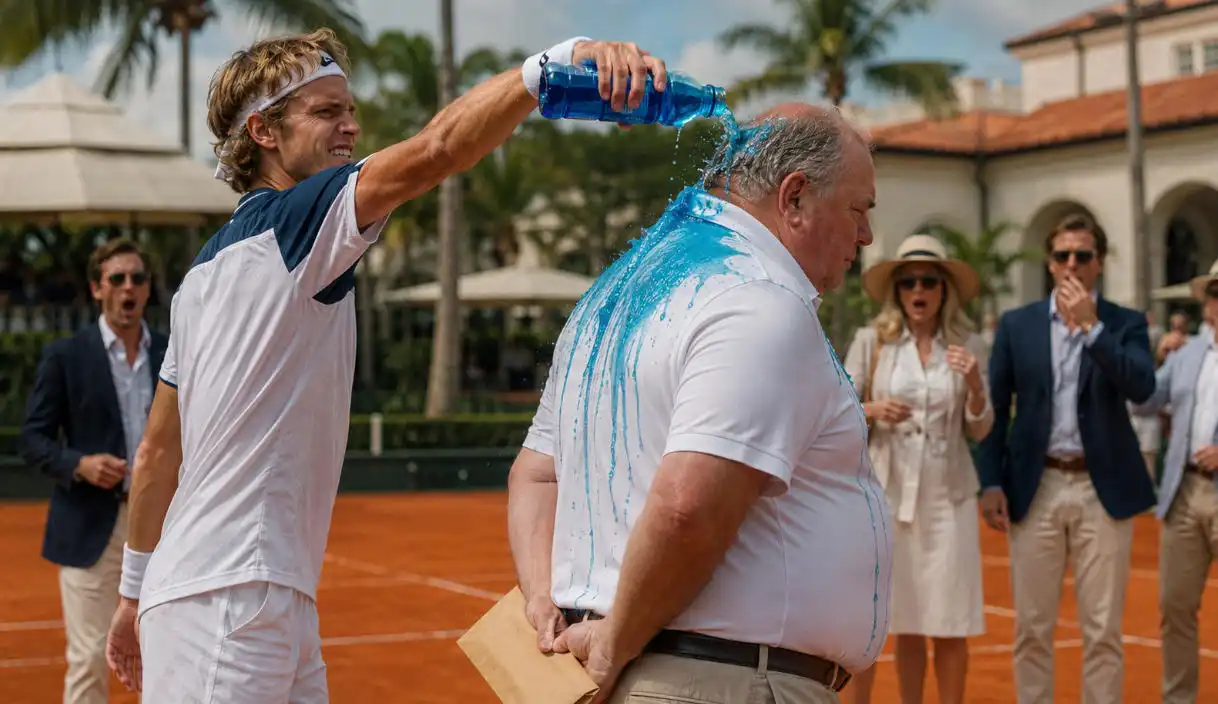
The envelope did not shake in Norman’s hand.
That was the part Trent noticed first.
A man who had just been slapped, soaked, shoved, and laughed at should have been trembling.
Norman wasn’t.
He stood on the red clay of Court 3 with blue sports drink dripping from his chin, torn shorts hanging awkwardly at one side, and thirty wealthy club members staring at him like he was a problem they hoped would quietly disappear.
Trent still had his racket in his hand.
He still had that little celebrity smile on his face.
But it was thinner now.
“What did you say?” Trent asked.
Norman wiped his face once.
Slowly.
“I said,” Norman replied, “before you serve again, you may want to read what my attorney filed this morning.”
Nobody laughed that time.
Not one person.
The Palm Beach Tennis Club was the kind of place where people measured a man by his shoes before they heard his name.
That morning, Norman had walked in looking painfully ordinary.
A big belly.
Gray hair.
Old sneakers.
A plain gym bag.
No diamond watch.
No designer sunglasses.
No assistant walking behind him.
So the members placed him in a category immediately.
Not one of us.
Maybe a guest.
Maybe a mistake.
Maybe staff.
Trent placed him even lower.
Target.
Trent was not just any member.
He was a rising professional player with a famous temper, a loud sponsor contract, and a habit of treating courts like private kingdoms.
He had won just enough to be arrogant.
Lost just enough to be angry.
And been protected just enough to believe rules were for people beneath him.
That morning, Norman checked in at the desk and told the young attendant, “Court 3, please.”
The attendant blinked.
“Court 3 is usually reserved for advanced players.”
Norman smiled.
“I know.”
Behind him, Trent heard the exchange.
He turned around with three club members beside him and looked Norman up and down.
“Advanced?” Trent said loudly. “Advanced what? Sandwich ordering?”
The woman beside him covered her mouth and laughed.
Norman said nothing.
That bothered Trent.
Bullies like noise.
They need reaction.
Norman only walked to the court, placed his bag on the bench, and stretched carefully.
That made Trent louder.
He stepped onto the opposite baseline without asking.
“Tell you what,” Trent said. “Let’s warm up. I’ll go easy.”
Norman nodded.
“Fine.”
The first ball came fast.
Too fast for a warm-up.
It hit the clay near Norman’s shoes and kicked toward his shin.
The second ball hit him in the thigh.
The third ball struck his stomach.
Members on the patio laughed into their mimosas.
“Come on, old-timer!” Trent shouted. “Move that beach ball!”
Norman bent over slightly, but he did not quit.
He picked up the ball and rolled it back.
That quiet dignity seemed to offend Trent more than anger would have.
He walked to the bench, grabbed Norman’s sports drink, and held it up.
“What is this?” Trent said. “Diet courage?”
Then he poured it over Norman’s head.
Blue liquid ran down Norman’s forehead, nose, mouth, and shirt.
A phone camera came up from the patio.
Then another.
Norman heard someone whisper, “This is horrible.”
But no one stepped in.
That is the part people never want to admit.
Cruelty often survives because decent people wait for someone else to be decent first.
Then Trent slapped him.
Open hand.
Across the face.
The sound cracked across Court 3.
Norman staggered back.
Trent grabbed at his hair, shoved him by the shoulder, and Norman fell sideways into the clay.
His shorts tore against the bench edge.
The laughter stopped.
For the first time, the club realized this was no longer “funny.”
This was ugly.
Trent stood over him.
“Go home,” he said. “This club is for winners.”
Norman stayed on the ground for three seconds.
Not because he could not get up.
Because he was looking.
Security camera over the west fence.
Second camera above the clubhouse door.
Sponsor wall behind Trent.
Three phones recording.
Four witnesses near the patio.
One club president frozen near the entrance.
Then Norman stood.
He did not brush himself off.
He did not ask for sympathy.
He reached into his bag and pulled out the sealed envelope.
That was where the Facebook post ended.
But what happened next is why Trent ended up on his knees in the clay.
The club president, Martin Voss, came jogging across the court.
“Norman,” he said, breathless. “Mr. Caldwell, please—”
Trent’s face changed.
Just slightly.
“Mr. who?” he said.
Norman looked at Martin.
“You know me now?”
Martin swallowed.
“I knew who you were when you checked in.”
Norman nodded toward Trent.
“But you let this continue.”
Martin’s mouth opened.
Nothing useful came out.
That was when Norman handed him the envelope.
“Open it.”
Martin’s hands moved like they belonged to an older man.
He broke the seal.
Inside were three documents.
First: a formal misconduct complaint filed through the club’s ethics board.
Second: a preservation notice requiring all security footage from Court 3 to be saved.
Third: a letter from the legal department of Caldwell Family Sports Foundation.
Trent snorted.
“Foundation? What, you sponsor junior lessons?”
Norman looked at him.
“Among other things.”
Martin’s face had gone pale.
Because Martin knew what Trent did not.
Norman Caldwell was not a random guest.
He was the largest private sponsor connected to the national tennis open’s charity development program.
His foundation funded youth courts across Florida.
His family company held naming rights on two tournament facilities.
And most importantly, Norman had personally backed the elite sponsor package that kept Trent’s biggest endorsement deal alive.
Trent’s logo was on the wall behind him.
Norman had paid for that wall.
But Norman still did not announce it.
Not yet.
He let Martin read.
Because real power does not need to shout.
Trent pointed his racket at Norman.
“You think paperwork scares me?”
Norman said, “No.”
Then he looked at the patio.
“But video does.”
A woman holding a phone slowly lowered it.
Another man cleared his throat.
Martin turned toward the security camera.
“Download all footage now,” he told the attendant. “Do not delete anything.”
Trent laughed, but it sounded forced.
“You’re all being dramatic. I was joking around.”
Norman looked down at his torn shorts.
“Was the slap a joke?”
Trent said nothing.
“Was pulling my hair a joke?”
Silence.
“Was pushing me to the ground part of the club’s warm-up policy?”
The patio was dead quiet.
Norman finally opened his own copy of the envelope and read from it.
“Clause 9. Morals and conduct. Any sponsored athlete who engages in public misconduct, harassment, intimidation, or physical aggression at a sanctioned partner facility may be suspended pending review.”
Trent blinked.
“You can’t suspend me.”
Norman looked at Martin.
“Tell him.”
Martin rubbed his forehead.
“Trent… Caldwell Family Sports Foundation is the principal sponsor on your development endorsement.”
Trent’s mouth opened.
No words came out.
Norman continued.
“Clause 12. Reputation protection. If misconduct is recorded in a public or semi-public venue, the sponsor may notify affiliated boards, tournament partners, and licensing committees.”
Trent’s face turned red.
“You set me up.”
Norman’s voice stayed calm.
“No. You behaved exactly as you wanted to behave because you thought I was nobody.”
That line hit harder than any serve.
Because everyone knew it was true.
Trent had not attacked Norman because Norman had done anything wrong.
He attacked him because Norman looked safe to humiliate.
Older.
Heavier.
Quiet.
Unimpressive.
A man Trent believed would absorb the insult and disappear.
But Norman had not disappeared.
He had documented.
He had waited.
He had let Trent show every person there who he really was.
Martin tried to soften it.
“Maybe we can handle this privately.”
Norman turned to him.
“Privately?”
The word hung in the heat.
“Was I humiliated privately?”
Martin looked down.
“No.”
“Then accountability won’t be private either.”
That was when Norman did something nobody expected.
He picked up the racket.
Not Trent’s.
His own.
Old grip.
Scuffed frame.
Nothing flashy.
Trent smirked again, desperate to recover something.
“What are you going to do with that?”
Norman walked to the baseline.
The members shifted closer.
Even Martin stepped back.
Norman bounced the ball once.
Twice.
His body did not look athletic.
But his hands did.
Steady.
Trained.
Familiar.
Then he served.
The ball exploded off the racket.
It cleared the net by inches.
Shot past Trent before Trent even moved.
And slammed directly into the sponsor sign behind him.
The plastic cracked across Trent’s smiling ad photo.
A clean ace.
The court went silent.
Then someone whispered, “Oh my God.”
Norman lowered the racket.
“I played in college,” he said. “Not professionally. But enough to know the difference between competition and cowardice.”
Trent stared at the cracked advertisement.
His own face split down the middle.
That image spread faster than the slap.
By noon, the club had the security footage.
By 3 p.m., Trent’s management team had it.
By sunset, two sponsors had frozen payments.
By the next morning, the professional conduct board issued an emergency review.
Trent tried to claim Norman provoked him.
The videos destroyed that lie.
Trent tried to say it was a misunderstanding.
The audio destroyed that lie.
Trent tried to say everyone laughed.
The witness statements destroyed that lie.
Because laughter does not erase responsibility.
It only proves how many people failed the first test.
Three weeks later, Trent stood in a hearing room wearing a suit that looked too tight around the collar.
Norman sat across from him.
Clean shirt.
Calm face.
No anger.
That bothered Trent most.
The board reviewed everything.
The targeted serves.
The insults.
The drink.
The slap.
The hair grab.
The shove.
The torn shorts.
The attempt to blame the victim afterward.
Then the chairwoman read the decision.
Trent’s professional credentials were permanently revoked from partner-sponsored circuits.
His club membership was terminated.
His endorsement contract was canceled under the morals clause.
The repayment penalty was enormous.
The kind of number that makes agents stop answering calls.
By the end of the month, Trent’s luxury apartment was gone.
His car was gone.
His public image was gone.
Six months later, someone spotted him working in the kitchen of a waterfront restaurant, washing dishes behind the same kind of people who used to cheer for him.
Norman did not celebrate that.
He did not post about it.
He did not mock him.
When a reporter asked Norman whether he felt satisfied, he said only this:
“I don’t enjoy watching a man fall. But I do believe some people only learn respect when privilege stops protecting them.”
The club changed too.
Martin Voss resigned.
Two board members were removed.
The Palm Beach Tennis Club installed a new code of conduct in the lobby, printed in large black letters:
Skill does not outrank dignity.
Norman returned one month later.
Same belly.
Same old sneakers.
Same plain bag.
This time, nobody laughed.
A teenage ball boy approached him nervously.
“Mr. Caldwell?”
Norman smiled.
“Norman is fine.”
The boy held up a racket.
“Could you show me that serve?”
Norman looked toward Court 3.
The sponsor sign had been replaced.
No Trent.
No smirk.
No cracked plastic.
Just sunlight on clay.
Norman took the ball, bounced it twice, and said, “First lesson: never use power to embarrass someone weaker than you.”
The boy nodded.
Norman served.
Another ace.
This time, people clapped for the right reason. 🎾
So choose a side:
Team Norman: dignity deserves consequences. or Team Trent: one mistake should not destroy a career.
Share this if you believe respect still matters.
Disclaimer: Mention of any brand or trademark is for identification only and does not imply partnership or endorsement
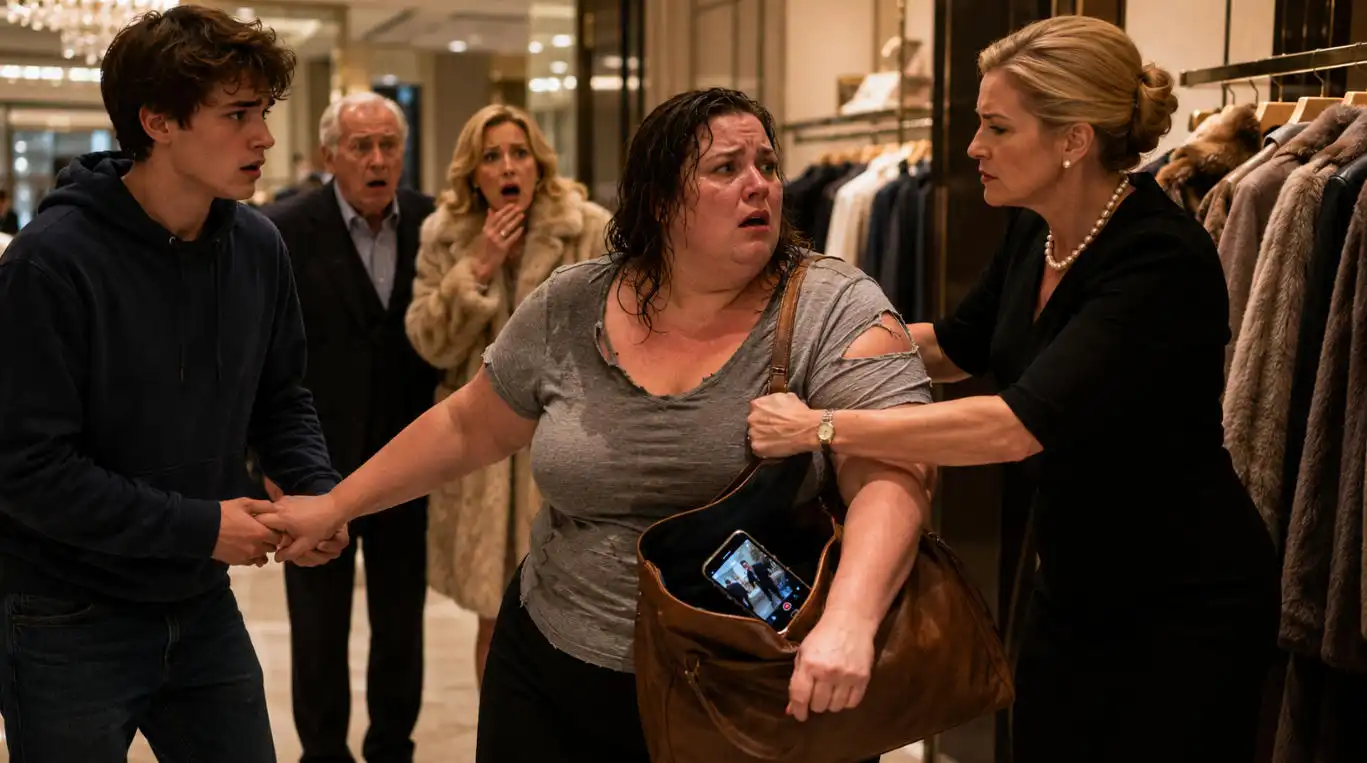
Maggie Was Covered In Shampoo, Slapped, And Laughed At In Front Of Rich Parents… Until One Quiet Phone Call Changed EVERYTHING
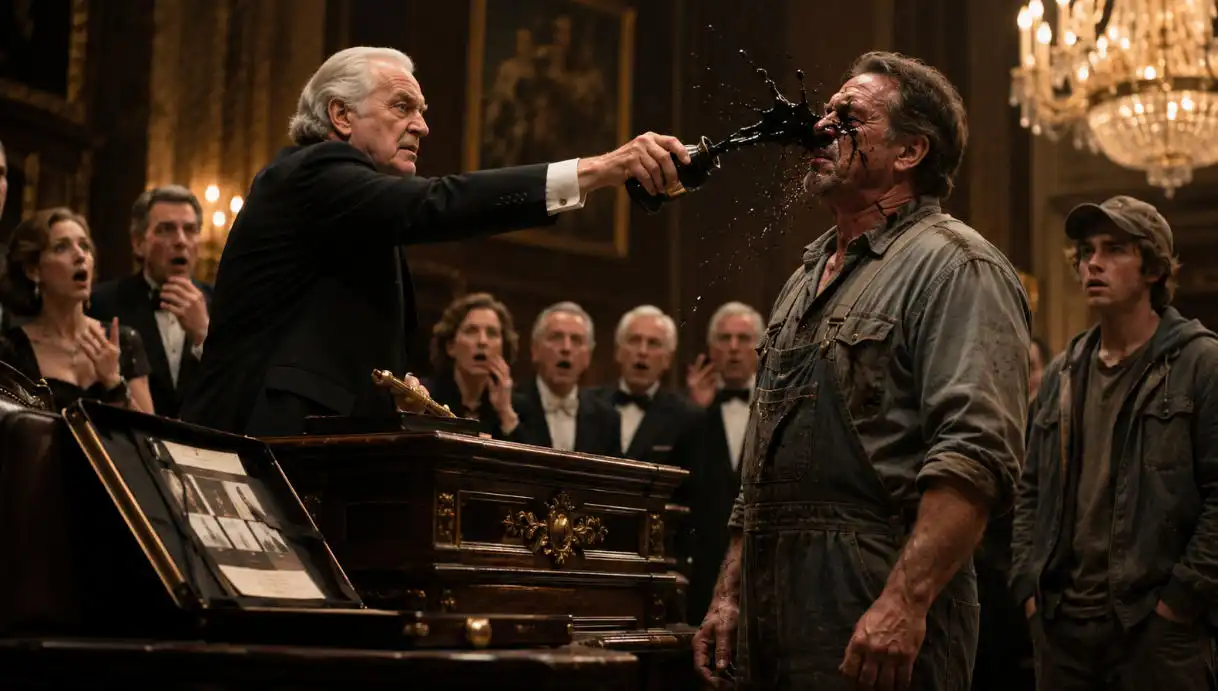
A Blue-Collar Dad Was DRAGGED Out Of A D.C. Private School Auction By A Snobby Auctioneer… But They Had NO IDEA Who He Really Was 😳
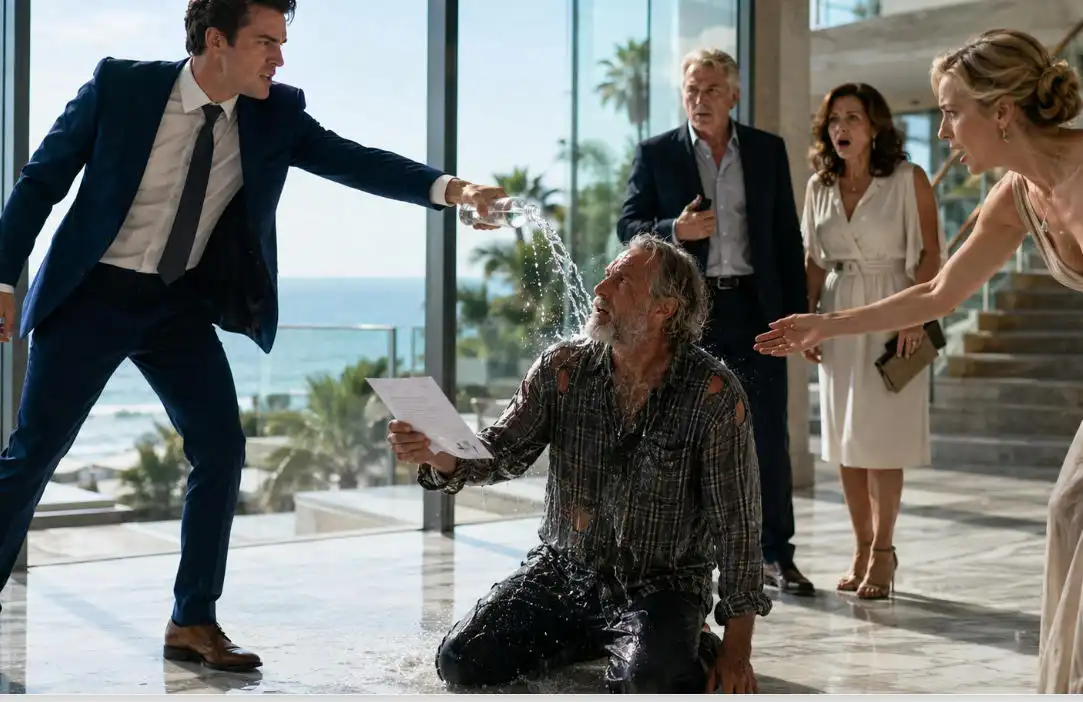
Chase Slapped the “Poor Old Man” at His Luxury Open House… Then Learned the Terrifying Truth Too Late